Skip to content
Losing a loved one is hard enough. When someone in the family starts saying, “There is no will,” or refuses to show the document everyone expected to exist, grief quickly turns into confusion and distrust.
If you're asking What Happens If Someone Hides a Will in Texas?, the short answer is this: Texas law takes it seriously, and you do have options. A hidden will can change who inherits property, who controls the estate, and whether your loved one's wishes are followed at all. It can also create a race against an important probate deadline.
The good news is that this isn't just a private family disagreement. Texas probate courts have tools to force disclosure, protect heirs, and address misconduct. The key is acting promptly and understanding the process in plain English.
The Legal Duty to Produce a Will in Texas

When a person dies, the will doesn't belong in a desk drawer, a safe, or the trunk of someone's car. In Texas, the person holding the will has a legal duty to turn it over.
Under Texas Estates Code § 252.201, anyone possessing a will must file it with the county clerk where the deceased person resided. If someone withholds it, heirs can ask the probate court to order its production, supported by affidavits and other evidence, as explained in this discussion of who can see a will after someone dies in Texas.
What that means in plain English
A will is the written document that says who should receive property after death and usually names an executor, which is the person chosen to handle the estate. Filing the will with the clerk starts the formal process of putting that document before the probate court.
Once filed, the will becomes part of the court record. That matters because it stops one person from privately controlling access to your loved one's final instructions.
If you want a closer look at how these disputes can unfold, this article on the case of the vanishing will is helpful background.
Why families get confused
Many people assume that only the named executor can file the will. That's not the issue. The first legal question is simpler: Who has the document? If someone has it, Texas law requires them to produce it.
Common points of confusion include:
- “It's a private family matter.” It isn't, once a death has occurred and a will is being withheld.
- “We can wait until everyone calms down.” Delay can create real probate problems.
- “If the will isn't filed, the court will eventually find it.” Usually, the court only acts when someone brings the matter before it.
Practical rule: If you know who has the original will, that person doesn't get to decide whether the document should be used. The probate court decides whether the will is valid and how the estate should proceed.
For many families, this is the first turning point. The law starts from the position that a will should be produced, not hidden.
Civil Consequences for Concealing a Will

Probate judges in Texas do more than criticize someone for hiding a will. They can enter orders that shift control of the estate, require repayment of losses, and protect the heirs who were kept in the dark.
For families, that matters because a hidden will is not just a paperwork problem. It can change who is managing property, who is getting information, and who is making decisions while time keeps passing.
Removal from control of the estate
One of the first civil consequences is loss of authority.
If the person concealing the will is serving as executor, acting as administrator, or informally taking charge of estate property, the court can remove that person or block further action. A judge is not likely to leave estate business in the hands of someone accused of suppressing the very document that may control every major decision.
That remedy is practical. It stops the person with possession of the will from also controlling the bank accounts, the house, the mail, and the flow of information to the rest of the family.
Financial liability can follow
Hiding a will can also create direct financial exposure.
If the delay causes losses, the court may order the responsible person to answer for the harm. That can include money spent fixing avoidable problems, fees tied to extra court proceedings, or losses caused by property being mishandled while the estate was in limbo.
A simple way to view it is this: probate court tries to put the estate back where it should have been if the will had been produced on time.
Examples of civil harm often include:
- Higher legal expenses because heirs have to file motions or petitions just to get the document before the court
- Frozen or delayed transfers involving homes, vehicles, business interests, or financial accounts
- Wrongful distributions when property passes under intestacy or informal family arrangements before the actual will is produced
- Loss of trust that leads to broader estate litigation over accountings, reimbursements, and fiduciary conduct
A person hiding a will may believe the delay gives them an advantage or buys time. In practice, it often creates a court record that supports sanctions, repayment, and removal.
The court can do more than wait for cooperation
Families are often told to "work it out privately." That advice sounds calming, but it can waste valuable time.
Texas probate courts can require action. If there is reason to believe someone has the original will and is refusing to turn it over, heirs may ask the court for orders that compel production, restrict interference with estate property, and bring the dispute into the open under oath. Many of the same concerns appear in disputes involving hidden property and missing records, which is why this guide to Texas probate asset concealment risks and court remedies is useful background.
That is the practical point many articles skip. Civil consequences are not only about punishment at the end. They also create pressure points you can use early to force the issue into court.
What changes once a concealment claim reaches court
The difference is usually immediate:
| Issue | If the will is produced | If the will is concealed |
|---|---|---|
| Court can review the document | Yes | Only after someone asks the court to compel production |
| Estate leadership | Usually identified quickly | Often challenged or frozen |
| Beneficiaries' rights | Easier to confirm | Often uncertain and disputed |
| Cost to the estate | Lower | Often rises because of hearings, filings, and delays |
For a grieving family, the lesson is reassuring even if the situation feels unfair. One person does not get the final say by hiding the paperwork. The probate court has tools to take control of the problem and reduce the damage.
Potential Criminal Charges for Hiding a Will
Civil penalties and criminal charges are not the same thing.
A civil case focuses on fixing harm inside the estate. A criminal case focuses on whether the state believes a crime occurred and whether punishment is appropriate. In Texas, hiding or destroying a will can be treated as both a civil and criminal matter, with significant consequences, according to this explanation of what happens when someone conceals probate assets or estate documents.
When the issue becomes more serious
Not every missing will leads to criminal prosecution. Sometimes families are dealing with confusion, poor recordkeeping, or honest disputes about whether a valid will existed.
But intentional concealment is different. If someone deliberately hides, destroys, or alters a will to change who inherits, that conduct can move beyond probate misconduct into potential criminal territory.
That distinction matters for families because it changes the posture of the case. You are no longer dealing only with a resistant relative. You may be dealing with conduct Texas law treats as fraud or tampering.
Why this matters to grieving families
You don't need to become an investigator overnight. You also don't need to prove every detail before speaking with counsel.
What you should understand is this:
- The law treats a hidden will seriously
- The court can separate civil estate issues from criminal concerns
- Early legal action helps preserve evidence and prevent further damage
If someone is stalling, making inconsistent statements, or blocking access to estate information, don't assume the problem will sort itself out.
Families often feel guilty for taking formal action against a relative. That feeling is understandable. But asking a probate court to require transparency is not aggression. It is often the only way to protect the deceased person's written wishes.
A Realistic Scenario What Happens When a Will Vanishes
Consider a Texas family dealing with exactly this kind of problem.
Mr. Garcia dies owning a home, a vehicle, and financial accounts in his name. His adult son from a first marriage lived with him during his final illness. His daughter from a later marriage lives in another Texas city and remembers her father saying he had signed a will dividing things equally between both children.
After the funeral, the son tells everyone there was no will. He starts talking as if the estate will pass under default inheritance rules. He also discourages questions, saying probate would only “cause trouble.”
Why the daughter becomes concerned
The daughter notices several things that don't fit. Her father had been organized. He had mentioned signing estate documents. A family friend recalls driving him to a lawyer's office. Yet no one is allowed to see his papers.
She contacts probate counsel and learns an important point. If no will is admitted to probate, Texas may treat the estate as intestate, which means the law decides who inherits instead of the decedent's written instructions.
That risk is real. If a will is never probated, Texas intestacy law applies. In one documented Texas case, a widow learned that because her husband had children from a prior relationship and no will was probated, those children were legally entitled to part of his separate property, including a share of the family home, as described in this explanation of what happens if you do not probate a will in Texas.
What legal action looks like
The daughter's attorney starts with a formal demand asking for the original will to be produced. No response. The attorney then files in probate court and supports the filing with sworn statements from people who heard Mr. Garcia discuss the will and from the friend who accompanied him to sign documents.
The court allows further investigation. That may include requests for records, sworn testimony, and questions about where Mr. Garcia kept important papers.
A realistic timeline often looks like this:
- Suspicion develops after inconsistent statements or blocked access.
- A written demand goes out asking for production of the will.
- The probate court is asked to intervene when the document still isn't produced.
- Evidence is gathered from witnesses, copies, emails, or law office records.
- The will surfaces or a lost-will case begins if the original cannot be found.
How the scenario can resolve
Eventually, the son produces the will after court pressure and questioning. The will names both children as equal beneficiaries and names a different executor entirely.
The result is important for two reasons. First, the father's actual wishes are honored. Second, the son's effort to control the outcome by withholding the document backfires.
This kind of scenario is why estate planning and proper document storage matter. So does using clear probate procedure when a dispute starts. Families who want to avoid this kind of uncertainty often turn to Texas wills and trusts planning long before a crisis begins.
Your First Steps When You Suspect a Hidden Will
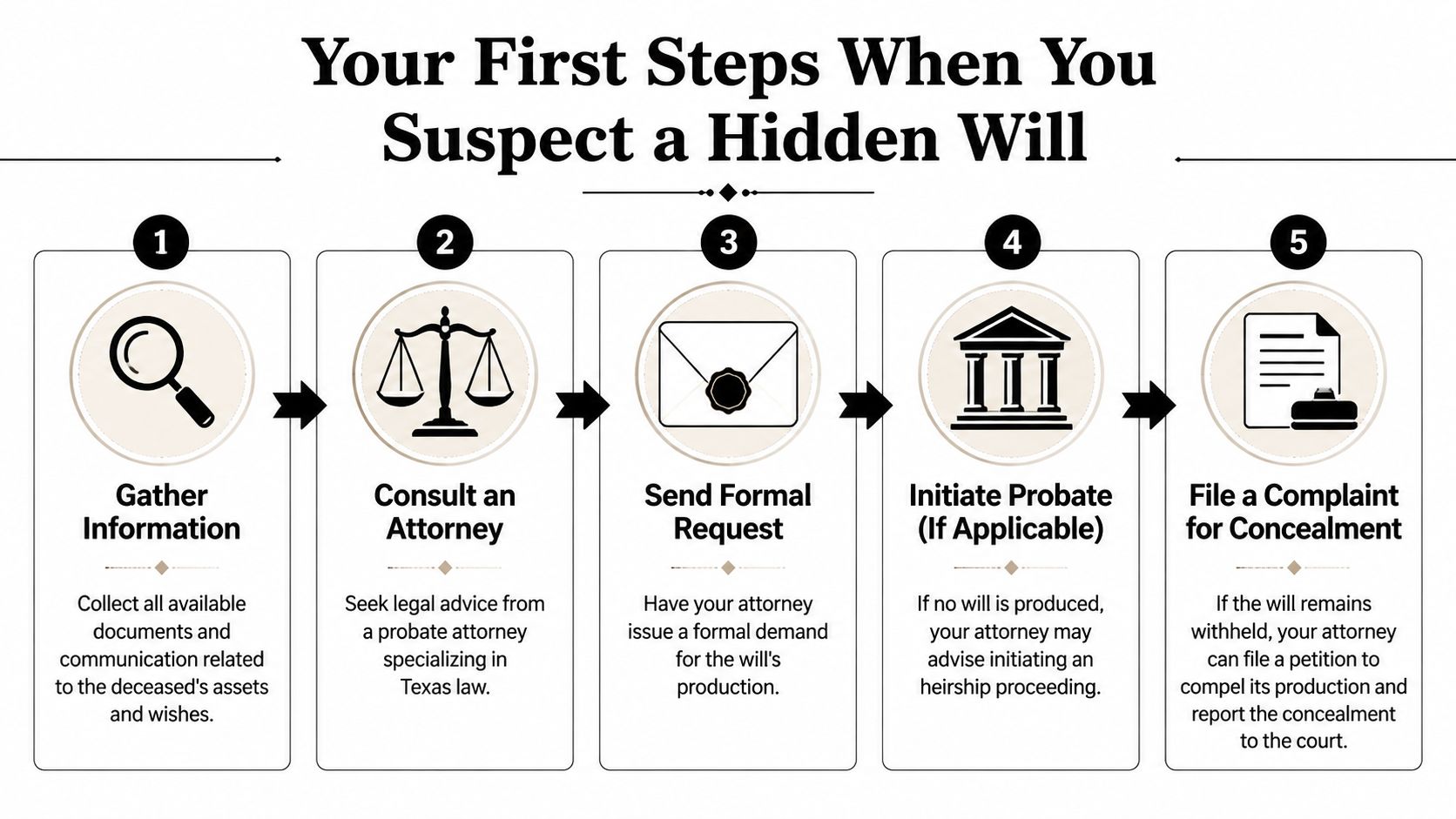
A common moment in hidden-will cases looks like this. One family member says, “There was never a will.” Another remembers the deceased talking about signing one. Bills are due, property needs attention, and someone has already started acting as if the estate belongs to them.
At that point, families need a plan. The goal is to preserve evidence, force the issue into the open, and get the probate court involved before property changes hands or records disappear.
If you are still trying to locate basic estate paperwork, start with this guide on how to find a deceased person's will. It helps you check the places where wills are often stored before a dispute grows larger.
Step 1 Gather facts and preserve the paper trail
Begin as though you may need to explain the situation to a judge later. That mindset helps. Probate courts respond to dates, documents, names, and specific conduct.
Collect copies of any estate planning papers, emails, text messages, contact information for prior attorneys, funeral records, and a simple list of the deceased person's assets. Write down anything unusual you have seen, such as changed locks, missing files, redirected mail, or a sudden refusal to let relatives enter the home.
Helpful items include:
- Prior copies or drafts of a will, even if they are not signed
- Names of witnesses who may have seen the will signed
- Attorney contact information for any lawyer who handled estate planning
- Messages or emails in which the deceased mentioned a will
- Records of major assets such as real estate, vehicles, and accounts
Small details matter here. A text saying “my lawyer finished my will” can become an important piece of evidence later.
Step 2 Send a written demand for the will
The next move is usually a formal letter to the person believed to have the will.
That letter should identify the deceased, explain why you believe a will exists, request immediate production, and give a short deadline to respond. Keep the tone professional. Angry accusations often cause people to dig in, while a clear written demand creates a record the court can review.
Verbal requests rarely solve this problem by themselves. A written demand shows the judge that you acted promptly and gave the other side a fair chance to produce the document.
Step 3 Ask the probate court to order production
If the will is still not produced, the practical next step is to ask the probate court for help. In plain terms, you are asking the judge to order the person holding the will to bring it forward.
This is often described as a petition to compel production or a motion to compel. The label matters less than the function. You are using the court's authority to stop the dispute from being controlled in a living room, over text messages, or behind a locked door.
Supporting material may include affidavits, copies of communications, witness statements, or records showing the deceased worked with an estate planning lawyer. If you need context for how that fits into the larger court process, the Texas probate process explains how probate moves from filing to administration.
Step 4 Use discovery to test the story
Once a case is in court, discovery gives you tools to get answers under rules that people cannot ignore so easily.
Discovery can include requests for documents, subpoenas to third parties, and depositions. A deposition is sworn testimony taken outside the courtroom. It works like a structured question-and-answer session under oath, with a court reporter present. If someone changes their story, that record matters.
This step is often where hidden-will cases become clearer. An attorney may have drafting files. A bank may confirm the existence of a safe deposit box. A witness may remember being asked to sign the will. What felt like rumor at the start can turn into proof.
Step 5 Be ready for a lost-will case if the original does not appear
Sometimes the original will is not produced because it is being concealed. Sometimes it is missing, destroyed, or impossible to locate. Those are different facts, but the legal response can overlap.
Texas law does allow probate of a lost or destroyed will in the right case. The court will want proof that the will was properly signed, proof of what it said, and proof that the deceased did not revoke it before death. The filing deadline matters too, and delay can create serious problems.
Here is the practical version:
| Requirement | Plain-English meaning |
|---|---|
| Valid execution | The will was signed with the formalities Texas law requires |
| Contents proof | The court needs reliable evidence of what the will said |
| Non-revocation | You must show the deceased did not intentionally cancel the will |
| Timely filing | The request has to reach the court before delay damages your claim |
If your family is in this position, treat it like a race to preserve evidence. Copies, witness testimony, lawyer files, and storage records can become the building blocks of the case.
The larger point is simple. Suspecting a hidden will is not just a family conflict. It is a legal problem with specific tools for forcing disclosure. Early action gives you the best chance to protect the estate and honor the deceased person's wishes.
Key Insight The Clock is Ticking on Your Rights

A hidden-will case can be lost by waiting.
Texas generally gives a limited window to offer a will for probate after death. Once that period passes, the person asking the court to admit the will usually has to explain the delay and show why the case should still move forward. If someone has been concealing the will, delay can become part of the damage, because the longer the document stays out of sight, the harder it can be to correct what has already happened.
Why that deadline matters in real life
Probate deadlines work a lot like a closing gate. Before the gate closes, the court has more room to sort out who has the original will, who should serve, and what the deceased wanted. After it closes, you may still have arguments, but they are harder, more fact-specific, and often more expensive to prove.
That practical reality is why families should treat suspicion early. If one person has moved into the house, transferred control of accounts, or started acting as though there is no will, each month of silence can make the estate harder to put back in order.
The time pressure can be even more serious if a beneficiary is a child or an adult who cannot manage their own affairs. In those situations, families may also need to consider related court protection such as guardianship proceedings in Texas.
What this means for you right now
If you suspect a will is being hidden, do not wait for family members to calm down or volunteer the truth. Put your concerns in writing. Gather the names of the lawyer, witnesses, and anyone who may have seen the will. Talk with Texas probate counsel promptly so the court can be asked to act before delay becomes a legal obstacle.
Silence helps the person withholding the document. Early action helps preserve your rights.
Frequently Asked Questions About Hidden Wills
What if the person hiding the will is the named executor
That doesn't give them a free pass. An executor is supposed to carry out the will, not suppress it. If the court finds they failed to produce the document, the judge can remove them from that role and appoint someone else to handle the estate.
What if I live out of state
You can still take action. Out-of-state heirs often participate through Texas counsel, remote communication, and court filings handled on their behalf. Distance can make things feel harder, but it doesn't cancel your rights.
Can I recover attorney's fees or damages
Texas courts can impose civil consequences when someone withholds a will and harms beneficiaries. Whether fees or damages are recoverable depends on the facts, the losses caused, and the orders requested from the court. Emotional strain is real, but courts usually focus most directly on legal and financial harm to the estate or beneficiaries.
What if there is only a copy of the will
A copy may still matter. Texas allows a lost-will proceeding in some cases, but the person offering the will must prove execution, contents, and that the will was not revoked. These cases are detailed and evidence-heavy, so early document collection is especially important.
Does every estate need full probate
Not always. Some estates qualify for simpler procedures depending on the assets involved. But if there is a dispute about a hidden will, court involvement is often necessary because someone must decide whether the document exists, whether it is valid, and who has authority to act.
If you're facing probate in Texas, the Law Office of Bryan Fagan, PLLC can help guide you through every step, from filing to final distribution. Whether you're dealing with a concealed will, a disputed executor, estate litigation, or questions about wills, trusts, or guardianship, our team is here to provide clear answers and practical support. Schedule your free consultation today.