Skip to content
A lot of Texas families start in the same place. A parent in Houston says, “We need to get this in order so the kids don't have to deal with court.” An adult child has just lost a loved one and is trying to figure out why a house, a bank account, or a car can't be transferred. A surviving spouse assumes a will alone keeps everything simple, then learns that a will often still has to go through probate.
That confusion is completely understandable.
If you're trying to learn how to avoid probate in Texas, the most important first step is knowing that there isn't one perfect tool for every family. The right plan depends on what you own, how it's titled, whether you have a will, whether there are debts, and whether your family situation is straightforward or likely to involve disagreement.
Texas law gives families several ways to move property outside the usual court process. Some are broad and powerful, like a revocable living trust. Others are narrow but very effective, like a Transfer on Death Deed for a house or a beneficiary designation on a bank account. Titles 2 and 3 of the Texas Estates Code govern much of the law around wills, estate administration, nonprobate transfers, and related procedures, so the details matter.
Why Texas Families Plan to Avoid Probate
Probate is the court-supervised process for handling a person's estate after death. In plain English, it's how the law confirms who has authority to act, identifies property, handles debts, and transfers what remains to the right people. In some cases, probate is manageable and even necessary. In others, families can avoid much of it with good planning.
Many individuals want to avoid probate for three practical reasons.
Cost, time, and privacy
First, families worry about cost. Court filings, legal work, notices, and administrative steps can reduce what eventually reaches heirs. Even where probate is relatively efficient, it still takes effort and money.
Second, they worry about time. Heirs may need access to accounts, the ability to sell a home, or clear authority to handle property. Probate can delay those steps, especially if paperwork is incomplete or family members disagree.
Third, they want privacy. Probate is a court process, and that means filings can become part of the public record. Many families would rather keep financial details and property transfers out of open court if the law allows another route.
Practical rule: A will directs who should receive property, but a will by itself usually doesn't avoid probate. The transfer method matters just as much as the instructions.
A simple way to think about it
A helpful question is this: What assets pass by contract, deed, or trust instead of by court order? If an asset already has a built-in transfer method, your family may not need probate for that asset.
That's why estate planning in Texas often focuses on matching the tool to the asset:
- Real estate may fit a deed-based solution.
- Bank and investment accounts may fit beneficiary designations.
- Complex estates or blended families may fit a trust.
- Very modest estates may qualify for a simplified post-death procedure.
When families understand that distinction, the process becomes much less intimidating.
Using a Revocable Living Trust for Total Control
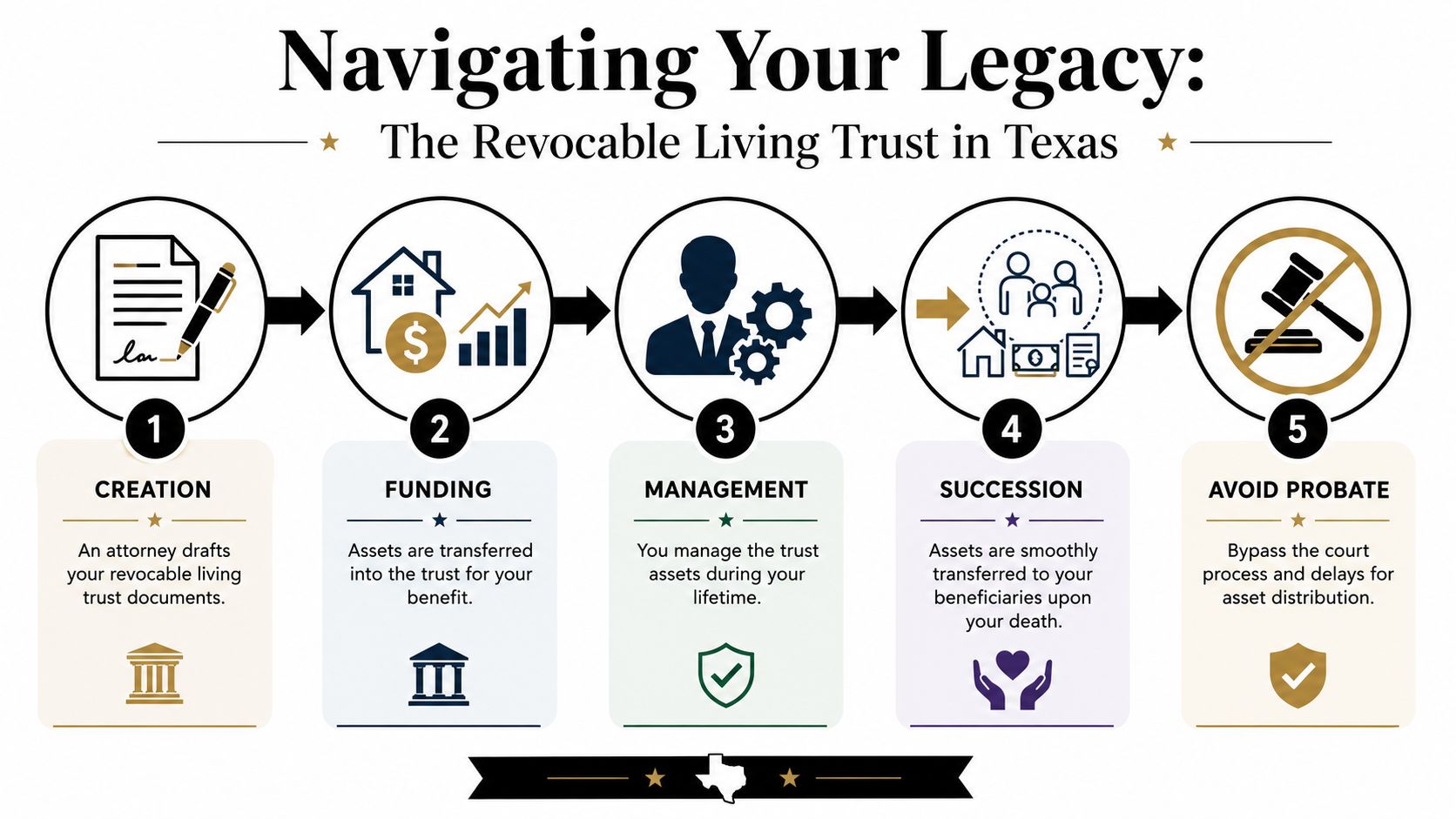
A revocable living trust is often the most complete probate-avoidance tool because it can hold many different types of assets and provide clear instructions for management during life, incapacity, and after death. The basic idea is simple. You create the trust, transfer assets into it, and keep control while you're alive.
In trust language, the person creating the trust is often called the grantor. The person managing it is the trustee. The people who eventually receive trust property are the beneficiaries. In many Texas estate plans, the same person serves as both grantor and trustee during life.
How the trust works in real life
Consider a Dallas couple who own a home, a rental property, and a brokerage account. They want their children to inherit in an organized way, and they also want part of their estate to go to a favorite charity. A trust can spell out who manages those assets if one spouse becomes ill, who steps in after both parents die, and how distributions happen.
That arrangement can keep trust-owned assets outside the probate court process when the trust is properly set up and funded. If you want a plain-language explanation of why trust assets are handled separately from probate assets, Probate vs. Trust Administration in Texas gives useful context.
The two steps people often confuse
Creating the trust document is only step one.
Step two is funding the trust, which means changing title or ownership so the trust owns the assets. For real estate, that usually means recording a new deed in the county records. For financial accounts, it may mean retitling the account or naming the trust according to the institution's procedures.
That second step is where many plans fail. A critical common pitfall is failing to fund the trust after creation. Statistical analysis from estate planning firms indicates that over 40% of “paper trusts” result in accidental probate because assets remain in the individual's name (Robbins Estate Law discussion of funding issues).
A trust only controls the assets that are actually placed into it.
Pros and cons of a revocable living trust
Here's where a trust often shines:
- Broad coverage: It can hold real estate, accounts, and other major assets.
- Privacy: Trust administration usually stays outside the public probate file.
- Continuity: A successor trustee can step in if you become incapacitated.
- Control: You can set detailed instructions for children, charities, or staggered distributions.
But there are tradeoffs:
- Upfront work: The trust has to be drafted and then funded correctly.
- Ongoing maintenance: New assets should be titled consistently.
- Not ideal for every estate: A smaller, simpler estate may not need this level of planning.
For a closer look at the tradeoffs, revocable living trust pros and cons can help you compare whether the tool fits your goals.
When a trust is usually the right fit
A trust often makes sense when you have:
- Multiple assets in different categories
- Property in more than one place
- A blended family or beneficiary concerns
- A desire for detailed control after death
- A need for incapacity planning during life
If your situation looks more modest, another method may be simpler and less burdensome.
Transferring Your Home with Special Texas Deeds
For many families, the house is the biggest concern. They aren't asking how every asset passes. They're asking one anxious question: “Can my home go directly to my child or spouse without probate?”
Sometimes, yes.

Transfer on Death Deeds in Texas
Texas formally recognized the Transfer on Death Deed, often called a TODD, on September 1, 2015, through Chapter 114 of the Texas Estates Code, allowing a property owner to designate a beneficiary to receive real property automatically upon death and bypass probate court (Texas Real Estate Research Center overview).
The owner keeps control during life. That means the owner can still live in the home, sell it, or revoke the deed before death. The beneficiary does not receive a present ownership interest while the owner is alive.
A key point trips people up. The deed must be recorded in the county deed records before the owner's death. If that recording step doesn't happen in time, the deed won't do the job it was intended to do.
A practical example helps. A single mother in Austin owns a home in her name alone and wants her only child to receive it without a court process. A properly prepared and recorded TODD can make that transfer happen automatically at death, rather than forcing the child to open a probate case just to deal with the house.
For readers comparing deed options in different states, it can also be useful to learn about Utah real estate probate because it highlights how transfer-on-death rules can vary from state to state.
TODD compared with a Lady Bird deed
A TODD isn't the only Texas deed used for probate avoidance. Another option is the Lady Bird deed, also called an enhanced life estate deed.
The difference matters. A TODD transfers at death through a statutory form of deed recognized in Chapter 114. A Lady Bird deed works differently and is often used when a property owner wants to retain strong lifetime control while arranging a nonprobate transfer.
If you're sorting out which deed fits your home, Lady Bird deeds in Texas explain the distinction in more detail.
Key point: A traditional life estate gives the future owner a present interest. A TODD does not. That's one reason many Texas homeowners prefer a TODD when it fits.
A more focused discussion of how Transfer on Death Deeds in Texas pass real estate without probate can also be helpful if your main concern is the family home.
Here's a short video overview many homeowners find useful before they sign anything:
When deed planning works best
A deed-based solution can be a strong fit when:
- The home is the main asset: You're mainly trying to keep the house out of probate.
- The intended recipient is clear: One child, one spouse, or another clearly identified beneficiary will receive it.
- You want lifetime flexibility: You don't want to give up control while you're alive.
It may be less suitable when there are likely disputes, multiple beneficiaries who may disagree, or broader planning concerns that go beyond one piece of real estate.
Simple Transfers with Beneficiary and Ownership Strategies
Not every probate-avoidance strategy requires a trust or a deed. Many assets can transfer with forms that people overlook for years.
That's often good news. If your estate plan feels unfinished, you may be able to make meaningful progress by updating account paperwork.
Accounts that pass by beneficiary designation
Bank accounts can often include a Payable-on-Death, or POD, designation. Investment accounts may allow a Transfer-on-Death, or TOD, registration. Life insurance and retirement accounts usually pass by beneficiary designation as a matter of contract, which means those assets don't pass under the will unless the beneficiary setup points them back to the estate.
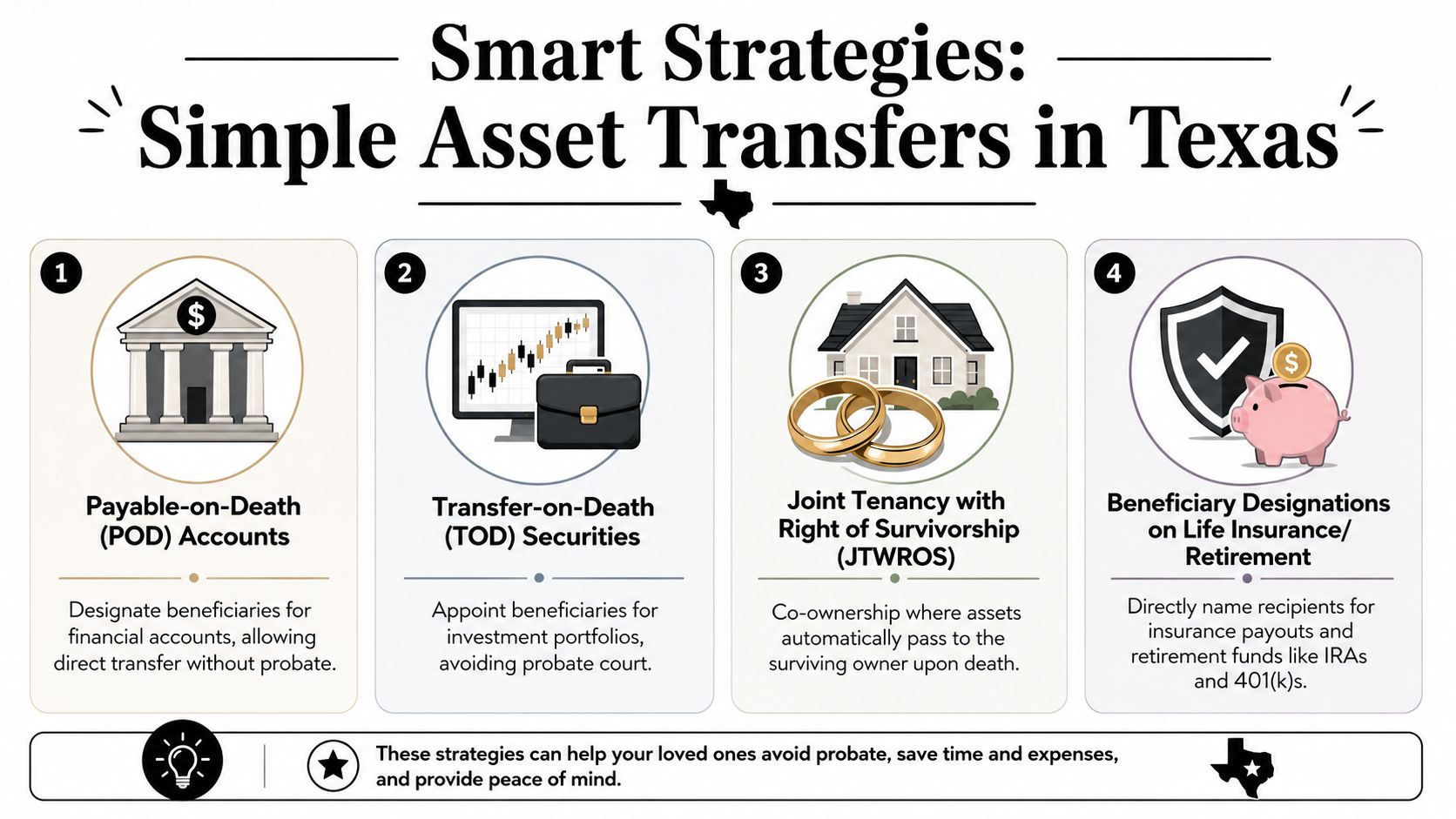
For vehicles in Texas, owners can also bypass probate by naming a beneficiary directly on the title using the VTR-121 beneficiary designation form with the Texas Department of Motor Vehicles. That allows the car or truck to transfer directly to the designated person without court approval upon the owner's death (Texas DMV beneficiary title discussion).
A simple family example
Suppose a widower in San Antonio has a checking account, an IRA, and a pickup truck. He may be able to avoid probate on all three by using a POD designation on the bank account, confirming the IRA beneficiary is current, and filing the vehicle beneficiary paperwork.
That kind of planning doesn't replace a full estate plan, but it can spare surviving family members from opening a court file just to access ordinary assets.
Joint ownership can help, but only if it's done correctly
Some people rely on joint ownership with right of survivorship. In that arrangement, the surviving owner receives the asset automatically when the other owner dies. This can apply to certain accounts and property if the ownership documents are drafted properly.
Take two siblings who buy an investment property together. If they intend for the survivor to own the whole property automatically, the title paperwork has to reflect that specific survivorship arrangement. Owning property together doesn't always create the result people expect.
Ownership language controls outcomes. Families often believe “joint” automatically means “the survivor gets everything,” but the legal effect depends on the way the asset was titled.
A side-by-side comparison
| Method | Best for | Privacy | Flexibility during life | Main caution |
|---|---|---|---|---|
| Revocable living trust | Broad, multi-asset planning | High | High | Must be funded correctly |
| Transfer on Death Deed | A Texas home or other real property | High | High | Must be recorded before death |
| POD or TOD account designation | Bank and investment accounts | High | Moderate to high | Must keep beneficiaries current |
| Right of survivorship ownership | Certain jointly owned assets | High | Depends on co-owner arrangement | Incorrect titling can defeat the plan |
When these simpler tools are enough
These tools often work well when your assets are easy to identify and each one has a natural transfer method. They are especially useful for:
- Single-purpose planning: You only need to address a few accounts or a vehicle.
- Supplemental planning: You already have a will and want fewer assets left for probate.
- Straightforward family situations: There's little risk of a dispute over who should receive the asset.
But a collection of forms can become messy if the overall plan isn't coordinated. A beneficiary form that conflicts with a trust, or a survivorship account added for convenience, can create real problems later.
Probate Alternatives for Smaller Texas Estates
Some families don't need a trust, a deed strategy, or a long administration. They need a practical way to handle a modest estate without spending more time and money than the estate can bear.
Texas law does offer simpler procedures in the right situation.
Small Estate Affidavit basics
A Small Estate Affidavit can be used when the total value of the estate is under $75,000, excluding the homestead. It requires the agreement of all heirs and court approval, and it is generally cheaper and faster than full probate (Texas Small Estate Affidavit overview).
This option is post-death. It isn't a substitute for planning during life. It's a procedure heirs may use after someone dies if the estate qualifies.
There is also a waiting period. Families must wait 30 days after death before filing, and the affidavit must satisfy strict procedural requirements. That includes gathering information about heirs and assets and obtaining signatures from everyone required.
A realistic example
Consider a family in a rural Texas county whose mother dies without a will. She rented her home, owned a modest bank account, and left little else that wasn't exempt property. If the estate falls under the legal limit and every heir agrees, a Small Estate Affidavit may let the family collect the bank funds without opening a full administration.
That sounds simple, but the details matter. If heirs misclassify assets or overlook property that counts toward the limit, the court may reject the affidavit. If one heir refuses to sign, the shortcut may disappear.
For a focused explanation of eligibility and filing details, Small Estate Affidavits in Texas are worth reviewing before anyone files.
When a muniment of title may fit
Another simplified probate option is muniment of title. In plain language, that's a limited court process used to recognize a valid will as evidence of title transfer, usually when there are no unpaid debts that require full administration.
It's often helpful when the main issue is clearing title to property, not managing a complicated estate. For example, if a deceased person left a valid will and owned a house but there's no need for a full executor-led administration, a muniment of title proceeding may be enough to transfer the property record.
Families who are unsure whether they need a Small Estate Affidavit, muniment of title, or a full administration usually benefit from reading about the broader Texas Probate Process so they can see how these procedures fit into the larger picture.
Who should pause before using a shortcut
A simplified procedure may not be the right tool if:
- There's a valid will that doesn't fit the shortcut
- The estate includes more property than expected
- Heirs disagree about family history or ownership
- A creditor issue needs formal administration
- The estate includes business interests or other complications
When grief is fresh, families often want the fastest path. That instinct is understandable. The safer path is the one that fits the estate under Texas law.
Common Pitfalls and When to Consult an Attorney
The most common probate problems don't usually start with bad intentions. They start with partial planning. Someone signed documents years ago, never updated them, and assumed everything would work itself out.
That “set it and forget it” approach creates many of the disputes families face after a death.
The mistakes that show up again and again
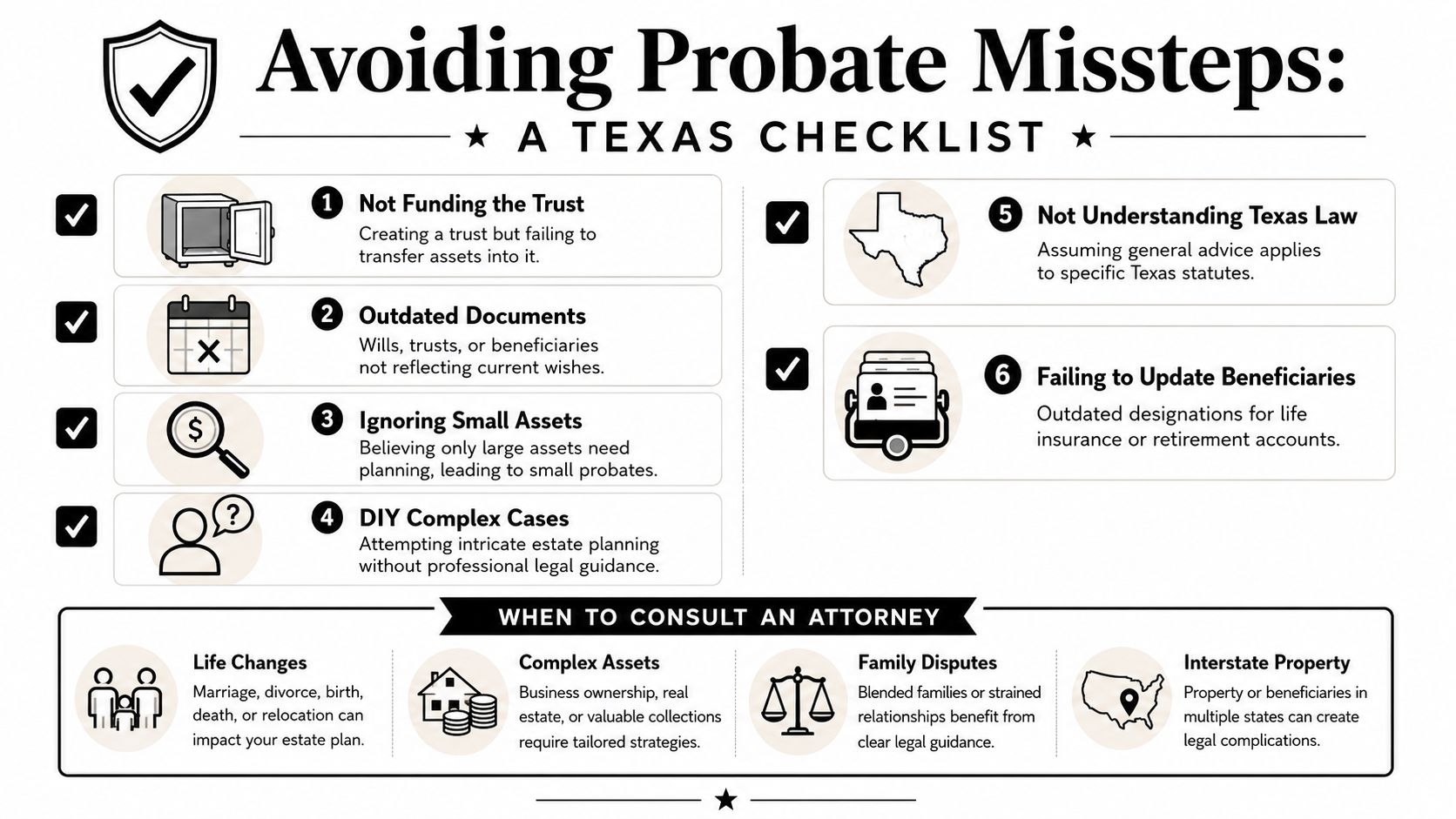
A few errors deserve special attention:
- An unfunded trust: The trust exists on paper, but assets still sit in the individual's name.
- Old beneficiary forms: A former spouse, deceased relative, or unintended person is still listed.
- A deed that was never recorded: The homeowner thought the transfer plan was complete, but the county records say otherwise.
- An estate that doesn't qualify for a shortcut: The family assumes a simplified process applies when it doesn't.
- Mixed signals across documents: The will says one thing, the account contract says another, and the deed says something else.
Key Insight: Probate avoidance works best when each asset has a deliberate transfer path and all documents tell the same story.
The value of a hybrid plan
Not every family needs one large planning tool. Some do better with a hybrid estate plan, where each asset is matched to the most practical method.
Analysis of Texas probate data shows that hybrid plans combining a small estate affidavit with a Lady Bird deed can reduce average probate costs by 35% compared to full trust setups, yet the strategy remains underused (Texas Law Help discussion of hybrid planning).
That doesn't mean everyone should skip a trust. It means a well-matched plan can be more efficient than a one-size-fits-all solution. A homeowner with a modest estate may need a deed for the house, beneficiary designations for accounts, and a simple will to catch anything left over. A family with business assets or children from different marriages may need much more structure.
When legal help becomes especially important
There are times when a do-it-yourself approach becomes risky fast.
Seek individual legal guidance if any of these are true:
- You have a blended family. Children from a prior relationship can change how ownership and inheritance issues play out.
- You own a business or unusual assets. Those require coordination beyond a basic beneficiary form.
- You expect a dispute. If one heir may challenge documents or ownership, planning must be precise. If conflict has already begun, Probate Litigation may become part of the conversation.
- You own property in more than one state. A simple Texas-only plan may not solve the whole problem.
- A loved one has died and the documents don't match. That's the moment to slow down before filing anything with the court.
If your family is dealing with estate planning, probate administration, a small estate procedure, or related concerns such as Guardianship or Wills & Trusts, careful review can prevent expensive mistakes before they become court problems.
Takeaway
The best answer to how to avoid probate in Texas isn't “get a trust” or “file one deed.” It's this: match the right tool to the right asset and the right family situation.
For some Texans, that means a revocable living trust. For others, it means a Transfer on Death Deed for the house, beneficiary designations on accounts, and a vehicle beneficiary form. For smaller estates, it may mean using a legally available shortcut after death. The legal framework in Titles 2 and 3 of the Texas Estates Code gives families options, but the details of ownership, signatures, recording, and court procedure make all the difference.
If you're not sure which path fits your situation, getting advice early is often far easier than fixing a broken plan later.
If you're facing probate in Texas, our team can help guide you through every step, from filing to final distribution. Schedule your free consultation today. Contact Law Office of Bryan Fagan, PLLC for compassionate, step-by-step help with probate, estate administration, and planning options that may help your family avoid unnecessary court involvement.