In Texas, stepchildren have zero automatic inheritance rights if a stepparent dies without a will. The law treats biological children and legally adopted children as the default heirs, not stepchildren.
That answer feels harsh when it lands in the middle of grief. Many families have lived as one household for years, shared expenses, celebrated milestones together, and never imagined that Texas probate law would draw such a hard line between a biological child and a stepchild. But that line matters, especially when a blended family is sorting out a home, bank accounts, personal property, and the future of minor children after a death.
A Difficult Question for Blended Families
A common call to a probate office starts this way: a husband or wife has died unexpectedly, there was no will, and someone in the family asks, “He raised her since she was little. Doesn't that count?”
Emotionally, many would say yes. Legally, Texas may say no.
That disconnect is one of the most painful parts of probate for blended families. A stepchild may have called the deceased “Dad” or “Mom” for years. The surviving spouse may have assumed everyone would naturally share fairly. Then probate begins, and the family learns that Texas inheritance law doesn't follow family feelings. It follows legal relationships and property rules.
Where families usually get confused
Many people mix up three different ideas:
- Being family in daily life means the relationship is real and meaningful.
- Being an heir under Texas law means the Estates Code recognizes that person to inherit when there is no will.
- Being a beneficiary means the person was specifically named in a will, trust, or beneficiary form.
Those are not the same thing.
Texas probate often becomes hardest when a loving family relationship was never turned into a legal inheritance plan.
If you're reading this after a recent loss, your confusion is normal. Probate terms like intestate succession, community property, separate property, and guardianship can feel cold and technical at a time when your family is already carrying enough. The good news is that the rules can be explained in plain English, and once you understand them, the next steps become much clearer.
Here's the central issue behind Stepchildren vs. Biological Children: Who Inherits in Texas Probate? Texas law gives default inheritance rights to some children and not others. That affects who inherits, how probate is opened, who may need court approval, and what the surviving spouse should do next.
The Default Rule Who Inherits Without a Will in Texas
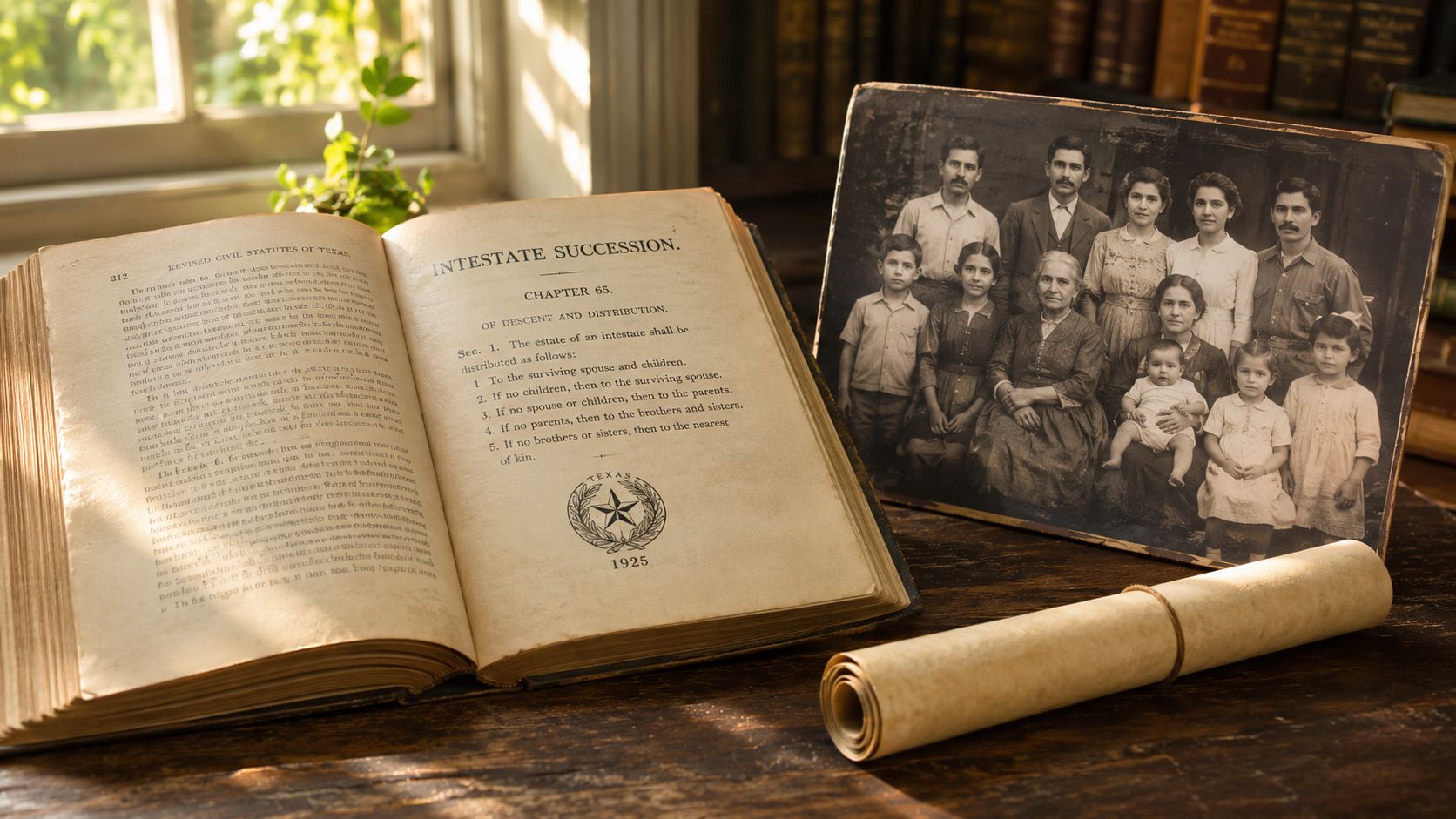
When a person dies without a valid will, that person dies intestate. In Texas, intestate estates are handled under Title 2 of the Texas Estates Code, especially the parts that govern heirs and property distribution. The court doesn't try to guess what the deceased probably wanted. Instead, it applies a set order of inheritance.
What intestate succession means in plain English
Think of intestate succession as the state's backup estate plan. If you leave no enforceable instructions, Texas supplies them for you.
Under the Texas Estates Code, which has governed probate since 2011, stepchildren have absolutely zero automatic inheritance rights if a stepparent dies without a will, no matter how long they lived together or how close the relationship was, as explained by Texas probate guidance on intestate succession and heirship. The law focuses on legally recognized family status, not personal history.
If you want a simple overview of how a no-will estate moves through court, this guide to the Texas intestate succession process can help.
Who counts as a child under the law
For inheritance purposes, Texas generally recognizes:
- Biological children
- Court-adopted children
A stepchild doesn't become a legal heir just because the deceased helped raise them, supported them financially, or introduced them as their son or daughter. The legal system asks a narrower question: was there a legally recognized parent-child relationship?
That distinction comes from Title 2, Subtitle E of the Estates Code, which governs descent and distribution. Probate courts use those rules when identifying heirs and deciding who receives probate assets.
Practical rule: If a stepparent dies without a will, trust, or beneficiary designation naming the stepchild, the stepchild isn't in the default line of inheritance.
Why this matters during probate
This rule doesn't just affect who receives money at the end. It affects the entire case from the start:
| Probate issue | Biological or adopted child | Stepchild not adopted |
|---|---|---|
| Status in heirship | Recognized as legal heir | Not recognized as legal heir |
| Right to inherit intestate assets | Yes | No |
| Standing in probate decisions | May have rights depending on the case | Often much more limited |
| Need to be specifically named in planning documents | Helpful, but not required for intestacy | Essential |
The result can surprise families. If there is no surviving spouse and no biological or adopted descendants, Texas law can send the estate to the deceased person's blood relatives instead of to a stepchild who lived in the home for years. That feels unfair to many families, but it is how the default system works.
Biological Child vs Stepchild A Clear Comparison of Rights
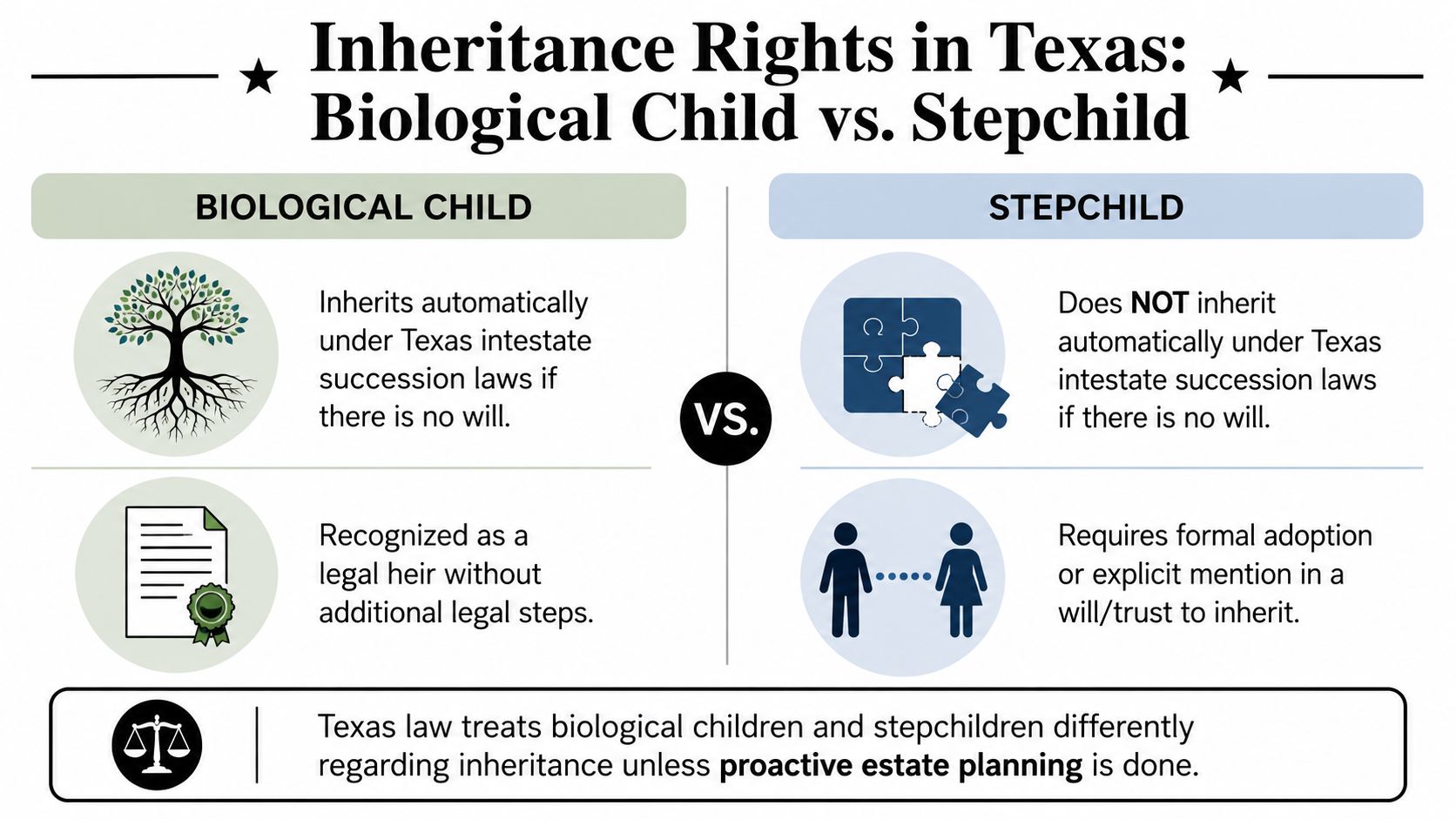
The easiest way to understand this issue is to compare the two categories directly. In Texas probate, the legal difference between a biological child and a stepchild isn't small. It's foundational.
Side by side comparison
| Issue | Biological child | Stepchild |
|---|---|---|
| Default heir if there is no will | Yes | No |
| Recognized automatically in intestacy | Yes | No |
| Can inherit through a legal parent-child relationship | Yes | Not unless legally adopted |
| Can receive assets by will or trust | Yes | Yes, if specifically named |
| Can receive assets by beneficiary designation | Yes | Yes, if specifically named |
The practical takeaway is simple. A biological child starts inside the probate system as an heir. A stepchild starts outside it unless a legal document brings them in.
What this looks like in real life
Consider three common situations.
Biological child inherits: Texas treats the child as part of the default line of succession.
Stepchild inherits: Only if the deceased completed an adoption or named the stepchild in a valid estate planning document.
If a married person dies without a will and leaves biological children, those children may have rights in the estate under Texas intestacy rules. If that same person also helped raise a stepchild but never adopted that child, the stepchild doesn't receive an automatic share just because everyone considered the household a blended family.
If there is no surviving spouse, the contrast becomes even sharper. A biological or adopted child remains in line to inherit. A non-adopted stepchild still does not.
A commonly missed edge case
A point many families miss is whether a stepchild can inherit through a stepparent if the stepparent never completed an adoption. Texas-focused discussion of that issue explains that intestacy turns on legal parent-child status, so a stepchild remains excluded unless adopted or specifically named in a valid estate planning tool, as described in this discussion of stepchildren and inheritance rights in Texas.
That matters because families often assume long-term caregiving creates legal inheritance rights. In Texas, it doesn't.
Why wording matters
Even outside intestacy, loose wording can cause trouble. If a will says “my children” without naming names, the family may end up arguing about whether that phrase includes a stepchild. Clear estate planning avoids that uncertainty.
A safer approach is to identify each intended beneficiary by name and specify what that person should receive. That keeps the probate court from having to interpret family assumptions after a death.
How Legal Adoption Transforms Inheritance Rights
For blended families, adoption is the clearest legal turning point. It changes the relationship from emotional and social to fully recognized under inheritance law.
Historical Texas probate guidance explains that legal adoption is the single definitive mechanism that transforms a stepchild into a legal heir with equal inheritance rights to biological children, and once that adoption is complete, the adopted child stands on the same legal footing as a biological child under intestate succession. If you're planning around remarriage and children, this resource on preserving an estate for children after remarriage is a useful starting point.
What adoption changes
A completed stepparent adoption affects probate in a direct way:
- Heir status changes. The child becomes part of the legally recognized parent-child line.
- Intestacy treatment changes. The adopted child is treated the same as a biological child when there is no will.
- Probate administration becomes clearer. The court doesn't have to wrestle with whether a step-relationship should count. The legal status is already established.
This is important under Title 2 of the Texas Estates Code, because intestate inheritance depends on recognized legal relationships. Adoption supplies that recognition.
What adoption does not do by itself
Adoption helps with intestacy, but it doesn't solve every estate issue.
For example:
- It doesn't replace a will if you want unequal gifts, special instructions, or specific asset distributions.
- It doesn't create a trust structure for a child who may need money managed over time.
- It doesn't update life insurance, retirement accounts, or payable-on-death designations.
Adoption changes heirship. Estate planning changes instructions.
Why families still need planning
Even when a stepchild has been adopted, families still need to think about practical issues under Title 3 of the Texas Estates Code, which deals with probate administration. Who will serve in court? Which assets pass through probate? Which ones pass outside probate? Should funds for a young beneficiary stay in trust?
A stepparent adoption is powerful because it removes the legal barrier that otherwise excludes the child. But it works best when paired with clear planning documents that reflect the family's current structure, property, and goals.
Using a Will or Trust to Provide for Stepchildren
A blended family can run into a painful result after a death. The surviving spouse may assume the household will stay financially intact, while the law sends part of the estate in a different direction. A will or trust lets you decide what happens instead of leaving those choices to Texas default rules.
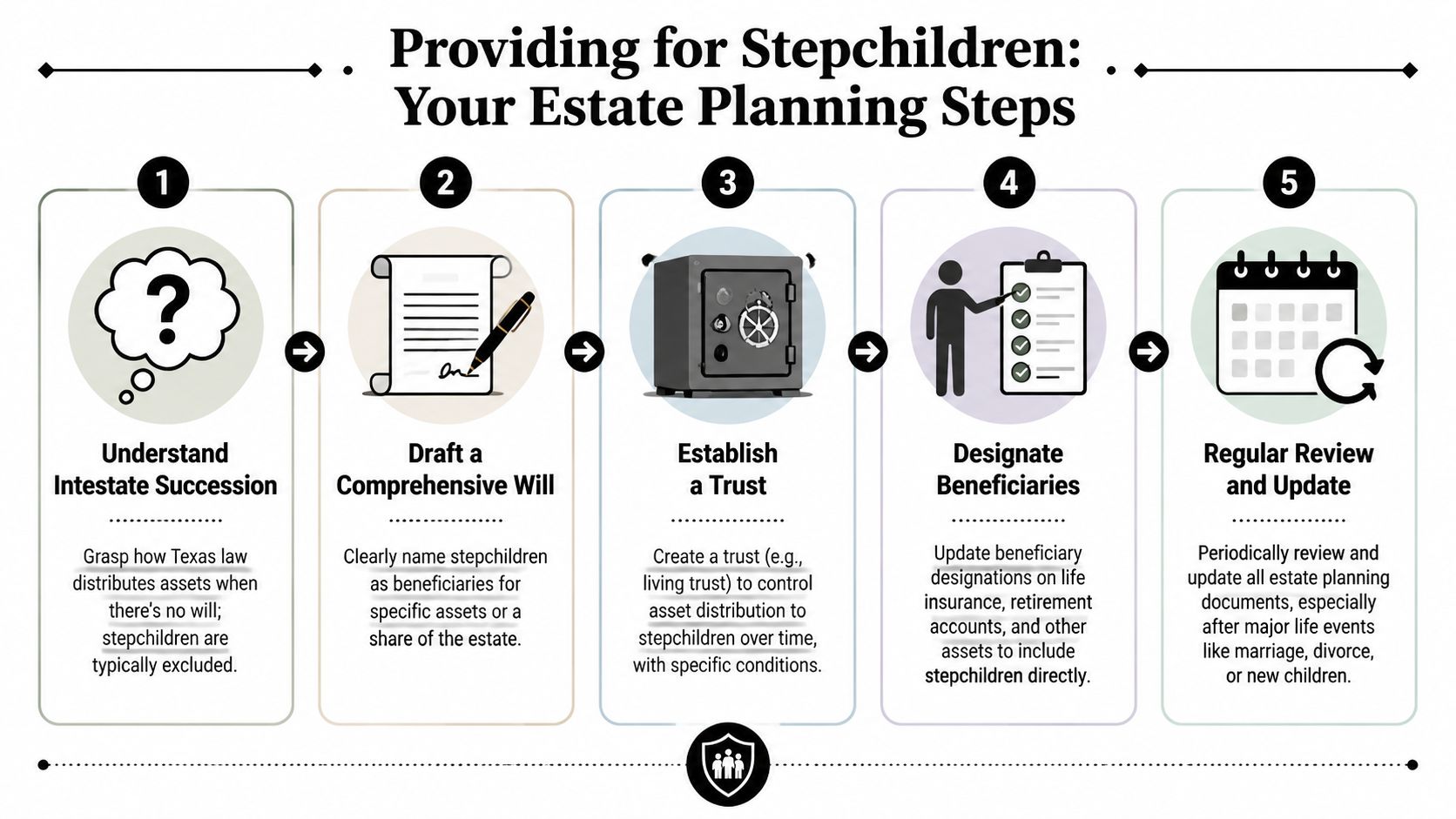
For blended families, that matters in very practical ways. If a stepparent dies without a will, stepchildren can be left out entirely, even if the stepparent raised them for years. At the same time, minor biological children may inherit property they cannot manage on their own, which can force the surviving spouse into added court procedures just to access or oversee funds. Community property can add another layer of strain if the surviving spouse expected to keep using assets that now partly belong to the deceased spouse's heirs.
A will and a trust help with different parts of that problem.
A will directs who receives probate assets and names the person who will handle the estate. It is the written instruction sheet the probate court follows. If you want a stepchild to inherit, the will should name that child clearly rather than relying on broad phrases like "my children."
A trust works like a set of holding instructions for property. It can say who benefits, who manages the assets, and when distributions should be made. That is often helpful when the family includes minors, because a trust can hold a child's inheritance until a chosen age or allow a trustee to pay for health, education, and support without requiring the child to control the funds directly.
For a practical overview of these choices, see this guide to estate planning for blended families.
A short video can also help illustrate how planning choices affect probate and inheritance in Texas.
A will and a trust solve different family problems
The right tool depends on what you are trying to prevent.
- Use a will to name stepchildren specifically, choose an executor, and state who receives probate property.
- Use a trust to control timing, protect a minor beneficiary's share, and appoint someone to manage money responsibly.
- Use beneficiary designations for life insurance, retirement accounts, and similar assets, because those assets usually pass according to the form on file, not the will.
Many blended families need all three. One document rarely covers every asset.
Common planning mistakes in blended families
Probate disputes often begin with a family trying to fill in blanks after someone has died. Courts cannot rewrite unclear instructions.
- Relying on assumptions. Love and intent are real, but probate courts need valid legal documents.
- Using vague labels. "My children" can create conflict if the family includes biological children, adopted children, and stepchildren.
- Ignoring community property consequences. A surviving spouse may expect to keep full control of an asset, but part of the deceased spouse's interest may pass elsewhere if planning is incomplete.
- Forgetting minors need management. A child may inherit money without being legally able to manage it, which can trigger guardianship or other supervised arrangements.
- Failing to update documents after remarriage, birth, or adoption. Family changes should lead to document changes.
One practical planning path
A clear plan usually names people and duties with precision.
- A will that identifies each intended beneficiary by name.
- A trust if any child is young, financially inexperienced, or should receive funds in stages.
- Updated beneficiary forms that match the estate plan.
- Clear nominations for executor, trustee, and guardian or manager roles when minors are involved.
The Law Office of Bryan Fagan, PLLC handles probate and estate planning matters involving wills, trusts, guardianship issues, and probate disputes. Those are the same kinds of problems blended families often face when no written plan answers the hard questions in advance.
A Realistic Scenario Navigating Probate in a Blended Family
Consider the Garcia family in Houston. Daniel and Elena have been married for years. Daniel helped raise Elena's daughter, Sofia, from elementary school through high school, but he never legally adopted her. Daniel and Elena also have two younger biological children together, both minors. Daniel dies without a will.
The family assumes the children will all be treated the same. Probate says otherwise.
What happens first
Because there is no will, the probate court looks to Title 2 of the Texas Estates Code to identify heirs and determine how probate property should pass. Daniel's legal relationship to each child matters immediately.
Sofia is Daniel's stepchild, not his adopted child. That means she isn't part of the intestate heir line.
Daniel's two minor biological children are legal heirs. But being heirs doesn't mean they can take possession of funds and manage them on their own.
Where the family runs into trouble
Texas-focused probate guidance notes that in mixed-family estates with minor children, a minor biological child cannot directly control inherited property and may require a court-supervised guardianship, while stepchildren remain outside intestacy unless adopted, creating a difficult question about who gets what and under what court process, as discussed in this article on Texas probate in a blended family with a minor child.
That creates several practical problems at once:
- Elena is grieving and managing the household, but now she may also need to deal with probate filings, asset inventories, and court deadlines.
- The minor children may need an adult to manage inherited property, subject to court supervision.
- Sofia may feel excluded, even though Daniel parented her in every way that mattered emotionally.
- Community property questions may arise, especially if the estate includes a house, bank accounts, or assets acquired during marriage.
Families often expect probate to sort things out fairly. Probate sorts things out legally.
Why community property complicates blended families
Texas is a community property state, and that adds another layer. Some assets may belong partly to the surviving spouse already, while other assets may be separate property or may require closer tracing. In a blended family, the difference between community and separate property can affect how much remains in the probate estate and who inherits what share of it.
That doesn't mean every estate becomes a courtroom battle. It does mean the surviving spouse often needs careful advice before transferring property, using estate funds, or assuming all family members stand in the same position.
If the inherited share belongs to a minor child, the family may also need to explore guardianship in Texas probate matters. That process can be manageable, but it adds time, court oversight, and paperwork during an already difficult season.
Key Insights and Estate Planning Steps for Your Family
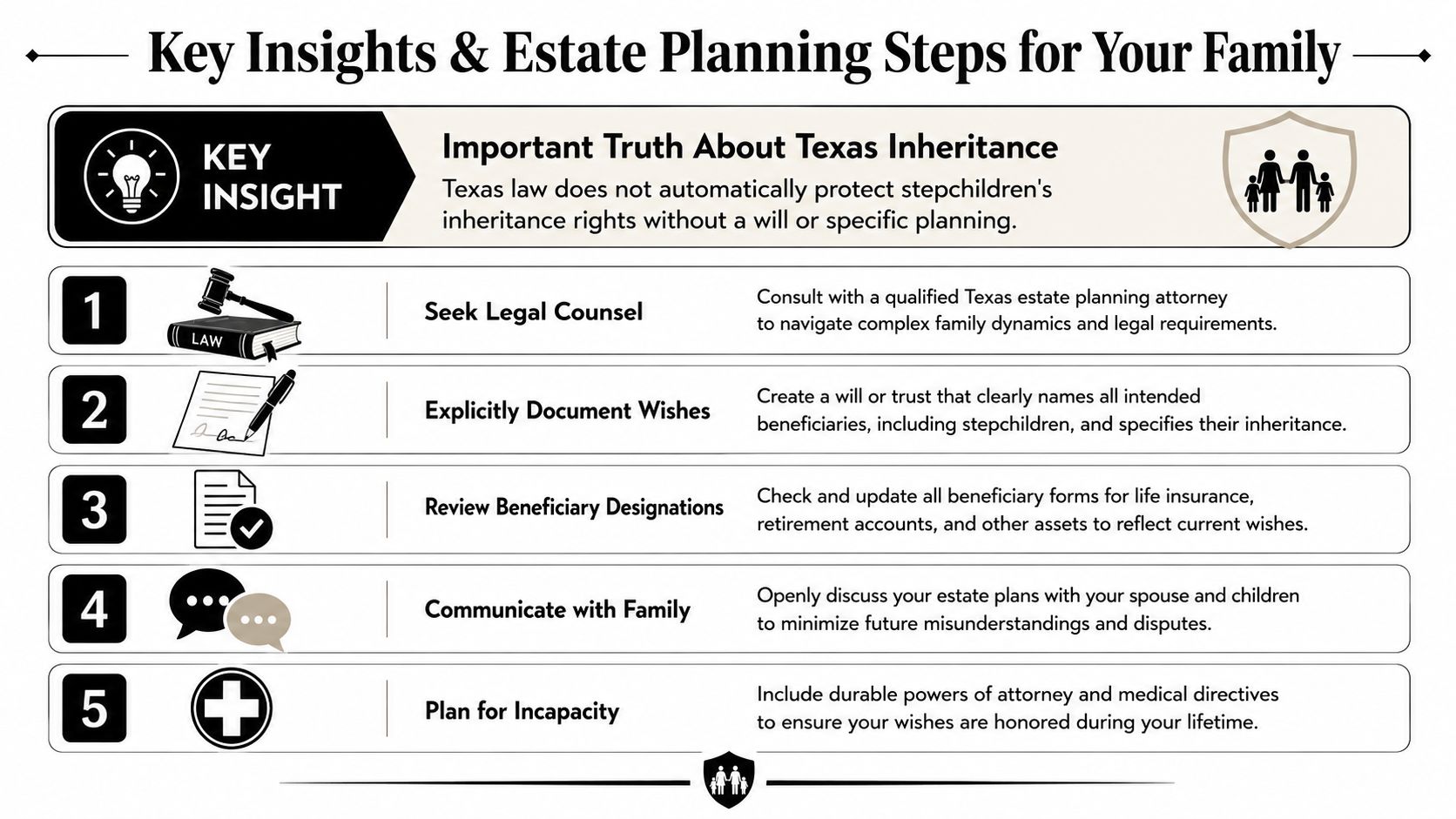
The most important truth is simple. Texas law doesn't automatically protect stepchildren in probate. If a stepparent wants a stepchild to inherit, that intent needs legal support.
Key insight
In Texas intestacy, stepchildren have zero automatic inheritance rights unless they were legally adopted or expressly named in a valid will, trust, or beneficiary designation, while biological and court-adopted children are treated as default heirs under the intestacy scheme, as outlined in this explanation of Texas inheritance rights for stepchildren and heirs.
That one rule explains why so many blended families are shocked by probate outcomes.
A practical checklist for blended families
Talk through your intentions early. Spouses often agree in principle but haven't decided the details. Should stepchildren inherit equally? Should a surviving spouse have use of the home first? Should gifts be delayed until a child reaches a certain age?
Put names in writing. Don't rely on family labels like “our kids” or “my children” if you mean to include stepchildren. Name each beneficiary directly in a will, trust, or account designation.
Review beneficiary forms. Some of the most important assets pass outside probate. It's also helpful to understand the distinction between insurance and financial account roles by clarifying beneficiary vs dependent roles, because families often confuse who is covered, who is listed, and who receives funds.
Consider adoption where appropriate. In some families, stepparent adoption may be the right step for both legal and personal reasons.
Plan for minor children. If a child may inherit while still young, think ahead about whether a trust or another management structure would avoid a later court-supervised guardianship.
A blended family needs more than good intentions. It needs documents that match the family's reality.
If you're facing probate now, gather the death certificate, any estate planning documents, deeds, account statements, and beneficiary information before making assumptions about who inherits. If you're planning ahead, now is the time to create or update the documents that protect your spouse, children, and stepchildren.
If you're facing probate in Texas, our team can help guide you through every step, from filing to final distribution. Schedule your free consultation today with Law Office of Bryan Fagan, PLLC.