Skip to content
A probate court order can land like a second loss.
You may have just buried a parent, spouse, or sibling. Then a judge signs an order that admits a will you believe was manipulated, appoints an executor you don't trust, or interprets your loved one's estate plan in a way that feels plainly wrong. Most families in that moment aren't thinking in legal vocabulary. They're thinking, "How can this be happening?" and "Is there anything we can do now?"
In Texas, the answer is sometimes yes. A probate appeal texas case gives a higher court the chance to review whether the probate court made a legal mistake that affected the outcome. That matters because probate isn't just paperwork. It controls who manages the estate, who receives property, how debts are handled, and whether your loved one's wishes are carried out.
An appeal is not a way to relive the hearing because the result felt unfair. It is a formal challenge based on legal error. That distinction matters. It shapes whether an appeal is possible, whether it's wise, and whether the investment of time, money, and emotional energy makes sense for your family.
If you're weighing that decision right now, the practical questions usually come fast. Can this specific order be appealed? How long do you have? What does the appellate court review? What happens if you win? And just as important, when is an appeal the wrong move?
Challenging a Probate Ruling When You Feel It Is Wrong
A common situation looks like this. Two siblings expect their mother's estate to be handled without incident. Instead, one cousin presents a late-signed will. The probate court admits it. The cousin becomes executor. Within days, the family home may be listed, accounts may be controlled by someone the siblings never trusted, and everyone is stunned by how quickly things changed.
That reaction is normal.
Grief already narrows your focus. Probate litigation adds deadlines, legal filings, and pressure from relatives who may want you to "just let it go." But when a ruling threatens your inheritance, your role as executor, or what you believe your loved one intended, standing still can be the most expensive choice.
What an appeal is, and what it isn't
A probate appeal asks a higher court to review the trial court's ruling for legal error. In plain English, that means the appellate court looks at whether the probate judge applied the law correctly and followed proper procedure based on the record that already exists.
An appeal is not:
- A second trial: You usually don't get to bring in new witnesses or introduce new documents.
- A chance to vent frustration: Hurt feelings alone won't reverse an order.
- A guaranteed reset: Some rulings are upheld, even when the family strongly disagrees with them.
An appeal can be appropriate when the problem is something concrete, such as a will admitted over a preserved evidentiary objection, a mistaken interpretation of estate language, or a ruling entered in the wrong procedural phase.
Families often call after a hearing and say, "The judge didn't listen." The harder legal question is different: Did the court commit a reversible error that's preserved in the record?
Why the decision has to be strategic
The emotional instinct is often immediate. File something. Fight back. Do something now.
Sometimes that's correct. Sometimes it isn't.
A measured appeal strategy looks at three things together:
The order itself
Some probate rulings are appealable right away. Others are not.The error
There must be a legal problem, not just an unfavorable result.The practical return
If the appeal won't materially protect property, rights, or estate administration, the cost may outweigh the benefit.
Texas probate law under Titles 2 and 3 of the Texas Estates Code governs administration, heirship, wills, fiduciary duties, and related disputes. Those rules create remedies, but they also create traps for families who wait too long or appeal the wrong issue.
When handled carefully, an appeal can stop a bad ruling from becoming permanent. When handled casually, it can drain the estate and leave the original order untouched.
Identifying an Appealable Probate Court Order
A family leaves a probate hearing convinced the judge got it wrong. The order is signed. Everyone wants to act immediately.
The first strategic question is narrower. Has the court signed an order you can appeal now, and will an appeal solve a problem that matters enough to justify the cost, delay, and strain on the estate?
That question is harder in probate than in many other cases because estate administration does not move in one straight line. Texas probate cases often unfold in separate phases, and some rulings become final for appeal purposes before the estate closes. The appellate court will care less about how upsetting the hearing felt and more about whether the signed order ended a distinct part of the case.
Why some probate orders can be appealed before the estate is closed
Texas courts apply the Crowson finality framework in probate matters. In practical terms, an order is usually appealable if a statute makes that phase final, or if the order resolves all parties and issues in the particular phase then before the court. That is why an order admitting a will, declaring heirship, or appointing a personal representative may be immediately reviewable even while other estate issues remain pending. A fuller explanation appears in this discussion of appealable probate orders and standards in Texas.
That rule exists for a good reason. If families had to wait until the very end of administration, assets could be distributed, fiduciaries could act for months, and errors could become much harder to correct in any meaningful way.
Orders that often justify immediate review
Several types of probate orders regularly raise appeal issues because they decide rights in a discrete phase of the case:
- Order admitting a will to probate. This often matters when the dispute involves capacity, undue influence, forgery, or execution defects.
- Order appointing an executor or administrator. This can matter if the appointed person is disqualified, unsuitable, or likely to control estate property in ways that are hard to reverse later.
- Order determining heirship. These rulings can directly affect who inherits and in what share.
- Order construing a will or trust provision in probate. If the court's interpretation changes who receives property, the stakes may justify appellate review.
The right question is not just whether the order is appealable. It is whether appealing now protects something concrete. Sometimes the answer is yes because control of the estate, title to property, or inheritance rights are on the line. Sometimes the better choice is to conserve resources and fight in the trial court first.
Orders that usually are not ready for appeal
Families are often frustrated by rulings made in the middle of a probate fight. Frustration alone does not create appellate jurisdiction.
Routine scheduling rulings, discovery disputes, requests for more briefing, and directions to return for another evidentiary hearing usually do not end a probate phase. Those orders may be wrong, and they may still matter, but the answer is often to preserve the issue and continue building the record rather than file an immediate appeal.
That distinction can save a family from spending money on an appeal that gets dismissed without reaching the merits.
A practical way to evaluate the order
Start with the signed order itself, not the courtroom experience. Read what the judge ordered. Then ask four direct questions:
- What phase of the probate case did this order decide?
- Did it fully resolve that phase, or is the court clearly expecting more proceedings on the same issue?
- What legal error do you believe occurred?
- If the order stands, what harm follows for the family or the estate?
That last question matters more than many people expect. An appeal may be legally available and still be a poor strategic choice if the likely benefit is small compared with the cost, delay, and risk of reducing what remains in the estate.
A realistic example
Suppose the court signs an order admitting a late-life will to probate over your objection that your mother lacked capacity. The same order appoints the person who offered the will as executor. That is usually the point to assess an appeal promptly because the ruling may affect both who inherits and who controls estate assets during administration.
Now compare that with a hearing where the judge says additional medical records must be produced before deciding capacity. That is a serious development, but it usually is not the appeal point yet. The better move is often to prepare for the next hearing, make proper objections, and create a clean record.
Legal error drives the appeal, not outrage
Appellate courts review legal mistakes. They do not retry the family conflict from the beginning, and they do not reverse a ruling because it felt unfair.
Probate appeals are often stronger when the record shows one of these problems:
- The court misapplied the Estates Code
- The court interpreted a will in a legally incorrect way
- Key evidence was wrongly admitted or excluded
- A party did not receive required notice
- The court acted beyond its authority in that phase of the case
A screening rule helps here. Identify the exact order, the date it was signed, the phase of the proceeding it resolved, and the specific legal error you intend to challenge. If any of those pieces are missing, the family may need a different response before committing to an appeal.
Navigating the Texas Probate Appeal Timeline
The hardest calls often come a few days after the hearing, when the family is still upset, the written order has just been signed, and someone asks whether to appeal. At that point, timing is only part of the decision. The other part is whether an appeal is likely to produce a result worth the cost, delay, and strain on the estate.
Texas appellate deadlines come fast. In many probate appeals, the notice of appeal is due within 30 days after the judge signs the appealable order. Waiting to decide can close the door. I often tell families to treat the first week after a signed order as a working period for decision-making. Get the order. Confirm the signing date. Get advice on whether the ruling is appealable and whether the alleged error is one an appellate court can correct.
The sequence matters because each deadline affects strategy
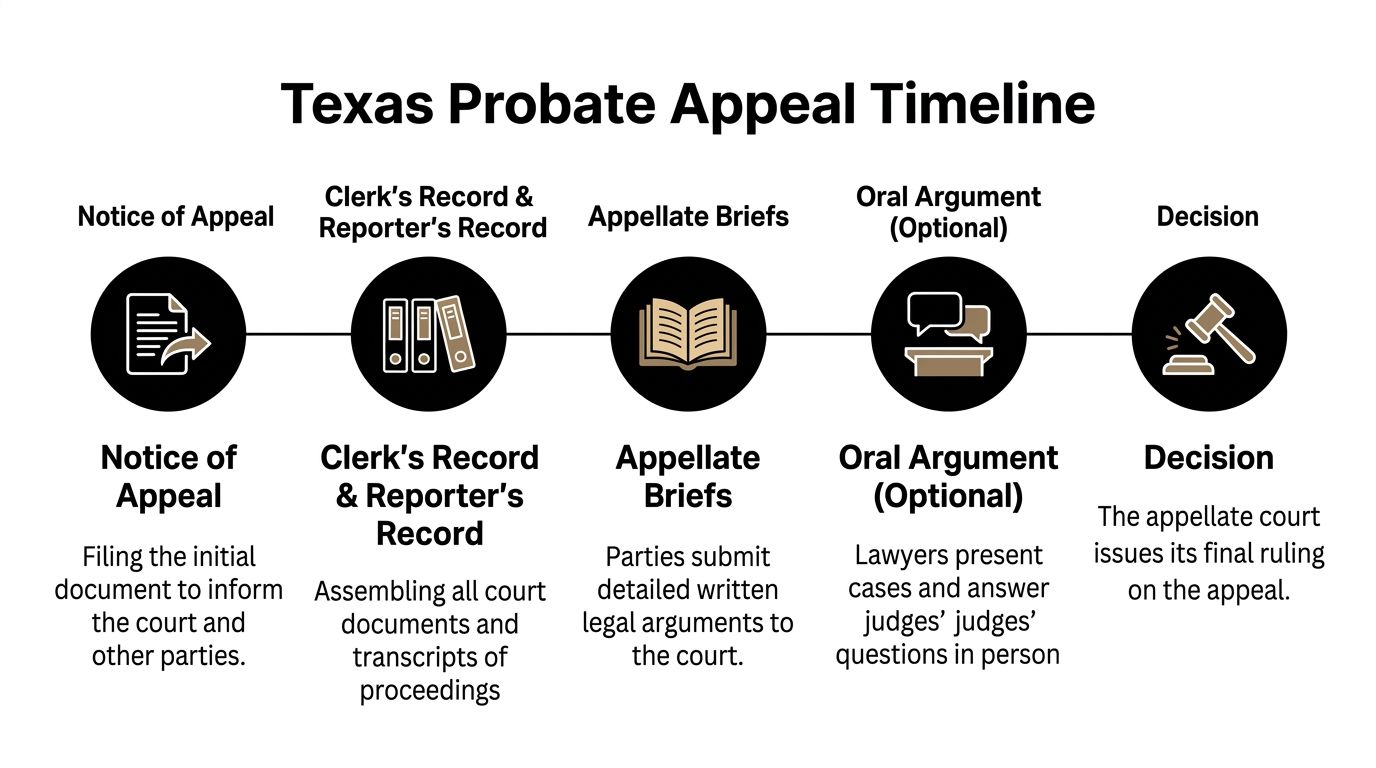
An appeal is not one filing. It is a chain of deadlines and record-building steps, and each one affects strategic advantage, cost, and risk.
Notice of appeal
This starts the appellate process. If it is late, the court may dismiss the appeal without reaching the merits.Clerk's record and reporter's record
These materials tell the appellate court what happened below. If a hearing was not transcribed, or an exhibit never made it into the record, that can limit what can be argued later.Appellate briefing
The written briefs usually matter more than anything said in court. The arguments must be tied to the record and the controlling law.Oral argument
Some cases get oral argument. Many do not. Families should not assume they will get another chance to tell the full story in person.Decision
The court may affirm the order, reverse it, modify it, or send the matter back to the probate court for further proceedings.
Texas Probate Appeal Key Deadlines
| Procedural Step | General Deadline | Governing Rule (TRAP) | Notes for Families |
|---|---|---|---|
| Notice of Appeal | Often 30 days from the signed appealable order | TRAP 26.1 | Missing this can end the appeal before it starts. |
| Restricted Appeal | Within 6 months if narrow eligibility rules are met | TRAP 26.1(c) and 30.1 | Usually applies only if you did not participate in the hearing and error appears on the face of the record. |
| Appellant's Brief | Filed after the record is filed under appellate scheduling rules | TRAP 38.1 | The brief must follow strict formatting and content rules. |
| Supersedeas or Stay Issues | Case-specific | TRAP 24 | This may matter if you need to pause enforcement of the order while the appeal is pending. |
What to do right away
The first practical step is simple. Work from documents, not memory.
- Get the signed order. The appeal clock usually runs from the written order, not from what the judge said at the hearing.
- Confirm the signing date from the docket and file stamp. One wrong date can destroy an otherwise valid appeal.
- Order the record early. Hearings, exhibits, objections, and offers of proof often decide what arguments remain available.
- Assess whether estate assets could move before review. If distributions, sales, or account transfers may happen soon, counsel should evaluate a stay or supersedeas promptly.
- Collect the proof that framed the probate dispute in the first place. Families dealing with a contested will often benefit from reviewing the evidence commonly needed to contest a will in Texas while the record is being assembled.
Timing is also a cost-benefit question
A fast filing deadline does not mean every bad ruling should be appealed.
Sometimes an appeal is the right move because the order changes control of the estate, creates immediate financial risk, or rests on a clear legal error that affected the result. Sometimes the better answer is different. A family may decide that the likely cost of briefing, the delay in administration, and the chance of affirmance outweigh the expected benefit, especially if the disputed issue is narrow or can be addressed in a later phase of the probate case.
That judgment requires honesty. Anger can justify action in family life. It does not justify an appeal by itself.
What a supersedeas bond can and cannot do
A supersedeas bond may suspend enforcement of a judgment while the appeal is pending. In probate, that can matter if property may be sold, funds distributed, or authority exercised under the challenged order before the appellate court has time to review it.
Still, a bond is not automatic, and it is not always practical. The amount, availability, and effect depend on the type of order and the governing rules. For some families, pursuing a stay makes sense because preserving the estate is the whole point of the appeal. For others, the cost of the bond may be too high relative to what is at stake.
Restricted appeals are narrow
Restricted appeals exist for limited situations. A party generally must file within six months, must not have participated in the hearing that led to the judgment, and must be able to show error from the face of the record.
That is a narrow remedy. It helps some families. It does not rescue every missed deadline.
For a broader look at strategies for winning appeals in Texas, it helps to compare how deadlines, preservation rules, and record quality shape appellate results across different types of cases.
If you believe the probate court got it wrong, act quickly, but do not act blindly. The best early decision is usually the one made with the signed order in hand, the deadline confirmed, and a clear answer to a hard question: if the appeal succeeds, what changes for your family and the estate?
How to Build a Persuasive Case on Appeal
A strong appeal is built on discipline, not volume.
Appellate judges won't re-try the probate case. They won't hear family lore that never made it into evidence. They won't consider documents discovered later unless a separate procedural path allows it. They review the existing record and decide whether the trial court made a reversible legal error.
The brief is the heart of the appeal
The appellant's brief is the written argument that explains why the order should be changed. It must connect four things:
- the issue presented,
- the relevant facts from the official record,
- the controlling law,
- and the reason the error mattered.
If the probate court misread a will clause, the brief must point to the actual will language in the record, identify the legal rule for construction, and show how the court's interpretation changed the outcome.
If the court excluded evidence on capacity, the brief must identify where the objection, ruling, and excluded material appear in the record.
Error preservation decides many appeals
The appellate court usually reviews only issues properly raised below. In plain English, if your lawyer did not object, request a ruling, or otherwise preserve the issue at trial, the appellate court may treat the complaint as waived.
Key insight: Appeals are often won or lost before the notice of appeal is filed. If the error wasn't preserved in the probate court record, the appellate court may never reach the merits.
That is one reason trial and appellate strategy should align early in a contested estate.
Appeals are technical for a reason
Texas appellate practice is exacting. According to appellate practice observations summarized here, an estimated 70-80% of appeals filed by non-lawyers are derailed by procedural problems, and the most common fatal mistake is missing the jurisdictional notice deadline. The same source explains that briefs must comply with the Texas Rules of Appellate Procedure on format, content, and service or risk being struck by the court. That summary appears in this discussion of Texas probate appeal steps and common procedural mistakes.
For families trying to understand how legal arguments are framed in other Texas appeal settings, this overview of strategies for winning appeals in Texas can help illustrate how record-based arguments and standards of review shape appellate outcomes. Probate appeals work under their own substantive rules, but the broader lesson is the same. Winning arguments are usually precise, preserved, and tied tightly to the record.
A practical example
Assume a probate court interprets your mother's will to give a ranch to one beneficiary outright. You believe the will language created a trust or delayed distribution until a later event. On appeal, the winning argument is not, "That isn't fair." It is, "The court misinterpreted the legal effect of the will's language, and the record shows the ruling changed ownership."
That kind of issue is often stronger than a witness-credibility complaint, because appellate courts are more willing to correct legal interpretation than to second-guess a trial judge's view of testimony.
Families dealing with underlying evidentiary disputes in a will contest often benefit from reviewing what proof mattered at trial. This guide on evidence used to contest a will in Texas is useful for understanding what has to be in the record before an appellate argument can succeed.
Understanding the Outcomes Costs and Strategic Risks
You may leave the courthouse feeling certain the judge got it wrong and that an appeal will fix it. Sometimes it does. Often, the value of an appeal is narrower. It can protect a major asset, correct a legal ruling that will affect the rest of the administration, or create settlement pressure. It can also consume time, money, and emotional energy without changing the result.
That is why this stage is not only about whether an appeal is possible. It is about whether the appeal is worth it for your family.
An appellate court may affirm the probate court, which means the ruling stays in place. It may reverse and render, which means the appellate court changes the result itself. Or it may reverse and remand, which sends the case back to the probate court to do more work under the correct legal standard.
For grieving families, that last outcome is often the hardest to hear. A remand is a win in one sense, but it usually means more proceedings, more delay, and more cost before anything is resolved.
What appellate statistics can and cannot do for you
Families often see reversal statistics and assume they reflect their own odds. They do not. Appellate numbers show that trial courts are sometimes reversed when a legal error is properly presented. They do not tell you whether your record, your issue, and your standard of review make this a strong appeal.
The situation is more nuanced.
The intermediate Courts of Appeals matter most in probate cases because that is where the process usually starts. A published review of Texas Supreme Court and intermediate appellate statistics shows that outcomes vary by court and by the kinds of cases those courts see. That is useful background. It is not a forecast for your family.
A better question is this: if the appellate judges accept every fact in the record as it stands, do you still have a legal argument that can change the result?
The standard of review often decides the business case for an appeal
Two families can be equally upset by a probate ruling and face very different appellate prospects.
If the issue is legal interpretation, such as the meaning of will language or the proper reading of a statute, the appeal may have value. If the issue turns mostly on which witness the trial judge believed, the path is harder because appellate courts usually give trial judges room on credibility calls.
That difference matters in practical terms. A strong legal issue may justify the expense and delay. A weak issue framed as "the judge should have believed us" often does not.
What an appeal costs
Every probate appeal has a financial side and a human side.
The financial side usually includes attorney time, record preparation, filing fees, and in some cases the cost of seeking a stay to prevent distributions or sales while the appeal is pending. The human side is less visible but just as present. Estate administration may slow down. Family relationships may get worse. A personal representative may remain in control while the appeal runs its course.
For a grounded discussion of those variables, this guide to probate litigation costs in Texas is a useful starting point.
Before filing, families should ask a few hard questions. How much property or authority is at stake? Can the harm be undone later if no immediate appeal is taken? Will the likely cost of the appeal eat up a meaningful share of the estate or your expected recovery? Those questions are not cynical. They are responsible.

When an appeal usually makes strategic sense
An appeal often deserves serious consideration when the ruling affects something concrete and difficult to repair later, such as:
- A significant asset, including a home, ranch, mineral interest, or business interest
- Control of the estate, especially the appointment, removal, or powers of an executor or administrator
- A clean legal issue, such as will construction, jurisdiction, notice, or statutory interpretation
- An action that may be hard to unwind, such as a sale, transfer, or distribution of estate property
In those situations, even a difficult appeal may be justified because waiting can create permanent consequences.
When an appeal may be the wrong move
Some appeals are legally possible but strategically unsound.
That is often true when the claimed error was not preserved, the dispute is mainly about witness credibility, the amount in controversy is modest compared with expected fees, or settlement could protect your position faster and with less damage to the family. I have had cases where the better advice was to spend money on a targeted negotiated solution rather than on a full appeal. Families do not always want to hear that. It is still the right advice when the numbers and the record point that way.
A probate appeal should protect property, control, or a clear legal right. If it does not, it may extend the conflict.
For some families, the strongest appellate posture leads to a settlement rather than an opinion. Once the other side sees a well-grounded notice of appeal and a serious plan, resolution becomes more likely.
One practical option for families evaluating administration, litigation, and appeal issues in one place is the Law Office of Bryan Fagan, PLLC, which handles probate administration, will disputes, and related estate conflicts in Texas. That is one route. The larger point is to work with counsel who can assess both the legal merits and the cost of pursuing them.
A Practical Checklist for Your Probate Appeal
The first days after a bad probate ruling are usually chaotic. A checklist helps families move from shock to action.

What to gather before you call counsel
Bring these items together first:
The signed probate order
Not a minute entry. Not a recollection of what the judge said. The signed order.The case number and county
Probate procedure can vary by court, and the appellate district matters.Your hearing dates and any notices received
Those details help assess deadlines and due process issues.Copies of pleadings, motions, and exhibits you have
Even if incomplete, they help frame the issue quickly.A short timeline in your own words: Keep it factual. Who filed what, when, and what the court did.
Questions that make the consultation more productive
Ask direct questions.
- Is this order appealable now, or are we too early?
- What is the deadline to file the notice of appeal?
- What legal error do you see in the record?
- What standard of review will apply?
- Should we seek a stay or supersedeas?
- Would a post-judgment motion or settlement effort help more than an appeal?
A standard-of-review question is especially important. A summary of Texas appellate treatment of probate issues notes that many probate rulings are reviewed for abuse of discretion, and appellate data discussed there suggests reversal rates around 12% under that deferential standard. The same source notes that legal interpretation issues, such as construing a will, may receive de novo review, where success rates can reach 25% or higher when the evidentiary and legal argument is strong. That discussion appears in this article on probate appeals through Waco's 10th Court.
The mistakes that hurt families most
The worst errors are usually preventable.
- Waiting too long: Delay is the most common way rights disappear.
- Arguing new facts on appeal: The appellate court usually reviews the existing record only.
- Confusing unfairness with legal error: Courts reverse legal mistakes, not emotional disappointment.
- Ignoring the estate's economics: A valid appeal can still be a poor financial decision.
- Using the wrong lawyer for the task: Trial skills and appellate skills overlap, but they aren't identical.
This short video gives a helpful overview for families trying to understand the broader process before making a decision.
Quick-reference family checklist
| Item | Yes or No |
|---|---|
| Do you have the signed order? | |
| Do you know the exact signing date? | |
| Can you identify the specific legal error? | |
| Do you know whether the issue was preserved in the record? | |
| Have you assessed what is at stake? | |
| Have you asked whether settlement is a better route? |
Takeaway and Next Steps for Your Family
Your family may be sitting at the kitchen table with a signed probate order in hand, reading language that feels wrong and wondering whether to fight or let it go. That is usually the core question. Not whether an appeal exists in the abstract, but whether an appeal makes sense for your family after weighing time, cost, stress, and what can be gained.
A probate appeal can protect a meaningful interest. It can also drain estate resources and prolong conflict without changing the outcome. Grief makes that judgment harder. So does the pressure of short deadlines and orders written for lawyers, not families.
The next step is usually practical, not emotional. Put the signed order, the date it was signed, and the key probate filings in one place. Then ask for a direct legal assessment of three points: whether the order can be appealed now, whether the claimed error appears in the court record, and whether the likely benefit justifies the expense and delay.
I often tell families the same thing. An appeal should serve a purpose you can name clearly, such as protecting an inheritance, removing an unfit fiduciary, or correcting a ruling that changes how the estate will be administered. If the goal is only to express frustration, an appeal is rarely the right tool.
Speed matters.
If a ruling feels unjust, get advice quickly so you can choose among the options while they are still available. Depending on the order and the posture of the case, that may mean filing an appeal, asking for a stay, trying to resolve the dispute, or deciding that further litigation would cost more than it is worth.
If you are facing probate in Texas, Law Office of Bryan Fagan, PLLC can help your family evaluate the ruling, the record, and the practical next step. Schedule a consultation with Law Office of Bryan Fagan, PLLC.