A parent dies. The family finds the will. Then someone notices a painful detail: the will was signed before the youngest child was born or adopted, and that child isn’t named anywhere.
That moment can turn grief into confusion very quickly. Adult children may wonder whether the will controls everything. A surviving spouse may worry about keeping the estate together. An executor may feel stuck between following the document and doing what seems fair.
In Texas, this situation has a name. It may involve a pretermitted child claim. If you’re searching for answers about pretermitted child texas probate, the most important thing to know is this: the law has a framework for these cases, and families can work through it with clarity and care.
A Loved One's Will and a Child Left Behind
A Houston family gathers after their father’s death to review his will. The document names two older children and leaves them the family home and other property. Then the family remembers something obvious and heartbreaking. Their father signed that will years before his youngest daughter came into the world.
Nobody is sure what happens next.
The older siblings may feel defensive, even if they love their younger sister. The surviving spouse may fear a legal fight. The person named as executor may be asking a very practical question: “Am I supposed to follow the will exactly, or does Texas law change the outcome?”
That uncertainty is common in probate. It doesn’t mean anyone has done something wrong. It often means the estate plan wasn’t updated after a major life event.

Texas probate law tries to prevent a child from being accidentally left out when a parent made a will and later had or adopted another child. That’s the heart of the rule. The law isn’t trying to punish the children who were named in the will, and it isn’t trying to create conflict where none existed.
A pretermitted child claim usually starts with a very human problem, not a legal strategy. Someone realizes the family changed, but the will didn’t.
Families also get tripped up by guilt and assumptions. Some people think, “Dad must have meant to leave the younger child out.” Others think, “The court will just divide everything equally.” Neither assumption is safe. Texas law asks specific questions, and the answers matter.
If you’re in this position, slow down and gather the documents first. The will date matters. Birth or adoption dates matter. Beneficiary designations and trust papers may matter too. Probate can feel heavy, especially while you’re mourning, but this is a navigable process when you approach it one step at a time.
What is a Pretermitted Child Under Texas Law
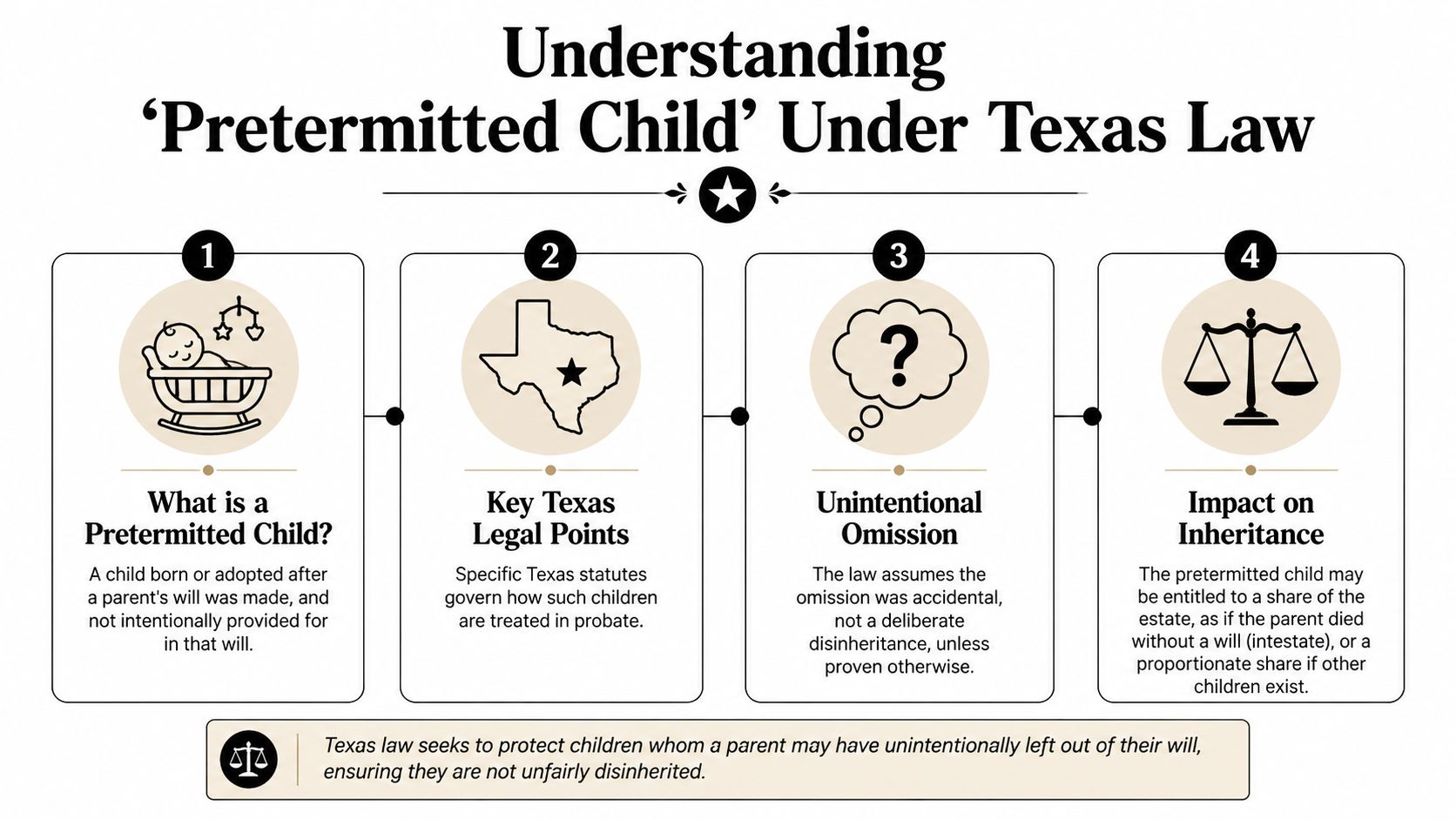
A pretermitted child is, in plain English, a child who was left out of a parent’s will because the will was signed before that child was born or adopted. Texas Estates Code Section 255.051 gives protection to that child in certain situations. The basic idea is simple: if a parent made a will and later had or adopted a child, the law may step in so that child isn’t accidentally disinherited.
The basic definition in plain language
Under Texas law, this protection generally applies when the child was born or adopted after the will was executed and the child was not mentioned, provided for, or otherwise supported by the parent through another valid arrangement. The statute is designed to address accidental omission, not to rewrite every will after death.
If you want a related explanation of omitted heirs in probate, this Texas omitted heir probate guide can help frame the issue in everyday terms.
Here’s the easiest way to understand it:
- The will came first. The child came later.
- The child wasn’t included. There’s no clear provision in the will for that child.
- There wasn’t another substitute plan. The parent didn’t otherwise provide for the child in a way the law recognizes.
- The omission appears unintentional. Texas law protects against being forgotten, not against a clearly stated decision.
Why Texas has this rule
The law recognizes a common reality. People write a will, then life changes. A child is born. A child is adopted. A blended family grows. The parent may fully intend to update the documents, but never gets around to it.
So Texas Estates Code Section 255.051 creates a safeguard. The child may receive a share similar to what would happen if there were no will, depending on the family setup and the terms of the document.
Practical rule: A pretermitted child claim is not based on hurt feelings alone. It depends on timing, family relationships, and whether the parent made some other legally meaningful provision.
What this does not mean
Not every omitted child qualifies.
A child usually won’t fit this category if the parent clearly intended to leave that child out, or if the child was cared for outside the will through another estate planning tool. That distinction matters because probate courts are not supposed to ignore a parent’s deliberate choices.
Families often get confused. They hear “left out of the will” and assume that automatically creates a claim. It doesn’t. The issue is narrower. Texas law asks whether the child was omitted in the specific way Chapter 255 addresses.
Questions families should ask early
Before anyone argues over shares, gather facts around these questions:
- When was the will signed?
- Was the child born or adopted after that date?
- Does the will mention that child at all?
- Did the parent set up a trust, gift, or beneficiary designation for the child?
- Is there language in the will showing a deliberate intention to exclude later children?
If those answers point toward an accidental omission, then a pretermitted child claim may be part of the probate case. If not, the analysis shifts toward proving intent or showing that the child was already provided for elsewhere.
How a Pretermitted Child’s Inheritance Share is Calculated
A family often reaches this point with one urgent question: If the child qualifies, what does that child receive?
The answer is rarely a simple equal split. Texas law uses a formula that depends on the family that existed when the will was signed and on who was already named in that will. A helpful way to view it is this: the court is trying to fit the omitted child into an estate plan that was written for a different moment in the parent’s life.

Two common paths under Texas law
Most cases fall into one of two patterns:
| Situation | General effect |
|---|---|
| The parent had no children when the will was signed, or the will failed to provide for children then living | The omitted child may receive the share that child would have received if there had been no will for that portion |
| The parent had other children who were already provided for in the will | The omitted child usually shares in the portion going to those children, and those gifts are reduced under the Estates Code rules |
Those two paths matter because they produce very different outcomes. In one case, the law looks more like intestacy. In the other, the law adjusts gifts that were already made in the will.
What that means in real life
Here is the practical version.
If a parent signed a will before having any children, and later had a child but never updated the will, the omitted child may be treated much more generously than families expect. The law may give that child the kind of share the child would have received if no will covered that property.
If the parent already had children when the will was signed, and the will left property to those children, the later-born or later-adopted child is often brought into that group. The result is usually a redivision of those gifts, not a complete rewriting of the estate plan.
A good analogy is a pie that was sliced for two children years ago. If a third child who qualifies under the statute must now be included, the court does not bake an entirely new pie. It usually cuts the existing slices differently, following the rules in the statute.
Why the math can feel confusing
Families often expect one clean percentage that applies to every asset. Probate does not always work that way.
A house, a bank account, mineral interests, and personal property may all pass under different parts of the will. Some gifts are specific. Others come from what is left over after debts and expenses are paid. A pretermitted child’s share can affect those categories differently, which is why the final result may look uneven at first glance.
That does not mean anyone made a mistake.
It usually means the executor and the court are applying the statute asset by asset, instead of using a rough sense of fairness. That distinction is hard emotionally, especially for siblings who feel blindsided, but it is part of how Texas probate protects both the omitted child and the parent’s written plan.
An everyday example
Suppose a father signed a will when he had two children. Years later, he had a third child and never updated the document. The will leaves certain property to the first two children.
If the third child qualifies as a pretermitted child, that child may receive an interest in property passing through probate, and the older children’s shares may be reduced to make room for that interest. The adjustment can affect real estate as well as cash or other probate assets. By contrast, property that passes outside probate, such as an account or policy with a valid beneficiary designation, is usually not part of that redistribution.
That point surprises many families. They see a parent’s full financial picture and assume every asset goes into the same pot. Probate law separates assets into categories first, then applies the rules.
What executors and families should do before making distributions
If you are serving as executor, slow the process down before transferring property. That pause can prevent expensive corrections later.
Start with these tasks:
- Match the dates. Compare the will signing date with the child’s birth or adoption date.
- List probate assets separately from non-probate assets. A home passing under the will is handled differently from life insurance with a named beneficiary.
- Review each gift in the will on its own terms. A specific gift may be treated differently from the residuary estate.
- Get legal advice before distributing anything contested. Once title changes hands, fixing the problem gets harder and more expensive.
For grieving families, this part of the case can feel cold because it focuses on fractions, titles, and account categories. But there is a human reason for being careful. A correct calculation protects the child who may have been accidentally left out, and it also protects the executor from making distributions that create conflict between siblings later.
Statutory Exceptions to a Pretermitted Child Claim
A painful moment in probate often sounds like this: “My brother was never named in the will, so he must inherit as a pretermitted child.” Sometimes that is true. Sometimes it is not.
Texas law protects children who were left out by mistake. It does not rewrite a parent’s plan if the parent already made arrangements for that child in another valid way. That distinction matters because families often focus on the will alone, while the legal answer may be sitting in a trust file, an insurance policy, or an old beneficiary form.
The phrase that causes the most confusion is otherwise provided for. A simple way to read it is this: the parent may have chosen a different container for that child’s inheritance. The will is only one container.
When a claim may not succeed
A pretermitted child claim can fail if the will shows the parent meant to leave that child out. Courts do not treat every omission as an accident. Clear language matters.
A claim can also fail if the parent provided for the child outside the will. In real life, that often looks like one of these arrangements:
- A trust for the child, whether created during life or through estate planning documents
- A life insurance policy that names the child as beneficiary
- A retirement or investment account payable directly to the child
- A transfer plan or documented gift showing the parent intended the child to receive support or property apart from the will
Families are often surprised here. They see no mention of the child in the will and assume the analysis is over. Probate courts usually need the larger paper trail before reaching that conclusion.
What evidence usually decides the issue
These cases often turn on records, not assumptions. Love, distance, family conflict, and verbal promises may explain the family history, but documents usually decide whether an exception applies.
Here are the records that tend to matter most:
| Document | Why it matters |
|---|---|
| Trust agreement | May show the child was given a separate benefit outside the will |
| Beneficiary designation form | May confirm that insurance or account proceeds were meant to pass directly to the child |
| Will language | May show intentional exclusion or instructions about children born later |
| Birth or adoption records | Help establish whether the child came after the will was signed |
A good practical step is to build a timeline. Put the will date, the child’s birth or adoption date, and the dates of any trust or beneficiary designations in one place. That simple exercise often clears up confusion before positions harden and family members start arguing from memory.
If a dispute is already taking shape, this guide to filing a probate claim in Texas can help you understand the court process, and this practical guide to settling an estate gives helpful background on the broader work an executor is handling at the same time.
Why the law makes these exceptions
The statute is aimed at accidental disinheritance. That is a narrow problem. If a parent used several planning tools on purpose, a court will usually try to honor that structure rather than treat the missing name in the will as the whole story.
This comes up often in blended families, second marriages, and situations where one child was provided for through a trust while probate property was left to someone else. The result can feel personal, especially to a child who sees siblings named in the will and feels erased. But the legal question is more specific. Was the child forgotten, or did the parent choose another lawful method to provide for that child?
That is why executors should move carefully. Before distributing property, gather the paperwork, compare dates, and get advice if the record is unclear. A slower start often prevents a more painful fight later.
A child can be absent from a will and still not be legally forgotten. For grieving families, that answer is not always easy to hear, but it is one the probate court can work through with the right documents.
Navigating the Probate Process with a Pretermitted Heir
A family can be halfway through probate before anyone realizes a child may have been left out of the will by accident. At that point, people are still grieving, but the executor also has to slow down, protect the estate, and make sure the court has the right information before any property is handed out. That can feel overwhelming. It is still manageable when everyone treats the issue as a question the probate court can answer with documents, dates, and careful procedure.

What the child or family usually needs to do
A person claiming to be a pretermitted child usually needs to raise that issue in the probate case and support it with proof. The court will want more than a painful family story. It will usually need records such as the will, birth or adoption documents, and any papers that show whether the child was provided for outside the will.
The first practical step is often learning how the probate claim process works on paper. This guide on how to file a probate claim in Texas explains the filing and notice issues families often run into.
If you are also trying to keep the estate administration organized at the same time, this practical guide to settling an estate can help you understand the larger set of tasks an executor may be juggling while this dispute is pending.
What the executor must handle
An executor stands in a hard position here. One beneficiary may be asking for a quick distribution. Another person may be saying, "Stop, I may have legal rights too." The executor's job is not to pick a side. The executor's job is to protect the estate until the correct shares are clear.
That usually means:
- Holding estate assets in place while the claim is reviewed
- Giving proper notice to interested parties so the case stays orderly
- Gathering family and financial records that help answer the court's questions
- Avoiding early distributions that could create personal liability later
Early distributions cause many of the avoidable problems in these cases. Money paid out too soon may have to be recovered. Property transferred too soon may create another layer of conflict. A slower, documented process often saves the family from a much bigger fight.
Understanding abatement in plain English
If the court decides the child is entitled to a share, the estate has to recalculate who receives what. Texas Estates Code Section 255.053(b) controls that adjustment, and the process can significantly add to the complexity of an ordinary probate administration.
Abatement works like resizing slices after the pie has already been served on paper. The will may have assigned gifts one way, but the law may require the estate to reduce certain gifts to make room for the omitted child's share. The court still tries to preserve the parent's overall estate plan as much as possible, rather than rewriting everything from scratch.
That matters because not every gift is reduced in the same way. Specific gifts, residuary gifts, and protected interests may be treated differently. The surviving spouse's share also receives special protection under the statute.
Important: Executors should treat abatement as an accounting and legal analysis, not a rough estimate. A careful recalculation is far safer than a guess.
What a hearing may focus on
If family members disagree, the probate court may need to decide several narrow questions:
- Was the child born or adopted after the will was signed?
- Did the parent provide for that child through another valid estate planning method?
- Does a statutory exception apply?
- How should the estate be recalculated under the Texas Estates Code?
For families, this part is often the hardest emotionally. One person may feel erased. Another may feel the parent's wishes are being challenged. The court does something more limited and more practical. It reviews the evidence and applies the statute.
That focus can help. It gives the family a structure. Instead of arguing only from hurt feelings or assumptions, the case moves toward records, timelines, and legal standards the judge can evaluate.
For some families, one practical option is working with a probate team that handles administration, filings, and contested estate matters. The Law Office of Bryan Fagan, PLLC provides those services in Texas, including probate administration and probate litigation.
Key Takeaways for Texas Families
When a child is missing from a will, families often assume the worst. Texas law approaches it more carefully than that. It asks whether the omission fits a specific legal category and whether the estate plan, taken as a whole, already accounted for that child.
Here are the points worth holding onto:
- Fairness is the purpose. A pretermitted child claim exists to correct an accidental omission, not to create unnecessary conflict.
- The will is only part of the file. Birth records, trust documents, beneficiary forms, and account designations may matter just as much.
- Executors need to slow down. Distributing assets too early can create serious problems if the court later recognizes an omitted child’s rights.
- The process is technical. Probate courts look at dates, documents, and statutory rules. Assumptions and family recollections usually aren’t enough.
- Communication still helps. Even when legal counsel is necessary, calm and respectful communication among heirs can reduce damage to family relationships.
Many probate fights begin with confusion, not bad motives. Clarity about the law often lowers the temperature.
If you’re the omitted child, your concern may be whether anyone sees your place in the family. If you’re the executor, your concern may be whether you’ll make a mistake. If you’re another beneficiary, your concern may be whether the estate will become a battle.
All three concerns are understandable.
The practical lesson is simple. Treat a possible pretermitted child issue early, document it carefully, and get advice before distributions are made. Probate is rarely easy after a loss, but it becomes much more manageable when the family stops guessing and starts working from the statute and the records.
How to Avoid Disputes with Proactive Estate Planning
A painful probate fight often starts with a simple gap. A parent signed a will years ago, life changed, and the documents never caught up.
That gap can leave a child feeling forgotten, an executor feeling trapped, and siblings arguing over what their parent "must have meant." Good planning lowers that risk because it replaces guesswork with clear instructions.
The safest approach is to review your estate plan whenever your family changes. A will works like a snapshot. If the picture was taken before a birth, adoption, remarriage, or divorce, it may no longer reflect the family standing in the room today.
Life events that should trigger a review
Certain events should prompt a fresh look at the full plan, not just the will:
- Birth of a child
- Adoption of a child
- Marriage or remarriage
- Divorce
- A major change in beneficiaries or household structure
Families with children from different relationships need extra care here. Property may pass in ways a parent did not expect unless the documents are written with those relationships in mind. For practical guidance on those issues, see this estate planning guide for blended families.
What parents can do now
Some families need an entirely new will. Others may be able to use a codicil if it fits the circumstances and is signed with the required formalities. The right tool matters less than the clarity of the result.
Here is what a useful update often includes:
| Action | Why it helps |
|---|---|
| Add the new child by name | Makes it clear the parent considered that child directly |
| Reconfirm gifts to current beneficiaries | Shows the parent reviewed the plan after family changes |
| State any intentional exclusion clearly | Reduces later arguments about whether the omission was accidental |
| Match the will with trusts, beneficiary forms, and account designations | Helps prevent one document from undoing another |
Clear wording is an act of care.
If a parent intends to leave a child out, vague language can create exactly the kind of conflict families hope to avoid. Texas probate courts focus closely on what the documents say. They cannot repair silence with assumptions.
Planning for care as well as property
Estate planning should also answer practical family questions. Who will care for a minor child? Who will manage money for that child? Who will step in if a parent becomes unable to make decisions before death?
Those issues matter because probate is not only about transferring assets. It is also about protecting people during a hard season. A well-kept plan gives the family a map. Without that map, loved ones are left trying to read intent through grief.
The strongest estate plan shows that the parent kept pace with real life and addressed the people who depend on them.
For many Texas families, the goal is peace as much as property. Updating documents after major life events, using precise language, and checking that all parts of the plan work together can spare children from feeling overlooked and spare executors from preventable court disputes.
Contact The Law Office of Bryan Fagan
If you’re dealing with an omitted child issue, serving as executor, or trying to update your own plan so this never happens, careful legal guidance can make the path clearer.
If you’re facing probate in Texas, our team can help guide you through every step, from filing to final distribution. Schedule your free consultation today.
A CTA for Law Office of Bryan Fagan, PLLC.