A daughter in Texas finds her father's will on a Saturday morning, sees her name listed as executor, and assumes she can start closing accounts by Monday. In most estates, it does not work that way. There is usually a court step first, and the timeline depends heavily on which probate path the estate fits.
That point matters because national probate guides often give a broad nine to eighteen month estimate. Texas can look very different. An uncontested estate handled through Independent Administration often moves with far less court involvement than families expect, while a dependent administration or a contested case can take much longer. The difference is a little like taking a frontage road instead of getting stuck in stop-and-go traffic on the main highway. You are still headed to the same destination, but the route changes the trip.
If you are reading this after losing a parent, spouse, or another loved one, the primary questions are practical ones. How long before someone has authority to act? Will the house be tied up for months? Are repeated court hearings ahead?
Texas probate does not run on one fixed clock. A valid will, cooperative heirs, and an executor who can serve usually create a much shorter and more predictable process than an estate with no will, unpaid debt issues, or family conflict.
Texas law also gives some estates simpler options than the generic national timeline suggests. That is why the right first question is not "How long does probate take?" The better question is "Which Texas probate process applies to this estate?"
The Probate Journey in Texas An Overview
Probate is the court process for recognizing a will, appointing the person who will handle the estate, paying valid debts, and transferring what remains to the right people. In plain English, it's the legal road from a loved one's death to the point where their property is properly wrapped up and passed on.
For a Texas family, the first source of confusion is usually this: probate is not one single procedure. The timeline depends on whether the estate qualifies for a simplified option, whether there is a valid will, and whether anyone objects. Titles 2 and 3 of the Texas Estates Code contain many of the rules families and executors end up dealing with during this process.
Consider a common situation. A daughter finds her father's will in a desk drawer, sees that she was named executor, and assumes she can immediately close accounts and sell the house. Usually, she can't do that right away. Banks, title companies, and other institutions typically want court-issued authority before they release assets or recognize her power to act.
Probate isn't just paperwork. It's the legal proof that the right person is handling the right property in the right way.
That said, Texas gives families some practical routes that are less burdensome than the systems used in many other states. If the estate qualifies for independent administration, the court's involvement is often limited after the initial appointment. If the estate is very small, there may be an even shorter route.
A helpful way to think about probate is this:
- The court opens the door: It confirms who has authority.
- The executor or administrator does the work: That person gathers assets, handles debts, and follows the law.
- The estate closes only after required steps are finished: Some waiting periods can't be skipped, even in smooth cases.
Families also ask about related planning issues, especially when a minor child or incapacitated adult is involved. In some situations, separate court proceedings such as Guardianship may become part of the bigger family picture, even if they aren't part of the probate case itself.
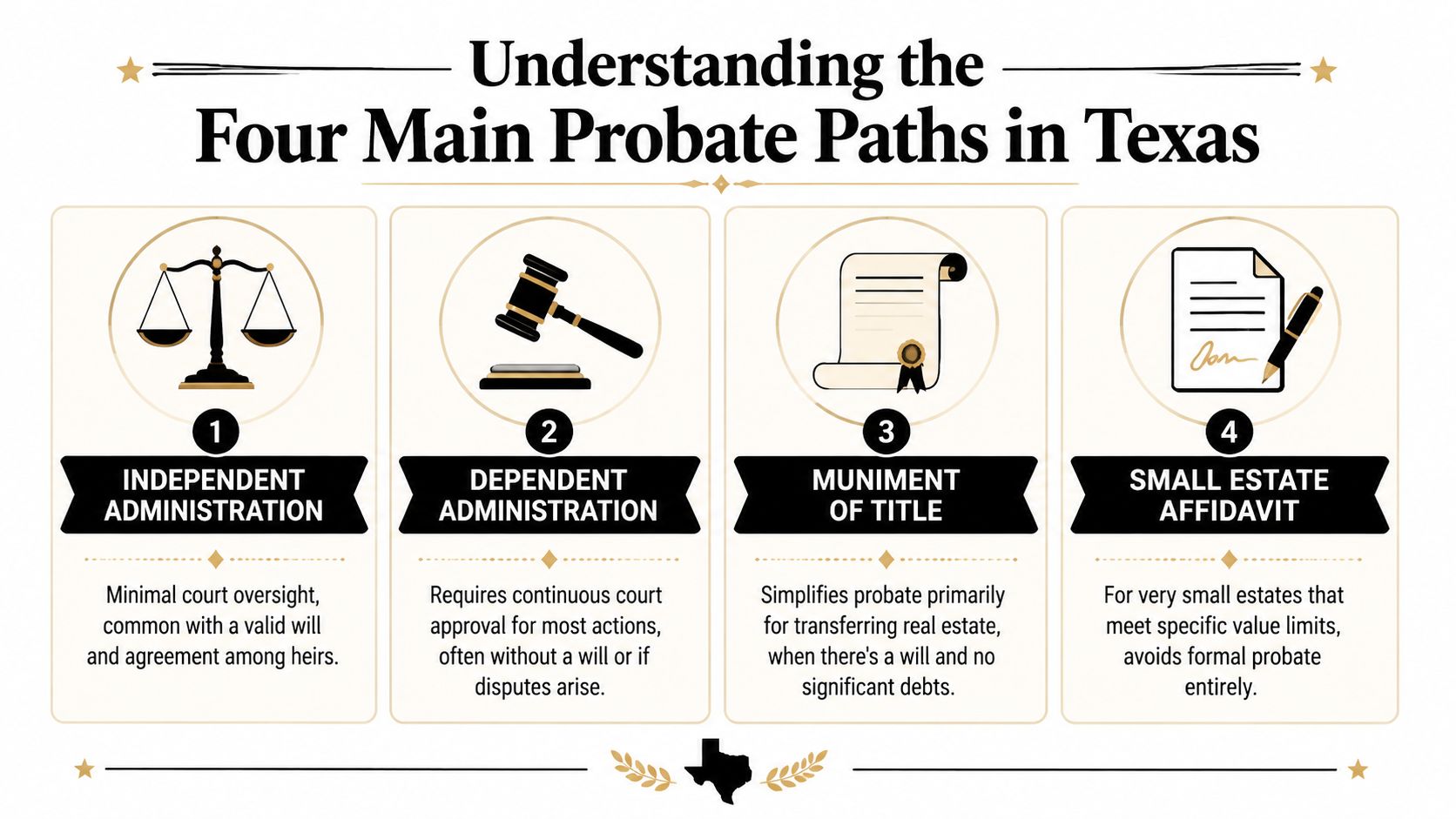
Understanding the Four Main Probate Paths in Texas
Texas probate works like a map with several roads. The biggest reason people get conflicting answers to “how long does probate take” is that they're talking about different roads without realizing it.
Independent Administration
This is the route most Texas families hope for. Under Texas Estates Code §301.001, independent administration is the most common and efficient formal probate path. It often finishes in 6 to 12 months when uncontested, while dependent administration can take 18 to 24 months or longer, as explained in this discussion of independent and dependent administration in Texas.
In plain language, independent administration means the executor can do most of the estate work without asking the judge for permission at every turn. The court appoints the executor, but it doesn't supervise each routine action. That's why Independent Administration in Texas is such a common fit for estates with a valid will and no serious dispute among heirs.
Dependent Administration
This is the more supervised route. The executor or administrator usually needs court approval for many actions. That can mean more filings, more hearings, and more waiting.
Dependent administration often appears when there is no will, there are disagreements, or the court believes closer supervision is necessary. It isn't “bad.” Sometimes it's the safest legal structure. But it usually moves more slowly because each major step may require court involvement.
Practical rule: The more often the estate has to go back to court for permission, the longer probate usually takes.
Muniment of Title
This is one of the most misunderstood probate tools in Texas. A muniment of title is not full administration. It's a simplified court procedure that allows a valid will to function as evidence of title, often for real estate, when there are no unpaid debts other than secured debt.
A family might use this when a parent left a will, owned a house, and didn't leave behind a mess of creditor issues. The court admits the will, and that order helps establish ownership without appointing someone to go through full administration.
Small Estate Affidavit
A small estate affidavit is another shortcut, but it applies only when the estate fits strict legal requirements. It can allow heirs to collect and transfer certain assets without opening full probate.
This path is not available just because an estate feels simple. The estate must meet statutory requirements, and the details matter.
Here's a quick comparison:
| Probate path | Court involvement | Typical use |
|---|---|---|
| Independent Administration | Low after appointment | Valid will or agreement among heirs |
| Dependent Administration | Ongoing supervision | Disputes, no will, or added complexity |
| Muniment of Title | Limited | Valid will and no significant unpaid debts |
| Small Estate Affidavit | Simplified filing | Very small qualifying estates |
If you're unsure which road applies, that's often the most important first question to answer before anyone tries to estimate the timeline.
For broader planning to reduce probate friction in the future, many families also revisit their Wills & Trusts after seeing firsthand what the court process involves.
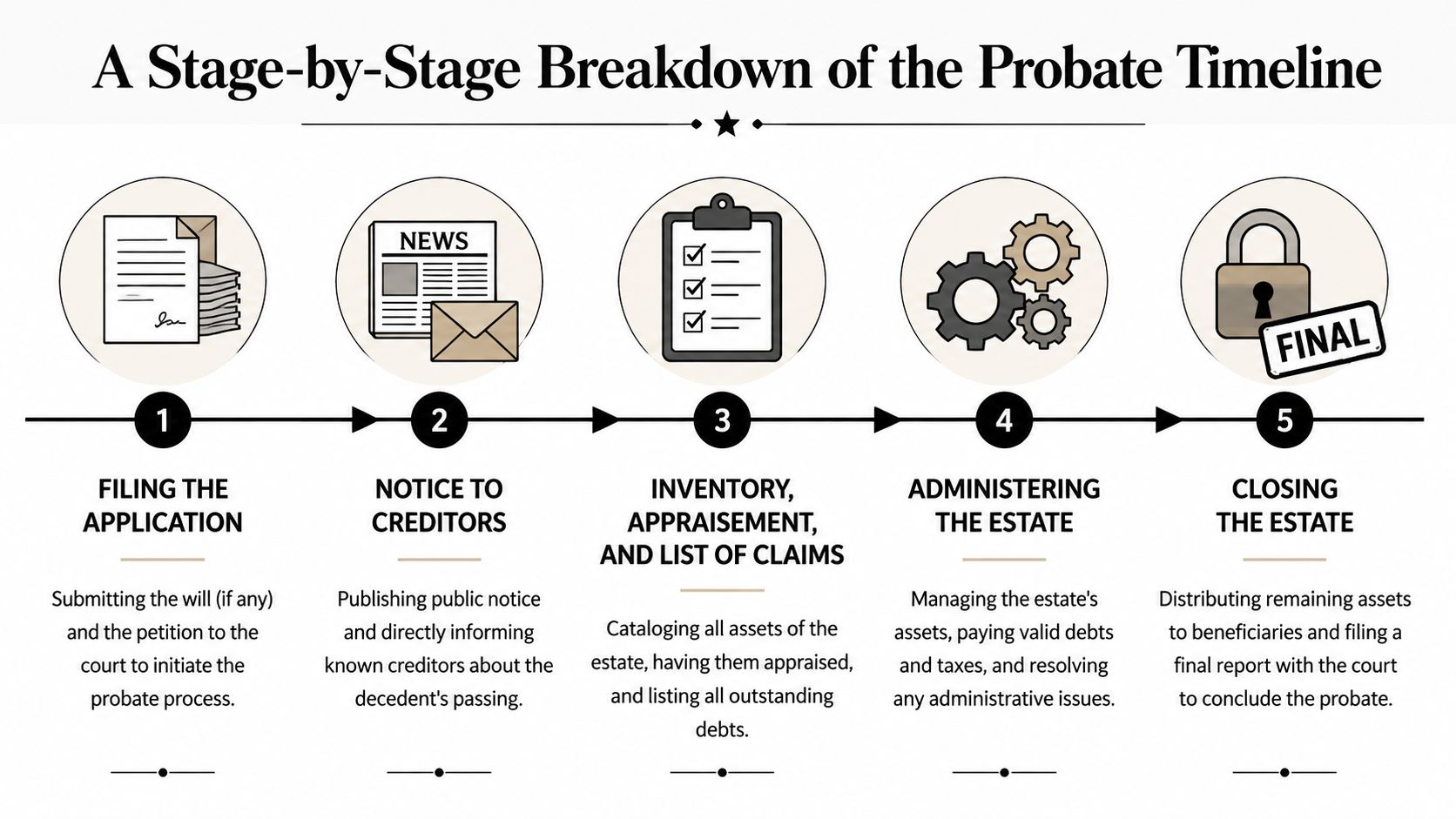
A Stage-by-Stage Breakdown of the Probate Timeline
A Texas probate case tends to feel slow in the middle. Families file the case, attend the hearing, get a stack of court papers, and then wonder why everything is not finished a few weeks later. In many estates, that pause is not a sign that something is wrong. It is part of how probate works.
That point matters even more in Texas because national articles often quote a broad 9 to 18 month probate timeline without explaining that Texas has several different procedures. An Independent Administration can move with far less court involvement than a supervised estate in another state. The calendar still matters, but the path matters just as much.
Early in the process, many executors also want to see the documents and timing explained visually. This overview can help:
Filing the application and opening the case
The first formal step is filing an application with the probate court. That filing asks the court to admit the will, if there is one, and appoint the person who will act for the estate.
At this point, the court is not handing out inheritances. The court is deciding who has legal authority to gather information, protect property, deal with creditors, and carry out the next steps. A complete filing and a clear will can keep this stage on track. Missing documents, questions about the will, or disagreement among family members can slow the case at the front door.
Texas courts often require a short hearing called a prove-up hearing. It is the hearing where the judge confirms the will and appoints the executor or administrator.
Letters Testamentary and legal authority
After the appointment, the clerk may issue Letters Testamentary. These documents work like official proof of authority. Banks, title companies, and other institutions want to see them before they will talk to the executor, release funds, or process transfers. This guide to the Letters Testamentary Texas process explains why that document matters so much in day-to-day administration.
Families often feel a burst of urgency here, and for good reason. The executor may know the decedent had a bank account, a vehicle, or a house, but knowledge is not enough. The letters are what let the executor act.
For readers comparing other states, timelines can differ sharply. For example, this overview of how long does probate take in Florida shows how another state's procedures create a different pace and set of expectations.
Notice to creditors and the waiting period
Texas law requires notice to creditors, and that requirement shapes the timeline in a very practical way. Under Texas Estates Code §308.001, creditors have a 4-month period to file claims after notice is published.
That rule catches many families off guard. They may think, "We know Dad did not owe much, so why can't we wrap this up now?" The answer is that probate has a built-in waiting period. The law gives creditors time to come forward, and the estate has to respect that window before closing.
A helpful way to view this stage is like waiting for a check to clear before handing over the balance. You may feel confident about the numbers, but the process still requires a pause.
Here is the basic sequence:
- Application filed. The probate case opens.
- Executor appointed. The judge authorizes someone to act for the estate.
- Letters issued. The executor can prove that authority to third parties.
- Creditor notice given. The claims window begins.
- Claims period runs. The estate waits, reviews claims, and keeps administration moving in the background.
Inventory, administration, and closing
Once the executor has authority, the work becomes practical and detail-heavy. The executor identifies what the decedent owned, what bills need attention, what paperwork is missing, and what property can be transferred. If the estate is in Independent Administration, much of this can happen without repeated trips back to court. That is one reason Texas probate can move faster than families expect after the initial hearing, even though the estate still has to follow the required timeline.
This stage can include:
- Asset collection: locating bank accounts, vehicles, real estate, and personal property
- Debt review: deciding which claims are valid and how they should be handled
- Property decisions: maintaining, transferring, or selling a house
- Beneficiary communication: keeping heirs informed so confusion does not turn into conflict
Some estates are straightforward. One home, one bank account, no dispute, and organized records often make administration much more predictable. Others take longer because the executor has to track down account information, resolve title issues, value unusual assets, or address family disagreement.
To make the process feel less abstract, some families find it useful to hear a basic walk-through before their first filing:
The case wraps up after debts, taxes, and required notices have been handled, and after the remaining property is ready for distribution. In an uncontested Texas Independent Administration, closing often involves far less court supervision than people expect from national probate guides. In a dependent or disputed case, the court may require more approvals, which stretches the timeline.
Common Factors That Speed Up or Delay the Process
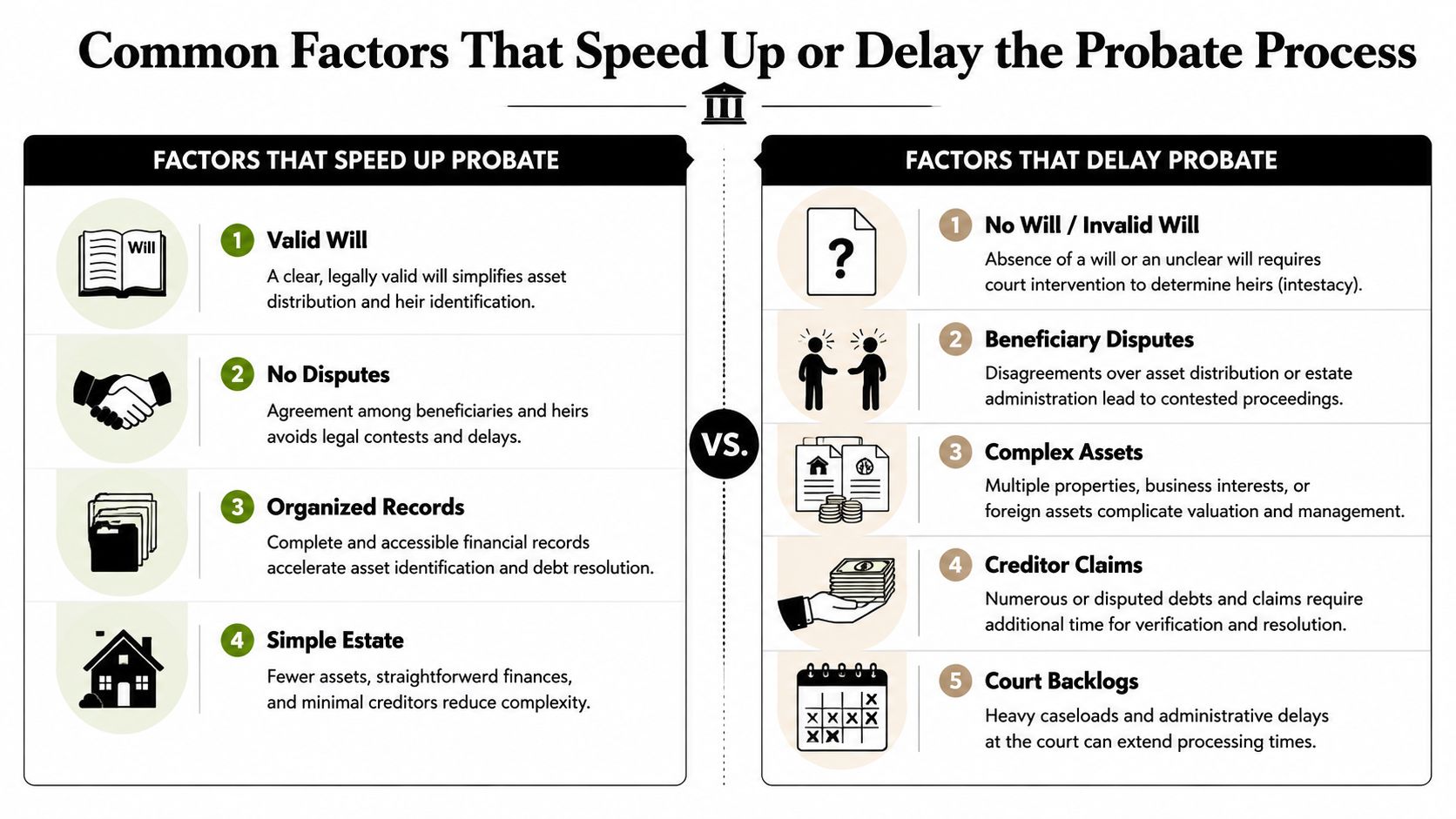
A good way to understand probate timing in Texas is to picture two families who file in the same month. Both have a house, a bank account, and a car. One estate is wrapped up with few surprises. The other keeps getting stuck. In Texas, that gap often comes from how the estate is set up, how prepared the family is, and whether the case can stay in the lower-court-supervision track that makes Independent Administration so different from the long timelines people read in national probate articles.
What tends to move probate faster
Probate moves more smoothly when the executor is solving fewer mysteries.
A clear, valid will helps because it names the person in charge and gives the court a roadmap. Family cooperation matters for the same reason. If everyone agrees on the basic facts and the general plan, the executor can spend time completing tasks instead of putting out fires.
A few practical details also make a real difference:
- Organized records: bank statements, deeds, insurance papers, vehicle titles, and contact information for financial institutions
- Simple assets: a home, standard bank accounts, and a vehicle are easier to handle than business interests, mineral rights, or property in multiple states
- Independent Administration: in Texas, this often shortens the process because the executor can act without asking the court for routine approval at every step
- Prompt responses: heirs, buyers, title companies, and financial institutions all affect the pace when documents need signatures or clarification
Homestead property can slow families down if no one is sure who has the right to live there, whether the property will be sold, or how title should be handled after death. For background on those questions, INTELLI's Texas homestead insights can help families understand the homestead issues that often overlap with probate.
What slows things down
The biggest delay often starts at the beginning. If there is no valid will, the court may need an heirship proceeding before anyone has clear authority to act. That adds hearings, notice requirements, and more opportunities for confusion about who inherits what under Texas law.
Paperwork problems also add time. A missing deed, an unopened mail pile, an unknown retirement account, or a vehicle title with old information can each create its own small stall. Probate works a lot like clearing a blocked drain. One clog may be manageable. Several clogs in a row can slow the whole system.
Family conflict changes the timeline even faster than paperwork does. One disagreement over a house sale, reimbursement claim, or personal property list can pull an estate away from routine administration and into motion practice, hearings, or formal discovery. Court calendars matter too, especially in busy counties where hearing dates are not available right away.
Here are common causes of delay:
- No valid will
- Disputes among heirs or beneficiaries
- Unclear title to real estate
- Hard-to-value assets
- Creditor claims that need review
- A dependent administration or contested case
- Slow communication from institutions or family members
If delays have already started, this guide on what happens when probate gets delayed in Texas explains what those slowdowns can mean in practice.
The main point is simple. Texas probate can move much faster than the generic 9 to 18 month estimate people see online, but only when the estate is clear, the family is cooperative, and the case stays on the more efficient Texas path.
A Realistic Probate Scenario The Rodriguez Family Story
The Rodriguez family gives a good example of what a smoother Texas probate can look like.
Mr. Rodriguez died in Harris County with a valid will. He named his oldest daughter, Elena, as executor and left his estate equally to his three children. His main assets were a home, a bank account, and a vehicle. There was no family business, no fight over the will, and no disagreement about who should handle things.

Elena filed the probate application, attended the hearing, and received authority to act. Because the will supported independent administration, she didn't have to return to court for routine decisions. That made a noticeable difference in how much control the family had over timing and logistics.
During the next several months, Elena gathered account information, notified the necessary parties, and handled the creditor notice requirements. She also worked with her siblings to decide what to do with the house. They agreed to sell it and divide the net proceeds later.
That home sale added time and paperwork, but not conflict. Elena kept everyone updated, responded promptly when documents were needed, and stayed focused on finishing each task in order.
By the end of about 8 months, the estate was ready for final distribution. That's a realistic example of a Texas probate that isn't instant, but also isn't the drawn-out ordeal many families fear.
A few lessons from the Rodriguez family stand out:
- The valid will mattered: It named the executor and reduced uncertainty.
- Independent administration mattered: Elena could act without constant court approval.
- Communication mattered: Her siblings never had to guess what was happening.
- Preparation mattered: Records were available, and the family made decisions without turning every issue into a dispute.
This kind of experience doesn't happen by luck alone. It usually happens when the legal path fits the estate and the executor understands the job. For practical duties such as notices, inventory, and distribution, many executors benefit from learning the basics of An Executor's Duties in a Texas Probate.
Your Key Takeaways for a Smoother Probate Journey
If you remember only a few things about Texas probate timing, remember these.
Texas probate may be faster than you fear
National averages can create unnecessary anxiety. Texas often offers a more efficient path, especially when an estate qualifies for independent administration and no one is fighting.
The legal path controls the clock
The right first question isn't only “how long does probate take.” It's “which probate path applies to this estate?” Independent administration, dependent administration, muniment of title, and small estate procedures do not move at the same pace.
Some waiting can't be avoided
Even a clean estate has legal timing rules. The creditor claim window is one example. Families often feel frustrated during these periods, but delay isn't always a sign that something is wrong.
A good will still helps after death
A valid, well-drafted will doesn't erase probate, but it usually makes probate more predictable. It can reduce confusion, shorten decision-making, and lower the chance of conflict.
Guidance often saves time
Executors are expected to do real legal and practical work. One option families consider is the Law Office of Bryan Fagan, PLLC, which handles probate filings, estate administration, and related planning matters for Texas families. Clear legal guidance often helps prevent avoidable setbacks.
Clarity is part of the timeline. Families who understand the process usually make better decisions and feel less overwhelmed.
Frequently Asked Questions About Texas Probate Timelines
Can a small estate avoid formal probate in Texas
Yes, in some cases. Under Texas Estates Code §205.001, a small estate affidavit may be available if the estate meets the legal requirements, including the value limit that applies after excluding the homestead and certain exempt property. In plain English, this option can shorten the process from a full court administration to a simpler paper-driven route. For families in Texas, that can make a real difference in how quickly they can deal with bank accounts, bills, and next steps.
What if there is no will
The timeline tends to stretch because the court has extra work to do. Someone must ask the court to determine the heirs under Texas law, and the court must appoint an administrator before that person has legal authority to act.
A family may agree on who should receive property, but agreement by itself does not replace the court process. The court still needs a clear legal record showing who inherits and who is authorized to gather assets, pay debts, and make distributions.
Does every Texas estate need full probate
No. Texas gives some estates shorter paths. A muniment of title can work in the right case when there is a valid will and no need for full administration. A small estate affidavit may help when the estate qualifies. Some property also passes outside probate altogether, such as assets with beneficiary designations or rights of survivorship.
That is one reason Texas probate timelines can look very different from the broad national estimates families find online. The path controls the clock.
What if an heir is hard to find or not cooperating
That can slow things down. Probate works a bit like clearing a title before a house sale. If one name is missing, disputed, or unreachable, the paperwork and notice requirements become more complicated.
The case does not always come to a halt, but the executor or administrator may need extra court steps, more formal notice, or added time to document efforts to locate the person and keep the process on solid legal ground.
What should an executor do first
Start with the basics. Find the original will, make a list of assets and debts, secure property, and get legal advice before distributing anything or retitling accounts.
That early stage sets the tone for the rest of the case. A rushed decision at the beginning can lead to notice problems, disputes over authority, or distributions that need to be corrected later.
If you're facing probate in Texas, our team can help guide you through every step, from filing to final distribution. Schedule your free consultation today.
If your family is dealing with a Texas estate, Law Office of Bryan Fagan, PLLC can help you understand the likely timeline, identify the right probate path, and work through each step with clarity and care. Contact the firm for a free consultation.