Skip to content
When a loved one dies, families often expect grief, paperwork, and difficult decisions. What they don't expect is to open a will and find language that seems to say, "If you challenge this document, you lose everything."
That moment can feel paralyzing. Maybe the will suddenly favors one child. Maybe a new caregiver appears in the document and close family members do not. Maybe the person who died had memory problems near the end, and now you're wondering whether this was really their choice. If you've searched for no contest clause texas will, you're probably trying to answer one urgent question. Can anyone still speak up if something seems wrong?
In Texas, that answer is often yes.
A no-contest clause is serious, but it isn't an impenetrable shield. Texas probate law tries to balance two important goals at once. It respects a person's right to decide who inherits their property, and it also leaves room for courts to examine wills that may have been shaped by fraud, undue influence, or lack of mental capacity. That matters for grieving families because fear alone shouldn't stop a valid concern from being heard.
Probate itself is the court process used to settle a person's estate after death. Under the Texas Estates Code, especially Titles 2 and 3, the court may admit a will to probate, appoint an executor, oversee payment of debts, and allow the remaining property to be distributed. In plain English, probate is the legal path for transferring what the deceased person owned.
If you're facing questions about a no-contest clause, it's normal to feel torn. You may want to honor your loved one's wishes while also protecting them from the possibility that someone manipulated them in their final days. Those feelings can exist at the same time.
When a Will's Terms Create More Questions Than Answers
Maria sat at her kitchen table with her brother and sister, reading their father's will for the third time. One paragraph left them stunned. It said any beneficiary who challenged the will would forfeit what they were supposed to receive.
Their first reaction wasn't anger. It was fear.
Their father had always promised that his children would be treated fairly. But the final will gave most of the estate to one sibling who had taken over finances near the end of his life. The others didn't know whether to stay silent, ask questions, or prepare for a legal fight they never wanted. Many Texas families find themselves in that exact place.
Why this clause feels so intimidating
A no-contest clause is written to discourage disputes. The person making the will, called the testator, may have wanted to reduce conflict after death. In some families, that intention is understandable. Probate disputes can strain already fragile relationships.
Still, the clause often creates more anxiety than clarity. People worry that even asking whether the will is valid could cost them an inheritance. They may feel pressured to accept a document that doesn't look right.
A threatening sentence in a will doesn't automatically end the conversation. In Texas, courts still examine whether a challenge is based on legitimate concerns.
That point matters because families often confuse two different ideas:
- Being disappointed with a will isn't the same as having a legal basis to challenge it.
- Being alarmed by suspicious circumstances may justify closer review.
If your concern involves a loved one's mental state, pressure from another person, or possible fraud, the law may give you room to act without automatically triggering the penalty the clause tries to impose.
What grief can hide
The first days after a death are not ideal for spotting legal red flags. Executors are filing papers. Relatives are calling. Funeral arrangements take over everything. Meanwhile, important probate deadlines begin running, and early choices can affect the rest of the case.
For that reason, it helps to slow down and ask simple questions:
- Was this will signed under unusual circumstances?
- Did the deceased recently become isolated from family?
- Was there a sudden change from an earlier estate plan?
- Did anyone control access to doctors, finances, or mail?
Those questions don't prove wrongdoing. They do help identify whether the issue is emotional disappointment or a genuine legal concern.
Texas law does enforce no-contest clauses, but not blindly. That distinction gives families a path forward when a will raises more questions than answers.
Understanding the In Terrorem Clause
Lawyers often call a no-contest clause an in terrorem clause. That's Latin for "in fear." The name fits. The clause is designed to make a beneficiary hesitate before filing a lawsuit.

In plain English, the clause says this: if a person named in the will contests it and loses, that person may also lose what the will left to them. It functions as a financial deterrent. A beneficiary who steps into a failed will contest may be sidelined from the inheritance altogether.
What it looks like in real life
A no-contest clause often appears in dense legal language, but the basic idea is straightforward. It usually targets someone who is already receiving something under the will.
"If any beneficiary under this Will directly or indirectly contests or attacks this Will or any of its provisions, any share or interest given to that beneficiary shall be forfeited and shall pass as if that beneficiary had predeceased me."
This is sample language for illustration, not a quote from a statute or court opinion. Actual wording can vary a great deal from one will to another. That's important because Texas courts read these clauses strictly and narrowly. The exact words matter.
Who the clause is trying to stop
Individuals who include this provision often aim to prevent a family fight. They may worry that one child will claim unfairness, or that a late-life marriage, remarriage, or blended family situation will lead to conflict. The clause sends a warning. Accept the will, or risk losing what you've been given.
That purpose sounds simple, but confusion starts quickly because families often assume the clause blocks any courtroom challenge. It doesn't work that broadly in Texas.
Here are the parts readers most often misunderstand:
- It isn't a general gag order. It doesn't erase the probate court's power to review a disputed will.
- It usually matters most to named beneficiaries. Someone who receives nothing under the will may not be risking a forfeiture of a gift they never got.
- It doesn't turn a suspicious will into a valid one. If the document was the product of undue influence, fraud, or lack of capacity, the clause doesn't magically cure those problems.
A simple way to read the clause
When you see a no-contest clause in a Texas will, ask three practical questions:
| Question | Why it matters |
|---|---|
| Who is named in the clause's reach | The language may apply only to beneficiaries under the will. |
| What conduct does it prohibit | Some clauses target direct contests. Others try to reach broader attacks. |
| What is the stated penalty | Usually, the consequence is forfeiture of the gift that beneficiary would otherwise receive. |
Practical rule: Don't assume the clause means "nobody can challenge this will." It usually means "a beneficiary should get legal advice before taking action."
That distinction can lower the temperature in a very emotional moment. The clause is a warning sign, not the final word.
The Good Faith and Just Cause Exception
Texas recognizes no-contest clauses, but Texas courts don't enforce them as a blanket threat against every will challenge. The law leaves room for legitimate claims.
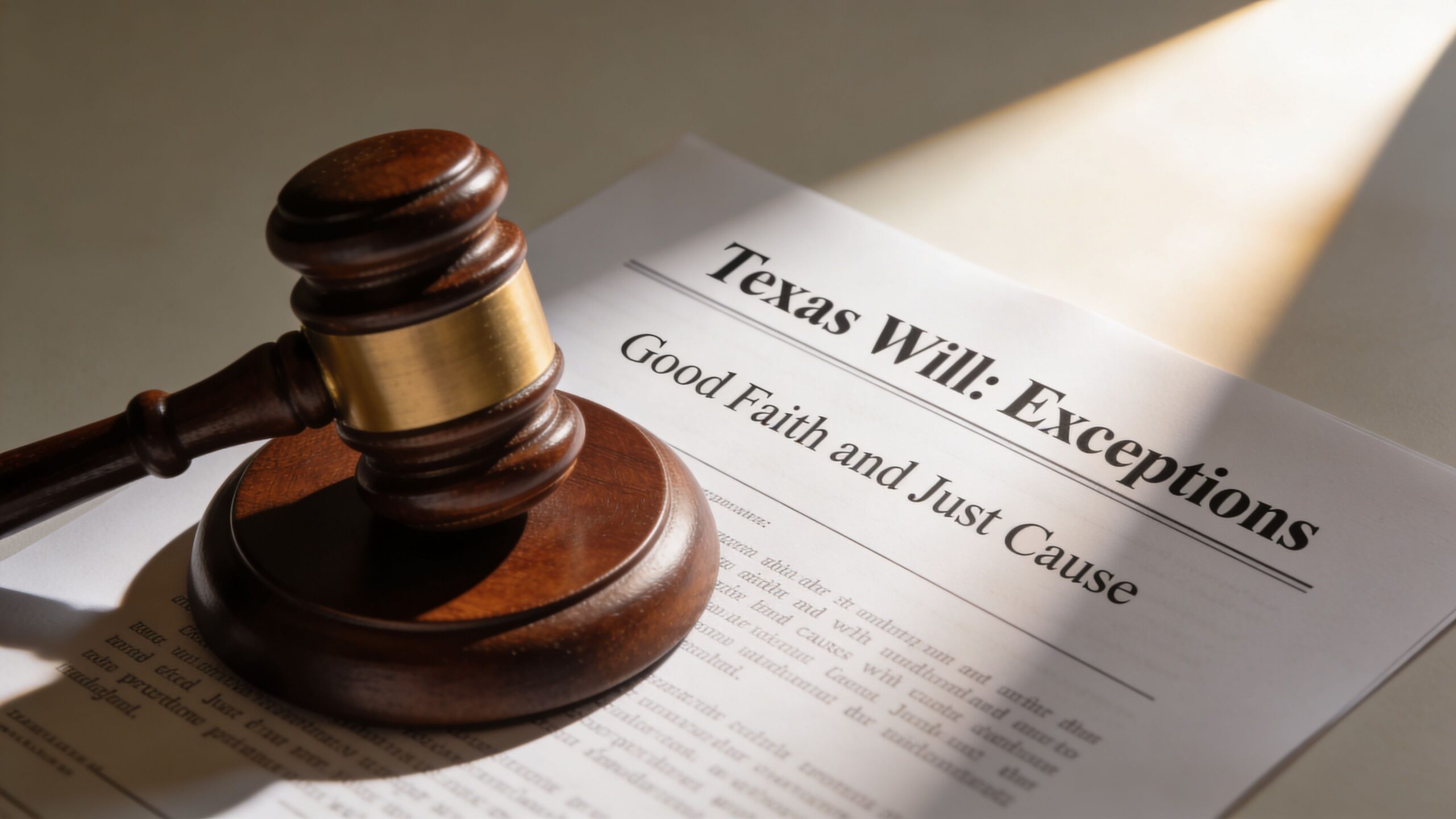
Under Texas probate law, a beneficiary may still challenge a will without forfeiting an inheritance if the challenge is brought with good faith and just cause. Texas probate litigation guidance explains that courts enforce these clauses with significant limitations, and experienced probate attorneys report never having turned down a will contest based solely on the presence of a no-contest clause. That discussion appears in this review of Texas no-contest clauses.
What good faith means in plain English
Good faith means you aren't filing a challenge just to punish someone, delay the estate, or pressure another heir into a settlement. You genuinely believe the will is invalid, and your concern is sincere.
Good faith is about your purpose and honesty. If you have a real concern and you're acting to protect the estate or the deceased person's true wishes, that is very different from filing a contest out of resentment.
A court may look at facts like these:
Your reason for filing
Are you responding to suspicious events, or unhappy with the distribution?Your behavior before the contest
Did you investigate facts responsibly, or make accusations without any basis?Whether your position is sincere
Courts can tell the difference between a serious concern and a family grudge dressed up as a lawsuit.
What just cause means
Just cause means you have a reasonable basis for the challenge. In everyday terms, there should be evidence pointing to a genuine legal problem.
Examples of possible legal grounds include:
Undue influence
Someone pressured the person making the will and overrode their free choice.Fraud
The person was deceived about what they were signing or why.Lack of testamentary capacity
The person didn't have the mental ability to understand the will when it was signed.
In these situations, specifics are important. A beneficiary saying, "I deserved more," usually won't be enough. A beneficiary saying, "My mother had advanced memory problems, a relative kept everyone away from her, and the will changed suddenly," is describing facts a court may take seriously.
A comparison that helps
Consider these two situations.
Situation one: A son receives a smaller share than his sister and files a contest because he feels the will is unfair. He has no records, no witnesses, and no evidence of pressure or incapacity.
Situation two: A daughter learns that in the final weeks of her father's life, one relative controlled appointments, blocked family contact, and arranged a new will while the father was experiencing serious cognitive decline. She has emails, witness observations, and medical information that support those concerns.
The first challenge looks like dissatisfaction. The second looks like a possible good-faith claim with just cause.
Here is a short video that helps explain how Texas probate disputes can develop in practice.
Why this exception matters so much
Families often assume that a no-contest clause ends the analysis. In Texas, it doesn't. Courts interpret these clauses cautiously because public policy also cares about preventing fraud and protecting vulnerable people.
A will contest supported by real evidence is not the same thing as a family argument about fairness.
That doesn't mean every challenge will succeed. It does mean the clause is not absolute. If you're a beneficiary with credible grounds, Texas law may protect your ability to bring the issue before the court.
What to Do When You Suspect a Problem with a Will
Once you suspect a will may not be valid, the hardest part is often deciding what to do first. Families worry about making a mistake. They don't want to inflame conflict, but they also don't want to miss an opportunity to protect a loved one's estate.
The safest approach is calm, organized, and deliberate.
Start with caution, not accusations
If you think a will was affected by undue influence, fraud, or lack of mental capacity, avoid public accusations right away. Early emotional confrontations can make evidence harder to gather and can deepen family conflict before you understand the legal posture.
Instead, write down what concerns you. Dates, names, conversations, changes in behavior, and unusual financial activity are all worth noting. Details that seem small now may later help a lawyer evaluate whether there is a real basis for a contest.
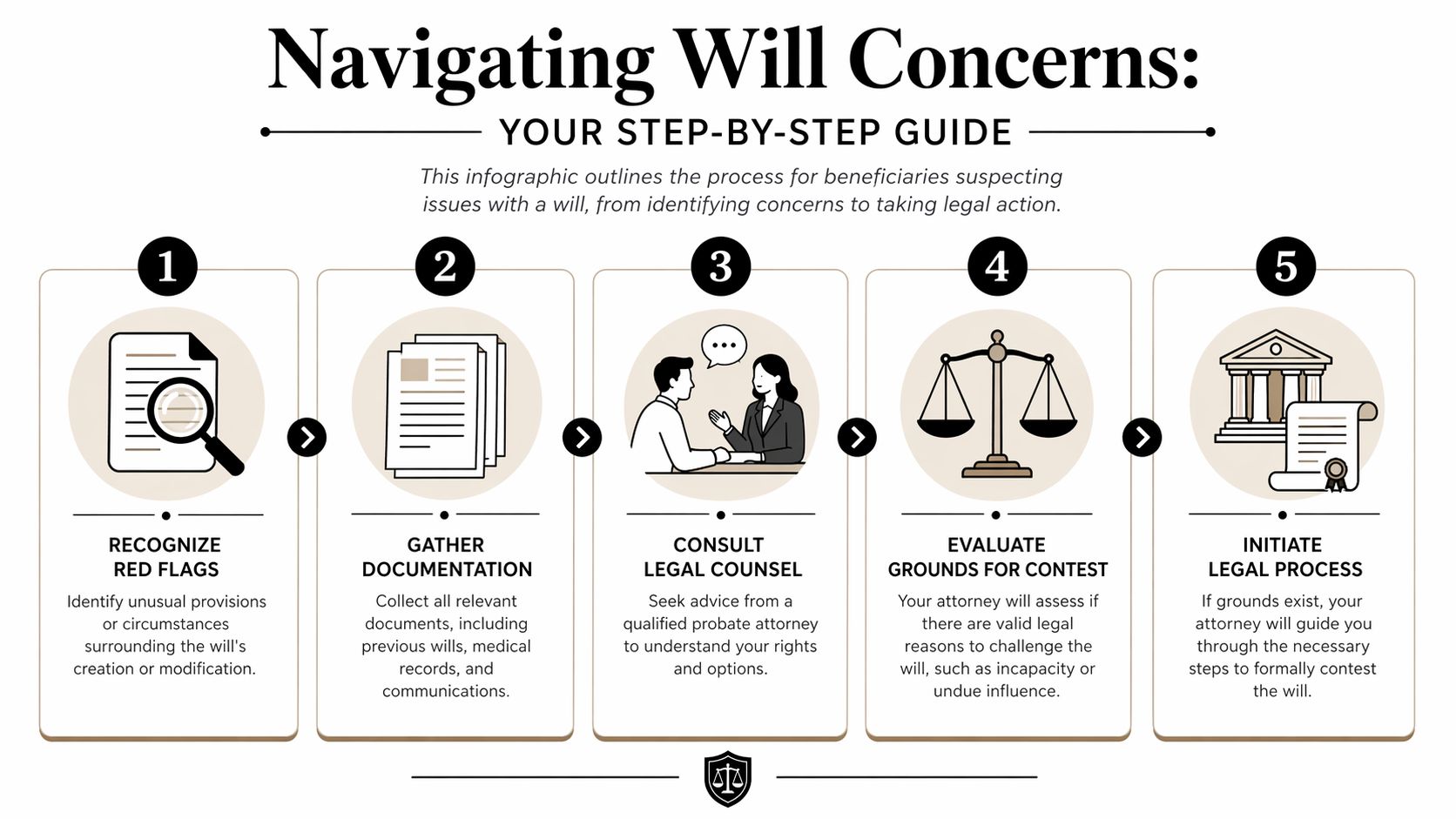
Five practical steps
Pause before accepting benefits
If you believe the will may be invalid, be careful about taking distributions or signing documents you don't fully understand. A lawyer can help you decide whether accepting property under the will may complicate your position.Collect the paper trail
Save copies of the will, prior wills if available, emails, text messages, bank records, and information about who arranged the signing. Medical records may also matter where mental capacity is in question.Identify witnesses early
Think about caregivers, neighbors, nurses, friends, or relatives who observed changes in the deceased person's health or relationships. Memories fade, and witness accounts are often easier to preserve sooner rather than later.Get a legal case review before filing anything
A probate litigation attorney can tell you whether your concern sounds like disappointment, suspicion, or an actionable claim. This is often the moment when families feel the most relief, because they finally move from fear to a concrete plan.Watch the deadline closely
In Texas, a will contest generally must be filed within two years from the date the will is admitted to probate, as explained in this discussion of how long you have to contest a will in Texas. That deadline can shape every strategic decision.
Why timing matters
Many people assume they can wait until the estate administration is almost over. That's risky. Probate cases move forward while families are still processing grief, and delay can weaken both evidence and options.
Texas probate procedure under the Estates Code includes formal steps after a will is admitted. The executor may seek Letters Testamentary, gather estate assets, notify creditors, and begin administration. If you are considering a challenge, you want to understand where the estate is in that process and how the timeline affects your rights.
The clock doesn't stop because a family is still grieving. If something feels wrong, investigate promptly.
What evidence usually matters most
No two probate disputes look exactly alike, but certain types of proof come up again and again:
- Medical information that speaks to memory, confusion, diagnosis, or decision-making ability
- Witness testimony from people who observed isolation, pressure, or sudden changes
- Document history showing unusual revisions, missing pages, or abrupt departures from earlier plans
- Financial records suggesting control, dependency, or exploitation
- Communications such as texts or emails that show manipulation or secrecy
If you want a clearer picture of what lawyers often look for, this guide on evidence needed to contest a will is a helpful starting point.
What families can expect during the process
A will contest doesn't always mean a dramatic courtroom trial. Sometimes the first stages involve review of probate filings, obtaining records, interviewing witnesses, and evaluating whether the challenge fits within the good-faith and just-cause framework discussed earlier.
You may also hear common probate terms like executor, estate administration, and interested person. In plain English, the executor is the person named to carry out the will, administration is the process of managing the estate, and an interested person is someone whose legal rights may be affected by what happens in the probate case.
The most important first move is not filing in anger. It's building a careful factual foundation before the deadline closes.
Who Is Not Bound by a No-Contest Clause?
One of the biggest misunderstandings in Texas probate is the belief that a no-contest clause binds everyone connected to the estate. It doesn't.
A no-contest clause usually threatens a beneficiary under the will with loss of that beneficiary's gift. That leaves a major category of people outside its direct reach. In many cases, a person who has a legal interest in the estate but is not receiving under the will may still challenge the document.

The overlooked group of interested persons
Texas law allows an interested person to participate in probate disputes. That can include people who were omitted, disinherited, or otherwise affected by the estate but are not taking under the challenged will.
A common example is a pretermitted child, which is a child omitted from a will in circumstances addressed by Texas Estates Code §255.051. Creditors may also have interests that are not controlled by the clause in the same way a named beneficiary's gift would be.
This overlooked point has real litigation consequences. Texas probate commentary notes that non-beneficiaries initiate about 40% of Texas will contests, and there has been a 25% increase in out-of-state contest filings via virtual hearings. That discussion appears in this analysis of the myth that you cannot contest a will with a no-contest clause in Texas.
People who may fall outside the clause
The exact answer depends on the will's language and the facts, but these categories often deserve close attention:
Omitted heirs
A child or family member left out of the will may not be risking the loss of a gift under that will because no gift was made to begin with.Creditors
A creditor's claim is generally about money owed by the estate, not about preserving a bequest under the will.Remote or out-of-state interested parties
A person living outside Texas may still have standing to raise issues in a Texas probate case if their rights are affected.
A no-contest clause may deter the people named in the will while leaving room for someone outside that gift structure to challenge the document anyway.
Why this can backfire
Testators often include these clauses to prevent litigation, but the result can be more complicated. A named beneficiary may stay quiet out of fear, while a disinherited heir or creditor pushes forward because the clause doesn't threaten that person's inheritance in the same way.
That means a clause can fail to accomplish what the family assumes it does. It may chill one person's response without stopping another person's lawsuit.
For executors, this distinction is especially important. If you are administering an estate under Title 3 of the Texas Estates Code, you need to understand who has rights in the probate proceeding and who may still challenge the will despite the presence of intimidating language.
A Scenario of Undue Influence in a Texas Estate
Eleanor Smith had always told her three children that her estate would be divided equally. She had an older will that reflected that plan. In her final months, however, her health declined sharply, and she depended heavily on a new caregiver who had become involved in nearly every part of her daily routine.
After Eleanor died, the family learned that a new will had been signed not long before her death. It left nearly the entire estate to the caregiver and contained a strong no-contest clause. Her children were shocked, but their concern wasn't just about money. They had watched their mother become forgetful, isolated, and increasingly dependent.
What raised suspicion
The children compared the new document to the earlier will. The change was dramatic. Eleanor's long-standing estate plan had been replaced by one that cut out her children almost entirely.
They also began to piece together what had happened in the months before her death:
- The caregiver often answered Eleanor's phone and limited family contact.
- Bank activity suggested unusual withdrawals.
- A long-time nurse noticed Eleanor seemed confused about important decisions.
- The will had been signed during a period when Eleanor was struggling with dementia-related symptoms.
None of that automatically proved undue influence. But together, it created a factual picture worth investigating.
How the family proceeded
Instead of confronting the caregiver immediately, the children started gathering records. They obtained medical information, spoke with the nurse, collected financial documents, and located the prior will. They also sought legal advice before taking any formal action.
Their attorney focused on a central question. Did the children have enough evidence to show they were acting with honest grounds rather than simple disappointment?
For many families, this distinction determines whether a case either firms up or falls apart. A will contest based on emotion alone is weak. A will contest built on witness testimony, medical context, and suspicious circumstances is very different.
If you're dealing with a similar concern, understanding how to prove undue influence can help you see what courts typically look for.
Evidence of isolation, dependency, sudden changes, and cognitive decline often matters more than one dramatic accusation.
How the court may view a case like this
In a case like Eleanor's, the probate court would not limit its consideration to the no-contest clause. The court would examine whether the challenge had a real factual basis. The children could argue that they filed in good faith because they sincerely believed the new will did not reflect Eleanor's independent wishes. They could also argue just cause because they had supporting proof.
The caregiver, on the other hand, might argue that Eleanor was entitled to change her mind and reward the person who cared for her. That is also a serious point. Texas law protects a competent person's right to leave property however they choose.
The dispute would turn on evidence, not assumptions.
If the court concluded that Eleanor lacked testamentary capacity or that the caregiver exerted undue influence, the new will could be set aside. In that event, the prior valid will might control, or the estate might pass under Texas intestacy rules if no earlier valid will applied.
For the children, the no-contest clause would not be the end of the story. The primary question would be whether they could support their concerns with credible facts.
Key Insights for Texas Families and Executors
When families search for no contest clause texas will, they usually need a short, practical answer. Here it is.
Takeaway
A no-contest clause is serious, but it isn't absolute
Texas courts can still hear a legitimate challenge to a will.Evidence matters more than fear
If your concern involves capacity, fraud, or undue influence, the strength of your facts will shape the case.Not everyone is bound in the same way
Omitted heirs, creditors, and other interested persons may have rights that differ from named beneficiaries.Probate has a structure under Texas law
Titles 2 and 3 of the Texas Estates Code govern core issues such as probate procedure, estate administration, and rights of interested parties.Early legal guidance is often the safest first move
Getting advice is not the same as filing a contest. It helps you understand risk before you act.
If you're trying to understand the broader probate picture, these service resources may help:
| Texas Probate Process | Guardianship | Wills & Trusts | Probate Litigation |
|---|---|---|---|
| Texas Probate Process | Guardianship | Wills & Trusts | Probate Litigation |
Families who are reviewing the larger estate planning picture may also benefit from learning how professionals approach Trust And Estate Planning, especially when the goal is to reduce conflict before it starts.
Common Questions on No-Contest Clauses
Does asking the executor for information trigger the clause
Usually, asking for basic estate information is not the same as contesting the will. Beneficiaries often have legitimate questions about assets, debts, and administration. An executor has fiduciary duties, which means legal duties to act responsibly for the estate and its beneficiaries.
I'm the executor. Can my actions be treated as a contest
Serving as executor is different from attacking the will for personal gain. Executors often have to file papers, gather assets, handle creditor matters, and communicate with heirs. But if an executor personally challenges the will's validity, the analysis can become more complicated. Capacity and motive matter, so individualized advice is important.
What if the no-contest clause is in a trust instead of a will
Trust disputes can raise similar concerns, although trusts are governed under a different body of Texas law than wills. The key issue is still whether someone is making a good-faith challenge supported by legitimate grounds, rather than using litigation for strategic advantage.
Does talking to a lawyer count as a contest
No. Seeking legal advice is usually the safest first step. A consultation helps you understand your options before you file anything or waive any rights.
How do I check the filing deadline
The deadline can be critical in any probate dispute. If you need a practical overview, this guide on the Texas will contest deadline is a useful place to begin.
If you’re facing probate in Texas, our team can help guide you through every step, from filing to final distribution. Law Office of Bryan Fagan, PLLC offers compassionate, practical guidance for families, executors, and heirs dealing with wills, probate administration, and contested estate matters. Schedule your free consultation today.