Skip to content
When you're grieving the loss of a loved one, the last thing you want to deal with is a mountain of confusing legal terms. One phrase you might hear in Texas is muniment of title, and while it sounds complicated, it's actually a legal shortcut designed to make life simpler. Think of it less like a full-blown court proceeding and more like an express lane for validating a will and transferring property.
This guide will explain in plain English what a muniment of title is, who can use it, and how it can bring Texas families peace of mind during a difficult time.
Understanding This Simplified Probate Path
So, what exactly is this process? Let's break it down in simple terms.

At its heart, a muniment of title is a special kind of probate proceeding unique to Texas. Its main job is to legally recognize a valid will and officially transfer ownership of property—especially real estate like the family home—to the heirs named in it.
This process cuts out many of the steps you'd find in a traditional probate administration. For instance, the court doesn't appoint an executor to manage the estate, pay bills, or gather assets. Instead, the court’s order itself becomes the legal key that moves property from the deceased person to their beneficiaries.
How It Works in Plain English
Imagine a will is like a set of instructions for who gets what. A muniment of title is the court’s official stamp of approval on those instructions. It’s the court saying, "Yes, this will is legitimate, and the people named here are now the legal owners of this property."
The most important thing to understand is that the court order probating the will as a muniment of title effectively acts as a new deed. Once that order is filed in the county’s property records, it becomes the official proof of ownership for the heirs.
This legal tool is a lifesaver for estates where the main asset is a house and there are no outstanding debts, other than maybe a mortgage. It gives families a much more direct route to securing their inheritance without unnecessary hassle.
Key Benefits for Texas Families
For estates that qualify, the muniment of title process offers some huge advantages that bring peace of mind during an already difficult time. The biggest benefits include:
- Speed and Efficiency: It's typically much faster than a full probate. We're often talking about a matter of weeks, not the months or even years a traditional administration can take.
- Reduced Costs: By cutting out the need for an executor and many of the formal steps, it can be significantly more affordable for the family.
- Simplicity: The process involves far less court supervision and fewer administrative headaches, making it less overwhelming for grieving families to navigate.
- Clear Title: It creates a clean, legally recognized transfer of property. This is absolutely critical if you plan to sell or refinance the home down the road.
This unique Texas procedure, laid out in Texas Estates Code, Title 2, Chapter 257, was specifically designed to help families sidestep needless legal red tape. By understanding what a muniment of title is, you can figure out if this simpler path is the right one for settling your loved one's estate.
Does Your Loved One's Estate Qualify for This Process?
Not every estate can take this simplified probate path. While it's a faster and more affordable route for many Texas families, the law lays out specific, non-negotiable requirements. Getting a handle on these qualifications is the first step to figuring out if probating a will as a muniment of title is the right move.
Think of it as an express lane at the courthouse, designed for straightforward situations where the deceased person's wishes are crystal clear and their financial loose ends are already tied up. These rules act as guardrails, making sure this shortcut is only used when it’s appropriate and won't cause legal headaches for the family down the road.
The Two Essential Requirements
According to the Texas Estates Code, Chapter 257, an estate has to clear two main hurdles to qualify for a muniment of title. These are the absolute pillars of the process—if either one is missing, you’ll have to look at other probate options.
- There Must Be a Valid Will: The whole process hinges on having a valid, written will. The court's job here isn't to figure out who the heirs are; it’s simply to rubber-stamp the instructions already laid out in a legally sound will.
- The Estate Must Have No Unsecured Debts: This is a big one. The estate can't owe money to credit card companies, hospitals for medical bills, or anyone for personal loans. The only debt the law usually allows is a mortgage or another loan that is "secured" by real estate, like a home equity loan.
If your loved one passed away without a will (this is called dying "intestate"), a muniment of title is off the table. Likewise, if there are outstanding credit card bills or medical debts that need to be paid from the estate's assets, the court will require a more formal administration to make sure creditors are properly notified and paid.
Understanding Secured vs. Unsecured Debts
It’s critical to know the difference between these two types of debt. It's a concept that trips a lot of people up, but a simple analogy makes it clear.
A secured debt is a loan that's attached, or "secured," to a specific piece of property. The classic example is a mortgage on a house. If the payments stop, the lender can foreclose on the house itself. Because the debt is tied directly to an asset, it doesn't stand in the way of a muniment of title.
An unsecured debt, on the other hand, isn't tied to any particular asset. This is where things like credit card balances, medical bills, and personal loans come in. The lenders for these debts can’t just seize a specific item if you don't pay; they would have to sue the estate to get their money.
This streamlined probate method has become a cornerstone for Texas families looking to preserve real estate legacies. State data shows it resolves 22% of all real property transfers in estates under $1 million, helping families sidestep the full probate gauntlet. Enacted through Texas Probate Code reforms, this process requires no bond or inventory, slashing costs by 60-80%—dropping from an average of $15,000 in independent administration to under $3,000. You can discover more insights about these legal terms on Nolo.com.
If the estate is very small and is made up of only personal property, a different route might be better. You might be interested in learning if a Small Estate Affidavit in Texas is a better fit for your family's situation.
Navigating the Muniment of Title Process Step by Step
Knowing that a muniment of title might be the right path is a great start. Now, let’s pull back the curtain on what the process actually looks like. While no two cases are identical, the journey follows a pretty clear and predictable sequence of events.
Think of this as your roadmap. It’s designed to turn a potentially confusing legal procedure into a series of manageable actions, guiding your family toward officially securing your loved one's property.
Step 1: Gather Your Essential Documents
Before a single form is filed with the court, you need to assemble some key pieces of paperwork. This first step is the foundation for everything that follows, ensuring the court has what it needs to validate the will and confirm the estate’s eligibility.
Here's what you'll need to track down:
- The Original Will: This is the non-negotiable centerpiece. The court needs the actual, signed original document. Photocopies are a no-go unless you're prepared for a separate, more complicated legal fight to prove their validity.
- A Certified Death Certificate: This official record confirms the date and place of death and is a requirement for almost all estate-related matters.
- Information About the Heirs: You’ll need the full legal names and current addresses for every beneficiary named in the will.
- A List of Assets: While you don't need a formal, itemized inventory like in a full probate, you do need a clear list of the assets being transferred. For any real estate, this means having the proper legal description of the property.
As you collect details on the assets, modern tools can simplify things. For instance, something like an AI Photo Estate Inventory can help document personal property efficiently.
Step 2: File the Application with the Court
With your documents in hand, the next move is to file a formal application with the probate court. The official name for this is an Application to Probate Will as a Muniment of Title.
This legal document gets filed in the county where the person passed away. It formally asks the court to review and legally recognize the will. The application will also state that there are no unpaid debts (other than a mortgage on a house, for example) and that a full, formal administration of the estate isn’t necessary. This is the step that officially kicks off the legal process.
To get a better feel for the paperwork involved, you can check out our guide on how to file a petition for probate in Texas and key documents.
Step 3: Attend the Court Hearing
After the application is filed, there's a required waiting period, usually about two weeks. Once that passes, the court will schedule a hearing. Don't picture a dramatic courtroom trial; this is typically a short, simple, and straightforward proceeding.
During the hearing, the judge just needs to confirm a few key facts by asking a series of routine questions:
- Is the person who made the will actually deceased?
- Is the document being presented their final will and testament?
- Does the estate have any unsecured debts?
- Is this the correct court to be hearing the case?
One person—usually whoever filed the application—will swear an oath and provide the testimony to verify these points. Once the judge is satisfied, they'll sign an order admitting the will to probate as a muniment of title.
This decision tree breaks down the core questions at the heart of the process.
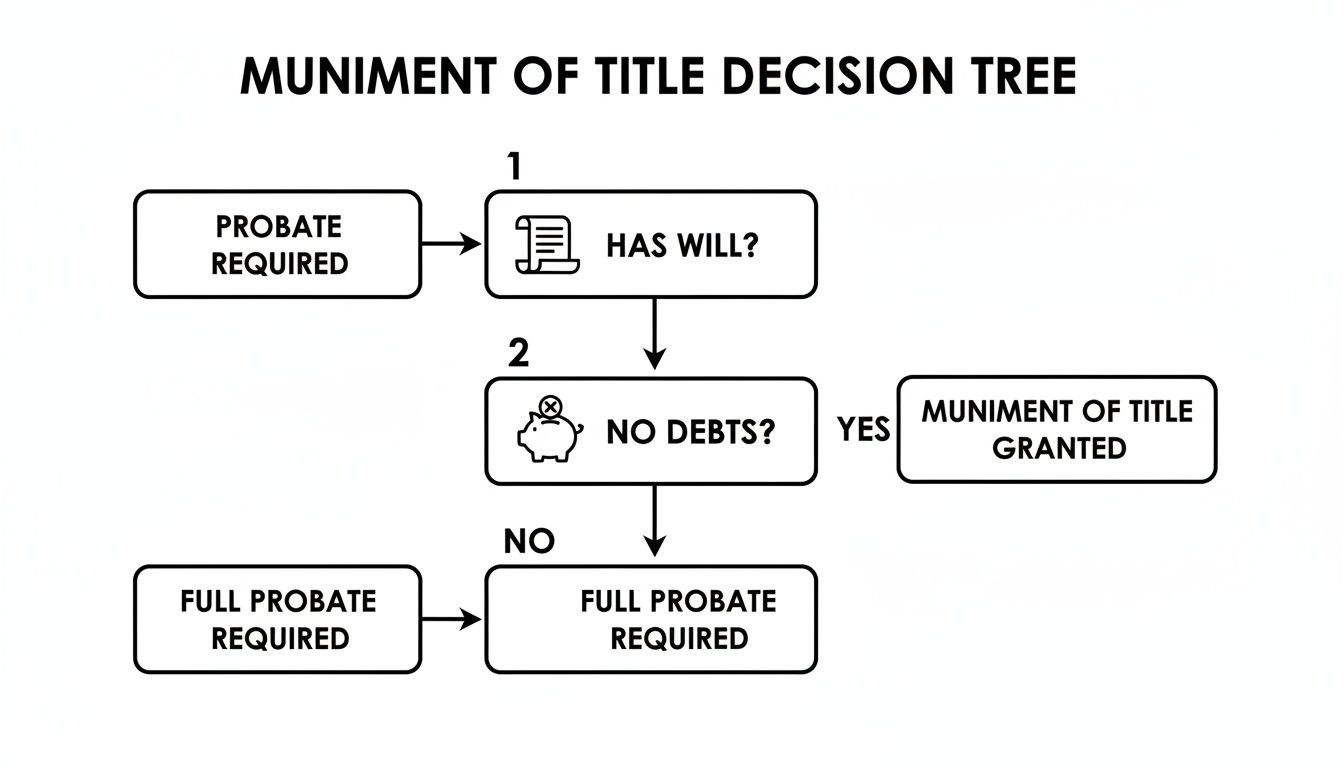
As the visual shows, if you have a valid will and no unsecured debts, the path to a muniment of title is wide open.
Step 4: Obtain and Record the Court Order
That signed court order is the prize. It’s the legal document that acts as a bridge, officially transferring ownership of the property from the deceased person to the beneficiaries named in the will.
But you're not quite done. The final, critical step is to take a certified copy of both the will and the court’s order and file them in the county clerk’s office for every county where the deceased owned real estate. This recording makes the transfer of ownership a matter of public record, which is absolutely essential if you ever want to sell or refinance the property down the road. Once it's recorded, the transfer is complete and legally binding.
Comparing Muniment of Title to Other Texas Probate Options
Choosing the right legal path after a loved one passes away can feel like a heavy burden. Texas law offers several different ways to settle an estate, and knowing the difference can save your family a huge amount of time, money, and stress. The muniment of title process is a fantastic option in the right circumstances, but it’s crucial to see how it stacks up against other probate routes to know if it’s the best fit for your situation.
Each method was designed for a specific set of circumstances, from large estates with complex debts to small, straightforward ones with no will at all. Making an informed choice now is the best way to prevent legal headaches and family disagreements down the road.
Muniment of Title vs. Independent Administration
Independent Administration is the workhorse of Texas probate. It's the most common route when there’s a valid will that either names an "independent executor" or all the beneficiaries agree to appoint one. This person is given the authority to manage the estate—pay debts, sell assets, and distribute property—with very little court supervision.
While it's more flexible than other types of probate, independent administration is still a much more involved process than a muniment of title.
- The Big Difference: The main distinction is the appointment of an executor. A muniment of title skips this step entirely because its only job is to transfer title. Independent administration, on the other hand, is built around the executor's duties, making it necessary for estates that have debts to settle.
- The Timeline: Independent administration usually takes several months, sometimes longer, because the executor has to give notice to creditors and actively manage the estate's finances. A muniment of title can often be wrapped up in a matter of weeks.
- Best For: Independent administration is the go-to for estates with a valid will that also have debts to pay or complex assets that need to be managed before being passed on to the heirs.
Muniment of Title vs. Dependent Administration
At the other end of the spectrum is Dependent Administration. This is the most formal, restrictive, and expensive type of probate. In this scenario, a court-appointed administrator has to get a judge’s permission for nearly every single action, from paying a simple utility bill to selling a piece of property. It's costly, drags on forever, and is typically a last resort for estates riddled with conflict among beneficiaries or serious creditor problems.
Think of dependent administration as the probate court keeping the estate on a very short leash. It's the complete opposite of the streamlined, hands-off approach of a muniment of title and is generally only used when things have gone wrong.
Compared to a muniment of title, dependent administration is worlds apart in complexity. It costs significantly more due to higher attorney fees and court costs and can easily drag on for a year or more. It’s the path taken when there’s no will, or the will doesn’t allow for an independent administration and the beneficiaries just can’t agree.
Muniment of Title vs. Small Estate Affidavit
For very small estates, Texas offers another simplified tool: the Small Estate Affidavit (SEA). You can use this option when the person passed away without a will and the value of their estate (not counting their primary home) is $75,000 or less.
Like a muniment of title, an SEA is designed to avoid a full-blown administration. But its use is far more limited.
- Will vs. No Will: This is a hard line. A muniment of title absolutely requires a valid will. A Small Estate Affidavit can only be used when there is no will.
- Type of Assets: An SEA is most often used to transfer simple assets like bank accounts or a car title. While it can be used to transfer a homestead, it doesn't provide the same clear, marketable title for real estate that a muniment of title does, which can cause problems later.
- Debt-Free Requirement: Both procedures require the estate to be free of unsecured debts.
In many situations, even if an estate qualifies for an SEA, a family might choose another route just to ensure a clean transfer of real estate. For instance, sometimes non-probate tools are a better fit, like those we cover in our guide on the Texas Transfer on Death Deed.
Comparing Texas Probate Methods
To make it easier, we’ve put together a table that gives you a clear, at-a-glance comparison of these options.
| Feature | Muniment of Title | Independent Administration | Small Estate Affidavit |
|---|---|---|---|
| Will Required? | Yes, always. | Yes, typically. | No, never. |
| Executor Appointed? | No | Yes | No |
| Court Supervision | Minimal (one hearing) | Minimal | None (filed with clerk) |
| Handles Debts? | No (except secured) | Yes | No |
| Best Use Case | Transferring property in a debt-free estate with a will. | Managing and distributing assets in an estate with a will and some debts. | Transferring small assets (under $75k) in an estate with no will and no debts. |
| Typical Timeline | 4-8 weeks | 6-12 months | 2-4 weeks |
As you can see, the right path really depends on three key factors: whether there’s a will, whether there are debts, and the total value of the assets. Getting this choice right from the start is the key to a smooth and efficient process.
A Real-World Example of the Muniment of Title Process
Legal concepts can feel abstract and distant until you see them in action. Let’s walk through a realistic scenario to show just how the muniment of title process works, and how it can bring a family peace of mind during an incredibly emotional time.

Meet the Garcia family—three adult siblings who just lost their beloved mother. In the days after she passed, they found her will. It was clear and simple: the family home where they all grew up was to be left to them in equal shares.
The Garcias were already overwhelmed with grief, and the sudden weight of settling her affairs felt immense. Their number one concern was the house. It was the heart of their family, and they needed to secure ownership without getting tangled up in a long, drawn-out court battle. They knew their mother had a mortgage, but thankfully, she had no other significant debts to worry about—no outstanding credit card bills or medical expenses.
Identifying the Best Path Forward
Unsure where to even start, the Garcias booked a consultation with a probate attorney. They came prepared, bringing their mother's original will and her death certificate. Their goal was simple: get the house title transferred into their names as quickly and affordably as possible.
The attorney reviewed everything and asked a few key questions about their mother’s finances. In just a few minutes, he confirmed two critical facts:
- There was a valid will. Their mother’s will had been properly signed and witnessed.
- The estate was essentially debt-free. The only debt was the mortgage, which is a secured debt tied directly to the house itself.
Because these two conditions were met, the attorney immediately knew the muniment of title was the perfect fit. He explained they could completely bypass a full probate administration. That meant no need to appoint an executor, saving them months of time and thousands in legal fees.
The Steps the Garcia Family Took
The sense of relief among the Garcia siblings was palpable. What had looked like a daunting legal mountain was now a clear, manageable path. With their attorney guiding them, they took the following steps:
- Filed the Application: Their lawyer quickly drafted and filed an "Application to Probate Will as a Muniment of Title" with the local Texas probate court.
- Attended a Brief Hearing: A few weeks later, one of the siblings went to a short, informal hearing. The judge asked a few basic questions to confirm their mother had passed away, that the will was valid, and that there were no unsecured debts. The entire hearing was over in less than fifteen minutes.
- Received the Court Order: The judge signed an order admitting the will to probate as a muniment of title. This order was the magic document—it legally functioned as a deed, officially transferring the house to the Garcia siblings.
- Recorded the Order: As a final step, their attorney took a certified copy of both the will and the court order and filed it in the county's public property records. This made the transfer official for everyone to see.
For the Garcia family, the court's order became their proof of ownership. The entire process, from filing the application to recording the order, took just over a month. They completely avoided the stress and expense of a traditional probate, allowing them to focus on supporting each other and honoring their mother's memory. This story shows the profound emotional and financial benefits of choosing the right legal strategy during a difficult time.
Key Insight for Texas Families
Losing a loved one is hard enough without the added stress of navigating the probate system. The good news is that Texas offers a unique solution called a muniment of title that can provide comfort and control when you need it most. For the right kind of estate, it’s a game-changer.
Let’s quickly recap the absolute must-knows.
- A Valid Will is Non-Negotiable: This process is built on one thing: a properly written and signed will. Without it, a muniment isn’t an option.
- No Unsecured Debts Allowed: The estate can't owe money on things like credit cards or medical bills. The only major exception is typically a mortgage on a house.
- No Executor is Appointed: This is a huge benefit. It means no one has to be formally put in charge of managing the estate, paying creditors, or filing detailed inventories with the court.
- The Court Order is the New Deed: Once the judge signs the order, you file it in the county property records. That piece of paper legally proves the heirs are the new owners of the property.
A muniment of title is like the court giving an official stamp of approval to a will. The judge is essentially saying, "These instructions are valid, and the property now belongs to the people named here." This creates a clean, clear title that lets you sell or refinance the property down the road.
The term muniment of title sounds old-fashioned because it is—it's rooted in centuries of property law, referring to documents that prove ownership. But its modern use in Texas courts, like in Dallas County where cases often wrap up in just 90 days, saves families an incredible amount of time and money. If you're curious about the deep history of these legal concepts, you can explore more on property law at Skogsstyrelsen.se.
Figuring out the right path forward starts with understanding all your options. To get a broader view, our guide on the Texas Probate Process is a great place to start. For more targeted planning, our information on Wills & Trusts can help clarify your next steps.
Common Questions About Probating a Will as a Muniment of Title
When families are exploring probate options, a few questions always come up. Here are straightforward answers to some of the most common things we're asked about using a muniment of title in Texas.
We know navigating the legal side of things after losing a loved one can be overwhelming. Let's clear up some of the details about this unique Texas process.
What Happens If We Find a Debt After the Process Is Complete?
Discovering an unsecured debt after a muniment of title is granted can throw a wrench in the works, since the entire process hinges on the estate being debt-free. If this happens, it’s critical to contact a probate attorney right away.
Depending on the situation, you might be able to resolve the debt directly with the creditor. In other cases, you may need to take further legal steps to make sure the property title remains clear and legally sound. The best first move is always to get professional legal advice.
Can a Muniment of Title Transfer Bank Accounts and Cars?
While its main job is to transfer real estate, a court order from a muniment of title can sometimes work for other assets. But here’s the catch: many financial institutions, especially those outside of Texas, have never heard of it.
These banks might insist on seeing Letters Testamentary, which are only issued in a traditional probate administration where an executor is appointed. For cars or smaller bank accounts, other tools like a small estate affidavit might be a better fit. An attorney can look at all the assets and map out the most efficient strategy.
A muniment of title shines when it comes to real estate. For other assets like bank accounts or vehicles, its effectiveness can be hit-or-miss, sometimes forcing you to use different legal tools to finish the job.
How Long Do I Have to File for a Muniment of Title in Texas?
The Texas Estates Code, Title 2, Chapter 252 is very clear on this: you generally have four years from your loved one's date of death to probate a will. This four-year statute of limitations applies directly to the muniment of title process.
There are a few very limited exceptions, but missing this deadline can make transferring property much harder and more expensive. It's always best to start the process as soon as you're able to avoid running out of time.
Is an Executor Appointed in a Muniment of Title Proceeding?
No, and this is one of the biggest advantages of this process. A muniment of title action does not require an executor or administrator. The court's role is simply to confirm the will is valid and then issue an order that acts like a deed, legally transferring property to the people named in the will.
This single feature strips away many of the duties, responsibilities, and costs that come with traditional probate. It’s a direct path to transferring ownership without the headache of ongoing estate management.
If your family is dealing with a loved one's estate, understanding every option is crucial. For situations involving potential disputes or legal challenges, learning about Probate Litigation can provide valuable context. Similarly, if you need to make decisions for an incapacitated loved one, our resources on Guardianship can help.
If you’re facing probate in Texas, our team can help guide you through every step — from filing to final distribution. Schedule your free consultation today.