When a loved one passes away, the term ‘probate citation’ often surfaces as one of the first legal hurdles. This formal notice is a critical step in the Texas probate process, but for families already navigating grief, it can sound confusing and intimidating. We understand that legal procedures are the last thing you want to worry about during such a difficult time.
This guide is designed to provide clear, step-by-step explanations of what a probate citation is, why it's necessary, and how to handle the requirements with confidence. Our goal is to demystify this process, offering the reassurance and clarity your family needs.
What Is a Probate Citation and Why Does It Matter?
Losing a family member is a deeply emotional experience, and the legal jargon that follows can feel overwhelming. One of the very first terms you'll likely encounter is the probate citation. Understanding this initial step is crucial, as it sets the legal foundation for the entire Texas probate process.
Think of a probate citation as the official starting gun for an estate case. It’s a formal legal notice delivered to anyone with a potential stake in the estate. Its core purpose is to guarantee due process—a cornerstone of our legal system that ensures everyone gets a fair chance to be heard before their rights are affected. In simple terms, it makes sure no one is left out of the loop.
The Purpose of a Formal Notice
The Texas Estates Code, which governs probate matters, doesn't treat this notice as a mere formality; it's a mandatory step designed to ensure the process is transparent and fair from day one. A citation serves several vital roles:
- Informs Heirs and Beneficiaries: It officially notifies all potential heirs that a will has been filed for probate or that someone is asking the court to be appointed as the estate's administrator.
- Creates an Opportunity to Contest: It gives interested parties a legal window to object. Maybe they believe the will is invalid, or they oppose the person nominated to serve as executor. The citation ensures they have a chance to voice their concerns in court. This can be a crucial step in preventing future Probate Litigation.
- Validates the Entire Proceeding: Proper notice is what gives the court the authority—or jurisdiction—to act. Without it, a judge can’t legally move forward, and any orders they issue could be challenged and thrown out years later.
Simply put, a Texas court won’t officially recognize a will or appoint an executor until it’s satisfied that everyone who needs to know has been properly told.
Who Is an "Interested Party"?
The law is very specific about who must receive a citation. This group of "interested parties" isn't just a suggestion; it's a strict requirement. It typically includes:
- All beneficiaries named in the will.
- All legal heirs who would inherit under Texas law if there wasn't a will (this is key, as it includes relatives who may have been left out of the will).
- Any creditors of the estate, in some specific situations.
The person applying to open the probate case—the applicant—is responsible for making sure every single one of these people gets proper notice. The courts enforce this strictly.
Realistic Scenario: Imagine a father passes away, leaving a will that gives everything to his two children but excludes his third child from a previous marriage. Even though the third child isn't named in the will, they are still a legal heir under Texas law. They must receive a formal citation. This gives them the legal opportunity to contest the will if they believe it was created under undue influence or is otherwise invalid.
Our guide on the Estates Code can help you understand where these rules come from, providing more detail on the laws that protect families.
Key Insight: A probate citation isn’t just paperwork; it's a legal shield. It protects the rights of every heir, validates the executor's authority, and helps prevent costly family disputes down the road, ensuring the entire process is handled with the transparency and care your family deserves.
Figuring out who needs to be served and how to serve them is one of the most technical parts of starting a probate. Getting it right from the beginning is one of the best ways to ensure a smooth and efficient administration of your loved one's estate.
How Probate Citations Are Delivered in Texas
Once you know who needs to get notice in a Texas probate case, the next question is a big one: how do you legally deliver it? This isn’t just a formality. The Texas Estates Code has very specific, approved methods for serving a probate citation. Getting this step wrong can bring the whole process to a grinding halt, adding unnecessary stress during an already challenging time.
A simple mistake here means you’ll likely have to restart the notification clock, pushing back court hearings and adding unnecessary frustration and expense. Let’s walk through the three main ways citations are delivered in Texas so you can feel prepared for what's ahead.
The process is pretty straightforward, flowing from the court to the people who need to be notified.
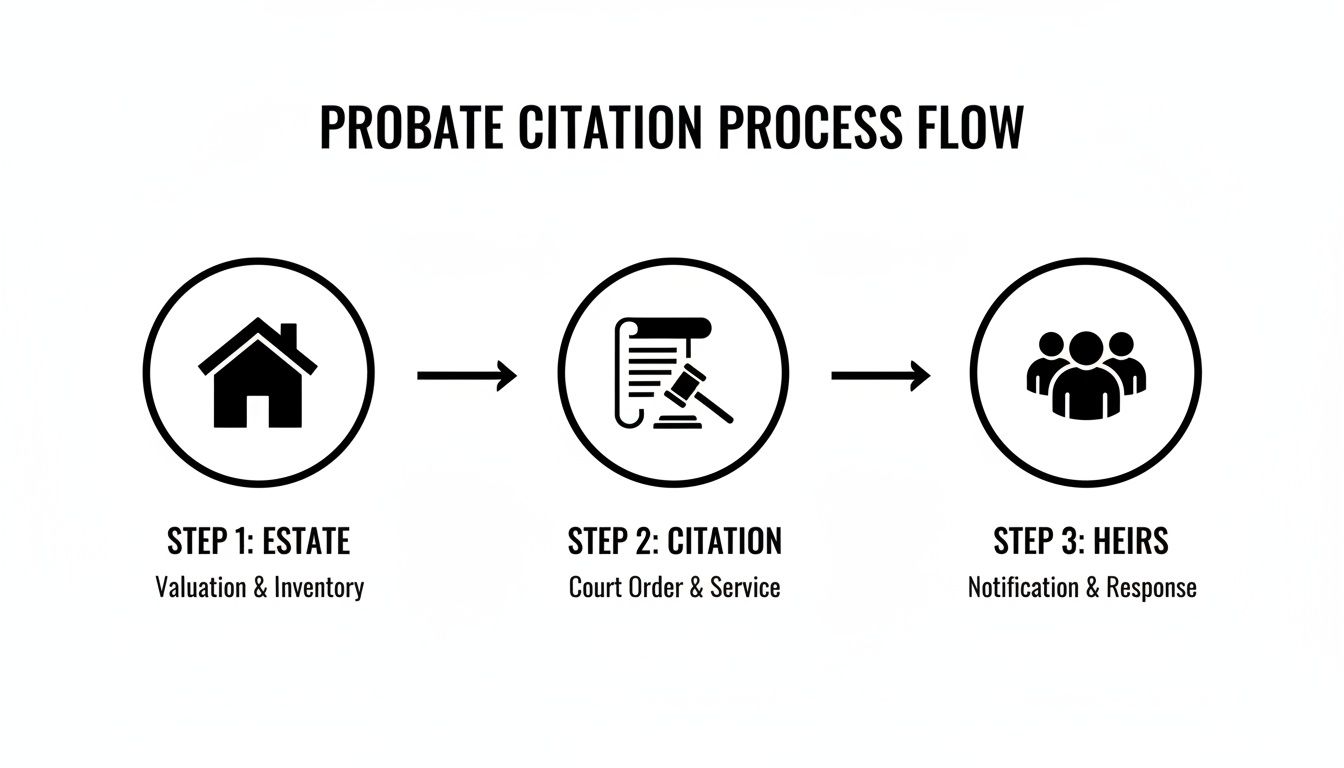
As you can see, once the estate case is filed, the court issues the formal citation, which then must be properly delivered to the heirs.
Personal Service
Personal service is exactly what it sounds like. It’s the gold standard for delivering legal notices because it's direct and leaves little room for argument. It involves having a neutral third party physically hand the court documents to the intended person.
- How it Works: The county clerk issues the citation, and you give it to an authorized officer for delivery. This can be a county sheriff, a constable, or a private process server. That person then finds the heir and serves them the papers in person, as outlined in the Texas Estates Code.
- When it's Used: This is the go-to method for serving any heir who lives inside Texas. It creates undeniable proof that they received the notice.
After the papers are delivered, the officer files a "Return of Service" with the court. This is a sworn statement detailing the date, time, and place of delivery, creating an official record for the judge. While it’s highly effective, waiting for a sheriff to track someone down can add weeks to your timeline. You can learn more about how a process server can speed up a Texas probate case and why it's often the faster choice.
To give you a clearer picture, here’s a quick summary of the main service methods.
Texas Probate Citation Methods at a Glance
This table breaks down the three primary ways to serve citation in Texas probate, helping you see which method fits your situation.
| Method of Service | When It's Used | Governing Code Section (Example) | Typical Timeline |
|---|---|---|---|
| Personal Service | Serving heirs located within Texas. | Tex. Est. Code § 51.051 | 1-4 weeks, depending on server availability. |
| Service by Mail | Serving heirs located outside of Texas. | Tex. Est. Code § 51.055 | 2-6 weeks, allowing for mail travel and return receipt. |
| Service by Posting | When an heir's address is unknown. | Tex. Est. Code § 51.053 | At least 10 days plus time until the next Monday. |
Each method serves a specific purpose, and choosing the right one is critical to keeping the probate process moving forward.
Service by Mail
What about heirs who live out of state? Driving to another state for personal service is usually impractical and far too expensive. For these situations, Texas Estates Code § 51.055 allows for service by mail, but with very strict rules.
You can't just stick a stamp on it and drop it in a mailbox. The law demands you use registered or certified mail and, most importantly, request a return receipt. That little green postcard gets signed by the recipient upon delivery and is mailed back to you, becoming your concrete proof of service.
Key Insight: That signed return receipt is everything. Without it, the court won't consider the out-of-state heir properly notified. You'll be forced to try serving them again, which means more delays and more costs.
Service by Posting
Sometimes, you know an heir exists, but you have no idea where they are. For these tricky situations, Texas law provides a method called "Service by Posting."
Here, the county clerk or sheriff takes a copy of the citation and posts it in a designated public spot at the courthouse. According to Texas Estates Code § 51.053, that notice must stay up for a minimum of 10 days. The court hearing can't happen until the Monday after that 10-day posting period is over.
Realistic Scenario: Let’s say your uncle’s will names a long-lost cousin as a beneficiary. You know the cousin is alive but have no address or phone number. After you've shown the court you've made a real effort to find them, a judge would likely order service by posting at the courthouse to satisfy the legal notice requirement.
This method serves as a last-resort option. It’s considered "constructive notice," which is a legal way of saying the law presumes the heir was notified because the information was made publicly available exactly as the statute requires.
Dealing With Missing or Out-of-State Heirs
The probate process gets complicated fast when an heir lives outside of Texas or, even worse, has completely fallen off the map. You can’t just skip over them; every heir has a legal right to be notified. Handling these situations correctly is critical to keeping the probate of an estate on track and legally sound.
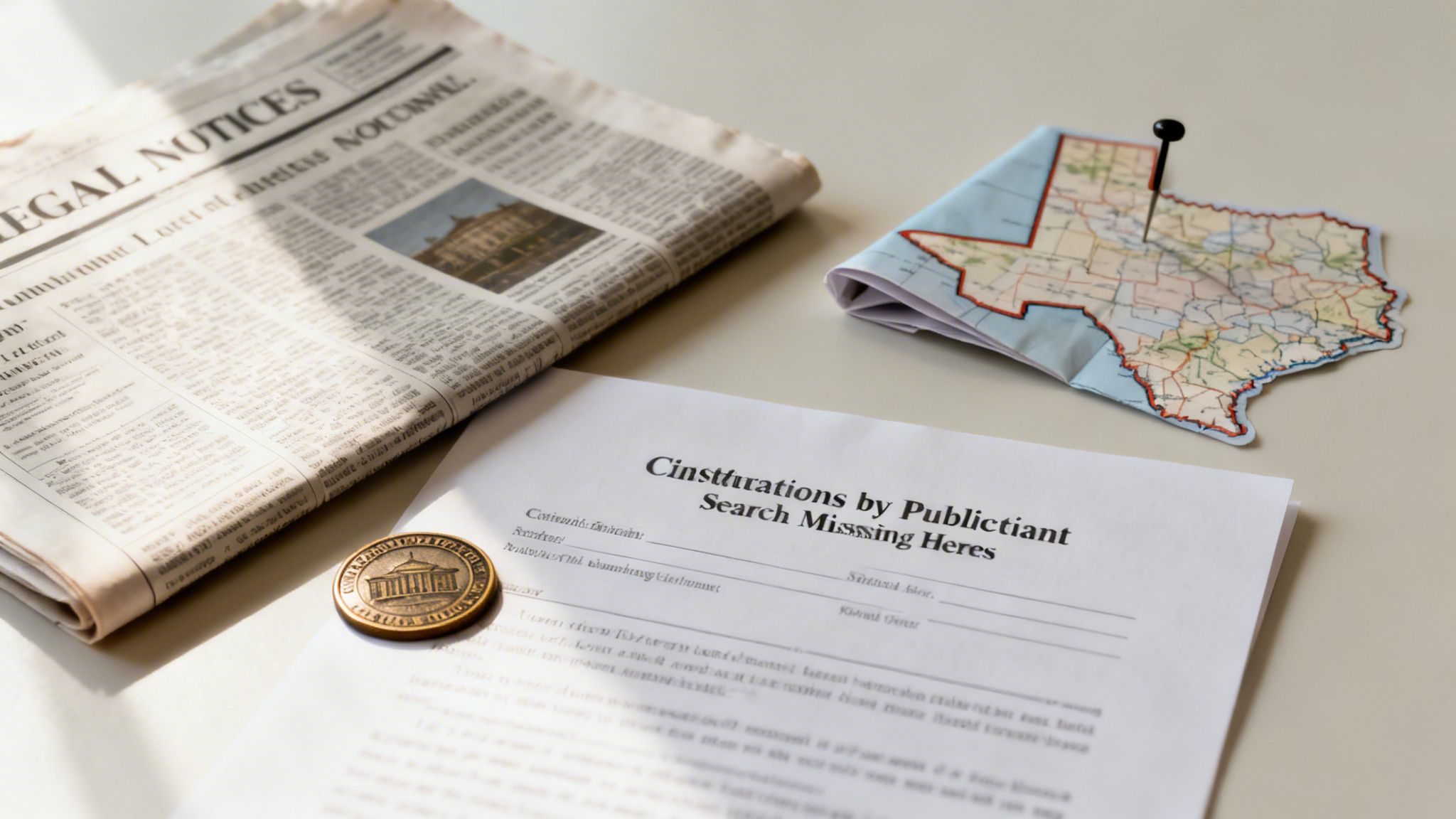
When you can’t physically hand a notice to an heir or get a signature on a certified mail receipt, Texas law has a specific backup plan: Citation by Publication. It’s a formal process that ensures you’ve met your legal obligation to provide notice, even when you don’t have an address. Getting this right is non-negotiable if you want to avoid major delays or having your probate application thrown out.
When Is Citation by Publication the Right Move?
Let’s be clear: citation by publication is a last resort. You can’t use it just because it seems easier than tracking someone down. A court will only let you go this route when you’ve hit a genuine dead end.
This typically happens when:
- Heirs are Unknown: After a thorough search, you can’t identify the names or even confirm the existence of certain potential heirs.
- Heirs are Transient: You know who an heir is, but they move constantly without a forwarding address, making personal service impossible.
- Heirs are Non-Residents of Texas: An heir lives out of state, and either their exact whereabouts are unknown or they’ve dodged attempts at service by mail.
In these specific scenarios, Texas Estates Code § 51.101 gives you the green light to publish the citation in an approved newspaper. This is what’s known as "constructive notice," and it stands in as the legal equivalent of personal delivery, allowing the probate to proceed.
The "Diligent Search" Requirement: Proving You Tried
A judge isn’t just going to take your word for it that an heir is missing. You must first file a sworn statement, known as an affidavit, with the court. This is your chance to lay out, in detail, all the diligent efforts you made to locate the person.
Your affidavit should paint a clear picture of your search, including things like:
- Searching public records, social media platforms, and online people-finder tools.
- Contacting known family members, friends, and even old employers of the missing heir.
- Checking their last known address and sending mail that might have been forwarded.
Only after the judge reviews your affidavit and is satisfied that you’ve done your due diligence will the court order the citation to be published. This step is fundamental to the integrity of the Texas probate process because it shows you respected the rights of all potential heirs.
Takeaway: Before a judge will consider citation by publication, you must prove you’ve made a "diligent search." This isn’t a casual effort. It means documenting every attempt you made to find the heir, from online searches to calling distant relatives. This thoroughness protects the finality of the court's decisions.
The Role of the Attorney Ad Litem
Once the court orders citation by publication, its job of protecting the missing heir’s interests is far from over. The judge will then appoint an attorney ad litem. This is an independent lawyer whose sole purpose is to step in and represent the interests of the unknown or missing heir.
The attorney ad litem has a specific job to do. They will:
- Conduct their own independent and diligent search for the heir.
- Review the entire probate file—the application, the will, and all supporting documents—to ensure the absent heir's rights are being protected.
- File a formal report with the court that details their search efforts and conclusions.
This appointment adds a crucial layer of legal protection. It ensures the proceedings are fair and just, even for someone who isn't there to speak for themselves. This step becomes especially important in complex cases that might involve a Guardianship or disputes over Wills & Trusts. You can discover more about the costs and procedures for these filings in Texas courts.
If the attorney ad litem manages to find the heir, the case can move forward with their direct involvement. If the search comes up empty, their report gives the judge the assurance needed to proceed, knowing every reasonable step was taken. This is particularly vital in contested estates that could escalate into full-blown Probate Litigation.
Can You Legally Skip the Citation Process?
The idea of serving formal legal notices to family members can feel daunting, especially when everyone is on the same page and grieving. It’s a common question we hear: "Do we really have to go through the whole citation process if we all agree?" Thankfully, Texas law isn't just about rigid rules; it also provides compassionate, practical shortcuts for families who are in agreement.
For families who are in sync and estates with straightforward finances, these exceptions are a lifesaver. They can dramatically cut down on the time, stress, and legal costs involved in probate. These aren't loopholes. They are specific legal paths designed for exactly these kinds of situations.
Let's look at two of the most powerful ways to legally sidestep the standard citation service: the Waiver of Citation and a unique Texas process called Muniment of Title.
Using a Waiver of Citation
The most direct way to skip formal service is by using a Waiver of Citation. It’s a surprisingly simple legal document with a lot of power. When an heir or beneficiary signs it, they are officially telling the court three things:
- "I’ve received a copy of the probate application."
- "I understand what it says."
- "I’m waiving my right to be formally served with a legal citation."
This is the ideal route when there’s no family conflict. Instead of paying a process server or waiting weeks for certified mail receipts to come back, each heir just signs the waiver. Once filed with the court, these waivers show the judge that everyone is ready to move forward, which gets the case to a hearing much, much faster.
Realistic Scenario: A mother passes away, and her three adult children are all beneficiaries in her will and agree on the chosen executor. Instead of formally serving each other, they can each sign a Waiver of Citation. This simple act can shave weeks off the probate timeline and reduce costs, allowing the family to move forward together without unnecessary legal formalities.
Muniment of Title: A Uniquely Texan Shortcut
Texas offers another incredibly efficient path known as probate as a Muniment of Title. This process, found in Chapter 257 of the Texas Estates Code, is specifically designed for one main purpose: to legally transfer ownership of property from the decedent to their beneficiaries when there are no outstanding debts (other than a mortgage on a home).
Think of it like this: you're asking the court to simply recognize the will as a valid link in the property's chain of title. It's a perfect fit for estates where the main asset is the family home and there are no other significant debts.
Key Insight: The Muniment of Title process entirely bypasses the need for an executor, an estate inventory, and formal citations to heirs. It is purely a title-transfer mechanism, making it one of the fastest and most cost-effective forms of probate available in Texas.
This streamlined method can often be completed in a fraction of the time of a traditional probate. It's an excellent example of how the law provides practical solutions for straightforward situations. To learn more about other probate alternatives, check out our guide on when probate may not be necessary in Texas. Figuring out whether your family’s situation qualifies for one of these paths is a critical first step.
You've Served the Citation. Now What?
Successfully serving a probate citation on every required party is a huge step forward in settling an estate. It means you’ve laid the legal groundwork for the court to act. But the work isn't finished. What comes next is just as critical for keeping the probate process moving smoothly and respectfully.
Step 1: Proving to the Court That Notice Was Delivered
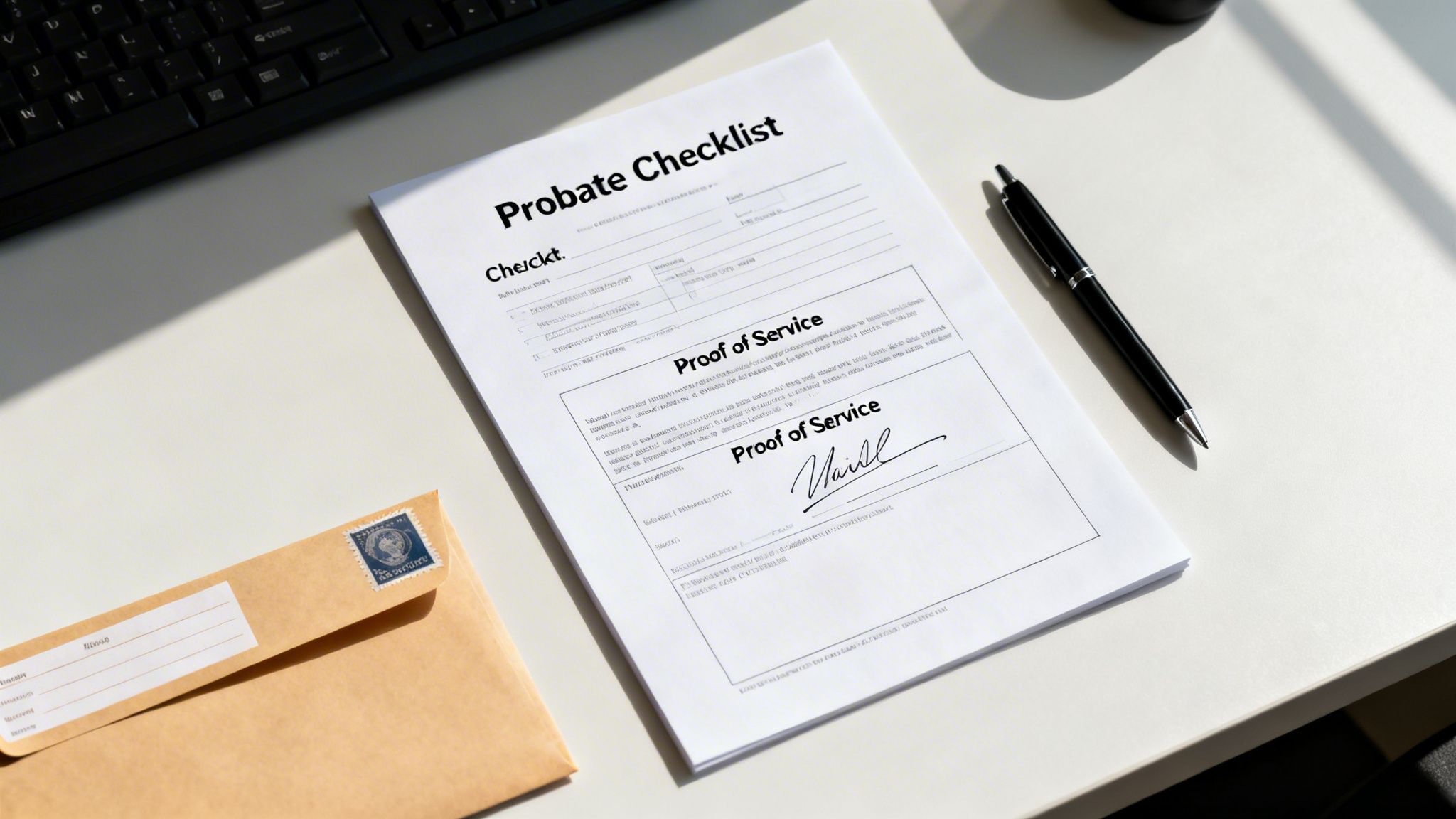
After a citation is served, you can't just tell the judge it was done. The court needs official confirmation that the notice was delivered correctly. This is where a document called a Proof of Service (often called a Return of Service) comes in.
This document is a sworn statement from the sheriff, constable, or private process server who delivered the citation. It details precisely when, where, and to whom the papers were handed. If you served someone by certified mail, that signed green return receipt card is your proof.
Without this official record on file, the court has no evidence that you met the legal requirements for notice. A probate hearing simply cannot and will not happen until this proof is properly filed for every single person who required notice. This step is critical because it validates the entire process and shields the executor from future claims that an heir was left in the dark.
Step 2: A Quick Checklist to Stay on Track
Staying organized is your best defense against delays. This simple checklist can help you track these essential steps after filing the initial probate application.
- Finalize the Heir List: Are you 100% certain you’ve identified every legal heir and beneficiary who needs notice?
- Decide on Service Method: Have you determined the right method for each person—personal service, mail, or publication?
- Get Citations Served: Has the clerk issued the official citations, and have they been delivered for service?
- File All Waivers: Have you collected and filed any signed "Waiver of Citation" forms from heirs who agree to the probate?
- File All Proof of Service: Has a Return of Service or signed mail receipt been filed for every single heir who didn't sign a waiver?
- Get on the Docket: Once all proof is filed, have you contacted the court clerk to schedule the probate hearing?
Think of this as your pre-flight check. Completing it ensures you've covered all your bases before moving to the next phase: the hearing.
Step 3: The Probate Hearing and Beyond
The period after serving citation is all about documentation and verification. Filing the Proof of Service is the final piece of the puzzle that proves you followed the law. It’s what gives the judge the green light to hold a hearing, appoint an executor, and admit the will to probate.
Once the hearing is over and the court officially appoints an executor, the focus shifts to the broader tasks of estate administration. This is when the work of gathering assets, notifying creditors, paying debts, and eventually distributing the remaining property to the beneficiaries begins.
Navigating these steps can get complicated, especially if disagreements pop up. Knowing how to handle disputes over Wills & Trusts or what to do if the case turns into full-blown Probate Litigation is essential for any executor.
Common Questions About Texas Probate Citations
When you're trying to navigate the probate process after losing a loved one, the legal paperwork can feel overwhelming. One area that trips up many families is the probate citation—the official notice required by Texas law. We get a lot of questions about this step, and a small mistake here can cause big delays.
Here, we'll answer some of the most common questions we hear, clearing up the confusion and giving you the practical insights needed to handle citations correctly.
What Happens If I Can't Find an Heir to Serve?
This is a scenario that happens more often than you'd think. You've made a real effort to find a distant cousin or a long-lost relative named in the will, but you've hit a dead end.
You can't just tell the judge you couldn't find them. You have to prove it. This requires filing a sworn statement called an affidavit of diligent search. In this document, you'll need to detail every single step you took—from searching online databases and social media to calling every family member you could think of. The court needs to see you've exhausted all reasonable options.
Once the judge is convinced you’ve done your due diligence, they will typically order "citation by publication." This means the notice gets published in a local newspaper. The court will also appoint an "attorney ad litem," who is an independent lawyer with one job: to represent the missing heir's interests. This attorney will conduct their own search and report back to the court, ensuring the process is legally sound and can't be challenged later for improper notice.
How Long Do I Wait After a Citation Is Posted?
The waiting periods for citations are strict, precise, and have zero room for error. Getting this wrong is one of the most common mistakes we see, and it forces courts to reset hearings, adding weeks or even months of frustrating delays to your case.
Here are the timelines you absolutely must follow, based on the Texas Estates Code:
- For Citation by Posting: When a notice is physically posted at the courthouse, your hearing cannot be held until after 10:00 a.m. on the first Monday that follows the full 10-day posting period.
- For Citation by Publication: If the notice is published in a newspaper, it has to run for its entire required duration before a hearing can even be scheduled.
You have to calendar these dates perfectly. A tiny miscalculation can bring the entire probate process to a screeching halt.
Takeaway: These waiting periods are jurisdictional. That’s a legal way of saying if your hearing is scheduled even one day too soon, the judge has no legal power to hear your case. The notice process will have to start all over again from square one.
Do Estate Creditors Receive a Probate Citation?
Not at the very beginning of the case. The first round of citations is specifically for the heirs and beneficiaries—the people who stand to inherit from the will. The process for notifying creditors is a completely separate step that happens later.
After the court officially appoints an executor or administrator, that person is required to publish a general "Notice to Creditors" in a local newspaper. Beyond that, the Texas Estates Code requires the executor to send a direct, formal notice via certified mail to any known secured creditors, like a mortgage company. This is a critical step to ensure all debts are handled properly.
Is a Lawyer Required to Handle Probate Citations?
Legally, you are allowed to represent yourself in a Texas probate court (this is called appearing pro se). But the reality is that the rules for citations are a minefield of technical requirements where one wrong move can have serious consequences.
An error in any of the following can get your case delayed or dismissed:
- Using the incorrect service method for a particular heir.
- Miscalculating a mandatory waiting period by a single day.
- Failing to properly file the Proof of Service with the court clerk.
- Drafting an insufficient affidavit when an heir can't be found.
An experienced probate attorney knows these rules inside and out, including the unique local procedures of different Texas county courts. They know how to document a search for a missing heir, ensure every deadline is met, and keep the process moving forward. Especially when a case could lead to Probate Litigation or involves complex assets laid out in Wills & Trusts, hiring legal counsel isn't just a good idea—it's a way to prevent costly mistakes and give you peace of mind during a difficult time.
If you’re facing probate in Texas, our team can help guide you through every step — from filing to final distribution. Schedule your free consultation today.