Skip to content
Losing a loved one is an overwhelming experience, and the legal duties that follow can feel like a heavy, unwelcome burden. When you’re handed a will, the first formal step in Texas is often "admitting the will to probate." It’s a legal-sounding phrase, but in plain English, it simply means taking the will to court to have it legally recognized and to get the named executor officially put in charge of settling the estate.
Your First Steps in Texas Probate After a Loss

While the word "probate" can sound intimidating, it’s just the legal roadmap Texas provides to make sure a person's final wishes are honored and their property goes to the right people. We understand that navigating this process while grieving is tough, but you don’t have to figure it all out alone. Our goal here is to make this starting point as clear and reassuring as possible, giving you a sense of what’s ahead so you feel more prepared for the duties to come.
Which Probate Path Is Right for Your Family?
In Texas, the law offers a few different ways to probate a will, and each is designed for a specific situation. Think of it like choosing the right tool for a job—picking the correct one from the start saves a tremendous amount of time, money, and stress down the line. The specific instructions in the will, combined with the estate's assets and debts, will point you in the right direction.
To help you see the options, this table breaks down the most common procedures.
Common Texas Probate Procedures at a Glance
| Probate Path | Best For… | Typical Timeline | Key Feature |
|---|---|---|---|
| Independent Administration | Estates where the will allows it or all heirs agree. | 2-6 months | Executor acts without constant court approval. Most common and efficient. |
| Dependent Administration | Estates with family conflict, no provision for independence, or complex creditor issues. | 12+ months | Requires court permission for most actions, offering more oversight and protection. |
| Muniment of Title | Estates with no unpaid debts (except a home mortgage) and a valid will. | 1-2 months | A simplified process to transfer title to property; no executor is appointed. |
Choosing the right path is the single most important decision you'll make at the start of the Texas Probate Process, as it sets the tone for everything that follows.
A Closer Look at Your Options
Let's dig into what those terms actually mean in practice for your family.
Independent Administration: This is the gold standard for Texas probate. It's the most common, efficient, and cost-effective route, used when the will specifically requests it or when all beneficiaries give their consent. The executor can handle most of the estate’s business—like paying bills and distributing assets—without needing a judge’s permission for every little thing.
Dependent Administration: This path involves much more direct court oversight. It's the default when the will is silent on independence or when family members can't agree. While it's slower and more expensive, that court supervision provides a layer of protection in contentious situations, which can be a relief for families navigating disputes.
Muniment of Title: This is a uniquely Texan process, and it’s a fantastic shortcut if the estate qualifies. It's designed for simple situations where the only major debt is a mortgage on a house. Essentially, the court signs an order that acts like a deed, officially transferring the deceased's property to the beneficiaries named in the will. It completely avoids a full administration. You can get a better sense of the paperwork involved in our guide to the Texas probate documents packet.
Key Insight
The most crucial document you have right now is the original will. Its language is your guide. If you see a clause stating the executor should serve “independent of court supervision,” you've just been handed the key to the most straightforward form of probate in Texas. Your first real task is to sit down with a probate attorney and review that will carefully. An experienced eye can quickly identify which of these paths are available and help you choose the one that makes the most sense for your family.
Choosing Your Probate Path: Independent vs. Dependent
After a loved one passes, figuring out the legal side of their estate can feel overwhelming. The first real step in admitting a will to probate in Texas is determining which path the law requires you to take. Your guide for this journey is the will itself—its specific wording often dictates everything that comes next.
Thankfully, Texas law, primarily in Title 2 of the Estates Code, doesn't force everyone down the same road. There are a few different ways to handle an estate, with the goal of making things as straightforward as possible. We'll focus on the three main routes: Independent Administration, Dependent Administration, and a unique Texas shortcut called Muniment of Title. Getting this choice right from the start can save your family months of time and a significant amount of money.
The Gold Standard: Independent Administration
If you could hope for one magic phrase in a loved one’s will, it would be a clause authorizing an independent administration. There's a good reason this is the most common, efficient, and preferred method of probate in Texas. As laid out in the Texas Estates Code, this provision allows the executor to manage the estate with very little court supervision.
Think of it this way: once the court officially appoints the independent executor and gives them Letters Testamentary (the document proving their authority), they are free to get to work. They can handle all the essential duties without constantly asking a judge for permission.
This includes:
- Gathering up all the estate’s assets.
- Paying off valid creditor claims and final bills.
- Selling property if needed to cover debts.
- Distributing the remaining assets to the beneficiaries named in the will.
This freedom to act is what makes the process so much faster and keeps legal fees from spiraling.
When Court Oversight Is Necessary: Dependent Administration
So what happens if the will doesn't mention administration, or if there's no will at all? In those cases, the default in Texas is a dependent administration. This path is exactly what it sounds like—the administrator is dependent on the court for approval on nearly every single action.
This process is far more structured, which means it’s also more time-consuming and expensive. Before paying a credit card bill, selling a car, or giving any property to an heir, the administrator has to file a motion, schedule a hearing, and get a judge’s signed order.
While this constant oversight can feel frustrating, it serves a critical purpose. It's designed to protect the estate when there's conflict among the heirs or concerns about complicated debts. For families navigating messy situations, this formal structure can prevent even more costly disputes down the road, especially those that could lead to Probate Litigation.
Muniment of Title: A Texas Shortcut
There's a third, uniquely Texan option that can be a fantastic alternative to a full administration. If the estate has no unpaid debts (other than a mortgage on a house), you might be able to use a process called probating the will as a Muniment of Title.
Think of it as a legal shortcut for transferring property. The process doesn’t appoint an executor or involve "administering" the estate in the traditional sense. Instead, the court simply issues an order that confirms the will is valid. This court order, once filed in the county’s property records, acts like a deed, legally transferring title of the deceased’s assets—like their house or land—directly to the beneficiaries.
Here's a realistic scenario:
Sarah’s mother passes away, leaving a valid will that gives her home to Sarah and her brother. The only debt her mother had was the mortgage on the house. Since there are no other unpaid bills (like credit cards or medical debt), Sarah's attorney files an application to probate the will as a Muniment of Title. The court reviews the will and the debt situation, then issues an order. That order functions as the new deed, officially making Sarah and her brother the owners without the hassle and expense of a full probate administration.
This process, authorized under Texas Estates Code §257.001, is by far the quickest and cheapest way to get a will recognized by the court. But it has one major catch: Many out-of-state banks and financial institutions have never heard of it and may refuse to transfer accounts without Letters Testamentary, which are only issued in an administration. This is a critical detail to consider with your attorney, especially if your loved one had assets held outside of Texas.
Takeaway
The language inside the will is your roadmap. The first and most important step is to see if it appoints an independent executor. If it does, your path is likely clear and straightforward. If not, or if there are significant debts or family disagreements in the picture, a more supervised administration may be the only option. Understanding these core differences empowers you to make an informed decision from the very beginning. For more information about Wills & Trusts, Guardianship, or the general Texas Probate Process, our experienced team is here to help.
If you’re facing probate in Texas, our team can help guide you through every step — from filing to final distribution. Schedule your free consultation today.
Preparing and Filing the Probate Application: Getting Started on the Right Foot
Once you have a handle on the different probate paths in Texas, it's time to formally kick off the process. This begins by preparing and filing an Application to Probate Will with the correct county court. While it might feel like just more paperwork, getting this first step right is absolutely critical for a smooth and timely probate.
This initial application is your formal request to the court, asking it to legally recognize the will as valid and to appoint you (or the named executor) to manage the estate. Think of it as the first and most important impression you'll make on the court. Any sloppiness here can cause frustrating delays and add unnecessary costs down the line.
Step 1: Gathering Your Non-Negotiable Documents
Before you can even think about drafting the application, you need to have two essential documents in hand. The court simply cannot and will not move forward without them.
- The Original Will: You need the actual, original document that your loved one signed. A copy won't cut it unless you're prepared for the much more complex and expensive process of trying to probate a lost will, which has a very high legal bar to clear.
- A Certified Death Certificate: This is the official, government-issued proof of death. You can typically order certified copies from the vital statistics office in the county or state where the death occurred.
Getting these two items squared away is your first concrete task. It’s a simple but non-negotiable part of admitting a will to probate in Texas.
Step 2: Don't Miss the Clock—The Four-Year Rule for Probating a Will
Here’s something many families don’t realize until it's too late: Texas has a strict deadline for probating a will. Under Texas Estates Code §256.003, you generally have just four years from the person's date of death to file the application.
If you miss that four-year window, the path forward gets incredibly steep. You’d have to convince the court that you were "not in default" for the late filing—meaning you had an exceptionally good reason for the delay. This is a tough standard to meet, so our advice is always to act well within the four-year timeframe. Don't procrastinate.
This flowchart gives you a visual map of the main routes the process can take once you've filed.
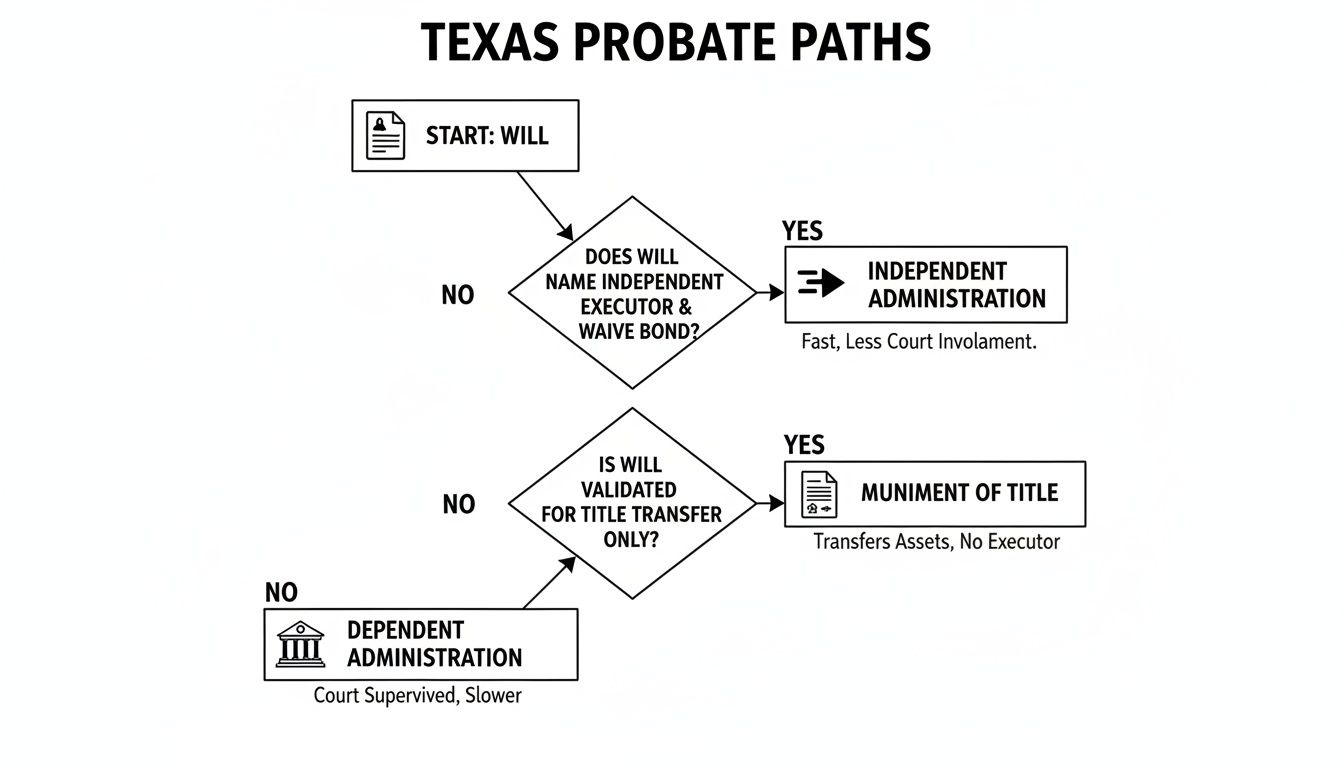
As you can see, the contents of the will and the nature of the estate will determine whether you're headed for a streamlined process (like Independent Administration or a Muniment of Title) or one with much more court supervision (Dependent Administration).
Step 3: Drafting and Filing the Application with the Court
The application is a formal legal document that contains very specific information the court needs to see. While it's always best to have a probate attorney draft or at least review this filing, it’s helpful for you to know what goes into it. The document will state the deceased's details, confirm a valid will exists, name the proposed executor, and list all the beneficiaries and heirs.
Once it's drafted, the application—along with the original will—is filed with the county clerk. This is where a common and costly mistake happens: filing in the wrong county. Probate must be filed in the county where the deceased person resided. Getting the venue wrong means your case gets rejected, and you have to start all over again in the correct court. When preparing and filing the necessary probate application and supporting documents, understanding the specific electronic signature legal requirements is essential to ensure their validity.
Unfortunately, court dockets in major Texas metro areas are more crowded than ever. This reality makes a clean, error-free filing more important than ever. You don’t want to give the court any reason to push your file to the bottom of the pile. You can read more about the specifics in our guide on filing a probate application in Texas.
Key Insight
Your initial application is the foundation for the entire probate process. Every error, from a misspelled name to filing in the wrong jurisdiction, creates an opportunity for rejection. This forces you to start over, wasting precious time and money. At the end of the day, preparing and filing the application is the official start of your job as executor. It requires gathering the original will and death certificate, staying mindful of that four-year deadline, and ensuring you file in the proper court. With how backed up the courts can get, precision at this stage isn't just a good idea—it's essential for a respectful and efficient handling of your loved one's final wishes.
Navigating the Court Hearing and Proving the Will

The thought of going to court can make anyone anxious, especially when they’re already grieving. But let us put your mind at ease: the hearing to admit a will to probate is almost always a brief and straightforward formality. It’s not the dramatic trial you see on TV. Knowing what to expect can turn this from an intimidating event into just another step in the process.
Once your probate application is filed, the court will schedule a hearing. Before that day arrives, Texas law requires a public notice to be posted for about two weeks. This isn’t just red tape; it’s a formal announcement that gives anyone with a legal interest in the estate a chance to step forward.
What to Expect at the Hearing
The probate hearing is where a judge officially reviews your paperwork and recognizes the will as valid. For a standard, uncontested probate, this proceeding is typically over in a matter of minutes. The only people who usually need to be there are you (the proposed executor) and your attorney.
You’ll be sworn in, and your attorney will ask you a handful of simple, direct questions to confirm the facts you already provided in your application.
Typical Questions Your Attorney Will Ask:
- Is it true that the decedent passed away on the date shown on the death certificate?
- Was their primary residence in this county at the time of their death?
- Are you the same person named as executor in the will?
- To your knowledge, was this will ever revoked or canceled?
- Are you qualified to serve as executor and not disqualified by law?
Answering these questions honestly is all you need to do. Think of the hearing as the final checkpoint before the court formally approves the will and gives you the green light to proceed.
The Core Task: Proving Up the Will
The central purpose of the hearing is to “prove up” the will—a legal term for showing the court it meets all legal requirements. How you do this depends on the type of will you have.
Most modern wills are attested wills, meaning they were signed by the decedent in front of two witnesses. If the will includes a "self-proving affidavit," the process is incredibly simple. This is a separate, notarized page where the decedent and witnesses already swore that all legal formalities were met. Under Texas Estates Code §251.051, this affidavit is typically all the proof the court needs.
If the will is holographic—written entirely in the decedent’s own handwriting—it requires a bit more legwork. You’ll need two credible witnesses who can testify that they recognize the handwriting as belonging to the person who passed away. We cover these different scenarios in more detail in our guide to the various proofs required in Texas probate.
Getting the Order and Your Letters Testamentary
Once the judge is satisfied with your testimony and the will's validity, they will sign an Order Admitting Will to Probate. This is the formal court document that makes everything official. It validates the will and, most importantly, appoints you as executor.
This order is the key that unlocks the final step: getting your Letters Testamentary. After you take your oath of office, the county clerk will issue this one-page certificate. This document is your golden ticket—the official proof of your authority to act for the estate. It's what you'll show to banks, financial institutions, and title companies to manage the estate’s assets.
Key Insight
The probate hearing isn't a test you can fail. It's a confirmation of facts designed to legally validate the will and empower you to carry out your loved one's final wishes. The Letters Testamentary you receive are the tangible result, granting you the legal authority you need to get the job done. With an experienced attorney by your side, the hearing is a simple and quick formality on the path to settling the estate.
Common Probate Hurdles and How to Avoid Them
Even when you have the best intentions, the process to admit a will to probate in Texas can be full of unexpected detours. These snags don't just cause delays; they drive up costs and pile emotional stress onto an already difficult time. The best defense is a good offense—knowing the common problems ahead of time is the surest way to sidestep them.
Think of this as your field guide to troubleshooting the most frequent issues executors run into, from a will that's gone missing to a full-blown family feud over the estate. Our goal is to give you the insight to handle these challenges, proving once again that careful preparation is the key to honoring a loved one’s wishes without needless conflict.
The Nightmare of a Lost or Missing Will
One of the most serious roadblocks you can face is not being able to find the original, signed will. In Texas probate courts, a powerful legal presumption kicks in: if the will was last known to be with the deceased and vanishes after their death, the court assumes they destroyed it on purpose to revoke it.
Overcoming that assumption is an uphill battle. It's possible, but it's tough. Under Texas Estates Code §256.054, you can try to probate a copy, but you'll have to prove a few things to the judge:
- You must provide a valid reason why the original will can't be produced.
- You have to establish the will's contents through a copy or very clear testimony.
- You need to present solid evidence that the will was properly executed and never revoked.
This isn't a simple probate anymore. It's a far more complex and expensive process that almost always demands the help of an experienced probate attorney.
Filing Errors and Getting the Venue Wrong
You’d be surprised how often simple administrative mistakes derail a probate case. Filing the application in the wrong county is a classic, all-too-common error. The law is crystal clear: the case belongs in the county where the decedent had their permanent home. File it anywhere else, and the case gets dismissed. You’ll have to start all over, losing precious time and money.
Likewise, simple mistakes or omissions on the application itself can get it bounced by the court clerk. We’re talking about things as small as a misspelled name or forgetting to list one of the required heirs. In a high-stakes legal process, even tiny errors can have big consequences, and the current workload of Texas courts, like the one seen in the Texas Supreme Court's 2024-2025 term, means there is little room for error. This makes getting the application right the first time absolutely critical.
The Basics of a Will Contest
A will contest is a formal lawsuit challenging the validity of the will itself. This is a type of Probate Litigation that can transform a straightforward administration into a long, bitter, and expensive court fight. Any "interested person"—like a disinherited child or a beneficiary from an older will—can file one.
In Texas, will contests are typically based on a few common grounds:
- Lack of Testamentary Capacity: The argument here is that the person signing the will was not of sound mind. Perhaps they didn't understand they were signing a will, didn't know what property they owned, or couldn't recognize their own family. This often intersects with issues of Guardianship.
- Undue Influence: This alleges that someone else manipulated or coerced the decedent, and the will reflects the influencer's desires, not the decedent's own true wishes.
- Improper Execution: This claim asserts the will wasn't signed with the proper legal formalities, like having two credible witnesses present who also signed.
You can't always stop a disgruntled heir from filing a contest. However, your best defense is a will that was meticulously drafted and executed, ideally with the guidance of an attorney specializing in Wills & Trusts. Our firm has navigated the entire Texas Probate Process for countless families and is always prepared to defend a valid will against any challenge.
Key Insight
The best solution to these hurdles is prevention. Urge your loved ones to store their original will somewhere safe and known—like a safe deposit box or with their estate planning lawyer—and make sure the executor knows exactly where it is. Having a professionally drafted will can also deter contests. A little forethought can prevent a massive legal headache for your family.
Your Key Questions About Texas Probate Answered
When you're dealing with the loss of a loved one, the last thing you need is more confusion. Probate in Texas can feel overwhelming, and it’s natural to have questions. We hear them every day from families just like yours, so let’s tackle some of the most common ones head-on with clear, plain-English answers.
How Long Do I Have to Admit a Will to Probate in Texas?
The clock starts ticking from the moment a loved one passes away. In Texas, you generally have four years from the date of death to file a will for probate. This isn't just a suggestion—it's a hard deadline set by the Texas Estates Code §256.003.
If you miss that four-year window, things get complicated fast. You’ll have to convince the court that you were “not in default” for the delay, which is a high legal bar to clear. It means proving you had an exceptionally good reason for waiting. To avoid this stress and potential complication, it's always best to start the process as soon as you're able.
What Happens If We Cannot Find the Original Will?
Losing an original will is a significant roadblock, but it’s not always a dead end. While Texas law allows you to probate a copy of a will, the process is far from simple and demands strong proof.
There's a legal presumption that works against you here: if the will was last seen with the person who died and can't be found, the court assumes they destroyed it intentionally. To overcome this, you must prove the copy is an exact replica and provide a rock-solid explanation for why the original is missing. This is one of those situations where having an experienced probate attorney is almost always a necessity.
Do All Assets Have to Go Through Probate?
No, and this is a key point that saves many families a lot of time and money. Many assets are designed to pass directly to a new owner without any court involvement. We call these "non-probate assets."
These types of assets bypass the will entirely. They include:
- Life insurance policies that name a specific beneficiary.
- Retirement funds like 401(k)s and IRAs with a beneficiary listed.
- Bank and brokerage accounts designated as "payable-on-death" (POD) or "transfer-on-death" (TOD).
- Real estate owned as "joint tenants with rights of survivorship."
Because these assets are transferred by contract or by law, they go straight to the named person upon death, outside the probate process.
What Is the Average Cost of Probating a Will in Texas?
The cost of probate in Texas varies widely. There’s no single "average" price because the final bill depends on the complexity of the estate, the debts involved, and most importantly, whether anyone decides to fight the will. A simple, uncontested Independent Administration or a Muniment of Title will always be your most affordable options.
On the other hand, a Dependent Administration (which requires constant court supervision) or any kind of contested Probate Litigation will be significantly more expensive due to mounting court costs and attorney's fees. The best way to understand potential costs is to discuss the specifics of your situation with an experienced probate attorney. Our firm handles every part of the Texas Probate Process, including related matters like Guardianship and creating Wills & Trusts.
Key Insight
Regularly reviewing and updating the beneficiary designations on your accounts is just as critical as having a will. An outdated beneficiary form can send assets to an ex-spouse or a long-lost relative, and your will can't do a thing to change it. This is a simple step you can take now to protect your loved ones in the future.
If you’re facing probate in Texas, our team can help guide you through every step — from filing to final distribution. Schedule your free consultation today.