Skip to content
A parent dies. The family gathers. Someone opens a will, reads a bank statement, or mentions the house. Within minutes, grief turns into suspicion.
One sister says Mom promised the home would stay in the family. A brother says the paperwork tells a different story. The sibling named as executor insists they're just following the documents, while everyone else starts wondering whether those documents can even be trusted.
That's usually how this begins in real life. Not with a dramatic courtroom scene, but with confusion, hurt, and a growing fear that someone is about to take more than their fair share.
If you're living through that right now, you're not alone, and you're not wrong for feeling overwhelmed. Estate disputes between siblings in Texas are emotionally heavy because they mix two painful things at once: loss and old family tension. What happens next depends on more than feelings. It depends on what property exists, how it was titled, what the will or trust says, whether non-probate assets are involved, and whether anyone crossed a legal line.
The Unsettling Reality of a Family Inheritance Dispute
A common Texas probate dispute starts with a surprise.
A father dies believing his children will “work it out.” One son has been helping with bills for years. One daughter lived nearby and handled doctor visits. Another child moved out of state long ago but stayed close emotionally. When the will is read, one child receives the house, another gets a smaller share, and a third learns that a retirement account passes outside the will entirely.
No one hears that as a neutral legal update. They hear it as a message about love, loyalty, and worth.
Why these fights feel bigger than money
Inheritance disputes rarely stay limited to numbers on paper. A disagreement over a ring may be a fight about who cared for a parent. A dispute over the family ranch may really be about who was trusted. Even when the legal question is narrow, the emotional meaning is usually much wider.
That's why families often get stuck. One person asks, “What does the law say?” Another asks, “What did Mom really want?” Those are not always the same question.
Family members often come into probate court seeking emotional fairness, but Texas courts decide legal rights.
Those seeking answers about what happens when siblings fight over an estate in Texas usually need two things at once. They need legal clarity, and they need someone to explain the process in plain English.
The first point that usually needs clearing up
Being upset with a will is not the same as having a legal claim.
Texas probate courts don't rewrite an estate plan because a sibling thinks it was unfair. Courts focus on documents, ownership, procedure, and proof. That can feel cold during a season of grief, but it also means there is a path forward. The key is identifying the actual issue before the family spends months arguing about the wrong one.
A few early questions usually shape everything that follows:
- Was there a valid will or is the estate passing under Texas intestacy rules
- Who controls the estate as executor, administrator, or trustee
- Which assets go through probate and which pass by beneficiary form, joint ownership, or trust
- Whether real estate can be divided or may need to be sold
- Whether anyone has evidence of incapacity, undue influence, fraud, or mismanagement
Those questions often lower the temperature. Not because they erase grief, but because they replace guesses with facts.
Common Triggers for Sibling Estate Fights in Texas
Some families fight because a parent left unequal shares. Others fight because the will is vague, because one sibling controlled finances before death, or because an executor won't explain what they're doing. The legal file may call it a probate dispute, but the spark is usually personal.
Research from Ameriprise on family conflict over money found that 15% of grown siblings report conflicts over money, and nearly 70% of those specific conflicts cause significant long-term family damage. That matters in probate because estate disputes often start as private resentment and then harden into formal litigation.
The legal trigger and the emotional trigger are often different
A daughter may say, “Dad never would have signed that.” Legally, that points toward testamentary capacity or undue influence.
In plain English, testamentary capacity means the person signing the will understood what they owned, who their family members were, and what the document would do. Undue influence means someone pressured or manipulated them so heavily that the document reflected the influencer's wishes instead of the parent's own intent.
Another common issue is the executor. The executor has a fiduciary duty, which is a simple way of saying they must act in the estate's best interests, not their own. If one sibling is executor and also a beneficiary, the others may question every decision, even routine ones.
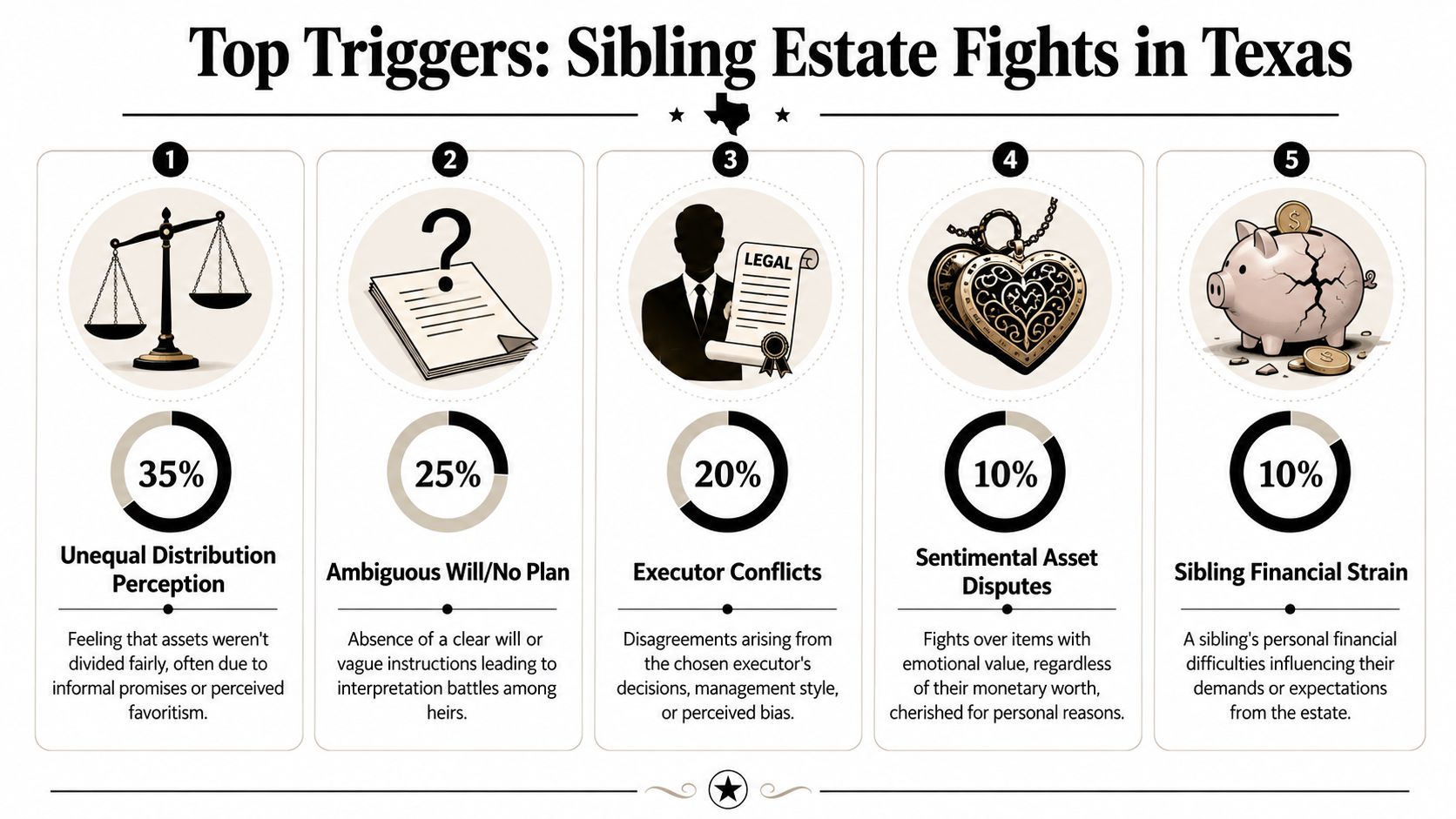
Five triggers that show up again and again
- Unequal treatment: A parent leaves one child more than another, or gives one child the house and others cash.
- Unclear wording: The will says an item should go to “the children” or “the one who needs it most,” which creates room for argument.
- Old caregiving resentments: One sibling believes years of help should matter. Another says only the written documents control.
- Control of information: One person handled bank accounts, mail, passwords, or medical appointments before death.
- Sentimental property fights: The market value may be small, but the emotional value is enormous.
Practical rule: If a sibling is asking for account records, deed records, beneficiary forms, or a copy of the will, that request usually means trust has already broken down.
Where readers often get confused
Many people assume that verbal promises settle the matter. In Texas, they usually don't. Probate courts give much more weight to signed documents, legal ownership, and statutory procedure than to statements like “Dad always said the farm was mine.”
That doesn't mean family conversations are meaningless. It means they are often weaker evidence than people expect.
Here's the hard truth: once siblings stop sharing information and start collecting it, the dispute has moved out of the family living room and into legal territory.
The Legal Arenas for Sibling Battles
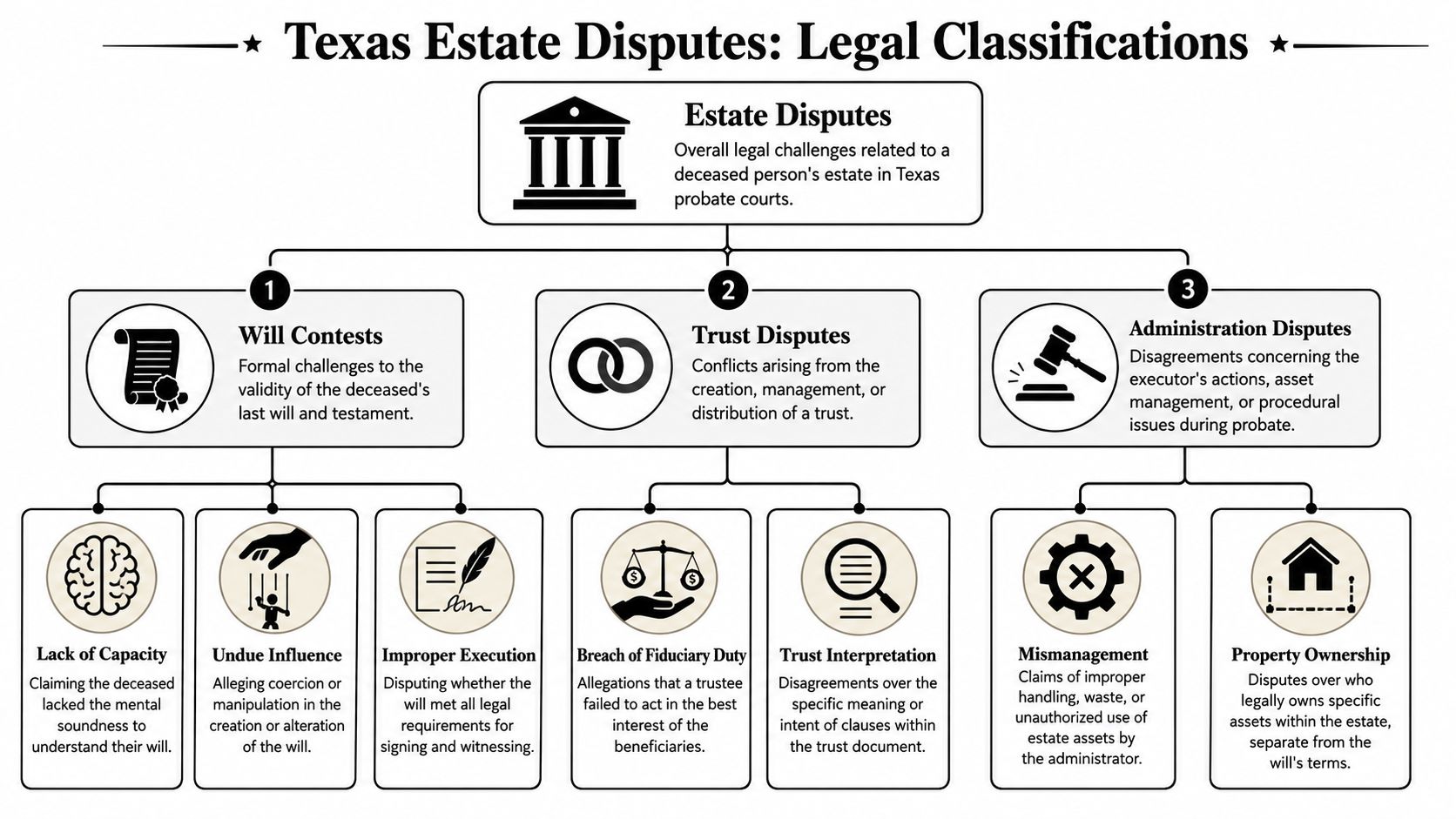
Not every inheritance fight is the same kind of lawsuit. That distinction matters because each dispute has its own proof problems, deadlines, and remedies.
Will contests
A will contest challenges whether the will is legally valid.
Under Texas Estates Code Chapter 251, a will can only be challenged on recognized grounds such as lack of testamentary capacity, undue influence, fraud, forgery, or improper execution, and Texas law imposes a two-year statute of limitations after the will is admitted to probate. A sibling cannot win just by saying the will feels unfair.
That point is critical. Texas courts don't act as referees for disappointed heirs. They decide whether a legal defect exists.
A few examples help:
| Situation | Is it a likely will contest issue |
|---|---|
| “I got less than my brother” | Usually no, by itself |
| “Dad had severe confusion when he signed” | Possibly |
| “My sister isolated Mom and brought in the lawyer” | Possibly |
| “The will wasn't signed or witnessed correctly” | Possibly |
For a closer look at these lawsuits, probate litigation in Texas when family disputes turn into lawsuits gives a more focused breakdown.
Breach of fiduciary duty and administration disputes
Sometimes the fight isn't about whether the will is valid. It's about what the executor, administrator, or trustee is doing after death.
A fiduciary duty means the person in charge must handle property carefully, keep records, follow the governing document, and avoid self-dealing. In plain English, they can't treat estate assets like a personal checking account.
Disputes here often involve claims such as:
- Poor recordkeeping: No inventory, no updates, no accounting
- Self-benefit: Using estate property for personal use
- Delay: Holding assets too long without a sound reason
- Unfair distributions: Favoring one beneficiary over another without legal authority
A valid will can still lead to a serious lawsuit if the person managing the estate mishandles it.
Intestacy and heirship disputes
Some estates have no will at all. Others have a will that doesn't dispose of every asset. In those cases, the estate may pass under Texas intestacy rules, found in Titles 2 and 3 of the Texas Estates Code.
That creates a different kind of fight. Siblings may argue over who qualifies as an heir, whether property was community or separate, or whether a particular asset belonged to the estate at all.
These disputes often sound simple at first. They aren't. A family may agree on who loved the deceased, yet still disagree sharply on who legally inherits.
Three common examples:
- No will exists: The court must determine who inherits under Texas law.
- A child claims property was promised to them: The estate says title never changed.
- Family members dispute ownership of land or bank funds: The court must decide whether the asset belongs in the estate before distribution can happen.
The Procedural Path from Dispute to Resolution
On Monday, one sister thinks probate is nearly finished. By Friday, her brother has hired counsel, frozen cooperation, and raised questions about missing records, a disputed bank account, and whether the family home must be sold. That is how many Texas inheritance fights begin. The legal process changes fast, and the money can start draining out of the estate just as quickly.
How a dispute changes the probate process
A routine Texas probate often begins as independent administration. In practical terms, that usually lets the executor gather assets, pay debts, and distribute property with limited court involvement.
A serious sibling dispute can pull the case into a much more supervised process. A sibling fight often pushes the estate from independent administration to dependent administration, which increases court oversight and cost, according to Ford + Bergner's discussion of inheritance disputes among siblings in Texas. The same source explains that a will contest generally must be filed within two years after the will is admitted to probate, and the challenger bears the burden of proof, as noted in Ford + Bergner's discussion of inheritance disputes among siblings in Texas.
That shift matters because court permission may be required for actions that seemed simple a week earlier. Selling property, paying certain claims, or resolving disputes over possession can become slower and more expensive.
Dependent administration works a lot like putting the estate on a tighter leash. The court watches more closely because the family no longer agrees on the basics.
A realistic example
Suppose three siblings are dealing with a Texas estate that includes a house, a checking account, jewelry, and household items. The oldest child is executor. At first, everyone assumes the process is mostly paperwork.
Then the conflict spreads beyond the will itself. One sibling says the executor is withholding statements. Another says a brother has been living in the house without paying expenses. A third wants the jewelry valued before anyone starts dividing it, which is why families often end up talking about getting your jewelry appraised before mediation or trial.
Now the case is no longer just about "who gets what." It becomes a process problem. Who controls the home while the case is pending? Who pays taxes and insurance? Can the executor distribute cash, or does the court need to rule first? If the siblings all inherit real estate together and cannot agree, one of them may eventually file a partition action to force a sale or division.
That is the part many families miss. Estate fights often turn into procedure fights, access-to-information fights, and cash-flow fights.
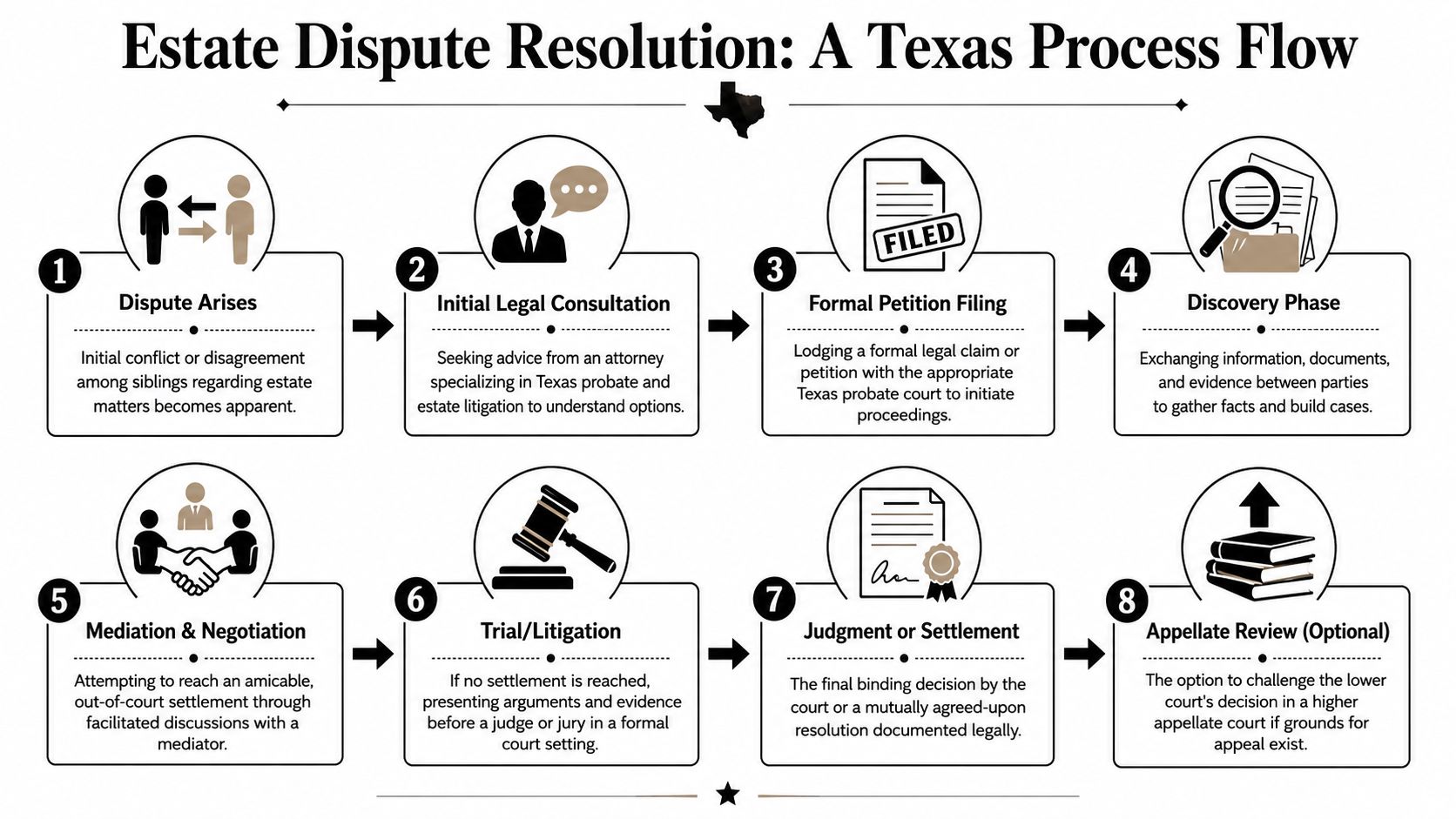
The usual sequence
Counsel identifies the type of dispute. The first job is to sort out whether the case is really a will contest, a fiduciary misconduct claim, a title dispute, a non-probate asset dispute, or a request to force the sale of property.
A pleading is filed in the right court. That might be an objection, contest, application, motion to compel an accounting, or a separate lawsuit tied to the estate.
The court addresses urgent problems first. If someone is using estate property, blocking access to records, or trying to transfer assets, the court may hear temporary requests before the whole case is ready for trial.
Discovery begins. This stage involves evidence gathering. Parties request bank records, medical records, texts, emails, deeds, signature cards, appraisals, and sworn testimony. In many sibling disputes, the full story starts to come into focus during this period.
Experts may enter the case. A handwriting expert, appraiser, physician, accountant, or real-estate professional may be needed, especially if the dispute involves capacity, valuation, tracing funds, or whether a sale is financially reasonable.
Mediation often follows. Many families reach a practical compromise here, even if trust is gone. If you are weighing that option, this guide on mediation versus litigation in Texas probate explains how the choice affects cost, timing, and control.
If settlement fails, the judge decides. The court may rule on the validity of the will, removal of an executor, ownership of an asset, approval of an accounting, or whether property should be sold.
Here's a helpful overview of the process many families find useful before their first hearing:
Mediation can still work in a bitter estate case. It gives siblings a structured setting to solve specific problems before more estate money is spent on hearings, experts, and trial prep.
Why mediation matters even in bitter cases
Mediation is not a casual family meeting. It is a structured settlement process with a neutral third party, and it often succeeds because it breaks one large emotional fight into smaller business decisions.
For example, the siblings may agree to sell the home by a set date, reimburse one heir for documented expenses, exchange estate records, divide personal property by draft, or reserve one issue for the judge. That kind of partial settlement has real value. It can stop the bleeding on insurance, taxes, storage, and attorney time while the remaining dispute is narrowed.
In other words, a good resolution plan does more than answer who was right. It answers what happens to the house, the accounts, the personal property, the bills, and the deadlines while the family is still in conflict.
Hidden Fights Over Assets Outside the Will
A common Texas probate shock goes like this: three siblings are reading the will, expecting to divide everything equally, and then they learn the biggest account is going to one child because of a beneficiary form signed years later. The house may also be stuck because two siblings want to sell and one refuses. At that point, the fight is no longer only about the will. It is about title, beneficiary designations, and who has legal control over property that may never enter the probate estate.
That distinction matters more than many families realize.
A parent may have life insurance, a payable-on-death bank account, a retirement account, a joint account, or a trust. Those assets often pass to the named beneficiary or surviving joint owner instead of passing under the will. So a sibling can feel cut out even when the will itself says something very different.
Non-probate assets can still trigger serious litigation
These disputes are common enough to surprise experienced families. According to Dallas Probate and Trust's discussion of hidden estate disputes in Texas, up to 30% of estate litigation stems from beneficiary designations allegedly altered by undue influence or fraud. In plain terms, the argument is often not “What does the will say?” but “Was this account or policy changed fairly, and does that change hold up?”
That question usually leads to a different set of documents and a different legal path.
Common pressure points include:
- Changed beneficiary forms: A late-life update leaves one child with a large account or policy.
- Joint accounts: One sibling says the account passed automatically by survivorship. Another says the parent added that child only to help pay bills.
- Trust property: The trustee may control assets outside probate, but the trustee still has duties to act in good faith, keep records, and follow the trust terms.
If your family is sorting through accounts and title paperwork, it helps to separate probate property from property that passes outside probate before anyone starts making demands. This guide on probate and non-probate assets gives a useful starting point.
Real estate disputes often turn into forced-sale cases
The other overlooked fight involves land, a family home, or mineral interests owned by multiple siblings after a death. One sibling wants to keep the property for sentimental reasons. Another cannot afford taxes, insurance, or repairs. A third may be living there without paying the others for their share.
That kind of case can move into a partition action, which is the court process used when co-owners cannot agree on what to do with property. A simple way to understand partition is this: if the owners cannot create a workable plan together, the court can create one for them. Sometimes that means dividing property if division is realistic. Often, especially with one house, it means a sale and division of the proceeds.
The court timetable for a partition matter depends on the county, the court's docket, and whether the parties are fighting over occupancy, reimbursement, or value. Hearing dates are not immediate, and the cost keeps running while the dispute sits unresolved. Mortgage payments, insurance, taxes, maintenance, and attorney's fees do not pause just because the family is deadlocked.
Personal property can create the same problem on a smaller scale. Jewelry, watches, collectibles, firearms, and heirlooms carry emotional value that rarely matches the number on a spreadsheet. Before siblings accuse each other of hiding or undervaluing items, it can help to start with a neutral framework for getting your jewelry appraised.
A fight over “outside” assets can drain just as much money and energy as a will contest, sometimes more, because the family is arguing over ownership rules that work differently from probate.
The practical lesson is simple. Do not assume the will controls every asset. Gather deeds, account statements, beneficiary designations, signature cards, trust documents, and payment records early. In many sibling disputes, the case turns on those papers long before anyone reaches trial.
The Reality of Timelines Costs and Evidence
A sibling dispute often changes tone the moment someone says, “Prove it.”
That is the point where many families realize the case will not turn on who sounds more sincere at Thanksgiving. It turns on records, testimony, deadlines, and money. In Texas probate disputes, the person making the claim usually has to prove it with admissible evidence. If a sister believes her brother pressured their mother to change accounts, or a brother believes the executor used estate funds for personal expenses, the court will expect more than suspicion. It will want documents, witnesses, and a clear timeline.
What courts actually look for
Courts tend to sort evidence into a few practical buckets.
- Documents: wills, deeds, trust papers, bank statements, signature cards, medical records, emails, and text messages
- Witness testimony: family members, caregivers, neighbors, financial advisors, and sometimes the lawyer who prepared estate documents
- Conduct over time: who paid the bills, who had access to the property, who changed beneficiary forms, who moved money, and when those events happened
- Expert opinions: appraisers, handwriting experts, or medical experts in cases involving capacity or valuation
A probate case works a lot like putting together a paper trail after a storm. One document rarely explains everything. Several records lined up in order often do.
What discovery really means for a family
Discovery is the formal process for getting information after a lawsuit begins. It sounds technical, but the idea is simple. Each side gets tools to ask for records, question witnesses, and test the other side's story.
That can include written questions, requests for documents, subpoenas to banks or medical providers, and depositions under oath. Depositions matter because they lock in testimony early. A sibling who says one thing in a text, another in an affidavit, and something different in sworn testimony creates a problem for their own case.
Discovery also explains why these disputes feel slow. Records must be requested, produced, reviewed, and sometimes fought over. If a bank account outside probate is part of the conflict, the parties may need signature cards, transfer history, and beneficiary paperwork before anyone can tell whether the asset passes automatically or belongs in the estate.
Why the clock often runs longer than families expect
Families often assume the hearing is the finish line. In practice, the hearing may come after months of groundwork.
Real estate disputes show this clearly. A partition by sale case can require pleadings, notice to all owners, valuation evidence, reimbursement claims, and arguments over who paid taxes, insurance, repairs, or mortgage costs. In some Texas courts, getting a hearing may take months, and the wait can stretch further if the docket is crowded or the parties are still fighting over access to the property.
The same pattern appears in disputes over bank accounts, retirement funds, or transfer-on-death designations. Those cases may avoid some probate steps, but they still require proof. A non-probate asset is not a shortcut when the siblings disagree about ownership.
The financial pressure is real
Time costs money. So does uncertainty.
While the case is pending, the house still needs insurance. Property taxes still come due. Utilities, lawn care, storage fees, appraisal fees, accountant fees, and attorney's fees can keep accumulating. If one sibling is living in the property, that can create another layer of argument over fair use, credits, or reimbursement.
This is why a family can win a legal point and still feel like it lost financially. The estate or the disputed asset may shrink while everyone waits for a ruling.
A practical way to prepare early
If you are involved in the dispute, start by building a file before the conflict hardens.
| If you are | Start here |
|---|---|
| Executor | Preserve accountings, receipts, communications, and proof of every estate payment |
| Beneficiary | Request inventories, statements, and copies of any document that changed ownership |
| Co-owner of inherited property | Gather the deed, tax records, mortgage statements, repair invoices, and occupancy history |
| Person considering a challenge | Build a timeline with names, dates, records, and witnesses who can confirm key events |
One clear file can change the course of a case. It helps your lawyer assess the claim, spot weak points early, and decide whether settlement makes more sense than a prolonged fight.
Probate courts decide disputes with evidence and procedure. Family certainty, by itself, is rarely enough.
Key Takeaways Protecting Your Family and Your Inheritance
A Texas inheritance fight rarely stays in one lane. One sibling may challenge how the executor handled estate money. Another may focus on a payable-on-death account that passed outside probate. A third may agree about the will but refuse to sell inherited land, which can push the family into a partition case. That is why the right first question is not, "Who is mad at whom?" It is, "Which asset is at issue, and which legal process controls it?"
That shift matters. Probate works by category. A house in the estate is handled differently from a joint bank account. A trust asset follows different rules than a vehicle title or life insurance proceeds. If you sort the assets correctly at the start, you can avoid spending time and money arguing in the wrong forum.
The points that matter most
- Start with a map of the assets: List each asset and label it as probate, trust, joint ownership, beneficiary-designated, or unclear. This simple step often explains why siblings are talking past each other.
- Match the complaint to a legal claim: Feeling excluded is painful, but a court needs a specific issue such as lack of capacity, undue influence, breach of fiduciary duty, improper accounting, or co-owner deadlock over property.
- Treat paperwork like evidence, not clutter: Bank statements, deeds, beneficiary forms, text messages, repair bills, and letters from financial institutions can decide what happened and who has authority.
- Watch the economics, not just the principle: A fight over a house can turn into months of taxes, insurance, upkeep, appraisals, and attorney's fees. A legal win can still leave less for everyone.
- Get advice before positions harden: Early guidance can identify weak claims, preserve deadlines, and create a plan for settlement, accounting, sale, or formal court action.
If you are the executor, your job is a lot like keeping the books for a business that several unhappy owners are watching at once. Clear records, timely communication, and careful handling of estate funds can lower suspicion and protect you if someone accuses you of favoritism or misuse.
If you are a beneficiary, focus on facts you can verify. Ask which assets comprise the estate, which passed outside the will, whether any property has to be sold, and what documents support those answers. Those questions often get the dispute out of the realm of rumor and into something a court, mediator, or lawyer can evaluate.
The Law Office of Bryan Fagan, PLLC handles probate administration, probate disputes, and related estate matters across Texas.
Grief makes every decision heavier. You do not need to solve the entire case today. You do need a clear next step, a clean list of assets, and a realistic plan for the costs and procedures ahead.
If you're facing probate in Texas, our team can help guide you through every step, from filing to final distribution. Schedule your free consultation today.