When a parent, spouse, or sibling dies, the legal questions usually arrive before the family has had time to breathe. Someone needs access to accounts. Someone needs to deal with the house. Someone else wants to know how long probate will take and how much it will cost.
That's where many Texas families ask the same practical question: How much can a probate lawyer save you in Texas? The answer usually isn't found by comparing hourly rates alone. Significant savings come from choosing the right probate path, avoiding avoidable court involvement, and preventing mistakes that turn a manageable estate into an expensive one.
Under the Texas Estates Code, especially Titles 2 and 3, the probate system offers more than one route for handling a deceased person's property. Some estates need full administration. Others qualify for a simpler approach. Knowing the difference is where money is either preserved or lost.
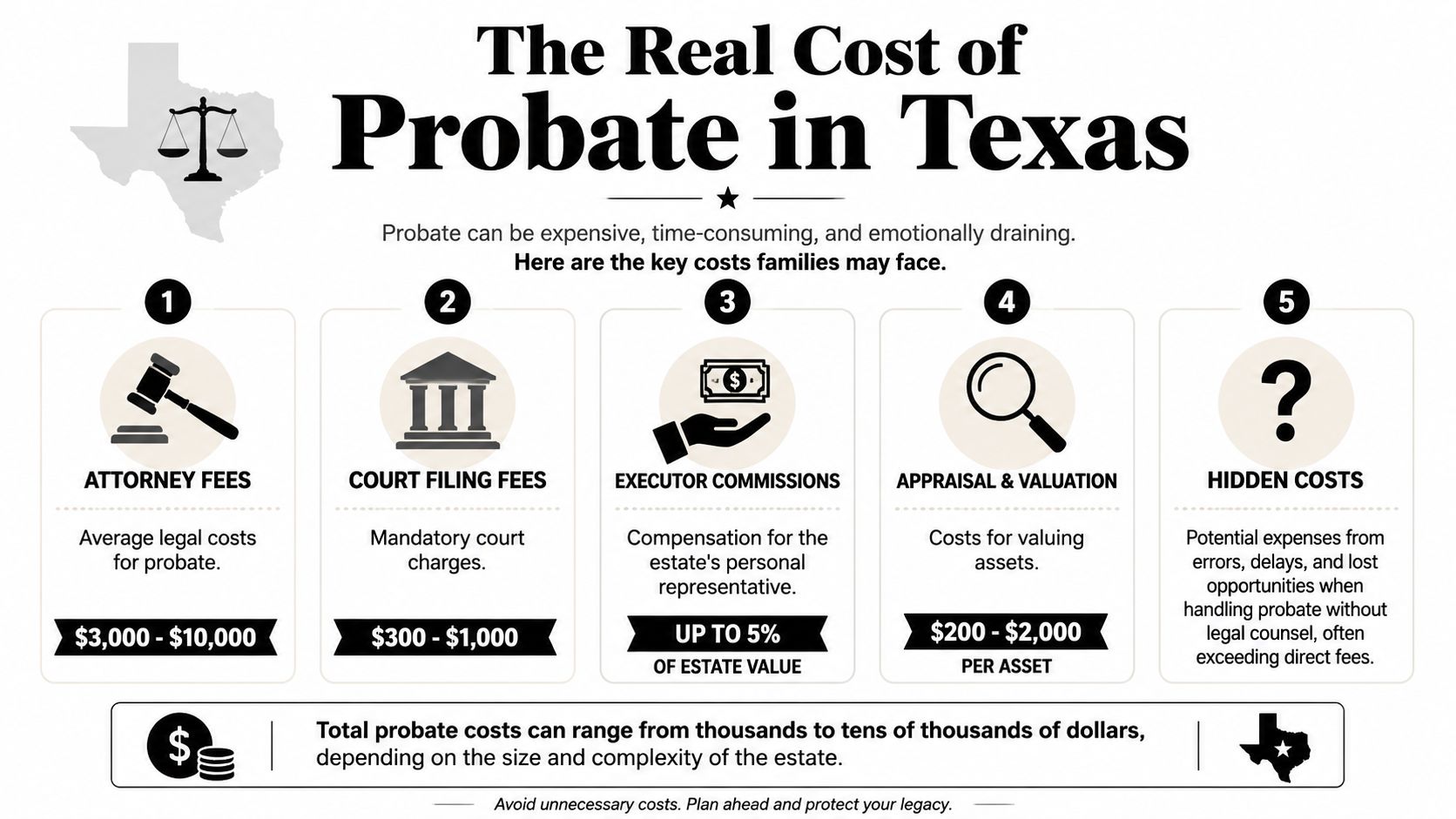
The Real Cost of Probate in Texas
A daughter comes into my office expecting one bill. By the end of the meeting, she usually sees three. There is the lawyer's fee, yes, but there are also court costs, filing mistakes that have to be fixed, and the expense of choosing a probate procedure that is heavier than the estate needs.
That is why families should look at total cost, not just the attorney's quote. A useful breakdown of probate costs in Texas shows the broader picture. Attorney fees are only one line item. Delay, conflict, title problems, and unnecessary court supervision often cost more than the initial legal bill.
In Texas, probate lawyers usually charge either hourly or flat fees. Published Texas fee ranges often place hourly work around $250 to $500 per hour, straightforward flat-fee matters around $2,500 to $5,000, and more difficult estates at $10,000 or more. The same pricing discussion also notes that some small estate affidavit matters are commonly handled for about $1,000 to $3,000 total, depending on the facts, as explained in this Texas probate cost guide.
The fee structure matters, but the estate facts matter more.
What usually makes probate more expensive
Some estates are routine. Others become expensive quickly because the executor starts with the wrong assumptions or incomplete information.
- The procedure selected: Full administration costs more than a shorter lawful option.
- The condition of the will: A clear, valid will usually reduces hearings and follow-up work.
- Disputes among heirs: Even a small disagreement can create added attorney time, postponed hearings, and delayed distributions.
- What the estate owns: Real estate, mineral interests, business assets, creditor problems, or title defects tend to increase the work.
- How prepared the executor is: Good records save time. Missing records create billable cleanup.
Lower cost probate often starts with the right fit
Texas law gives some estates simpler paths, but only if the estate qualifies. That is where money is preserved or wasted.
A small estate affidavit, for example, may work for a modest estate that meets the statutory requirements. A muniment of title may be enough where there is a valid will and no need for ongoing administration. If either option fits, the family may avoid a large share of the expense tied to a full probate case. If neither fits and someone forces it anyway, the estate can lose time, pay for corrective filings, and still end up in formal administration.
Practical rule: The biggest probate cost question is usually not “What does the lawyer charge?” It is “What process does this estate legally require?”
In plain English, probate is the court process for transferring a deceased person's property, addressing debts, and confirming who has authority to act. Administration is the hands-on management of the estate after appointment of an executor or administrator.
That distinction affects cost in a very practical way. Good legal help does not just prepare forms. It helps the family choose the least burdensome lawful path, avoid preventable expense, and keep a manageable estate from becoming an expensive one.
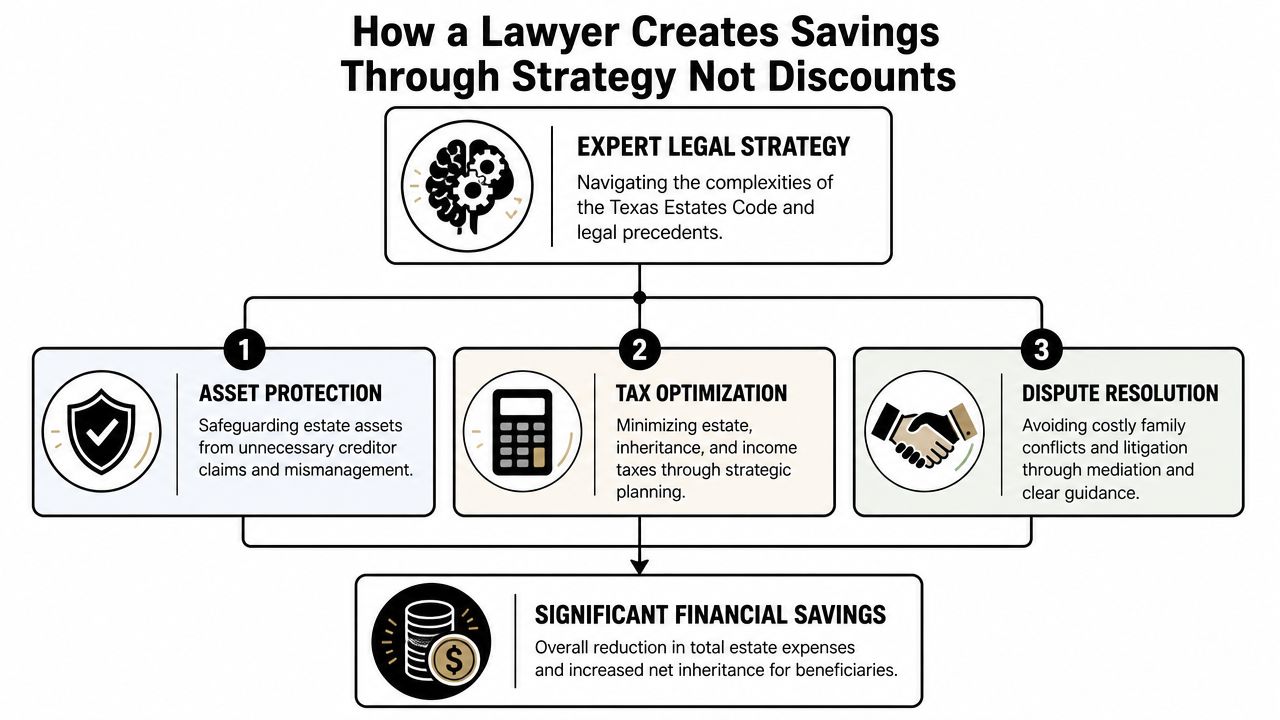
How a Lawyer Creates Savings Through Strategy Not Discounts
A family walks into my office focused on the quoted fee. Fair question. But the larger financial issue is usually whether the estate is being pushed into a process it does not need.
That is where probate savings are created in Texas. A lawyer saves money by choosing the right procedure early, preparing the case so the court does not send it back for corrections, and reducing the chances that a manageable estate turns into a slow, expensive administration.
Independent administration is a good example. In plain English, the executor can act with far less ongoing court supervision after appointment. That often means fewer hearings, fewer required filings, and less attorney time tied to routine requests for approval. The savings do not come from a discount. They come from keeping the estate out of extra procedure that adds cost without adding value.
The procedure often drives the bill
Texas probate law gives families more than one path, and those paths do not cost the same. The right choice depends on the will, the assets, the debts, and whether ongoing administration is necessary.
Here is the practical version:
| Probate path | What it means in plain English | How it can reduce cost |
|---|---|---|
| Independent administration | The executor handles most tasks without repeated court approval | Fewer hearings, fewer filings, less attorney time |
| Muniment of title | The will is admitted mainly to transfer title, often to real property | Avoids a full administration when the estate qualifies |
| Small estate affidavit | A simplified transfer process for certain smaller estates | Lower paperwork burden and fewer court steps |
| Dependent administration | The court closely supervises estate activity | More oversight usually means more cost |
The lawyer's first review matters because an estate can look simple on the surface and still call for a different approach. A house with title problems, a creditor issue, or a badly drafted will can change the analysis quickly. On the other hand, some families pay for full administration when a narrower tool would have done the job lawfully and at lower cost.
For a closer look at how fee structures and case design affect the total bill, see this explanation of Texas probate attorney fees.
Here's a helpful overview of probate process issues many families ask about:
Where strategy shows up in daily probate work
Legal savings are usually built through ordinary decisions made early and made correctly.
- Choosing the right filing at the start: Filing the wrong type of case can mean amended pleadings, another hearing, and more time billed fixing a problem that could have been avoided.
- Keeping the estate in the least court-intensive track allowed by law: Less supervision often means less procedural work.
- Cleaning up title and notice issues before they grow: A missed notice, unclear asset description, or recording problem can delay a sale or trigger objections.
- Setting realistic expectations with beneficiaries: Clear communication prevents many executor disputes from becoming formal contests.
- Moving the administration forward: Delay has a price. Mortgage payments, insurance, taxes, utilities, and property upkeep continue while the estate sits open.
I tell families this often. Probate cost is not just what the lawyer charges. It is also what the estate loses through delay, preventable conflict, repeated court appearances, and the wrong procedural choice.
That is why the better financial question is not, "What is your fee?" It is, "What process does this estate require, and how do we keep it from becoming more expensive than it needs to be?"
Probate Savings in Action Real-World Scenarios
Abstract fee ranges only go so far. Families usually understand probate value when they see how things unfold in a real estate administration.
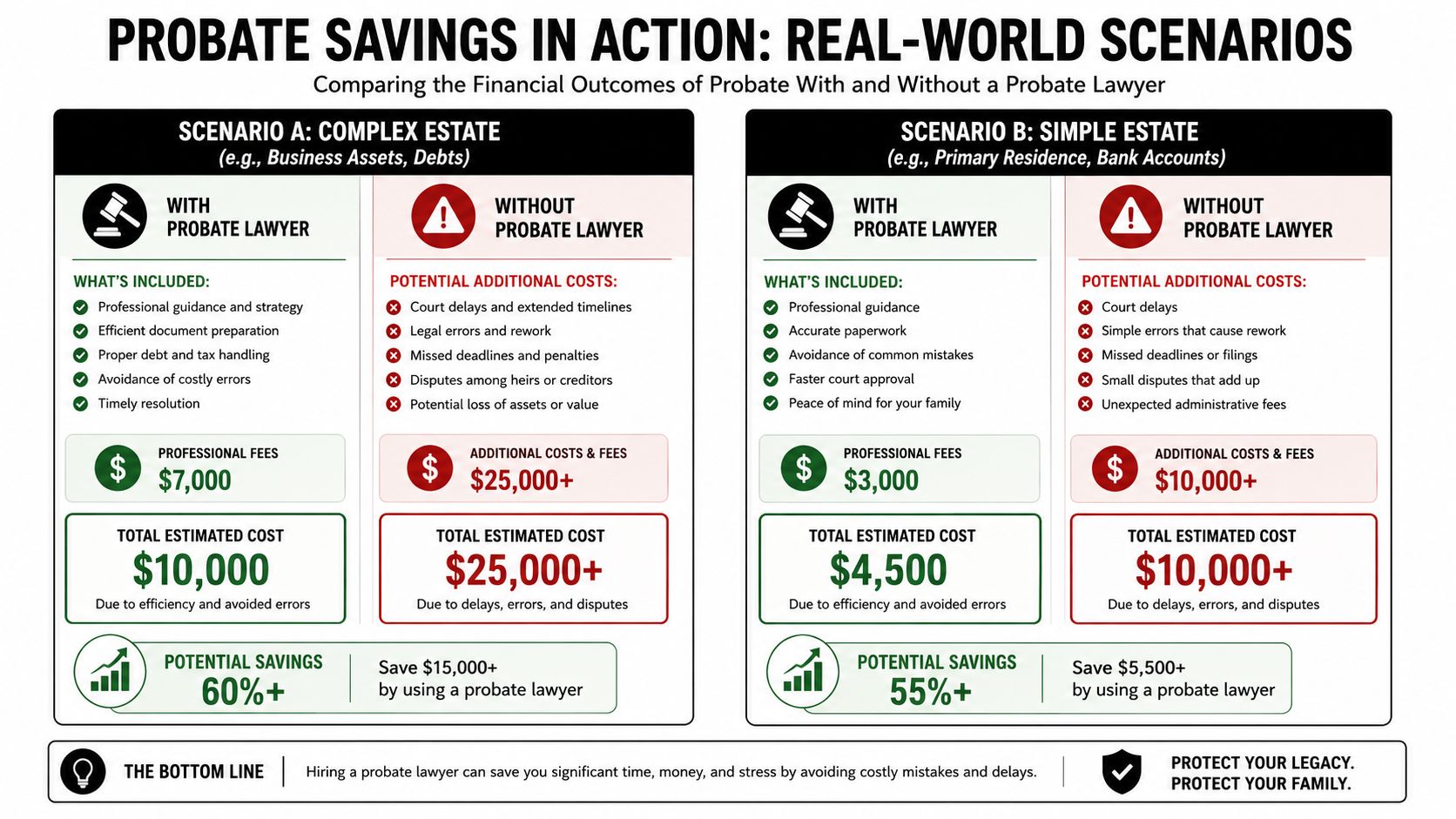
Scenario one, a clear will and a cooperative family
A widowed father dies owning a house, one bank account, and a car. He left a valid will naming his adult daughter as executor. The family gets along. No one expects a fight.
This sounds easy, and often it is. But even in a calm case, the daughter still has to decide whether the estate needs full administration, whether the will supports independent administration, what notices must be given, and how title to the house should be handled. If she starts the wrong kind of probate or files incomplete paperwork, the court may require corrections and more time.
A probate lawyer's value in this situation isn't drama control. It's precision. The estate can move through a cleaner process, and the daughter can act with confidence instead of guessing.
Scenario two, tension between siblings
Now change one fact. Two brothers believe their sister, the named executor, is moving too slowly and withholding information. Nobody has filed a lawsuit yet, but the tone of every family call has changed.
Estates become expensive, not because the original probate was complex, but because distrust creates extra work. A lawyer can set structure early by handling notices, communicating what the executor must do under Texas law, and creating a documented process for inventory, creditor issues, and eventual distribution.
Some probate disputes don't start as legal disputes. They start as poor communication.
Under Title 3 of the Texas Estates Code, administration involves real duties. The personal representative must protect estate property, address debts, and distribute what remains lawfully. When heirs don't understand those duties, they often assume bad faith where there is only delay or confusion.
If a disagreement is already forming, families should also understand when the matter may move toward Probate Litigation. Early legal guidance can sometimes keep the case out of that lane entirely.
Scenario three, an out-of-state executor
An executor living in another state often underestimates how local probate can be. County-specific practices, hearing requirements, title issues, and document execution rules can make a Texas estate hard to manage from afar.
In that setting, savings often come from avoiding repeated trips, rejected filings, and piecemeal problem solving. A Texas probate lawyer can coordinate filings, communicate with the court, and keep the executor focused on decisions that require their input.
A realistic example is a son in Colorado trying to probate his mother's Texas home and bank account. He may not know whether the home can pass through a simplified procedure, whether formal administration is necessary, or what proof the court requires. The wrong assumption can force the estate into a more involved process than necessary.
The practical point is simple. Probate savings are rarely dramatic in one moment. They accumulate through correct choices, fewer detours, and less conflict.
The Hidden Dangers and True Costs of DIY Probate
Doing probate yourself can sound sensible at first. If the estate looks small and the family gets along, many people assume they can avoid legal fees by filing the paperwork on their own.
Sometimes Texas law does allow simplified methods. But that doesn't mean every estate is safe for DIY handling. The Texas State Law Library explains that court-supervised estate administration is the most formal route and almost always requires an attorney, and that the single biggest cost driver is the legal procedure itself. Choosing the wrong one can lock an estate into unnecessary hearings, filings, and expenses, as noted in the Texas State Law Library probate guide.

Where DIY probate usually goes wrong
Most probate mistakes don't happen because the executor is careless. They happen because probate is technical.
- Wrong procedure chosen: A family files for full administration when a narrower route may have worked, or tries a shortcut that the facts don't support.
- Incomplete filings: Missing information can delay hearings and require corrected documents.
- Creditor issues mishandled: Debts must be handled carefully and in the right order.
- Title problems overlooked: Real estate transfers often fail later when probate steps were incomplete.
- Family expectations unmanaged: Silence creates suspicion, and suspicion creates conflict.
A plain-English example helps. An executor is the person named in a will to handle the estate. That individual's duties extend beyond collecting property and distributing it. The executor acts in a legal role with duties to the estate, creditors, and beneficiaries. A bad decision can create personal stress and prolonged delay.
The cost isn't only financial
Probate also asks a grieving family member to become part administrator, part record keeper, and part referee. That burden is real.
People often spend nights sorting statements, calling county clerks, and trying to decode forms while also planning a funeral, dealing with a vacant home, or answering relatives' questions. Even when they eventually get through the process, they often wish they had gotten legal guidance sooner.
For readers weighing that decision, this discussion of whether you can handle probate without a lawyer in Texas and the risks involved is a useful starting point.
The money “saved” by avoiding counsel often disappears into delay, rework, and family friction.
How to Maximize Savings When You Hire a Probate Lawyer
A family can spend less on probate and still get better legal work. The key is not shopping for the lowest hourly rate. The key is giving the lawyer the facts early, choosing a fee structure that fits the estate, and avoiding the kind of confusion that turns a manageable probate into expensive cleanup.
Good probate representation is most cost-effective when the attorney can make strategy decisions at the start. That means identifying whether the estate really needs a full administration, whether there is likely to be conflict, and where the practical trouble spots are, such as real estate, creditor claims, missing documents, or out-of-state assets. Early clarity usually saves more than late-stage fee bargaining.
Bring the right information to the first meeting
A well-prepared first meeting can reduce paid attorney time and shorten the overall process. Bring what you have, even if some items are incomplete:
- The original will: If an original exists, bring it.
- Death certificate: Courts and financial institutions usually require it.
- Asset list: Include real estate, bank accounts, vehicles, business interests, and personal property.
- Debt list: Mortgages, credit cards, medical bills, and tax obligations matter.
- Family information: Names and contact details for heirs, beneficiaries, and anyone who may have questions or objections.
Perfect records are rare. Honest records are useful.
If something is missing, say so early. I can usually work around an incomplete file faster than I can fix a bad assumption that made its way into court papers.
Help your lawyer work efficiently
Much of probate cost control comes from reducing avoidable attorney time. Families have more influence over that than they realize.
- Choose one primary contact. If several relatives give separate instructions or ask the same questions in separate calls, the estate often pays for repeated work.
- Disclose family tension early. A lawyer can plan for a difficult beneficiary, a second marriage issue, or a dispute over personal property if those facts come out at the beginning.
- Ask how the fee will be structured. Some matters fit a flat fee. Others are better handled hourly because the amount of work is uncertain.
- Respond promptly to document requests. Delay often creates follow-up calls, revised timelines, and court settings that could have been avoided.
Communication systems matter too. Missed calls from heirs, creditors, or referral sources often create delay and confusion that later shows up as billable work. For firms and professionals coordinating estate matters, addressing unanswered legal firm calls can help keep small problems from turning into administrative messes.
Ask the lawyer where the savings will come from
This question usually gets better answers than asking for the lowest fee.
A careful probate lawyer should be able to explain where legal help is likely to preserve money in your case. That may mean avoiding an unnecessary administration, preventing a title problem with real property, keeping an executor from making a costly mistake, or reducing the chance of a beneficiary dispute. Those are real savings. They often matter more than a modest difference in the quoted fee.
Families should also ask what work they can reasonably do themselves. In some estates, the client can gather financial statements, organize asset information, or help track down family contact details. In others, too much client involvement creates errors and rework. The right division of labor depends on the estate, the court, and the people involved.
Use probate as a point to fix other legal exposure
Probate often reveals planning gaps in the rest of the family. A deceased person may have left no updated will, no trust planning, or no legal structure to help a dependent adult.
That is why many families choose to address those issues while they are already working with counsel. Related services can include Wills & Trusts for future estate planning and Guardianship when a loved one needs legal protection and decision-making support. The Law Office of Bryan Fagan, PLLC handles both probate administration and related estate planning matters, which can help families resolve the current estate and reduce the chance of another expensive problem later.
Key Insight The Smartest Financial Move in Probate
The central probate question usually sounds like a fee question, but it's really a preservation question. How much can a probate lawyer save you in Texas? Often, the answer is whatever amount would otherwise be lost to the wrong procedure, preventable delay, title problems, or a family dispute that didn't have to become a legal fight.
Under the Texas Estates Code, the path matters. A full administration may be necessary. But sometimes a will can be admitted in a narrower way, or a smaller estate can use a simplified process. The lawyer's role is to match the estate to the correct legal tool, carry out the required steps, and keep the estate from spending money on work the law never required in the first place.
What actually works
The most effective probate cost control usually looks like this:
- Early legal analysis: Decide what procedure fits before filing anything.
- Accurate filings: Get the paperwork right the first time.
- Clear executor guidance: Help the personal representative understand their duties.
- Active dispute prevention: Keep confusion from turning into litigation.
- Focused administration: Move the estate toward distribution without unnecessary detours.
What usually doesn't work
Families often spend more when they rely on one of these assumptions:
- “The estate is simple, so probate will be simple.” Sometimes it is. Sometimes the assets or title issues say otherwise.
- “We all get along, so we don't need structure.” Even close families can disagree once money and property are involved.
- “The cheapest lawyer will save us the most.” In probate, cheap process decisions are often expensive later.
- “We can fix mistakes if they come up.” You usually can, but correction costs money and time.
The smartest probate savings come from preserving the estate, not from underinvesting in the process.
If you're grieving a loss, you don't need more uncertainty. You need a clear explanation of what Texas law requires, what options are available, and which path is likely to protect the estate best. That's the value of experienced probate counsel. Not just filing papers, but protecting a loved one's legacy from avoidable loss.
If you're facing probate in Texas, our team can help guide you through every step, from filing to final distribution. Schedule your free consultation today.
If you need help evaluating the most cost-effective probate path for a loved one's estate, Law Office of Bryan Fagan, PLLC can walk you through the options, explain what Texas law requires, and help you move forward with clarity. If you're dealing with probate now, or want guidance on related concerns such as estate administration, heirship, or next-step planning, contact the firm for a free consultation.