Skip to content
When a loved one passes away without a will in Texas, their property doesn't just disappear or automatically go to the state. That's a common myth. Instead, Texas law provides a default plan, known as intestate succession, that dictates who inherits the estate.
This legal framework, found in the Texas Estates Code, provides a roadmap, but it doesn't mean you can skip the courthouse. In fact, navigating probate without a will often makes the process more complex and emotionally taxing than if a will had been left behind. Losing a family member is devastating, and this guide is designed to bring clarity and reassurance during a difficult time.
Understanding Probate When There Is No Will in Texas
Discovering a family member died "intestate"—the legal term for without a will—adds a layer of confusion to an already painful time. Many families are left wondering what to do next, fearing a long, expensive court battle.
The reality is, the Texas Estates Code has a clear, though rigid, set of rules for distributing a person’s assets. However, this process requires court oversight to make it official. An intestate estate can easily get tied up in court for 9 to 18 months because of the extra steps needed to legally identify heirs, appoint someone to manage the estate, and get a judge’s approval.
How Texas Intestacy Law Works in Plain English
Think of intestacy law as the will the state of Texas writes for someone who didn't write one for themselves. It’s based entirely on family relationships, not on what the person may have wanted. The rules for dividing property depend on who survives the person who passed away and what kind of property they owned.
The law splits property into two main categories:
- Community Property: This is everything a couple acquires during the marriage. It’s the default for most assets earned or bought while married.
- Separate Property: This includes anything owned before the marriage, or assets received during the marriage as a gift or inheritance specifically for one spouse.
These distinctions are critical, as they completely change who gets what. The rules can get especially tangled with blended families, which is why having a clear understanding is so important for everyone involved.
Texas Intestate Succession At a Glance
To make this clearer, here’s a simplified summary of how property is typically divided under Texas intestacy laws. This table breaks down common scenarios for both community and separate property.
| If You Are Survived By | Community Property Distribution | Separate Property Distribution |
|---|---|---|
| Spouse, no children | Spouse gets 100%. | Spouse gets 100% of personal property and the right to use real estate for life. Parents/siblings inherit the rest of the real estate. |
| Spouse and shared children | Spouse gets 100%. | Spouse gets 1/3 of personal property. Children get the remaining 2/3 of personal property and all real estate. |
| Spouse and stepchildren | Spouse keeps their 50% share. Children inherit the deceased's 50% share. | Spouse gets 1/3 of personal property. Stepchildren get the remaining 2/3 of personal property and all real estate. |
| Children, no spouse | All property is considered separate. | Children inherit 100%, divided equally. |
| Parents, no spouse or children | All property is considered separate. | Parents inherit 100%, divided equally. |
As you can see, the outcomes can be surprising, especially in blended families where a surviving spouse might have to share property with their stepchildren. For a more exhaustive look at various family situations, you can refer to our detailed Texas descent and distribution chart.
Realistic Scenario: How Intestacy Impacts a Family
Let's imagine Maria's husband, David, dies unexpectedly without a will. They have two children together.
Here’s a step-by-step breakdown of how Texas law would likely divide their estate:
- Community Property: Maria inherits all of their community property—the house, cars, and joint bank accounts they acquired during their marriage.
- Separate Personal Property: She also inherits one-third of David's separate personal property, like his collection of rare coins or cash in an account he had before they married.
- Children's Share: Their two children would split the remaining two-thirds of David’s separate personal property.
- Separate Real Estate: If David owned separate real estate (like a piece of land he inherited from his parents), Maria would get a "life estate," meaning she could use one-third of it for the rest of her life. The children would inherit the property outright, subject to her right to use it.
This scenario highlights how the law's formula might not match what David would have wanted. He might have preferred Maria to get everything. The legal process to confirm these heirs and distribute the property is the heart of handling probate without a will in Texas.
Your First Steps: Identifying Heirs and Assets
When a loved one passes without a will, the path forward starts with two fundamental tasks: figuring out who the legal heirs are and creating a complete picture of what the person owned and owed. Think of this as the foundation for the entire process. This initial discovery phase is absolutely critical for a smooth and lawful estate administration.
You'll need to gather documents, talk to family, and methodically piece together your loved one's financial and family story.
Who Are the Heirs Under Texas Law?
Without a will to name beneficiaries, the Texas Estates Code provides the rulebook for who inherits. But identifying the legal heirs isn't always as simple as looking at a family tree. The law demands a formal process to legally establish who is entitled to the estate.
This usually means gathering detailed information on every potential heir, including their names, addresses, and relationship to the person who passed. Things can get complicated fast, especially with blended families or long-lost relatives.
- Step 1: Gather Vital Records: You'll need birth certificates, death certificates, and any marriage and divorce decrees. These documents are the official building blocks for proving heirship in court.
- Step 2: Identify All Potential Heirs: Texas law requires a thorough search. This means you have to account for all children (including any adopted or born outside of marriage), parents, and siblings of the deceased.
- Step 3: Locate the Heirs: Once you know who they are, you need to find them. This can be a challenge if family members have lost touch over the years.
In many cases, this information is compiled into a formal legal document. To learn more, see our guide on using an Affidavit of Heirship in Texas.
Creating a Detailed Inventory of the Estate
At the same time you're identifying heirs, you must build a comprehensive list of all assets and debts. A clear inventory isn't just for the family's peace of mind; it's a legal requirement for the court. Learning how to organize legal case files effectively can make this much less overwhelming.
You’ll need to separate assets into two distinct categories:
Probate Assets are properties titled solely in the deceased's name. These are the assets that must go through the court process.
- A house owned individually
- A car with only the decedent's name on the title
- Bank accounts without a named beneficiary
- Personal belongings like jewelry, furniture, and art
Non-Probate Assets pass directly to a designated beneficiary or co-owner, completely outside of the court process.
- Life insurance policies with a named beneficiary
- 401(k) or IRA accounts with a beneficiary
- Bank accounts set up as "Payable on Death" (POD)
- Property owned as "Joint Tenants with Right of Survivorship" (JTWROS)
These non-probate assets are not controlled by intestacy laws and are not part of the probate estate.
Realistic Scenario: Discovering Hidden Assets
Let's imagine a common situation. Sarah is managing her father's estate, and he died without a will. While cleaning out his home office, she stumbles upon a dusty folder with old stock certificates and a passbook for a savings account she never knew existed.
Here’s a step-by-step guide to how she would classify these items:
- The Stock Certificates: Because these are in her father’s name alone, they are probate assets. Their value has to be determined, and they will be included in the estate to be divided among the legal heirs.
- The Savings Account: Sarah calls the bank and learns her father never named a payable-on-death beneficiary for the account. That means the money in this account is also a probate asset and must be managed through the court.
Discoveries like Sarah's are why a meticulous search is so important. It ensures every asset is accounted for and that all heirs receive their rightful inheritance.
Choosing the Right Legal Path for the Estate
When someone dies without a will in Texas, the law offers a few different routes to take. Picking the right one from the start can save a family a tremendous amount of time, money, and heartache.
The best path forward boils down to the specifics of the estate—its value, the assets involved, and whether all the heirs are on the same page. This is one of the most critical decisions in the entire process.
The Small Estate Affidavit: A Simpler Route
For smaller, straightforward situations, the Small Estate Affidavit can be a lifesaver. This process, outlined in Chapter 205 of the Texas Estates Code, lets heirs collect property without going through a full, court-supervised administration. It's designed to be faster and much cheaper.
However, the rules are strict. To qualify, the estate must meet specific criteria:
- The total value of the assets (not counting the homestead) cannot be more than $75,000.
- The assets must be worth more than the estate's total debts.
- The only real estate owned must be the primary home (homestead).
- All legal heirs must be identified, located, and agree to sign the affidavit.
If you meet these requirements, the affidavit is filed with the court. Once approved, you can present that document to banks and other institutions to have assets released directly to the heirs.
When Formal Administration Is Necessary
What if the estate is worth more than $75,000 or includes other real estate besides the homestead? In those cases, a more formal court process, known as an administration, is unavoidable. Even here, you have options. The two main paths are Independent Administration and Dependent Administration. The biggest difference is how much the judge has to supervise.
This decision tree can help you visualize those first critical questions.
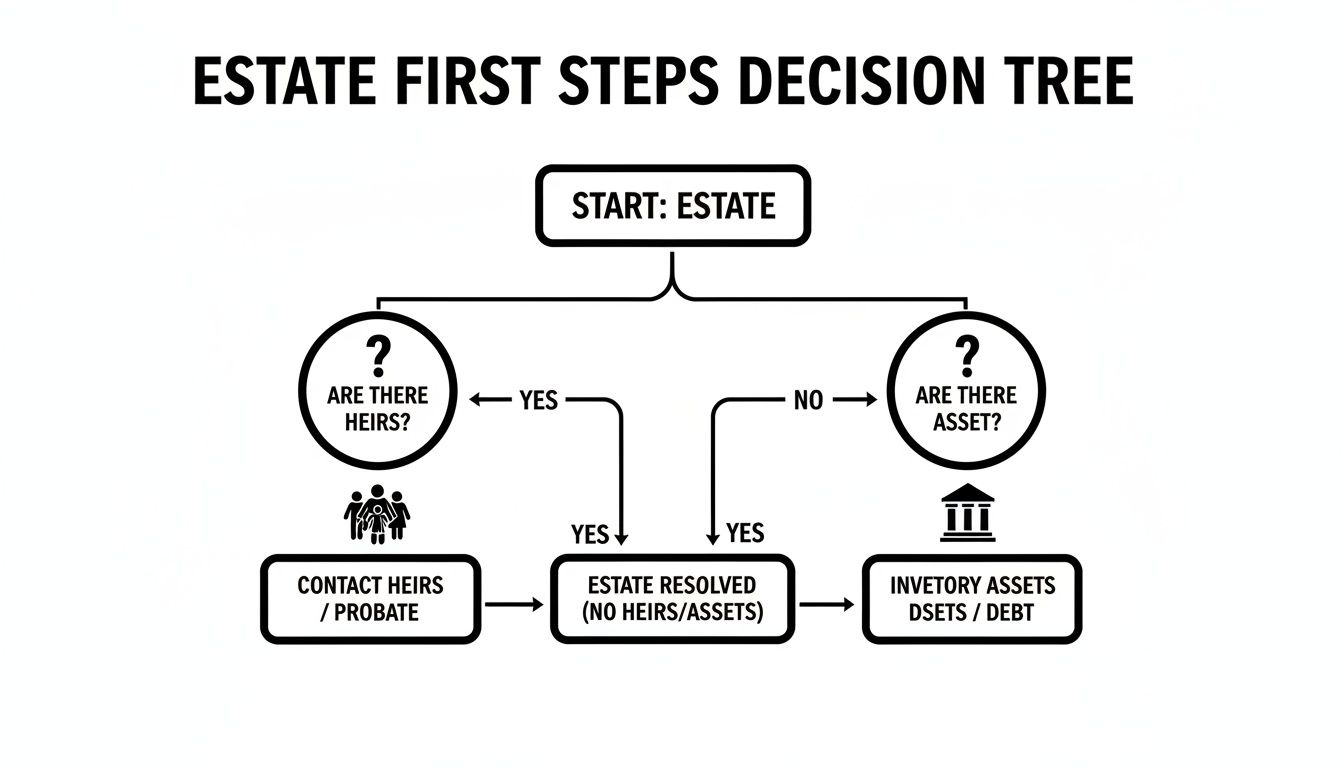
As you can see, the estate's contents and the heirs' relationships drive the entire process from the start.
Independent Administration: The Preferred Method
In Texas, Independent Administration is the most common and preferred route because it allows the person in charge—the administrator—to handle the estate’s business with very little court supervision. Once the court appoints an administrator with the heirs' consent, that person can pay debts, sell property if needed, and distribute assets without asking the judge for permission at every turn. This freedom makes the process far more efficient and less expensive.
Dependent Administration: When Court Oversight Is Required
A Dependent Administration is exactly what it sounds like—the administrator is completely dependent on the court's approval for nearly everything. It's the most formal, restrictive, and costly way to handle an estate. The administrator needs a judge's sign-off before paying a bill, selling a car, or settling a creditor's claim. This constant back-and-forth with the court drags out the timeline and racks up legal fees.
A Dependent Administration is typically required in complex situations, such as:
- Heirs are fighting and cannot agree on anything.
- One of the heirs is a minor and cannot legally consent.
- The estate has significant debts or might be insolvent (owing more than it's worth).
In these cases, the court’s heavy oversight acts as a crucial safeguard. After the court appoints someone, they will be issued Letters of Administration. This paperwork is the legal proof they need to act on the estate's behalf. To learn more, see our article on Letters Testamentary vs. Letters of Administration.
Navigating the Intestate Court Process: A Step-by-Step Guide
Stepping into a courtroom is intimidating, especially when you're grieving. When there's no will, the formal court process can feel like a maze. But understanding the roadmap provides a sense of control. This journey involves specific legal steps designed to officially identify heirs and appoint someone to manage the estate under the court's watch.

The good news is, you don't have to figure this out alone. The process is methodical, with each step building on the last.
Step 1: Filing the Application with the Court
The first official move is filing an Application to Determine Heirship with the probate court. Think of this document as a formal request asking the judge to declare who the legal heirs are according to Texas law. It's the cornerstone of handling probate without a will in Texas.
Usually, this application is filed alongside a request to appoint an estate administrator. This two-for-one approach is powerful: it identifies the rightful inheritors and gives a specific person the legal power to manage the estate.
Step 2: The Role of the Attorney Ad Litem
Once the application is filed, the Texas Estates Code requires the judge to appoint an attorney ad litem. This is a neutral attorney whose only job is to represent the interests of any unknown or missing heirs.
This attorney acts as an investigator for the court. They will:
- Conduct a search for any potential heirs who might have been overlooked.
- Review all documents and evidence.
- Interview witnesses and family members to confirm the family tree.
The attorney ad litem is the court's safety net, making sure no one is accidentally—or intentionally—left out.
Step 3: The Heirship Hearing
The heirship hearing is where everything comes together in front of the judge. During the hearing, evidence must be presented to prove who the heirs are.
Texas law requires that two disinterested witnesses testify in court. These are people who knew the deceased and their family but have no financial stake in the estate—think old friends or neighbors. They are sworn in to confirm the deceased’s family history. After hearing their testimony and reviewing the attorney ad litem's report, the judge will sign an Order Determining Heirship. This court order is the final, legally binding document that names the inheritors.
Step 4: The Administrator’s Duties
With the heirs officially declared and an administrator appointed, the real work begins. The administrator has a fiduciary duty—a legal obligation—to act in the best interests of the estate.
The administrator's main jobs include:
- Notifying Creditors: The administrator must publish a notice to creditors in a local newspaper and send letters directly to any known secured creditors.
- Gathering and Managing Assets: The administrator takes control of all probate assets, from bank accounts to real estate.
- Paying Debts and Taxes: All legitimate debts must be paid from estate assets. A final income tax return must also be filed.
- Distributing the Estate: Once all debts and expenses are paid, the administrator’s final task is to distribute the remaining property to the heirs as specified in the Order Determining Heirship.
Juggling these duties requires meticulous records and a sharp eye on legal deadlines. Our firm helps clients navigate the complexities of the Texas Probate Process every day, ensuring each step is handled with care and precision.
Common Complications and How to Handle Them with Compassion
Even with a clear legal path, the journey through intestate probate can be full of emotional landmines. The absence of a will can create confusion, disagreement, and frustrating delays. Getting ahead of these potential issues is key to honoring your loved one and preserving family relationships.

From surprise heirs to estates deep in debt, these hurdles can turn a straightforward administration into a complex legal battle.
Disputes Between Heirs
Without a will to spell out the deceased's final wishes, disagreements can ignite over anything, from sentimental items to major decisions like whether to sell the family home. When multiple heirs inherit a single property, they become co-owners, which can lead to a stalemate if they have different goals.
Realistic Scenario: Blended Family Conflict
Consider a common situation. Mark passes away without a will, leaving his second wife, Lisa, and two adult children from his first marriage, Sarah and Tom. Under Texas law, Lisa keeps her 50% share of the community property, but Sarah and Tom inherit Mark’s 50% share.
This means Lisa now co-owns her home with her stepchildren. The problem? Sarah and Tom need money and want to sell the house immediately. Lisa, however, has lived there for 20 years and has no intention of moving. This is a classic intestate conflict that can easily escalate into costly Probate Litigation.
The Appearance of an Unknown Heir
Another major complication is when a previously unknown heir emerges. Texas law requires a diligent search for all potential heirs, and sometimes that search uncovers a surprise—perhaps a child from a previous relationship no one knew existed. If a new heir is discovered and legally verified, they have the same inheritance rights as all other heirs in their class.
The Problem of an Insolvent Estate
Sometimes, an estate's debts are greater than its assets. This is known as an insolvent estate. The administrator has the tough job of paying creditors with limited funds. Texas Estates Code Chapter 355 sets out a priority system for who gets paid first. Heirs of an insolvent estate typically receive nothing, as every dollar must first be used to satisfy creditors.
Issues with Selling Real Estate
Selling a house during intestate probate can be tricky. The biggest problem is establishing a clear title. Title companies will not insure a property sale without absolute legal proof that the sellers have the right to sell it. To get that proof, the heirs must complete the heirship determination process. The court's final Order Determining Heirship is the document needed to provide legal proof of ownership and ensure a smooth sale.
Key Insight: The Most Important Takeaway
The absence of a will doesn't mean chaos, but it does mean you must follow the state's rigid rules. The most critical step you can take is to choose the right legal path from the very beginning—whether it's a Small Estate Affidavit or a formal administration. An experienced probate attorney can analyze your specific situation, explain your options in plain English, and guide you toward the most efficient and compassionate process for your family. This proactive approach saves time, reduces stress, and prevents costly mistakes during an already difficult period. Seeking guidance early is the key to a smoother journey.
Your Path Forward with The Law Office of Bryan Fagan
Losing a loved one is hard enough. Navigating the Texas probate system without a will can feel overwhelming, but it is a journey you can manage with the right guidance. The most impactful thing you can do is reach out for compassionate legal help early in the process. A good probate attorney does more than file paperwork; they clarify your options, protect your family from mistakes, and provide the peace of mind to move forward with confidence.
Settling an estate is about bringing closure with dignity and fairness. Whether you need help with the full Texas Probate Process, are facing potential Probate Litigation, or want to plan ahead with Wills & Trusts or Guardianship, our team is here to help.
If you’re facing probate in Texas, our team can help guide you through every step — from filing to final distribution. Schedule your free consultation today.
Common Questions About Texas Intestate Probate
When you're navigating a Texas probate without a will, a lot of specific, urgent questions come up. Families often feel lost in the process, so let's clear up a few of the most common concerns.
How Long Does Intestate Probate Usually Take in Texas?
You should prepare for the long haul. A typical intestate probate case in Texas can take anywhere from 9 to 18 months to fully wrap up.
That timeline isn't set in stone, either. If heirs start fighting, if it's tough to track down all the assets, or if other legal issues pop up, the process can stretch out even longer, requiring more time and more court involvement.
Can We Sell My Parent's House if They Died Without a Will?
Not right away. Before you can legally sell the property, you have to prove to the world—and more importantly, to a title company—who the new legal owners are.
You have two main paths to get there:
- Court-Ordered Heirship Proceeding: This is the most formal route. You'll go to court, and a judge will issue an official order that legally declares who the heirs are.
- Affidavit of Heirship: This is a sworn statement filed in the county property records. It’s often quicker and cheaper, but be warned: not all title companies will accept it as sufficient proof to clear the title for a sale.
Only after ownership is legally established can the estate's administrator or the heirs move forward with selling the house.
What If We Cannot Find One of the Heirs?
This is a surprisingly common problem, and it can bring the entire probate process to a grinding halt if not handled correctly. When an heir is missing, you can't just ignore them and split their share.
Instead, the probate court will appoint an independent attorney known as an attorney ad litem. This lawyer has one job: to conduct a diligent, official search for the missing person. They'll check public records, talk to family, and follow every reasonable lead.
If the heir still can't be found even after that exhaustive search, their inheritance isn't forfeited. The court will order their share of the estate to be paid to the Texas state comptroller, who holds the money in trust. The missing heir (or their descendants) can then claim their funds from the state whenever they surface, even years down the road.
If you’re facing probate in Texas, our team can help guide you through every step — from filing to final distribution. Schedule your free consultation today.