A lot of Texas families learn about probate at the worst possible moment. A spouse dies. Children from a prior relationship are grieving. A surviving husband or wife is trying to keep the household stable. Then someone asks a question that seems simple and turns out not to be simple at all: Who inherits what now?
In blended families, that question can create stress fast. Many people assume a surviving spouse automatically inherits everything, especially if the couple shared a home, bank accounts, and daily life for years. Under Texas law, that assumption can be wrong. If there isn't a valid estate plan, the law applies default inheritance rules that may not match what the family expected.
That gap between family intent and Texas default law is where confusion, conflict, and costly court problems often begin. Understanding how Texas probate law handles blended families and inheritance starts with one central truth. The law focuses on legal relationships and property classification, not on what loved ones believe would have been fair.
The Unique Challenge for Blended Families in Texas Probate
Blended families often live as one household but inherit under rules that don't always treat them as one unit. A second marriage may include children from an earlier marriage, stepchildren raised for years, shared property acquired during the current marriage, and assets one spouse brought into it. After a death, those layers matter.
The emotional problem and the legal problem usually arrive together. A surviving spouse may believe the home should stay fully under their control. Adult children from an earlier relationship may believe their parent wanted them protected. Stepchildren may feel like true children in every meaningful sense, yet the law may not treat them that way.
Why families get caught off guard
Texas probate courts work under the Texas Estates Code, especially the parts dealing with intestate succession and estate administration in Titles 2 and 3. In plain English, intestate succession means the state's inheritance plan applies because the person who died didn't leave a valid will.
That default plan can feel mechanical in a blended family. It doesn't ask who was closest to the deceased, who paid household bills, or who was promised an inheritance at the kitchen table. It asks legal questions instead:
- Was the person married at death
- Were there children from a prior relationship
- Was the property community or separate
- Was a child biological, adopted, or a stepchild only
Families often think probate is about carrying out what "everyone knew" the deceased wanted. Without a valid estate plan, probate is often about applying what Texas law says instead.
The practical tradeoff most families care about
Most blended families aren't trying to favor one side over the other. They want two things at the same time:
- Security for the surviving spouse
- A protected inheritance for children from a prior relationship
Those goals can clash if planning is vague or missing. If everything goes outright to a spouse, children may worry they'll be unintentionally cut out later. If everything is split immediately by default law, the spouse may lose financial stability.
That's why this area of probate deserves careful planning, not assumptions. The right plan can reduce fear, preserve relationships, and make administration far less painful for everyone involved.
Texas Intestacy Laws The Default Inheritance Plan
A common blended-family probate case starts like this: a husband dies without a will, his current wife is still living in the home, and his children from a prior relationship assume she now owns everything. Under Texas intestacy law, that assumption can be badly wrong. The result depends not only on who survives, but on how each asset is classified.
Texas has a default inheritance plan for people who die without a valid will. That plan is called intestacy. In a blended family, intestacy often creates tension because it tries to divide property by legal category, not by the family's actual goals. Families usually want both stability for the surviving spouse and fairness for children from an earlier relationship. The default rules do not always accomplish both.
Community property and separate property
Texas sorts a married person's property into two main buckets.
Community property is usually property acquired during marriage, unless an exception applies.
Separate property is usually property owned before marriage or received individually by gift or inheritance.
Those labels may sound technical, but they affect real-life control over a house, bank accounts, vehicles, and investments. A useful way to read the rule is this: before anyone can know who inherits, the family must first know what type of property is being inherited.
When a married person dies without a will and leaves children from a prior relationship, Texas intestacy can divide the estate in ways that surprise everyone. The surviving spouse keeps the spouse's own one-half interest in community property. The deceased spouse's one-half interest in that community property generally passes to the deceased spouse's children. For separate personal property, the surviving spouse generally receives one-third and the children receive two-thirds. For separate real property, the children inherit ownership, subject to the surviving spouse's one-third life estate, as explained in this discussion of Texas community property inheritance in blended families.
What that can mean in real life
Families often find themselves blindsided.
A surviving spouse may have the right to stay in the home for life, yet not own the full property outright. The children may own part of the value now, even though they cannot fully possess or sell around the spouse's life estate. That structure can work on paper and still create stress in practice, especially if the house needs repairs, refinancing, or a sale.
The same problem appears with other assets. An account one spouse thought would "go to my wife" may instead be split under the statute. Children may feel they need to protect what belongs to them. The surviving spouse may feel financially exposed. Neither side is necessarily being unreasonable. The law fills in the blanks with a one-size-fits-all formula.
Practical rule: In a blended family, do not assume a surviving spouse inherits everything if there is no will. Texas may divide property in a way that protects children first, the spouse first, or both only partially.
Probate steps that often follow
Before property can be distributed, the court may need to determine the legal heirs and confirm which assets are community or separate. Families can save time and confusion by understanding the Texas intestate succession process, because heirship disputes and property classification questions are common in blended-family estates.
A simple comparison
| Property type | General intestacy result in a blended family with prior children |
|---|---|
| Community property | Surviving spouse keeps their own half. Decedent's half passes to the decedent's children |
| Separate personal property | Surviving spouse generally receives one-third. Children receive two-thirds |
| Separate real property | Children inherit subject to the surviving spouse's one-third life estate |
Consequently, the distinction between community and separate property often determines how Texas probate law treats a blended-family estate. It also explains why default intestacy rules are often a poor fit for families trying to protect a surviving spouse's financial security while preserving a clear inheritance for children from an earlier relationship.
Understanding Stepchild Inheritance Rights
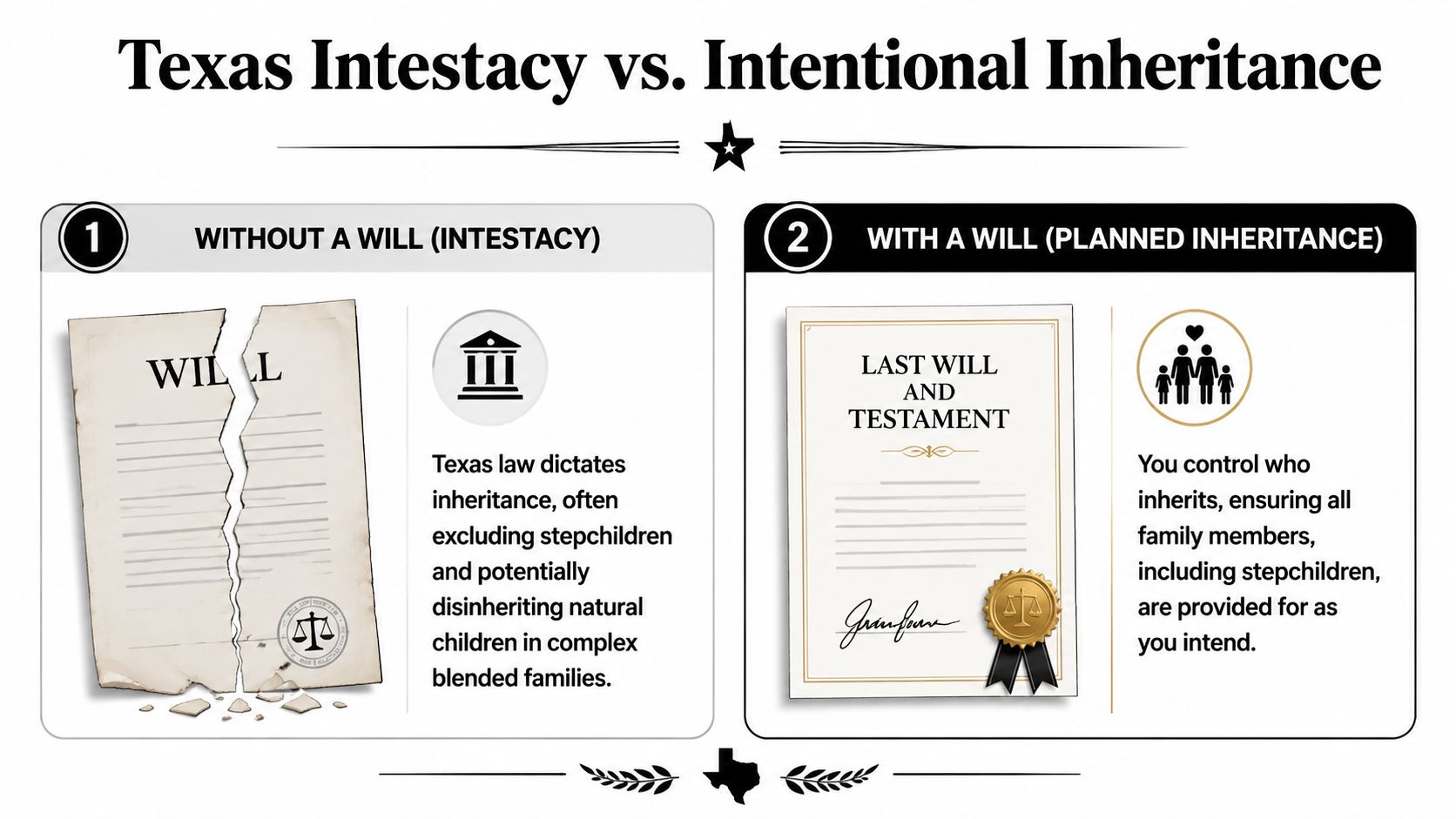
Texas law does not automatically give stepchildren inheritance rights. That single rule causes more heartbreak in blended-family probate than many people expect.
Texas law does not automatically give stepchildren inheritance rights, so a blended family that relies on intestacy can leave an intended heir entirely outside the estate. In practice, that means stepchildren inherit only if they were legally adopted or specifically included in a will, trust, or beneficiary designation. Otherwise, they may receive nothing, as explained in this discussion of stepchildren versus biological children in Texas probate.

Why this feels so unfair to families
The law draws a line between emotional family bonds and legal inheritance rights. A person may have helped raise a stepchild, paid for school, attended every milestone, and considered that child part of the family. But if no adoption occurred and no estate planning document names that child, probate may treat the stepchild as outside the heirship line.
That disconnect is where misunderstandings often become disputes. One side says, "He always treated her like his daughter." The court asks a different question: "Was she legally adopted or named in a valid planning document?"
Minor children can add another layer
If a biological or adopted child inherits and that child is still a minor, probate can become more complicated. Texas law may require court involvement to protect the child's inherited property rather than allowing the child to manage it directly.
That can pull families into guardianship issues at the same time they're handling the estate.
- Guardianship concerns: If a minor inherits property, the court may require a separate structure for management and oversight.
- Control issues: A surviving parent doesn't always get unrestricted authority over inherited assets just because the child lives with them.
- Planning opportunity: Clear estate planning can help avoid unnecessary confusion and reduce the risk of conflict involving minors and inherited property.
For families facing those issues, guidance on Texas guardianship matters can help explain what court supervision may involve.
Stepchildren may feel fully part of the family. Under intestacy, feelings don't control inheritance. Legal status does.
A Tale of Two Estates A Blended Family Scenario
David and Maria live in Texas. David has two children from his first marriage. David and Maria also have one child together. They own a home, some savings, and personal property collected over many years. David also brought certain assets into the marriage.
David dies unexpectedly.
If David dies without a will
Maria assumes everything will pass to her because they're married. David's older children assume their father's share should go to them. Both sides are partly right, and that's the problem.
In Texas intestacy, a blended-family decedent with children from a prior relationship does not pass the surviving spouse the entire estate. The spouse keeps only their own one-half share of community property, while the decedent's one-half community interest passes to the decedent's children. For separate property, the children take two-thirds of separate personal property and all separate real property subject to the surviving spouse's one-third life estate, as described in this overview of spouses, children, and blended families under Texas estate planning rules.
Now apply that to real life. Maria may continue living in the house under limited rights tied to real property rules, while David's children hold inheritance rights in the property itself. Savings may need to be sorted asset by asset. Family keepsakes can become legal property disputes if nobody agreed in advance who should receive them.
If David leaves a clear will
Now rewind the story.
Suppose David signed a valid will that clearly states who receives which assets, names Maria as executor, and directly addresses his children from both relationships. He can leave Maria the right to remain in the home, direct particular property to his children, and make express gifts to any stepchild or child he wants included.
The family still goes through probate, but the court's task is different. Instead of guessing at legal heirs and applying a rigid default formula, the court starts with David's instructions. That usually produces less confusion and fewer emotional collisions.
Where conflict often grows
The same family can end up in two very different places depending on whether planning exists.
| Without a will | With a clear will |
|---|---|
| Court applies default inheritance rules | Court starts with the decedent's written instructions |
| Asset ownership may be split in unexpected ways | Asset distribution can reflect family intent |
| Stepchildren may be excluded unless otherwise protected | Stepchildren can be included directly |
| Heirs may disagree about what is "fair" | The document answers many of those questions upfront |
When those disagreements escalate, they can move into contested probate issues involving ownership, fiduciary duties, or distribution disputes. Families in that position often need to understand the role of Texas probate litigation.
The First Solution Taking Control with a Will
A will gives a blended family something Texas default law cannot. It gives clear instructions for who should receive what, and under what terms.
That matters because blended families often have two goals at the same time. A surviving spouse may need stability, income, and a place to live. Children from an earlier relationship may still need to receive the share their parent always meant for them. A well-written will starts balancing those goals on paper, before grief and uncertainty make every decision harder.
What a will can accomplish
A will lets you name beneficiaries directly. That includes a spouse, children, adopted children, stepchildren, and other loved ones. If you want a stepchild to inherit, the will can say so plainly instead of leaving that question to assumptions or default rules.
It also lets you be specific about property. In a blended family, that level of detail often prevents conflict. You can leave one asset to a spouse, another to children from a prior relationship, and set out how personal items should be divided.
A will can also nominate an executor, the person responsible for collecting assets, paying valid debts, and carrying out the will through probate. In families with strained relationships or competing expectations, choosing a calm and organized executor can lower tension from the start.
A practical checklist for blended families
If your family has children from different relationships, the will should address that structure directly.
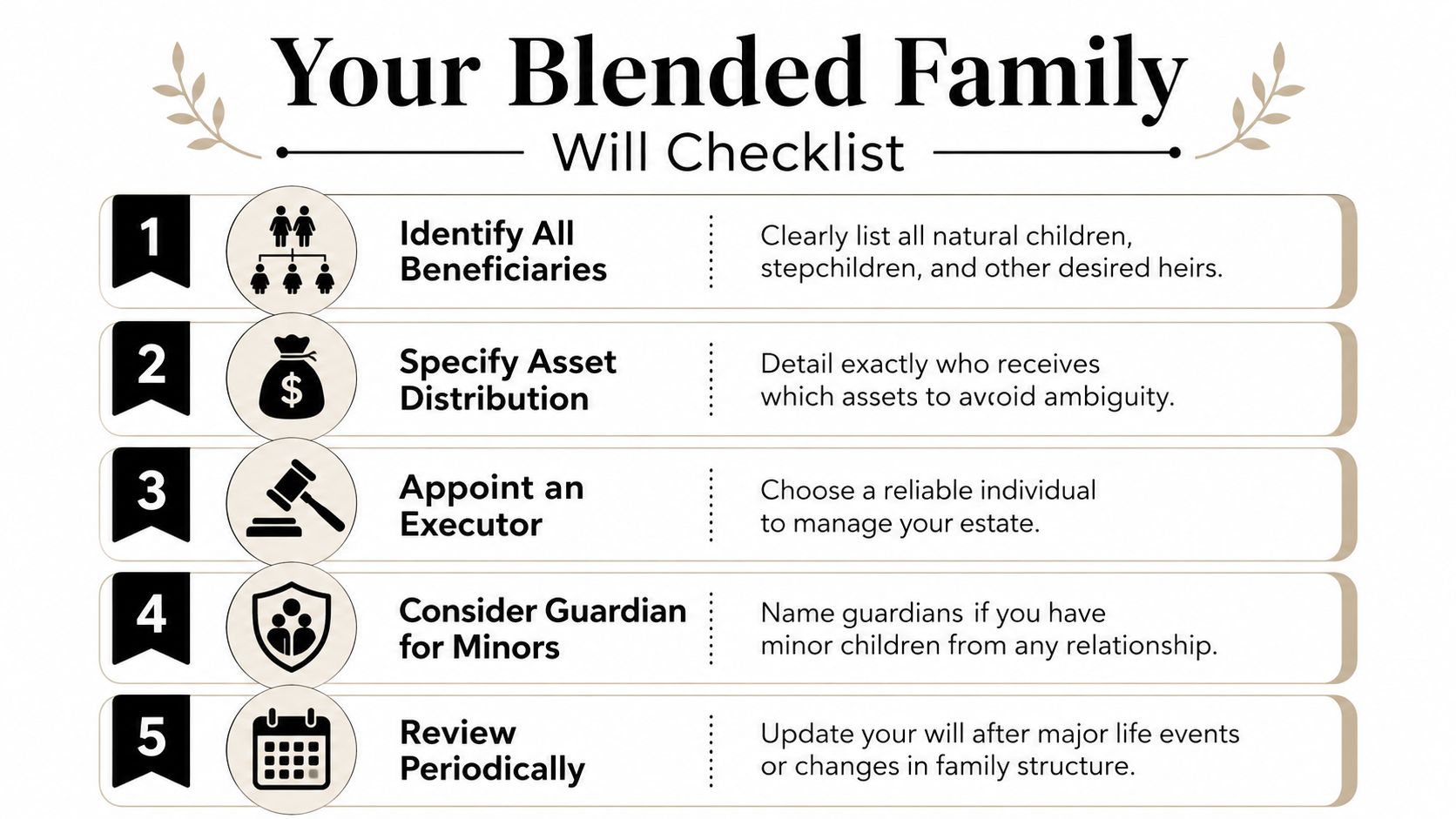
- Name each intended beneficiary clearly: Do not rely on phrases like "my children" if that wording could create confusion about stepchildren, adopted children, or children from an earlier marriage.
- Match gifts to the asset type: Real estate, retirement accounts, family heirlooms, and business interests often need different instructions.
- Choose an executor carefully: Pick someone who can communicate well, follow the document, and stay neutral if emotions rise.
- Plan for minor children: Consider who should manage inherited property for a child and whether a simple outright gift at age 18 really fits your family.
- Update the will after major changes: Remarriage, divorce, a new child, a death in the family, or a large purchase can all change what a fair plan looks like.
A will answers questions while the person who owns the property is still able to answer them.
Clarity matters more than good intentions
Vague language causes problems. A sentence like "my family knows what I want" may feel comforting, but it gives the probate court very little to work with. Clear names, clear shares, and clear instructions usually lead to fewer disputes.
For readers comparing planning tools, guidance on setting up a living trust in Texas can help explain when a will is enough and when added structure may make sense. The Law Office of Bryan Fagan, PLLC handles wills, trusts, probate, and related estate planning for Texas families who want written instructions in place before a crisis.
What a will may not solve on its own
A will is often the first step, not always the final step. That is especially true when the family is trying to protect two interests that can pull in different directions.
Here is the common tension. Leaving everything outright to a surviving spouse may give that spouse financial security, but it can also leave the children from a prior relationship with no guaranteed inheritance later. Leaving assets outright to the children may protect their share, but it can leave the surviving spouse financially exposed.
Trust planning becomes especially useful in that situation. A will can set the plan in motion, but some families need added rules that allow a spouse to use assets during life while preserving what remains for the children afterward.
Advanced Strategies Using Trusts to Protect Everyone
A trust is a legal arrangement that holds property under written instructions. The simplest way to think about it is this: a trust is a rulebook for your assets. It can say who benefits now, who benefits later, and who manages the property in between.
That flexibility is often what blended families need most.
A major underserved angle in this area is how to protect the surviving spouse without unintentionally disinheriting children from a prior relationship. Many discussions repeat that stepchildren usually do not inherit under intestacy, but the practical tradeoff families care about is how to give a spouse enough financial security during life while still preserving the deceased spouse's intended share for children after the second death, as discussed in this article on Texas probate, no will issues, and blended families with minor children.
Why trusts fit blended-family planning
A trust can separate use from ultimate ownership. That distinction is powerful.
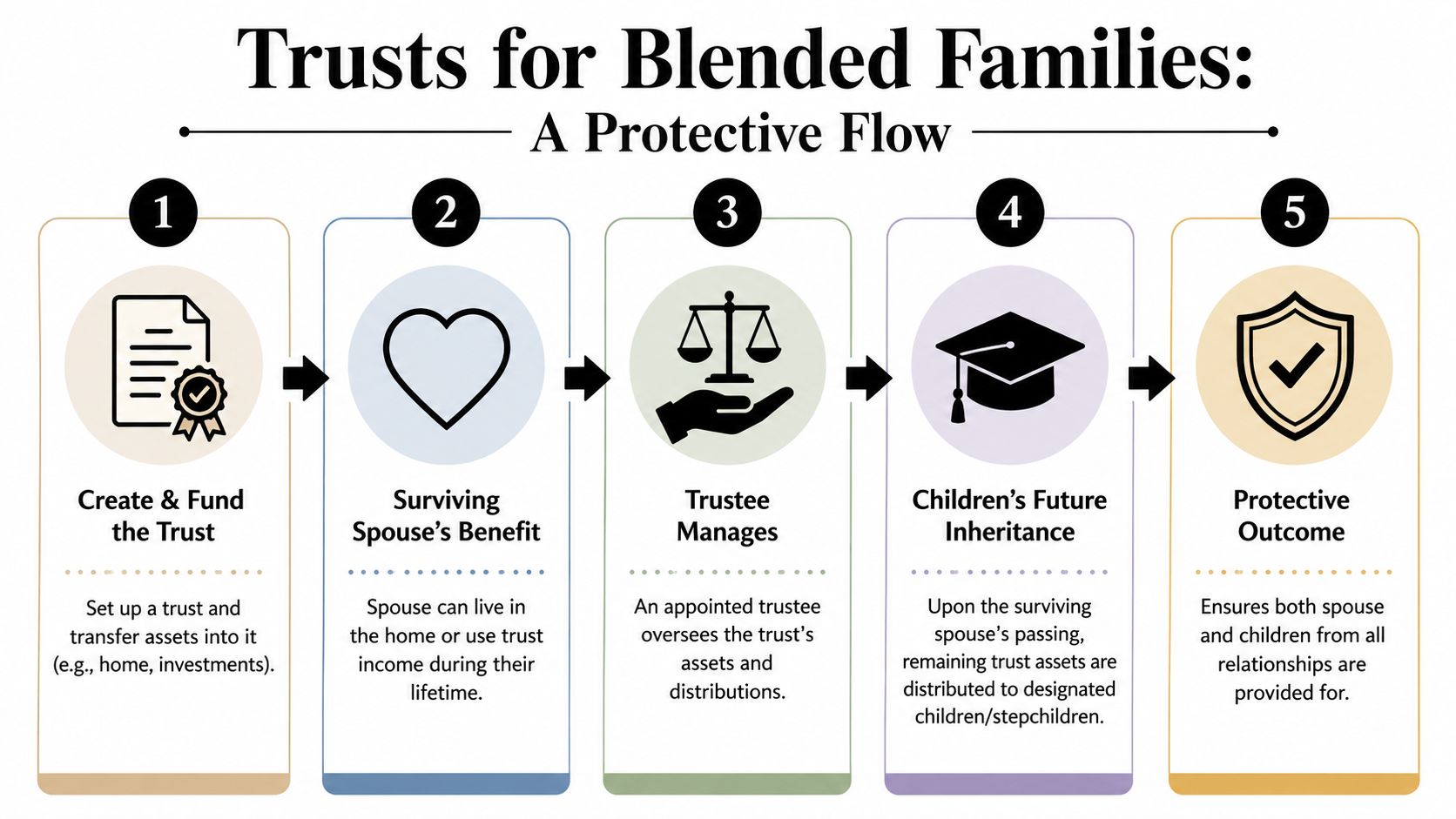
For example, a trust may allow a surviving spouse to live in the home or receive income from trust assets during the spouse's lifetime. After the spouse dies, the remaining trust property can pass to the deceased spouse's chosen children. That structure can reduce the fear that one side of the family will be left insecure or cut out.
One common approach
A QTIP trust is one example lawyers often discuss when a married couple wants to provide for a surviving spouse first while preserving the remainder for children later. The exact design depends on family goals, tax considerations, and the nature of the property involved, but the core idea is straightforward.
- Lifetime support for the spouse: The spouse may receive income or use of certain trust assets during life.
- Protected remainder for children: The trust terms can direct where the remaining assets go after the spouse's death.
- Management by a trustee: A trusted person or institution follows the written instructions rather than relying on informal family promises.
Trust planning often works best when the family wants fairness, not just equal fractions.
Trusts can also coordinate with other planning tools
Trusts work alongside wills, beneficiary designations, and powers of attorney. In many blended-family plans, the documents need to be coordinated so they don't accidentally undermine each other.
For Texas families considering whether this kind of planning fits their situation, guidance on how to set up a living trust can help frame the next conversation with counsel.
The key point is not that every family needs the same trust. It's that blended families often need a structure that can do two things at once. Protect a surviving spouse now. Protect children later.
Key Insights Your Action Plan for Peace of Mind
If you're part of a blended family, the safest approach is to treat estate planning as a way to reduce future conflict, not just as a set of legal forms. Texas probate law can be precise, but your family's goals may be more personal than the default rules allow.
Takeaway
- Don't rely on default inheritance rules: In blended families, intestacy can distribute property in ways that surprise both spouses and children.
- Identify community and separate property early: That classification often drives what happens in probate and can change the outcome in major ways.
- Put your wishes in writing: A valid will can name all intended heirs, including stepchildren and other loved ones who would otherwise be left out.
- Use trusts when goals are layered: If you want a spouse protected during life and children protected afterward, trust planning may offer a better fit than outright gifts alone.
- Plan for minors and management issues: If a child may inherit, think in advance about who should manage that property and under what rules.
- Talk to your family when appropriate: Clear communication can't eliminate grief, but it can reduce painful surprises after death.
A calm next step
Titles 2 and 3 of the Texas Estates Code provide the legal framework for probate, heirship, administration, and related estate issues. But statutes alone don't answer the human side of the problem. Families need plans that match actual relationships, actual assets, and actual concerns.
If you're grieving a loss now, focus first on getting accurate information before making assumptions about inheritance. If you're planning ahead, now is the right time to create documents that protect both your spouse and your children in a way that feels fair and workable.
If you're facing probate in Texas, our team can help guide you through every step, from filing to final distribution. Schedule your free consultation today with Law Office of Bryan Fagan, PLLC.