Skip to content
A lot of executor disputes start the same way. A son or daughter asks for an update, gets a vague answer, and then hears that a vehicle was sold, a house is sitting untouched, or distributions keep getting delayed without a clear explanation. Grief makes every delay feel heavier, and family history often makes it harder to tell the difference between poor communication and actual misconduct.
Texas law does draw that line. An executor isn’t just a family member helping out. The executor is a fiduciary, which means the law requires that person to handle the estate carefully and in the best interests of the estate and its beneficiaries. If you believe that duty has been ignored, you may have options to challenge the executor’s decisions in Texas probate.
When You Suspect an Executor is Mismanaging an Estate
One of the hardest parts of probate is the feeling that something is off, but you can’t yet prove it. Maybe the executor won’t return calls. Maybe you were told the estate is “still being worked on,” but no one can explain what that means. Maybe a bank account seems to have disappeared from the paperwork, or a family home was sold under circumstances that don’t make sense.

A common example looks like this. A beneficiary knows her father owned a truck, a savings account, and a small piece of land. After probate opens, she receives almost no information. Months pass. The truck is gone, the land is being discussed for sale, and the executor keeps saying the estate has “expenses” without showing any records. That doesn’t automatically prove theft or fraud, but it does justify closer review.
What fiduciary duty means in plain English
In plain terms, fiduciary duty means the executor must put the estate first, not personal convenience or personal gain. The executor is supposed to gather assets, protect them, pay valid debts, file required paperwork, and distribute property according to the will and Texas law. An executor can’t treat estate money like a personal checking account, and can’t make decisions merely because they benefit one family member over the others.
That’s why red flags matter. Unexplained delays, missing paperwork, poor recordkeeping, self-interested transactions, and refusal to answer reasonable questions can all point to a larger problem. Sometimes the issue is incompetence. Sometimes it’s conflict. Sometimes it’s direct misconduct.
Practical rule: Suspicion alone won’t win in probate court, but suspicion plus records, dates, and documents can.
What to do first when something feels wrong
Start by grounding yourself in the probate record. Get copies of the will, the order admitting the will to probate, the executor’s appointment papers, and any inventory that has been filed. Those documents often reveal whether the issue is a true legal problem or a misunderstanding about the Texas probate process.
Focus on facts you can verify:
- Communication problems: Keep emails, texts, letters, and voicemail summaries.
- Asset concerns: Write down what property you believe existed and why.
- Timing issues: Track missed promises, delayed sales, or postponed distributions.
- Paper trail gaps: Note whether you’ve received accountings, inventories, or explanations for expenses.
If you’re trying to understand how estates are normally administered, reviewing a broader guide to the probate process can help you separate routine delay from conduct that needs legal attention.
Legal Grounds for Challenging an Executor in Texas
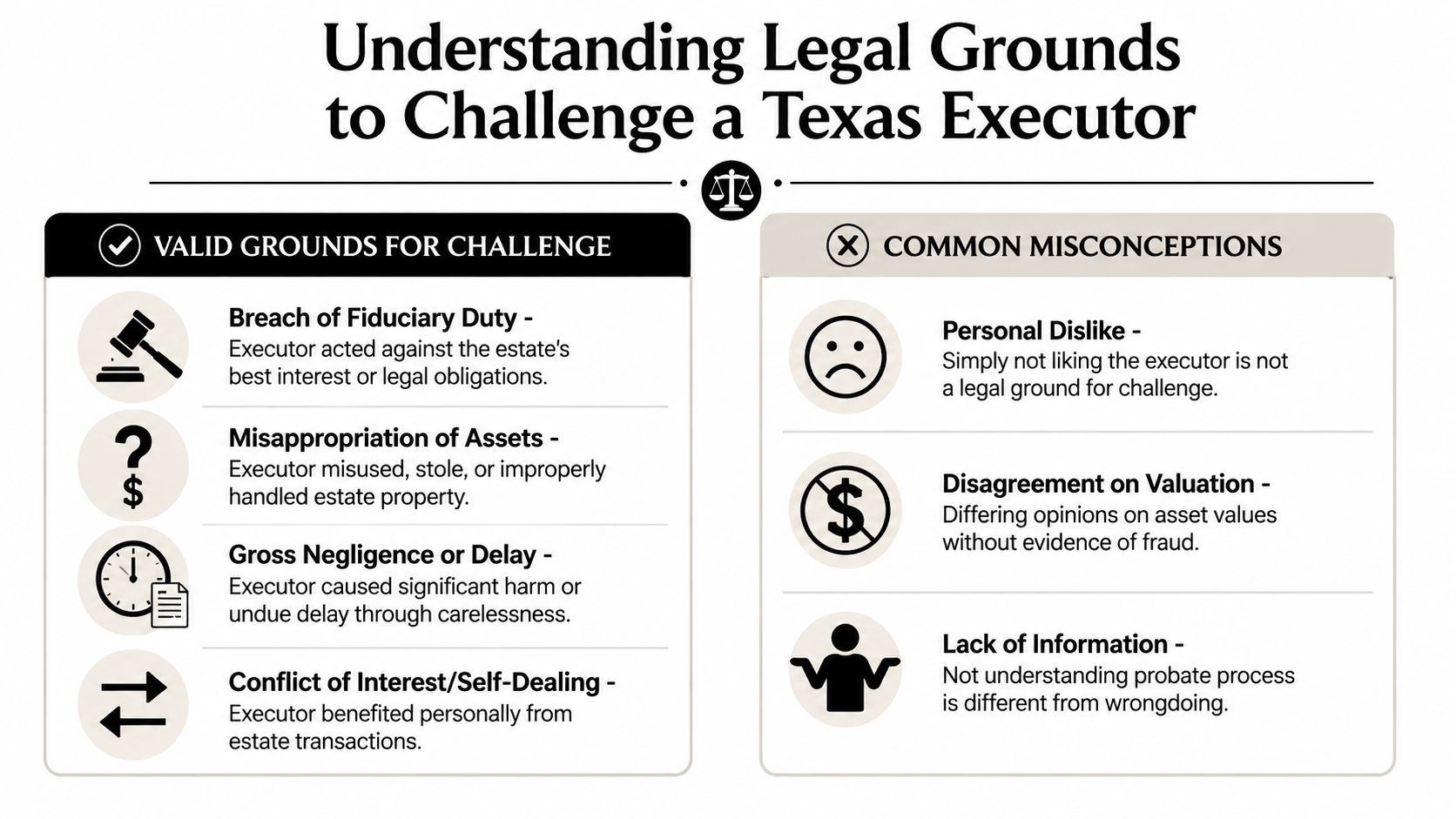
Not every frustrating executor can be removed. Texas probate courts look for specific legal grounds, not general family conflict. Under Texas Estates Code §404.0035, an interested party can seek removal based on grounds such as conflict of interest, breach of fiduciary duty, incompetence, and dishonesty, and courts may consider financial mismanagement and unsuitable behavior when deciding whether removal is justified, as discussed in this overview of executor removal under Texas law.
Grounds that usually matter in court
Here are the issues that tend to support a serious challenge.
Breach of fiduciary duty
This is the broad category. It means the executor acted against the estate’s best interests or ignored legal obligations. A simple example is using estate funds for personal expenses or favoring one beneficiary without authority to do so.
Conflict of interest or self-dealing
An executor can’t use the estate as an opportunity to profit personally. If the executor arranges for estate property to be sold to themselves, to a business they control, or to a close associate on questionable terms, that raises a real legal problem.
Incompetence
This doesn’t mean someone is unpopular or overwhelmed. It means they aren’t capable of properly handling the job. Repeated failure to maintain records, inability to account for assets, or serious confusion about basic estate duties can fall into this category.
Dishonesty or documented misconduct
Fraud, concealment, theft, false statements to the court, or hiding assets are among the most serious allegations. These cases often turn on bank records, transaction histories, and correspondence.
Complaints that usually aren’t enough
Families often come to court with real frustration, but not every frustration is a legal basis for removal.
| Concern | Court reaction |
|---|---|
| You don’t like the executor personally | Usually not enough |
| You think the executor is rude or hard to reach | Not enough by itself |
| You disagree with a value placed on property | Not enough without evidence of wrongdoing |
| You suspect favoritism but have no documents or examples | Weak without proof |
That distinction matters. Probate judges expect evidence tied to legal duties, not just emotional conflict.
A strong case sounds like, “The executor sold estate property without proper explanation and won’t account for the proceeds.” A weak case sounds like, “We’ve never gotten along and I don’t trust him.”
Timing and practical reality
There’s another important point many families don’t expect. Challenging someone before appointment is generally easier than trying to remove them after they are already serving. Once appointed, the executor has authority, procedural rights, and time to defend their actions.
The process can also take several months, and the executor may be able to use estate funds for a legal defense if the court finds they acted in good faith, as noted in the same discussion of Texas executor challenges and removals. That doesn’t mean a challenge isn’t worth bringing. It means your case needs to be built carefully.
Gathering Evidence and Taking Pre-Litigation Steps
The strongest probate challenges usually begin before anyone files a motion. They begin with records. If you think an executor is mishandling estate property, the first phase is a disciplined audit of what should exist, what has been disclosed, and what doesn’t match.

Start with the inventory and the paper trail
In Texas probate, the inventory matters because it is supposed to identify estate assets. Executors generally must file a complete inventory within 90 days of appointment, according to the verified Texas probate timeline discussed in this explanation of probate challenge deadlines. If you suspect omissions or inaccuracies, compare the filed inventory with the decedent’s records.
Useful documents include:
- Tax returns: They may reveal accounts, income sources, or property that should appear in the estate.
- Bank statements: These help track balances, withdrawals, and transfers.
- Titles and deeds: Vehicle titles and real property records can confirm ownership.
- Insurance documents: Policies may identify assets or beneficiaries.
- Prior correspondence: Emails or letters may show what the executor previously admitted existed.
When beneficiaries challenge inventory errors, they often compare the filed inventory against tax returns and bank statements. Under Texas Estates Code §361, a beneficiary may file an Objection to Inventory, but must prove material misrepresentation. According to this discussion of inventory disputes in Texas probate, challenges filed before inventory admission have a 70% success rate, compared with 25% after.
Request an accounting before you rush into court
A formal request for an accounting is often one of the best early moves. In plain English, an accounting is a detailed financial report showing what came into the estate, what went out, and what remains. If the executor can produce clean records, the dispute may narrow quickly. If the executor refuses or produces a confusing report, that response may become part of your evidence.
A practical written request should usually include:
Your identity and interest in the estate
State whether you’re a beneficiary, heir, or creditor.The case information
Include the probate court, county, and cause number if you have it.What you want produced
Ask for account statements, sale records, receipts, distributions, and explanations for major expenses.A deadline for response
Use a reasonable deadline and keep a copy of the request.A clear tone
Be firm, but don’t make accusations you can’t yet prove.
Keep a running timeline. Dates matter in probate. A simple list of requests made, responses received, and missing records can become one of the most useful tools in the case.
This video gives a useful overview of issues families often face during contested probate matters:
What works and what usually backfires
What helps:
- Documents over accusations
- Specific questions over emotional demands
- Copies of records over memory
- A focused review of probate filings and estate accounts
- Early attention to trust and estate planning documents when the estate overlaps with Wills & Trusts
What hurts:
- Family group texts full of allegations
- Threats before you understand the record
- Arguing over every small decision
- Waiting too long to review the inventory
Families sometimes want to “see how it plays out.” That can be costly. If assets are being sold, distributions are being delayed, or records are missing, early evidence gathering often matters more than forceful language.
Navigating the Formal Process to Remove an Executor
Once the evidence points to a real legal violation, the dispute may need to move from private requests to a court filing. This part of the case is procedural, and procedure matters. In probate court, a good claim can still fail if it’s filed by the wrong person, filed too late, or supported by the wrong kind of proof.
Who can file and what gets filed
The first issue is standing. In plain English, standing means you must have a real legal interest in the estate. Beneficiaries, heirs, and certain creditors commonly qualify as interested parties. If you don’t have a financial or legal stake in the estate, the court usually won’t hear your objection.
The usual filing is a Motion to Remove Executor. That motion should clearly identify the executor, describe the misconduct, attach supporting records where possible, and explain the relief requested. Relief may include removal, appointment of a successor, correction of estate administration errors, or additional court supervision.
A typical filing package may include:
- The motion itself
- Supporting exhibits such as bank records, correspondence, inventories, or sale documents
- Affidavits from witnesses with firsthand knowledge
- Notice to interested parties under the Texas procedural rules
If you’re looking for a practical overview of how these cases are filed and heard, this guide to the executor removal probate process in Texas is a helpful companion.
What the court process looks like
After filing, the executor has the right to respond and defend their actions. The court may set a hearing, require notice to other parties, and permit discovery. Discovery is the formal exchange of information. That may include requests for records, depositions, subpoenas, and written questions.
Probate judges generally want evidence tied to duty, harm, and estate administration. They are less interested in sibling rivalry, old resentments, or broad statements that “something isn’t right.” If your evidence shows self-dealing, hidden assets, misuse of funds, or refusal to comply with legal obligations, the court is in a far better position to act.
Probate court is not a place to vent. It is a place to prove.
Deadlines you can’t ignore
Texas probate deadlines are strict. There is a two-year statute of limitations for contesting a will after probate admission under Texas Estates Code § 256.204, and a beneficiary has four years from discovering executor misconduct to bring a breach of fiduciary duty claim under Texas Civil Practice & Remedies Code § 16.004, as explained in this review of Texas probate challenge time limits.
That four-year period matters because of the discovery rule. In plain language, the clock may start when you discover the wrongdoing, not necessarily when the executor was appointed. That can be especially important for out-of-state heirs or family members who weren’t receiving prompt information.
When related issues complicate the case
Some probate disputes involve more than estate administration. If capacity issues, vulnerable adults, or prior powers of attorney are involved, related concerns may intersect with Guardianship. Those cases need a coordinated strategy, because records from one proceeding can affect another.
Exploring Alternatives to a Full Court Battle
Not every executor dispute should end in a contested hearing. Sometimes court is necessary. Sometimes it’s the most expensive way to solve a problem that could have been narrowed through an accounting, targeted document requests, or mediation.
Probate litigation in Texas can average $15,000 to $50,000, and alternatives such as court-ordered mediation may save 40% to 70% in legal fees in many cases, according to this discussion of executor misconduct disputes and probate costs.

When mediation makes sense
Mediation is a structured settlement meeting with a neutral third party. The mediator doesn’t decide who wins. The mediator helps the parties work toward an agreement. In probate, that might mean the executor agrees to provide a full accounting, reverse a proposed sale, accept tighter court oversight, or step aside in exchange for a negotiated transition.
Mediation tends to work best when:
- The main issue is transparency rather than obvious theft
- The estate still has enough assets to justify protecting them without depleting them on fees
- Family members need a practical solution more than a public fight
- The records are incomplete but fixable
When settlement is realistic and when it isn’t
A negotiated settlement often works when the executor made mistakes but can still correct them. For example, if an executor failed to provide records, missed deadlines, or handled communication badly, a settlement may require immediate disclosures, an amended inventory, or a timetable for distributions.
A settlement is less likely to hold when the evidence points to concealment, fraud, or direct misuse of property. In those cases, a private agreement may not provide enough protection, and court orders may be necessary.
Here is a simple way to think about the trade-off:
| Option | Best fit | Main downside |
|---|---|---|
| Written demand for accounting | Early-stage concerns | Executor may ignore it |
| Mediation | Correctable disputes and family conflict | No guaranteed result |
| Settlement negotiations | Specific issues can be resolved on paper | May not address deeper misconduct |
| Removal litigation | Serious breaches of duty | High cost, long process, emotional strain |
A practical cost-benefit lens
Texas courts rarely remove an executor without clear and convincing proof of harm, and pre-litigation steps such as demanding an accounting under §404.001 often resolve many disputes without a lawsuit, as noted in the same probate cost discussion linked above.
That’s the key trade-off. If your evidence is thin, jumping into litigation may only increase stress and legal fees. If your evidence is strong and the executor is stonewalling, delay can make the estate harder to protect.
Key Insights and When You Need a Probate Attorney
Most families don’t begin probate looking for a fight. They want the executor to do the job correctly, keep everyone informed, and distribute property according to the will and Texas law. When that doesn’t happen, the right response is usually not immediate courtroom escalation. It’s careful fact gathering, a clear written record, and a realistic assessment of whether the problem is confusion, incompetence, or misconduct.
The practical lesson is simple. How to Challenge an Executor’s Decisions in Texas Probate is not just about filing papers. It’s about building a credible case. Probate judges respond to records, timelines, probate filings, account statements, and proof that the executor failed a legal duty. They do not respond well to generalized distrust or family anger without documentation.
Key Insight: The strongest executor challenges are usually won before the hearing starts. They are built through prompt action, careful document collection, and a clear link between the executor’s conduct and actual harm to the estate.
Red flags that mean it’s time to get legal help
You should strongly consider speaking with a probate attorney if any of the following are happening:
- The executor refuses to provide an accounting after a reasonable written request.
- You found missing assets that should appear in the estate inventory.
- Estate money appears to be mixed with personal money or spent without explanation.
- Property is being sold under suspicious terms or to people connected to the executor.
- The executor ignores court orders or filing obligations.
- You received notice of a court hearing or filing and you’re unsure how it affects your rights.
- Family conflict is escalating so quickly that informal communication is no longer productive.
- The estate includes related incapacity issues involving prior caretaking, powers of attorney, or vulnerable beneficiaries.
What an attorney helps you do
A probate attorney doesn’t just “go to court.” Good counsel helps you identify what kind of claim you have, preserve evidence, avoid procedural mistakes, and decide whether the best path is an accounting request, an inventory objection, mediation, or a removal motion. That evaluation matters because once probate litigation starts, strategy becomes just as important as the facts.
It also helps to have someone separate legal merit from emotion. Some cases need immediate court intervention. Others improve once the executor is forced to produce records and answer specific questions. Knowing the difference can protect both the estate and your budget.
If you’re already feeling behind, don’t assume it’s too late. Deadlines can be strict, but the sooner you review the probate file and the executor’s actions, the more options you’re likely to preserve.
If you’re facing probate in Texas, the Law Office of Bryan Fagan, PLLC can help guide you through every step, from filing to final distribution. Whether you need help with the Texas Probate Process, Wills & Trusts, Guardianship, or Probate Litigation, our team is here to provide clear answers and practical support. Schedule your free consultation today.