A parent dies. The funeral has barely ended, and someone in the family is already asking who can access the bank account, whether the house can be sold, and what happens to the bills that keep arriving in the mail. If you've just been named executor, that pressure can feel immediate and personal.
Most families don't start this process knowing probate vocabulary. They hear terms like “independent administration,” “dependent administration,” “Letters Testamentary,” and “inventory,” and it all sounds more complicated than grief should allow. That reaction is normal.
One of the first practical questions in Texas probate is whether the estate will move through independent administration or dependent administration. That choice affects how much control the executor has, how often the court stays involved, and how much friction the family may face along the way. It also shapes smaller questions families ask early, including whether certain assets pass outside probate. For example, if you're sorting out policy proceeds, this plain-English guide on is life insurance part of an estate can help clarify what may or may not need to go through the estate.
The good news is that these are familiar roads in Texas probate law. Families walk them every day. The key is understanding not just which path is faster, but why one path fits your family better than the other.
Navigating a Loved One's Estate in Texas
A common Texas probate story starts like this: a daughter finds her father's will in a desk drawer, sees that she's named executor, and assumes that means she can gather the assets and carry out his wishes. Then she learns that the court must first recognize her authority. Soon after, she hears two terms she's never needed before: independent administration and dependent administration.
Those terms matter because they describe two very different ways to settle an estate.
In plain English, estate administration means handling the legal and financial tasks left after someone dies. That usually includes identifying assets, dealing with debts and taxes, protecting property, and distributing what remains to the right people. Texas Estates Code Title 2 and Title 3 provide the broader legal framework for probate, wills, and estate administration, while the detailed rules for independent and dependent administration appear in the probate administration portions of the Code.
What families are really asking
People aren't asking for a lecture on procedure. They're asking:
- Can I do what needs to be done without going back to court every time?
- Will the family have to agree on everything?
- Is court supervision protection, or just extra delay?
- What happens if someone objects?
Those are the right questions. The answer usually turns on the family dynamic as much as the legal paperwork.
Grief doesn't pause deadlines. Mortgage payments, insurance issues, property security, and creditor notices still have to be addressed while the family is mourning.
Why the choice matters so much
Texas is known for favoring a more efficient probate process when the estate qualifies for it. But “better” doesn't always mean “less supervision.” In some estates, a judge's ongoing oversight protects the executor from accusations and protects heirs from conflict.
If your family is cooperative, the will is clear, and the estate is manageable, one route often works well. If there are minors, creditor pressure, or serious disagreement, the other route may be the safer choice.
The Two Paths of Texas Estate Administration

The core difference between these two probate paths is the level of court supervision. In an independent administration, the personal representative usually has authority to act without asking the court for approval at each step after appointment and the required initial filings. In a dependent administration, the court stays involved and must approve many major decisions.
That difference matters because probate is rarely just paperwork. A daughter serving as executor may need to secure a vacant house, deal with overdue bills, and answer questions from siblings who are already on edge. In a cooperative family, broad authority can keep the estate moving. In a tense family, that same freedom can trigger suspicion, objections, and more conflict.
Independent administration in plain English
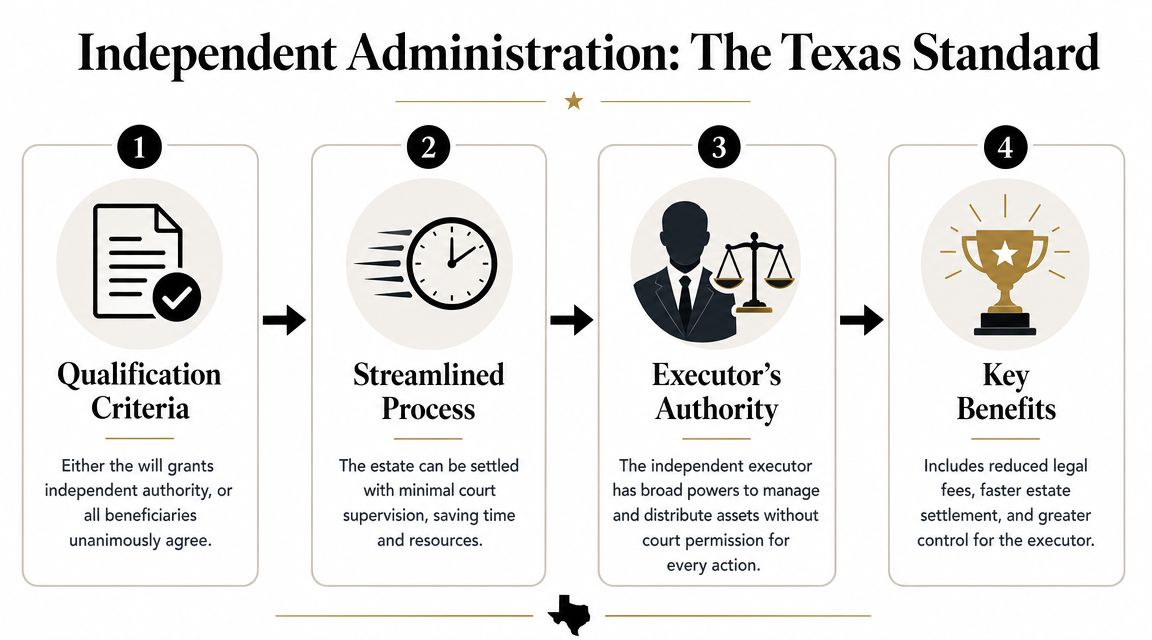
Independent administration is Texas's preferred model for many estates because it lets the executor do the job with less court involvement. Once the court appoints the executor and the estate clears the early procedural steps, the executor can usually collect assets, handle routine estate business, pay valid debts, and distribute property without repeated hearings.
That efficiency is real, but it is not the whole story. Independent administration works best when the will is clear, the executor is trustworthy, and the people receiving the estate are likely to accept the executor's decisions. Families who want a closer look at that process can read this explanation of independent administration in Texas probate.
Dependent administration in plain English
Dependent administration places the estate under regular judicial supervision. The administrator often must request permission before selling property, paying some claims, compromising disputes, or making distributions.
That adds time and expense. It can also add protection.
If an estate has creditor pressure, a questionable will, a blended family dispute, or beneficiaries who do not trust the person in charge, court oversight can serve as a shield. It creates a clearer record of what was approved, when it was approved, and why. For some administrators, that protection is worth the added procedure because it reduces the chance that every decision turns into a personal accusation.
A quick comparison
| Issue | Independent administration | Dependent administration |
|---|---|---|
| Court involvement | Limited after appointment | Ongoing for most major actions |
| Executor authority | Broad in day-to-day administration | Narrower, with court approval often required |
| Timing | Usually faster if the estate is cooperative | Usually slower because of added approvals |
| Cost | Often lower court and attorney costs | Often higher because of hearings and filings |
| Best fit | Clear will, manageable assets, low conflict | Disputes, creditor concerns, minors, or higher risk |
The better question is not which option costs less. The better question is why this estate needs freedom, oversight, or some protection for the person serving.
Texas law offers both models for a reason. One assumes the representative can handle the work responsibly with limited supervision. The other recognizes that some estates are safer when the judge remains closely involved.
Independent Administration The Texas Standard
A common Texas probate file looks like this. A parent dies with a valid will, names one child as executor, leaves property to adult children who generally trust each other, and the estate needs ordinary work done without weeks of delay between each step. In that setting, independent administration usually fits because the need is for someone to act responsibly and keep the estate moving.
Why Texas leans this way
Texas probate law generally prefers a model that gives the personal representative room to do the job after appointment. Once the executor is qualified and the required probate steps are handled, the court usually does not need to approve each routine decision. That design reflects a practical judgment. Many estates do not benefit from constant supervision if the executor is trustworthy, the beneficiaries are adults, and the estate is not headed for a fight.
That matters for families dealing with real deadlines. A vacant home still needs insurance and upkeep. Utility bills still arrive. Vehicles need to be retitled or sold. Waiting for repeated court approval can turn simple estate tasks into expensive ones.
What gives an independent executor real authority
The legal reason independent administration works is authority. Under Texas Estates Code § 402.002, an independent executor may take actions without a court order that a court-supervised representative could take only with court approval. A Texas probate guide discussing that section explains the scope of that authority in this overview of independent administration.
In practice, that often means the executor can:
- Protect estate property before neglect creates bigger problems
- Address creditor claims in the normal course of administration
- Handle transfers and distributions after debts, taxes, and other estate duties are resolved
Families who want a clearer picture of the day-to-day process can review independent administration in Texas probate explained.
Why independence is often the better fit
The appeal is not just lower cost or faster paperwork. The deeper reason is that some estates need decision-making room more than they need a judge involved at every turn.
Take a straightforward example. A widowed father leaves a house, a bank account, and a truck to his two adult daughters. He names one daughter as executor. They agree the house should be sold, the debts are ordinary, and there is no serious suspicion that the executor will misuse funds. Independent administration lets that executor deal with brokers, maintain the property, gather account information, and complete the estate work without asking the court to bless each step.
That freedom can reduce tension, too. Grief is hard enough. If every ordinary choice requires a hearing, the process can feel heavier than it needs to be.
Independence still comes with duties
Independent does not mean unchecked. The executor still owes fiduciary duties to the estate and the beneficiaries. That includes following the will, keeping accurate records, handling property carefully, avoiding self-dealing, and being prepared to account for actions if challenged.
That point matters because families sometimes hear "independent" and assume the executor can do whatever he or she wants. Texas law does not allow that. Independent administration is a grant of authority tied to legal responsibility. It works best when the estate calls for efficient action and the person serving can be trusted to use that authority carefully.
Dependent Administration When Court Oversight Is a Shield
Dependent administration often gets described as the less desirable option. That's too simplistic. In the right estate, it's a safeguard.
When a family is in conflict, when an heir is vulnerable, or when debts and claims could expose the representative to criticism, court supervision can provide structure that private decision-making cannot.
What court-gated workflow really means
A practical distinction is the control model. In dependent administration, major steps usually require separate court orders. A Texas probate resource describes this as a court-gated workflow, where property sales, creditor payments, and other major actions commonly need approval, and notes that this structure provides stronger procedural oversight and legal protection even though it is slower and costlier in its discussion of dependent versus independent administration.
That means the administrator is not making the call alone on every important move. The court becomes part of the process.
When that oversight helps
Dependent administration can be valuable in situations like these:
- Minor or incapacitated heirs. If someone cannot legally protect their own interest, court oversight may be necessary.
- Serious family disagreement. If heirs don't trust one another, independent administration can become a battleground.
- Unclear creditor issues. If the estate may not be able to pay everyone, caution matters.
- Questions about the representative. If family members believe a proposed executor may not handle things properly, a supervised process can reduce risk.
A family dealing with these issues often also needs guidance on the representative's formal authority, including Texas letters of administration, which establish who can act on behalf of the estate when an administrator is appointed.
A scenario where slower is better
Consider a blended family. A husband dies, leaving a surviving spouse and children from an earlier marriage. One side believes certain property belongs to the spouse. The other side believes it should pass to the children. No one agrees on whether to sell the home, and each decision is treated as suspect.
In that setting, independent administration can put the representative in an impossible position. Whatever the representative does, someone may claim favoritism or misconduct. Dependent administration slows the process, but it also places key decisions before the court.
Sometimes the best probate path is the one that creates a record, forces notice, and reduces the chance that one family member will later say, “No one told me.”
For a grieving family, that can feel frustrating. For a representative trying to avoid personal liability, it can be a shield.
A Head-to-Head Comparison Cost Speed and Control
A daughter who lives nearby may want authority to list the house, close bank accounts, and pay bills without asking the court for permission at each step. A son who lives out of state may want the opposite if he does not trust every decision being made. That is why this choice is rarely just about speed. It is about what kind of process the family can live with.
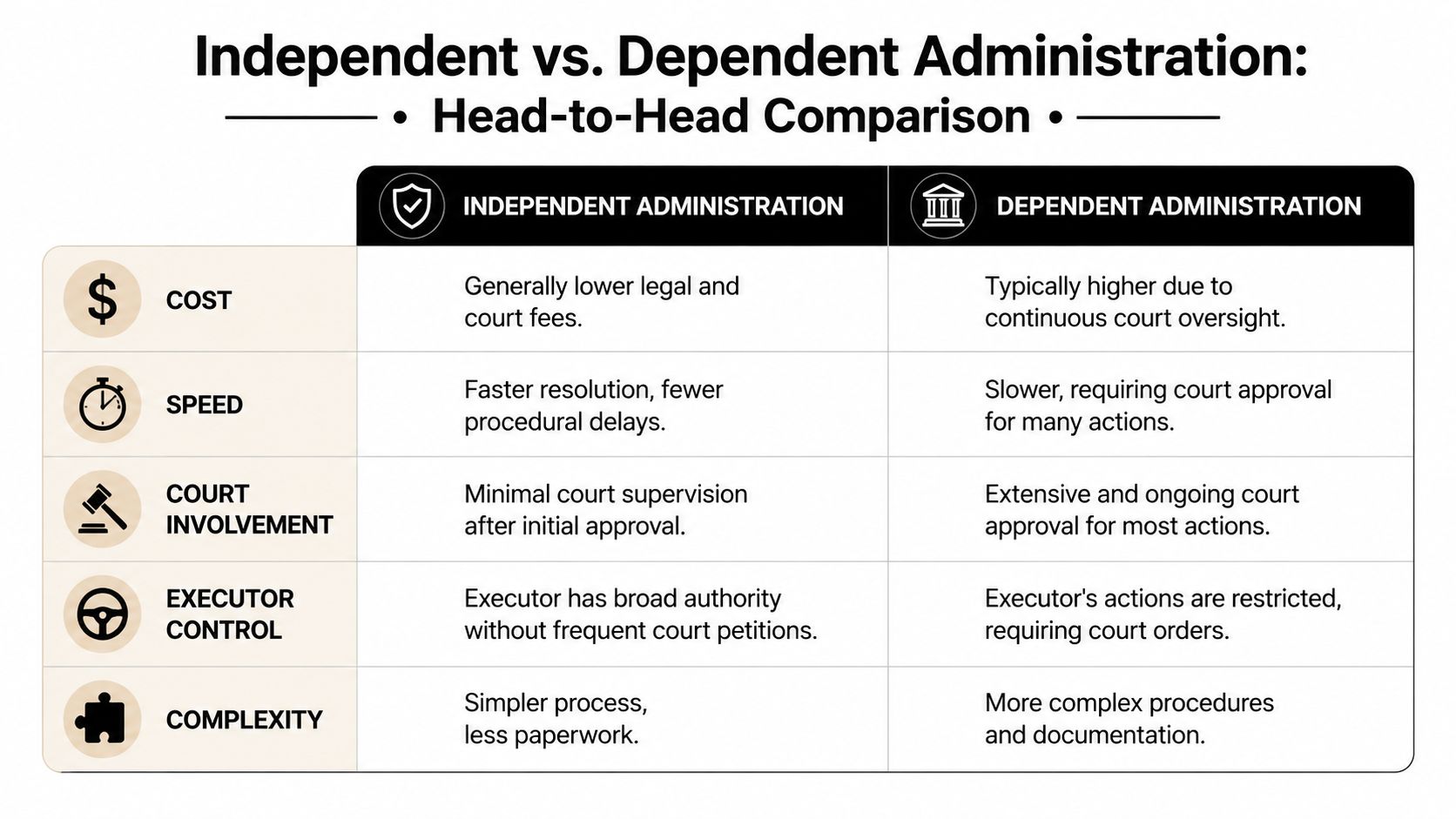
Side-by-side on the issues families actually care about
In many Texas estates, independent administration is the preferred route because it lets the personal representative do the work with less court involvement after appointment. That usually means fewer hearings, fewer filings, and fewer delays tied to routine decisions. Dependent administration asks for more court approval along the way. That can feel heavy, but it also creates structure at the moments families are most likely to argue.
Here is the practical comparison:
| Decision factor | Independent administration | Dependent administration |
|---|---|---|
| Court involvement | Concentrated at the start, with limited supervision afterward | Ongoing supervision for major actions |
| Decision-making | Executor or administrator can often act directly | Court approval is often needed before acting |
| Family friction | Works best where trust is already present | Helps when mistrust is likely to affect every step |
| Property sales | Usually more flexible and faster to handle | Often slower because approval is commonly required |
| Protection from later complaints | Depends heavily on good records, notice, and communication | A court order can reduce later claims that someone acted unfairly |
Cost matters, of course. Families who want a fuller picture of fees, filing expenses, and attorney time should review the broader cost of probate in Texas before deciding that the cheaper-looking path is the safer one.
A short video can also help if you prefer a visual explanation:
The trade-off
The harder question is not which process is faster on paper. The harder question is what problem the family is trying to solve.
Independent administration is often the right fit when the representative is organized, the assets are straightforward, and the beneficiaries are likely to accept ordinary estate decisions without turning each one into a dispute. In that setting, extra court supervision often adds expense without adding much protection.
Dependent administration serves a different purpose. It slows decision-making, but it can also protect the representative, force formal notice, and place disputed actions in front of a judge instead of in the middle of family conflict. For some estates, that structure is not a burden. It is the reason the administration stays on track.
A calm estate usually benefits from flexibility. A contested or fragile estate often benefits from a process everyone can see and challenge in the open.
Choosing the Right Path Real-World Scenarios
The law becomes clearer when you put it into family situations instead of abstract definitions.
Scenario one, the harmonious family
Maria dies with a will that clearly names her daughter Elena as executor. Maria's beneficiaries are her three adult children. They all get along, they all trust Elena, and they agree that the home should be sold and the proceeds divided after debts are paid.
This is the kind of estate where independent administration usually makes sense. The family doesn't need the court to supervise ordinary decisions because there's no active dispute to manage. Elena still has responsibilities. She needs to identify assets, gather records, address debts properly, and keep the beneficiaries informed. But the process doesn't need a judge at every turn.
Scenario two, the blended family dispute
James dies remarried. His second wife lives in the home. His adult sons from a prior marriage believe some accounts and personal property should go to them. The will language is being read differently by each side. Every conversation becomes tense.
That estate may need dependent administration, or at minimum a careful legal assessment before anyone assumes independence is safe. In a case like this, court oversight can reduce accusations that the representative is favoring one side. It also creates a formal process for notice, objections, and approval of major actions.
Scenario three, the debt-heavy estate
A small business owner dies with equipment, receivables, business records, tax questions, and multiple creditor claims. Some debts are clear. Others are disputed. The family also isn't sure whether all property is estate property or partly tied to the business.
That doesn't automatically require dependent administration, but it's the kind of estate where oversight may be strategically useful. If the representative is worried about paying the wrong party, selling the wrong asset, or being accused of mishandling an insolvent estate, a supervised path can reduce personal exposure.
How to use these examples
Ask yourself which of these sounds most like your family:
- Cooperative adults with a clear plan
- People who already distrust one another
- An estate with creditor pressure or legal uncertainty
If you're in the first group, independent administration often fits. If you're in the second or third, court oversight may be less of a burden than a source of protection.
One practical step is to have a probate attorney review the will, identify whether the estate can qualify for independent administration, and flag the issues that could make supervision wise. The Law Office of Bryan Fagan, PLLC is one Texas probate counsel families may consult for that kind of case-specific review.
Key Takeaways and Your Administration Checklist
Key takeaway
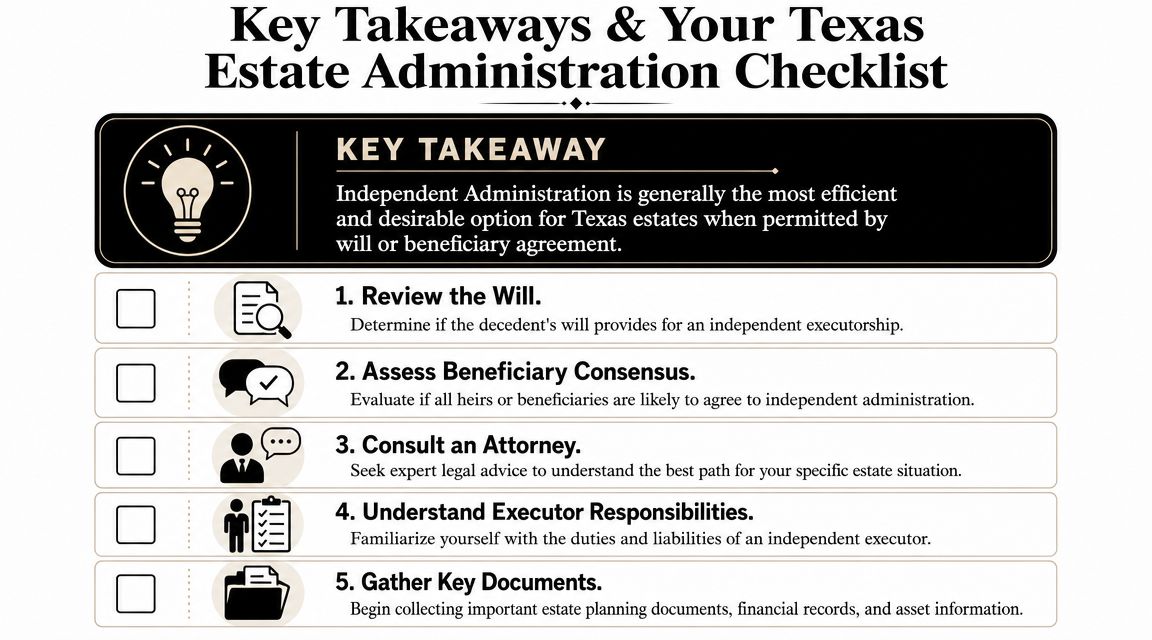
Independent administration is usually the better fit for a straightforward Texas estate. It gives the executor room to act and usually reduces delay and expense.
Dependent administration is better when oversight serves a purpose. If the estate involves vulnerable heirs, conflict, or meaningful uncertainty, court supervision can protect everyone involved.
Your practical checklist
Use these questions before filing anything:
- Review the will carefully. Does it support independent administration, or is the language silent or complicated?
- Identify the heirs and beneficiaries. Are they adults, and are they likely to agree?
- Look for risk factors. Are there disputes, debt concerns, missing records, or property questions?
- Assess the representative. Is the proposed executor organized, neutral, and able to carry out fiduciary duties?
- Gather core documents. Start with the death certificate, original will if there is one, account information, deeds, and debt records.
Related probate issues families often need
Texas probate decisions rarely happen in isolation. Families also need guidance on the broader Texas Probate Process, estate planning through Wills & Trusts, protection for vulnerable loved ones through Guardianship, and dispute resolution through Probate Litigation.
If you're not sure which path applies, that uncertainty itself is a sign to get legal advice before taking action.
Frequently Asked Questions About Texas Administration
What happens if the will doesn't say anything about the type of administration
If the will is silent, the family should not assume the estate automatically gets the simpler route. Whether independent administration is still available depends on the facts and on whether the necessary people can agree. If there's disagreement, the court may require the supervised path.
Can we start with dependent administration and switch to independent later
Sometimes that becomes possible if the issues that made supervision necessary are resolved and the required agreement exists. But families should not count on an easy conversion. It's better to evaluate the right path early, before the estate spends time and money moving under the wrong model.
What if one heir objects to independent administration just to be difficult
An objection still matters. Probate courts focus on whether the legal requirements for independence are satisfied, not on whether a family member is being reasonable. If a single heir's objection blocks the required agreement, that can push the estate toward dependent administration. In practice, this is often where legal counsel helps separate genuine legal concerns from strategic maneuvers.
Who pays for the extra legal fees in a dependent administration
Those costs are typically estate expenses, which means they usually affect what remains for distribution after proper obligations are paid. That is one reason family conflict can become expensive quickly. The more procedure the estate requires, the less flexibility it has.
Does independent administration mean no court involvement at all
No. The estate still begins in court. The executor still needs formal appointment and authority to act. “Independent” doesn't mean informal. It means that after the required starting steps, the executor usually doesn't need continued approval for routine administration.
If you're facing probate in Texas, our team can help guide you through every step, from filing to final distribution. Contact Law Office of Bryan Fagan, PLLC to schedule your free consultation today.