Skip to content
Losing a loved one is hard enough. Then the mail keeps coming, the property still needs attention, relatives start asking questions, and the person named to handle the estate realizes they can't walk into a bank and take care of business. That's often the moment families ask, what happens when probate gets delayed in Texas?
The short answer is that a delay can affect almost everything. It can slow access to property, complicate debt payment, increase conflict, and leave an executor feeling stuck between legal duties and practical problems. Texas probate law gives families a path forward, but when that path is blocked, the uncertainty can feel heavier by the day.
The Weight of Waiting An Introduction to Probate Delays
A common Texas probate story starts with someone trying to do the right thing.
A daughter is named executor in her father's will. She has the death certificate, a folder of papers, and a list of bills that still need attention. She assumes she can start paying expenses, collect accounts, and transfer the house once she files the will. Instead, she learns the court process takes time, the bank wants proof of authority, and family members are already anxious about what comes next.
That's what a probate delay looks like in real life. It doesn't always mean the case has gone completely off track. Sometimes it means the process is moving more slowly than the family expected. Sometimes it means the estate is stalled because a document is missing, a hearing hasn't been set, or someone has objected.

For many families, the first surprise is timing. For an ordinary uncontested estate, Texas probate often takes about 6 to 12 months, but delays from missing documents, disputes, court backlog, or complex assets can push the process to 1 to 3 years or longer, and the executor may not have full authority to collect assets, pay debts, or transfer real estate until the court process is completed, as explained in this discussion of Texas probate delays and timeline issues.
Why delay feels so disruptive
Probate is the legal process that lets the court recognize a will, appoint the right person to act, and oversee transfer of property under Texas Estates Code Titles 2 and 3. In plain English, it's the court's way of confirming who has authority and how estate property should be handled.
If that authority is delayed, everyday tasks can stop too:
- Bank access gets complicated. Financial institutions often want court-issued authority before releasing estate funds.
- Property decisions may have to wait. A house can't always be sold or transferred right away.
- Debt payment becomes uncertain. Bills don't always pause just because the family is grieving.
Practical rule: Probate delay isn't just court delay. It often means delayed control over the loved one's affairs.
Families who are dealing with probate after a death sometimes also realize they need guidance for their own planning. In that context, it may help to consult Lein Law Offices for estate planning as an additional educational resource on protecting assets and loved ones.
If you're trying to understand timing in your own situation, this overview of how long probate takes in Texas can help put the delay in context.
Common Reasons Why Probate Gets Delayed in Texas
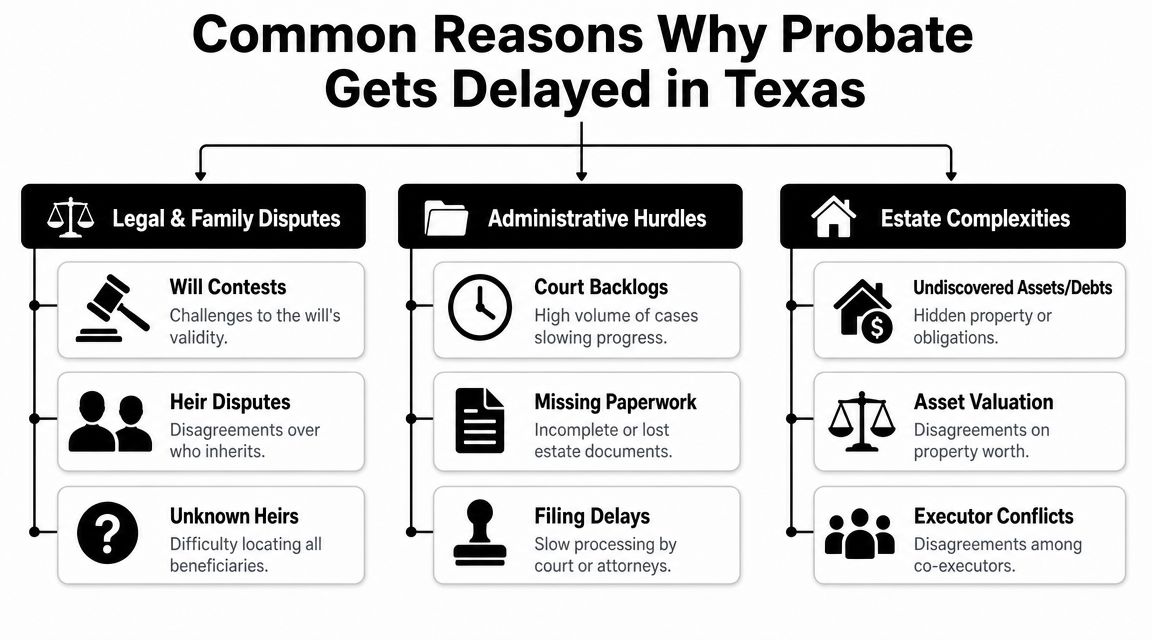
Some delays come from paperwork. Others come from people. Others come from the court system itself. When families understand which category they're dealing with, the next step becomes clearer.
Administrative hurdles
Probate depends on correct filings and complete information. If the original will can't be found, signatures are missing, names don't match, or required notices haven't been handled properly, the court may not move the case forward.
Some estates are delayed because no one has a full picture of what the deceased owned or owed. An executor might know about the homestead and one bank account, but not about mineral interests, old debts, or a vehicle title problem. Those loose ends matter because the estate can't be wrapped up cleanly until the record is clear.
Legal and family disputes
A second group of delays comes from conflict. One person may question whether the will is valid. Someone else may argue over who should serve as executor. In estates without a clear path, the court may need evidence, hearings, or additional filings before it can decide what happens next.
During probate delays, people often hear terms like will contest or probate litigation. In plain language, that means the probate matter has become a legal dispute that the judge must resolve before administration can continue.
To understand the issues that commonly slow estates down, this page on factors affecting probate timelines gives a useful overview.
A helpful primer on the process appears below.
Systemic delays and the four-year deadline
Even when a family does everything right, the court's calendar can still affect timing. Busy probate dockets, hearing schedules, and local procedures can slow progress.
There is also one delay issue that deserves special attention. In Texas, a will generally must be admitted to probate within four years of the decedent's death under Texas Estates Code Section 256.003. If that deadline is missed, the will can lose its ability to control distribution, and the estate may instead be treated under intestacy rules unless a narrow exception applies, as explained in this discussion of Texas Estates Code Section 256.003 and the probate filing deadline.
That point confuses many families. They assume a late filing just means a slower filing. It can be much more serious than that.
Missing the filing window can change the legal framework of the estate. It may no longer be a matter of carrying out the will's instructions. It may become a matter of proving heirship under Texas law.
Under Title 2 of the Texas Estates Code, intestacy means the law decides who inherits when a valid will doesn't control distribution. That can create a very different result from what the deceased person intended.
The Financial and Emotional Cost of a Stalled Estate
A stalled estate affects a family the way a house freeze affects plumbing. What looked manageable at first starts creating pressure in places you did not expect. Bills keep coming. Property still needs attention. Tension inside the family rises while no one feels free to fully move on.
That is why probate delay is rarely just a timing problem. It becomes a money problem, a legal problem, and often a grief problem too.
Why the financial strain grows over time
Many estates look stable on paper and still struggle in real life. A house, a vehicle, or land may hold value, but those assets do not automatically produce cash for taxes, insurance, repairs, storage, utilities, or creditor issues. Until the estate can access and use funds properly, the executor may feel like someone responsible for a property they cannot fully control.
The longer the case sits, the more those ordinary costs pile up. A vacant home may need lawn care, security, and maintenance. A car may need insurance and safe storage. If the estate has too little cash on hand, the personal representative may have to consider selling property just to cover ongoing obligations, and that can take time and court involvement depending on the type of administration.
Families often feel confused by this point, so it helps to say it plainly. Wealth and cash are not the same thing. An estate can be asset-rich and cash-poor at the same time.
Common financial pressure points include:
- Ongoing property expenses. Mortgage payments, taxes, insurance, utilities, and upkeep do not stop because probate is pending.
- Delayed access to estate funds. Heirs may assume money is available right away when it is not yet legally ready for distribution.
- Added administrative expense. More delay often means more paperwork, more professional help, and more work to preserve assets.
- Possible forced sales. Property may need to be sold at an inconvenient time to meet obligations.
Those costs can change how a family views the entire process. If you want a clearer picture of the fees and expenses that can arise, this guide to the cost of probate in Texas lays out the issue in practical terms.
The emotional cost is often heavier than families expect
Money problems are visible. Emotional strain is quieter, but it can be even harder.
A delayed probate keeps the family tied to a chapter that should be settling down. The executor may feel watched and second-guessed. Beneficiaries may start to suspect someone is hiding information, even when the issue is court timing, missing documents, or uncertainty about what can happen next. Small misunderstandings grow because grief makes every delay feel personal.
Uncertainty is usually the hardest part. A family can cope with bad news more easily than with no clear answer at all. If no one knows when the home can be transferred, when an account can be accessed, or whether a disagreement will turn into litigation, daily life starts to revolve around the estate.
A delayed estate keeps a family in suspense. The paperwork is unfinished, the property is in limbo, and grief never gets a clean place to rest.
That emotional strain has practical consequences. Brothers and sisters stop trusting each other. An executor delays decisions out of fear of being accused of doing the wrong thing. Family conversations that should be about remembrance turn into arguments about signatures, notices, and timelines.
The person in charge often feels trapped
Executors and administrators carry real duties under Texas law. They must protect estate property, deal with claims correctly, keep records, and follow court orders and procedures. When probate slows down, the person serving in that role may feel pressure from every side at once.
They may be asking themselves hard questions every day. Am I doing enough to protect the house? Can I pay this bill yet? Will the family blame me for a delay I did not cause?
That stress matters. A good probate lawyer does more than solve paperwork problems. A good lawyer restores order, explains what is happening, sets expectations, and gives the family a steady guide through a process that can otherwise feel chaotic. In a delayed estate, that kind of clarity can protect both the assets and the people trying to honor a loved one's wishes.
A Realistic Scenario An Executor's Story
Sarah lives in Harris County. Her father named her executor in a will that seemed straightforward. He owned a house, a vehicle, a checking account, and several items of personal property that mattered more for sentimental reasons than financial ones.
At first, Sarah thought probate would be mostly paperwork. She expected to file the will, attend a hearing, and begin wrapping up the estate. Then her brother objected and claimed their father had been pressured when he signed the will.
One conflict creates many others
That one objection changed the atmosphere immediately. The probate matter stopped being routine and started looking more like probate litigation, which is a dispute handled inside the probate system.
Sarah couldn't access funds as freely as she expected. The house still had ongoing expenses. Her father's antique car sat in storage while the family argued about whether it should be sold, preserved, or transferred later. Every delay created another decision that couldn't be finalized.
At family gatherings, no one talked about their father without also talking about the case. Sarah felt she had to defend every step she took, even basic ones like securing documents and checking account records.
Why Sarah felt trapped
The biggest problem wasn't just the disagreement. It was that Sarah didn't know what authority she had while the contest was pending. She had heard phrases like dependent administration and court approval, but she didn't understand how much those procedures could slow routine actions.
So she did what many executors do. She waited, tried to keep everyone calm, and hoped the court would clear things up quickly. Instead, the uncertainty kept growing.
When an executor doesn't know what authority exists, even ordinary decisions can feel risky.
Eventually, Sarah realized the estate wasn't just delayed. It was stuck. She needed someone who could explain the process in plain language, respond to the objection, and ask the court for practical relief so the property didn't continue drifting in legal limbo.
Her story is fictional, but the pattern is familiar. A single challenge to the will, a disagreement among heirs, or confusion about authority can turn a manageable estate into a prolonged source of stress.
How a Probate Attorney Can Break the Logjam
When an estate stalls, families often feel like they are standing in a traffic jam with no clear cause. Everyone is stopped, no one knows which lane will open, and each passing day adds cost and stress. A probate attorney's first job is to find the actual blockage so the case can start moving again.
That matters because probate delays rarely come from one single problem. A case may be held up by a missing notice, a title defect, an unanswered objection, confusion about the executor's authority, or a combination of several smaller issues. What looks like one big delay is often a chain of smaller problems linked together.
A lawyer starts by giving the family and the executor a map.
Finding the true source of the delay
Before anyone can fix a stalled estate, someone has to identify where the process broke down. In Texas probate, that usually means reviewing the court file, the will, the estate assets, and any disputes among heirs or beneficiaries. The goal is simple. Separate what is merely frustrating from what is legally blocking progress.
That work may include:
- Reviewing the probate file for missing or defective steps. Incomplete notices, unanswered deadlines, flawed pleadings, and title issues can keep a case from advancing.
- Explaining what authority the executor has right now. Many executors delay action because they are afraid of making the wrong move. Clear advice can help them protect the estate without guessing.
- Reducing the scope of a dispute. Some conflicts require a court hearing. Others can be narrowed through an agreement, a targeted motion, or better documentation.
For a grieving family, this kind of clarity can feel like turning on the lights in a dark room. The legal problem may still exist, but it is finally visible.
Asking the court for practical relief
Once the source of the delay is clear, a probate attorney can ask for the kind of court action that fits the problem. In some cases, that means requesting a hearing so the court addresses an issue that has been sitting unresolved. In others, it means asking the judge to require a party to produce information, comply with a duty, or stop conduct that is harming the estate.
Temporary orders can also help. These are short-term instructions from the court that protect property or allow limited estate management while a larger dispute is still pending. If the estate includes a vacant house, a business, livestock, or property that needs immediate attention, temporary relief can prevent the estate from losing value while everyone waits for a final answer.
A motion to compel serves a different purpose. It asks the court to require someone to do what the rules or a prior order already requires. That can matter when delay is being caused by inaction instead of a true legal disagreement.
These steps do not erase conflict. They do restore structure.
The Law Office of Bryan Fagan, PLLC handles Texas probate matters, including administration disputes, heirship issues, and contested estates, and families often seek this kind of step-by-step legal help when a case has become stuck.
Why the type of administration matters
One of the biggest sources of confusion in a delayed estate is the difference between independent administration and dependent administration. The terms sound technical, but the practical effect is easier to understand if you picture one system with more freedom and another with more checkpoints.
In an independent administration, the executor can usually act with less ongoing court involvement. In a dependent administration, the court keeps a closer watch, and that often means more approvals before major actions can be taken.
That difference shapes the speed, cost, and daily burden of the case.
| Feature | Independent Administration | Dependent Administration |
|---|---|---|
| Court oversight | Lower ongoing court involvement | Higher court involvement |
| Day-to-day decision making | Executor usually has more freedom to act | Executor often needs court approval for key actions |
| Speed | Often moves more efficiently when uncontested | Often slower because additional approvals may be required |
| Cost and workload | Usually less procedural burden | Usually more procedural burden |
| Best fit | Estates with cooperation and a clear path | Estates with disputes, conflict, or closer supervision needs |
For families, this distinction explains why ordinary decisions can suddenly feel slow and formal. Selling property, paying certain claims, or distributing assets may require steps the executor did not expect. A probate attorney helps the family understand those rules, plan around them, and avoid mistakes that create even more delay.
What legal guidance changes for a family
A probate attorney provides more than paperwork. Its value is order during a period that often feels chaotic. Someone needs to explain what the court is waiting for, what the executor can do now, what should be postponed, and what action could keep the estate from drifting further off course.
That guidance can calm family tension as much as it addresses the legal file. When people understand the process, they are less likely to assume the executor is hiding something, favoring one heir, or failing to act. Clear explanations often reduce suspicion, and reduced suspicion can make practical solutions possible.
In some cases, the right answer is litigation. In others, it is a settlement, a corrected filing, a focused request for court approval, or a change in strategy based on the assets involved. The attorney's role is to choose the next useful step, explain why it matters, and help the family regain a sense that the estate is being managed instead of merely endured.
Exploring Alternatives That Bypass Traditional Probate
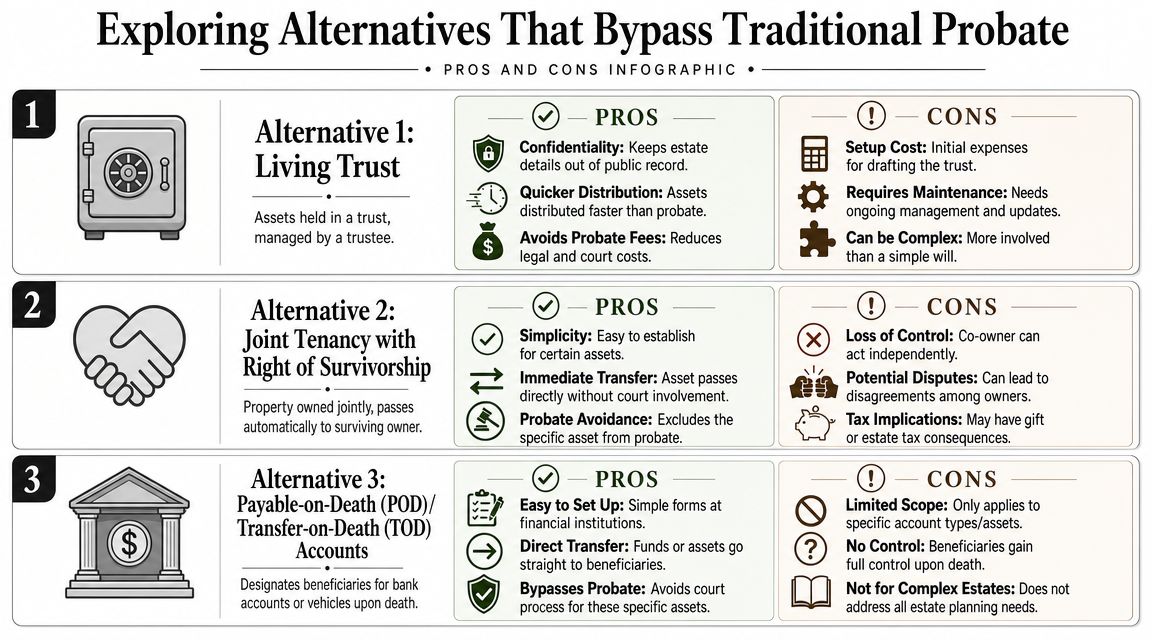
Not every estate needs the full traditional probate process. In some cases, Texas law offers alternatives that can reduce delay, simplify transfer, or avoid unnecessary court involvement. Some of these tools help with the current estate. Others are most useful as planning tools for your own family.
Probate alternatives inside the Texas Estates Code
Under Titles 2 and 3 of the Texas Estates Code, several simplified procedures may apply depending on the facts.
Muniment of title
This is a simplified way to admit a valid will to probate when the estate qualifies and a full administration may not be needed. In plain language, it can work as a court-recognized link in the chain of title, especially for real property. It isn't right for every estate, but in the right case it can be far simpler than full administration.Small estate affidavit
This is a sworn filing used in limited situations for qualifying estates. It can help families transfer certain property without opening a full administration. Whether it fits depends on the estate's composition and the statutory requirements.Affidavit of heirship
This tool is often used to help establish family history and ownership, especially when there is no will or when title to real property needs clarification. It can be useful, but it is not a substitute for probate in every situation.
Planning options that may avoid later delay
Some delay prevention happens long before death. For families planning ahead, assets may sometimes pass outside probate through non-probate designations or ownership structures.
Examples include:
- Living trusts
- Joint ownership with survivorship features
- Payable-on-death or transfer-on-death designations
These tools can be effective, but they need to be set up carefully. A designation that works well for one account may not solve a larger estate plan problem. A trust can avoid probate for funded assets, but only if the assets are transferred into the trust during life.
The best probate alternative is the one that fits the family's real circumstances, not the one that sounds simplest on paper.
Families who are also caring for an incapacitated loved one may need related planning in areas such as guardianship, powers of attorney, or trust administration. Probate and incapacity planning often overlap more than people expect.
Your Path Forward When Probate is Delayed
A delayed probate case can feel like a house left half-packed after a move. Bills still arrive. Property still needs attention. Family members still need answers. The court process may be stalled, but life is not.
The first step is to identify the kind of delay you are dealing with. Some problems come from missing paperwork, unclear asset information, or notice requirements that were not handled correctly. Other delays grow out of family conflict, questions about the will, or disputes over who should serve. Those problems call for different responses, and families often lose time by treating every delay as if it were the same.
One deadline deserves immediate attention. Under Texas Estates Code § 256.003, a will generally cannot be admitted to probate after the fourth anniversary of death unless the person filing can show they were not in default for the delay. Texas courts examine whether the applicant acted with reasonable diligence. For a helpful discussion of that rule, see this article on late probate filings under Texas Estates Code § 256.003.
That rule matters because delay rarely stays contained. A title problem can hold up a sale. Frozen access to estate funds can make it harder to pay taxes, insurance, or maintenance costs. Unanswered questions can turn grief into suspicion between relatives who were getting along only weeks earlier.
Families usually feel better once they stop asking, “Why is this happening to us?” and start asking, “What exactly is blocking the case, and what do we do first?” That shift brings order back into a stressful situation.
A probate attorney's role is often part translator, part organizer, and part problem-solver. A good lawyer can identify whether the case needs corrected filings, evidence to support a late application, court action to address a dispute, or a practical plan to protect estate property while the case is pending. Just as important, the attorney gives the family a clear path instead of a pile of unanswered questions.
You do not have to work through the confusion alone. Clear legal guidance can turn a stalled probate matter into a series of manageable steps.
If you're facing probate in Texas, our team can help guide you through every step, from filing to final distribution. Schedule your free consultation today with Law Office of Bryan Fagan, PLLC.