Skip to content
The quick answer is: you might. This is a question we hear from Texas families all the time, and the truth is, a trust isn’t just for the ultra-wealthy anymore. It’s a powerful tool for anyone who wants to control how their assets are distributed with minimal court involvement and maximum privacy.
If your goals include avoiding the public Texas Probate Process, maintaining family privacy, providing for minor children, or managing a blended family’s inheritance, a trust is definitely something you should consider.
Answering the Big Question: Do I Need a Trust?
Facing estate planning can feel overwhelming, especially when you’re navigating it for the first time or during a difficult period of loss. The conversation about whether you need a trust often comes with a lot of confusion, but it doesn’t have to be complicated. While a will is a fundamental piece of any estate plan, a trust serves different, more specific purposes.
Think of it this way: a will is a public letter to the probate court. In Texas, a will only becomes active after you pass away and must go through the court-supervised probate process, which can be both lengthy and public. This process is governed by the Texas Estates Code.
A trust, on the other hand, is like a private instruction manual for your assets. It’s active as soon as you create and fund it, which allows for a seamless, private transfer of your property without a judge’s sign-off.
Common Scenarios Where a Trust Makes Sense
Deciding if you need a trust often comes down to your unique family situation and what you want to accomplish. Here are a few common reasons why Texas families we work with choose to create one:
- Avoiding Probate: If you want your assets to pass directly to your loved ones without the delay and public record of probate court, a trust is the most effective tool for the job.
- Providing for Minors or Dependents: You can use a trust to hold assets for your children until they reach a specific age, ensuring their inheritance is managed responsibly by a trustee you hand-pick. This is a common concern for parents planning for their children’s future.
- Supporting a Beneficiary with Special Needs: A Special Needs Trust can provide financial support for a loved one without jeopardizing their eligibility for essential government benefits like Medicaid or SSI.
- Managing Complex Family Dynamics: For blended families, a trust can ensure assets are distributed fairly between a current spouse and children from a previous relationship, helping prevent potential family disputes and future Probate Litigation.
This flowchart helps visualize some of these key decision points.
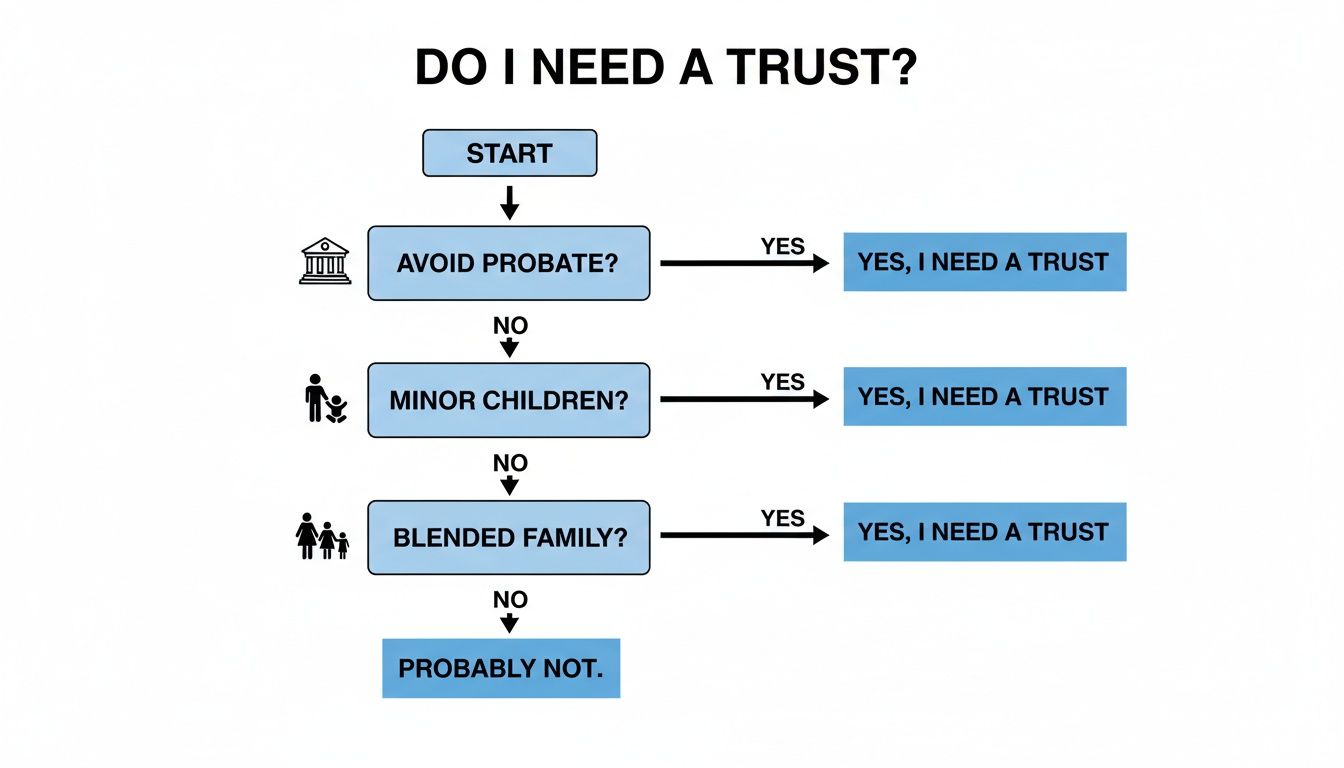
As you can see, if your goals include privacy, control over how assets are distributed, or keeping your family out of court, a trust becomes an incredibly valuable option. These considerations go far beyond a simple transfer of assets—they offer real peace of mind.
To give you a clearer picture, we’ve put together a quick summary of common situations where a trust often makes more sense than relying on a will alone.
When a Trust Might Be Right for You
| Your Goal | How a Trust Helps in Texas |
|---|---|
| Avoid the Probate Process | Assets in a trust bypass probate, allowing for a faster, private, and less expensive transfer to your beneficiaries. |
| Protect a Child’s Inheritance | You can set rules for when and how a child receives their inheritance, protecting it until they are mature enough to manage it. |
| Provide for a Loved One with Special Needs | A Special Needs Trust offers financial support without disqualifying the beneficiary from crucial government benefits. |
| Manage Assets for a Blended Family | A trust can provide for a current spouse while ensuring children from a prior marriage eventually inherit their share. |
| Maintain Family Privacy | Unlike a will, which becomes a public record in probate, a trust keeps your family’s financial affairs private. |
| Plan for Your Own Incapacity | A trust allows your chosen successor trustee to manage your assets for you if you become unable to do so yourself. |
Ultimately, a trust provides a level of control and privacy that a simple will just can’t match.
For a deeper dive into the specific advantages, you can learn more about why to set up a trust in Texas in our detailed guide.
Understanding What a Trust Is and How It Works
So, what exactly is a trust? Before you can decide if you need one, you have to get past the legal jargon. Let’s demystify it in plain English.
Think of a trust as a private, secure treasure chest you create to hold and protect your valuable assets. It’s a legal arrangement, not a physical box, but the analogy is a good one. You put your property inside, write a set of rules for how it should be managed, and name who gets what and when.

This arrangement has three main characters, and you need all of them for the trust to work the way you want it to.
The Key Players in a Texas Trust
Every trust has three essential roles. Sometimes, one person can even wear all three hats at once, but it’s crucial to understand what each one does.
- The Grantor (or Settlor): This is you—the person creating the trust. You’re the one deciding what goes into the “treasure chest,” writing the rulebook for managing it, and picking who gets to benefit from it.
- The Trustee: This is the manager you appoint to safeguard and manage the assets in the trust. The trustee has a fiduciary duty, a legal term meaning they must act in the best interests of the beneficiaries. It is the highest legal standard of care, and their job is to follow your instructions to the letter.
- The Beneficiary: This is the person, group of people, or even a charity who will eventually receive the assets. You get to set the specific conditions for how and when they receive their inheritance.
This whole structure is governed by the Texas Trust Code, which is found in Title 9 of the Texas Property Code. This is the legal framework that makes your instructions legally binding and holds your trustee accountable.
How a Trust Works in a Real-Life Scenario
Let’s put this into a real-world context. Imagine a Houston couple, Sarah and Tom, with two young kids. They own a home and have a few investment accounts. Their biggest worry is making sure their children are taken care of if something happens to them.
They create a revocable living trust, naming themselves as the grantors and the initial trustees. Next, they “fund” the trust by retitling their house and investment accounts into the name of the trust.
Day-to-day, absolutely nothing changes. Sarah and Tom manage their assets just like they always did. They can sell their house, move their investments, or refinance their mortgage without any extra steps.
But the real power of the trust kicks in during two critical moments:
- Incapacity: If Tom had an accident and became incapacitated, Sarah, as the co-trustee, could step in and manage all their joint assets immediately. She wouldn’t need to go to court for a costly and public Guardianship.
- After Passing: When both Sarah and Tom are gone, their chosen successor trustee—maybe a trusted sibling—takes over. This person follows the private instructions in the trust document, managing the assets for the children. They can use the funds for the kids’ education and living expenses until they reach the age Sarah and Tom specified, say 25 or 30.
A Private Agreement That Avoids Court
At its core, a trust is a private agreement that gives you control over your legacy. A will, on the other hand, is a public document filed with the court after you die. A trust keeps your family’s financial business out of the public eye.
This privacy is a huge reason why so many Texas families ask, “Do I need a trust?” By creating this private “treasure chest,” you’re essentially building a bypass around the courthouse. This ensures a smoother transfer of wealth and can head off the family fights that often erupt during public probate proceedings. A well-crafted Will & Trust plan can deliver both control and true peace of mind.
Exploring Different Types of Trusts for Your Family

The idea of a “trust” isn’t a one-size-fits-all solution. Just as every family has its own unique story and challenges, trusts are specialized tools designed to solve specific problems. Understanding the different types of trusts is the next critical step in answering the question, “Do I need a trust?”
Think of it like a toolbox. You wouldn’t grab a sledgehammer to fix a pair of glasses. In the same way, the right type of trust depends entirely on what you want to achieve for your family. Let’s walk through the most common options we help Texas families create.
Revocable Living Trust: The Flexible Foundation
The Revocable Living Trust is the most popular type for a simple reason—it’s incredibly flexible. You create it during your lifetime and can change it, add to it, or even tear it up completely as your life changes. You always remain in full control.
When you set one up, you typically name yourself as the trustee. This means you continue to manage your assets just like you always have. Its primary job is to hold your assets so they can pass directly to your beneficiaries after your death, completely bypassing the public and often lengthy probate process.
- Best for: Families whose main goals are avoiding probate, maintaining privacy, and planning for potential incapacity.
- Key Feature: You can make changes anytime you wish.
- Control Level: You maintain maximum control during your lifetime.
This adaptability makes it an excellent starting point for many families who want a straightforward, private way to manage their estate.
Irrevocable Trust: The Protector
Once you create and fund an Irrevocable Trust, you generally can’t change or revoke it. That might sound restrictive, but it comes with a powerful trade-off: serious asset protection. By legally transferring assets into this type of trust, you remove them from your personal ownership.
This separation can shield those assets from potential creditors, lawsuits, and, in some cases, even reduce your taxable estate. This is the tool families often use when they want to protect a legacy for future generations.
A sobering reality of estate planning is that 70% of family wealth is often lost by the second generation, and a staggering 90% vanishes by the third. Much of this is due to poor planning. Families who use tools like irrevocable trusts and hold structured planning meetings, however, can slash that generational wealth loss by as much as 40%.
Because you’re giving up control, the decision to create an irrevocable trust is a significant one that demands careful thought with an experienced attorney. It’s a permanent move designed for long-term protection.
Special Needs Trust: The Lifeline
For families caring for a loved one with a disability, a Special Needs Trust (SNT) isn’t just a good idea—it’s absolutely essential. Many individuals with disabilities rely on government benefits like Medicaid and Supplemental Security Income (SSI), which have strict income and asset limits.
A direct inheritance could instantly disqualify them from receiving these vital programs. An SNT elegantly solves this problem. The trust holds the inherited assets, and a trustee you appoint uses the funds for supplemental needs—things government benefits don’t cover—without jeopardizing their eligibility.
- What it can cover: Medical treatments, therapy, education, transportation, and quality-of-life expenses.
- What it protects: Eligibility for essential government aid.
- The goal: To enhance the beneficiary’s life without disrupting their core support system.
This trust provides incredible peace of mind, ensuring your loved one will be cared for in the way you intend, long after you’re gone.
Medicaid and Asset Protection Trusts: The Planner
Long-term care costs can be astronomical, capable of wiping out a lifetime of savings in a few short years. A Medicaid Trust (or similar asset protection trust) is a strategic tool designed to help seniors plan for these potential costs.
By transferring assets into a specifically designed irrevocable trust, you start a five-year “look-back” clock required by Medicaid. After this period passes, the assets held in the trust are generally not counted when determining your eligibility for long-term care, preserving them for your family instead of spending them down on a nursing home.
This strategy requires proactive planning well before care is needed. It’s a way to ensure you can get the help you need without being forced to spend every last dollar you’ve worked so hard to save.
Comparing Common Texas Trusts
| Trust Type | Key Feature | Best For… | Flexibility |
|---|---|---|---|
| Revocable Living Trust | Can be changed or canceled | Avoiding probate and managing incapacity | High |
| Irrevocable Trust | Cannot be easily changed | Asset protection and estate tax planning | Low |
| Special Needs Trust | Protects government benefits | Providing for a loved one with a disability | Moderate |
| Medicaid Trust | Helps with long-term care planning | Preserving assets from nursing home costs | Low |
Each trust is a powerful instrument when used correctly. The key is matching the right tool to your family’s unique circumstances and long-term goals.
Comparing Wills and Trusts in Texas
One of the first questions we hear from Texas families is, “Do I really need a trust if I already have a will?” It’s a great question, and the answer comes down to what you want your family’s experience to be after you’re gone. Understanding the fundamental difference between a will and a trust is the cornerstone of any solid estate plan.
A Last Will and Testament is basically a set of instructions for the probate court. It’s a legally binding document that says who gets your property, who should be the guardian for your kids, and who you want to manage the process (the executor). But here’s the catch: a will only kicks in after you pass away, and it must go through the public court system known as probate.
A trust, on the other hand, is a private legal entity you create and control while you’re alive. When you’re no longer able to manage it, or after you pass away, it continues to operate privately, completely outside the probate court system. This single distinction is a game-changer for Texas families. Avoiding probate almost always means more privacy, significant time savings, and lower overall costs for the people you leave behind.
The Public Path of a Will
When you rely on a will to settle your estate in Texas, you’re sending your family down a specific legal path defined by the Texas Estates Code. While it’s a necessary process, it’s also public and can be a long, drawn-out affair for a grieving family.
- Public Record: The moment a will is filed for probate, it becomes a public court document. Anyone can look up the details of your assets, your debts, and who you chose to inherit your property.
- Court Supervision: The entire process is micromanaged by a judge. Your executor can’t just start paying bills or distributing assets. They need the court’s official permission to act, must file a detailed public inventory of everything you owned, notify creditors, and get a final sign-off from the judge before your heirs get anything.
- Potential Delays: The Texas Probate Process isn’t quick. It often takes months, and in complex cases, it can drag on for over a year. During that time, your family may have very limited access to the assets they need.
For a deeper dive into these two critical documents, our guide on the differences between a living trust vs. a will in Texas breaks it down even further.
The Private Path of a Trust
A properly funded trust creates a completely different—and much smoother—experience for your family. Because the trust, a private entity, already owns the assets, there’s simply nothing for the probate court to oversee.
- Immediate Transition: Your chosen successor trustee can step in and start managing the trust’s assets the moment you pass away or become incapacitated. There is no waiting for a court to grant permission.
- Complete Privacy: The terms of your trust, the assets it holds, and the distributions to your beneficiaries all stay completely private. This shields your family from nosy neighbors, opportunistic creditors, and potential family squabbles.
- Efficiency and Control: Distributions can be made to your beneficiaries much faster and on the exact timeline you laid out in the trust document. You maintain control even after you’re gone.
A Tale of Two Families
To see how this plays out in the real world, let’s look at a realistic scenario.
Scenario: The Miller Family vs. The Garcia Family
Mr. Miller passed away with a valid will. His daughter, the executor, had to hire an attorney and file the will with the probate court. She waited weeks just to be officially appointed. Then, she spent months creating a public inventory of her father’s assets, notifying creditors, and dealing with endless court filings. The whole ordeal took 11 months, and the family’s financial business became public knowledge.In contrast, Mrs. Garcia had placed her home and investments into a revocable living trust. When she passed away, her son, the successor trustee, was able to walk into the bank the very next day and access accounts to pay for funeral expenses. He simply followed the private instructions in the trust document and distributed the assets to his siblings within six weeks—all without ever setting foot inside a courtroom.
This comparison isn’t just theoretical; it highlights the powerful, practical advantages a trust offers. It can transform what is often a stressful public ordeal into a smooth, private transition for the family you love.
| Feature | Last Will and Testament | Revocable Living Trust |
|---|---|---|
| Takes Effect | Only after death | Immediately upon signing and funding |
| Probate Required? | Yes, it must go through probate court. | No, it completely avoids probate. |
| Privacy | Becomes a public record. | Remains a private document. |
| Asset Control | Executor needs court approval. | Successor trustee takes over immediately. |
| Incapacity Plan | Not included; requires a separate Power of Attorney. | Your successor trustee can manage assets for you. |
| Cost | Lower upfront cost, but probate can be expensive. | Higher upfront cost, but avoids probate expenses. |
Practical Steps for Setting Up and Funding a Trust
Deciding you need a trust is a huge step toward protecting your family’s future. But here’s something many people don’t realize: creating the trust document is only the beginning. To make it do its job, you have to take practical, deliberate actions to ensure it works exactly as you intend.
It’s true that a trust is more expensive to set up than a simple will. However, that upfront investment often saves your family a great deal of money and time down the road. By putting a trust in place now, you help your loved ones avoid the significant legal fees and public court costs that come with the standard Texas Probate Process.
Step 1: Design Your Trust with an Attorney
First, you’ll work with an attorney to design a trust that meets your specific goals. This involves choosing the right type of trust, naming your trustee and successor trustee, identifying beneficiaries, and outlining the rules for how assets should be managed and distributed.
Step 2: Fund Your Trust (The Most Critical Step)
If there’s one critical mistake we see over and over, it’s creating an “empty” trust. A trust document by itself has no power. The process of legally transferring your assets into the trust is called funding. Without proper funding, your assets will still have to go through probate, completely defeating the purpose of creating the trust.
Funding means legally changing the ownership of your assets from your individual name to the name of your trust. This isn’t just a suggestion; it’s a requirement. The process includes:
- Real Estate: Preparing and filing a new deed for your home or other properties with the county clerk.
- Bank Accounts: Changing the title on your checking, savings, and money market accounts to the trust’s name.
- Investment Accounts: Working with your financial advisor to retitle any non-retirement brokerage accounts.
- Business Interests: Transferring ownership of your LLC or other business interests into the trust.
Each asset requires a specific legal procedure to be funded correctly. If you miss a step, you could create serious headaches for your family and even spark costly Probate Litigation if disputes arise over an asset left outside the trust.
Step 3: Understand the Trustee’s Role
Choosing your trustee and making sure they understand what they’re signing up for is vital. As the Texas Estates Code makes clear, a trustee has a fiduciary duty—the highest legal standard of care—to manage the trust’s assets prudently and in the best interests of the beneficiaries.
Choosing a successor trustee—the person who takes over after you—is one of the most important decisions you’ll make. This individual should be someone you trust implicitly to carry out your wishes with compassion and integrity.
Step 4: Maintain and Update Your Trust
Proper administration is the key to keeping your trust effective. This means updating it as your life changes—when you buy a new home, open a new bank account, or welcome a new grandchild. A well-maintained and fully funded trust is truly one of the most powerful gifts you can give your family.
When to Contact a Texas Estate Planning Attorney

Deciding whether you need a trust is a big step, and it’s deeply personal. While guides like this one are a great starting point, they can’t replace a real conversation with a legal professional who can dig into the specifics of your family’s situation. The good news is, you don’t have to figure this out alone.
Some life events are clear signals that it’s time to stop researching and start talking to an experienced Texas estate planning attorney. If any of the situations below sound familiar, getting professional advice isn’t just a good idea—it’s essential for protecting your family and everything you’ve worked for.
Key Moments to Seek Legal Counsel
It’s time to schedule a consultation if you find yourself in any of these scenarios:
- You Own Real Estate: Moving your home or other properties into a trust isn’t just about signing a piece of paper. It requires specific legal documents to be filed correctly to avoid major title headaches down the road.
- You Have a Blended Family: A trust is one of the best tools for the delicate balancing act of caring for your current spouse while also making sure the inheritance for children from a previous relationship is protected.
- You Have Minor Children: An attorney can help you design a trust that not only names a guardian but also manages your children’s inheritance until they’re old enough and responsible enough to handle it themselves.
- You Need to Provide for a Loved One with Special Needs: This is critical. A specialized trust can provide financial support without accidentally disqualifying your loved one from essential government benefits like Medicaid or SSI.
- You Are Worried About Family Disputes: A well-drafted trust leaves little room for argument. It minimizes ambiguity and can shut down the painful conflicts that often explode into full-blown Probate Litigation.
Key Insight
A trust isn’t about how much money you have; it’s about how much control, privacy, and peace of mind you want for your family. An attorney does more than just fill out forms. They make sure your trust is legally sound under the Texas Estates Code, properly funded with your assets, and truly reflects your wishes. It’s about getting peace of mind for you and lasting security for your family.
Frequently Asked Questions About Texas Trusts
When Texas families start looking into Wills & Trusts, a lot of great questions pop up. Getting clear, straightforward answers is the key to feeling confident about your estate plan. Here are some of the most common questions we hear from clients every day.
Can I Be the Trustee of My Own Revocable Living Trust?
Yes, absolutely. In fact, it’s the most common way to set up a revocable living trust in Texas. You create the trust (as the grantor), manage it yourself (as the trustee), and do it all for your own benefit (as the beneficiary).
You keep total control over your assets, just like you did before. The real magic of this setup is that you also name a successor trustee—someone you trust completely to step in and manage things for you if you become incapacitated or after you pass away. This simple step helps you avoid the need for a court-supervised Guardianship.
Do I Still Need a Will If I Have a Trust?
Yes, and this is a critically important point that a lot of people miss. A well-designed estate plan almost always includes both a trust and a special kind of will known as a pour-over will.
Think of this will as your plan’s safety net. Its entire job is to “catch” any assets you might have forgotten to transfer into your trust and “pour” them in after your death. This makes sure everything is managed under the private terms of your trust, even if a bank account or a car title was accidentally left out.
Are Trusts Only for Wealthy People?
This is one of the biggest myths in estate planning. While trusts are certainly useful for managing large, complex estates, their main benefits—avoiding probate, protecting privacy, and planning for incapacity—are just as valuable for families of all financial backgrounds.
If you own a home in Texas, you already have a significant asset that could be tangled up in court for months. A trust can prevent that. It’s a tool for bypassing the public, often expensive Texas Probate Process, a goal many middle-class families share.
How Does a Trust Protect My Privacy?
When a will is filed with the court after death, it becomes a public record. That means anyone—a nosy neighbor, a distant relative, a potential scammer—can walk into the courthouse and read all the details of your estate. They can see what you owned, who you owed money to, and exactly who inherited your property.
A trust, on the other hand, is a completely private document. Because the assets it holds don’t go through probate, the terms of your trust and the details of your assets remain confidential. This privacy shields your family from prying eyes and potential predators during an already vulnerable time.
If you’re facing probate in Texas, our team can help guide you through every step — from filing to final distribution. Schedule your free consultation today.