Skip to content
When you're planning for your family's future, the words 'trust' and 'estate' often come up. They can sound complicated and intimidating, but the core difference between a trust and an estate is actually quite simple. In plain English, an estate is just everything you own when you pass away—your house, your car, your bank accounts. If you have a will, that property has to go through the public probate court system to get to your heirs.
A trust, on the other hand, is a private legal arrangement you create while you're alive to hold those same assets. The biggest benefit? It allows your family to bypass the probate court entirely, saving them time, money, and stress during an already difficult time.
Understanding the Key Differences in Texas
Losing a loved one is hard enough. Figuring out how their assets will be managed shouldn't add to the pain. Here in Texas, the choice between an estate and a trust has a direct impact on your family’s privacy, how much they’ll spend, and how long it takes for them to receive their inheritance. We understand that navigating these decisions can feel overwhelming, and we're here to provide clear, compassionate guidance.
While both are tools for passing on assets, they operate in completely different worlds. One is public and supervised by a judge; the other is private, confidential, and managed according to your wishes.
The real difference comes down to the process. An estate is settled through a formal court procedure called probate, where a judge has the final say on everything. But with a trust, the entire process is managed privately by a person you choose, called a trustee, who simply follows the rules you laid out in the trust document. This one distinction creates a domino effect of critical differences for Texas families.
Quick Look: Trust vs. Estate in Texas
To give you a clearer picture, we've put together a simple table that breaks down how trusts and estates work in Texas. It's a high-level snapshot, but it really highlights the fundamental divide between these two approaches.
| Attribute | Trust (Private Agreement) | Estate (Public Court Process) |
|---|---|---|
| Governing Document | Trust Agreement | Last Will and Testament |
| Court Involvement | None (Bypasses probate) | Required (Probate court supervises) |
| Privacy | Completely private | Public record |
| Timeline | Typically fast (weeks to months) | Often slow (6 months to 2+ years) |
| Asset Control | Trustee manages assets immediately | Executor needs court approval first |
This table shows why so many people lean toward trusts. You get privacy, speed, and control—three things that are often in short supply during the public probate process.
One of the biggest real-world impacts is financial. The probate process for an estate can get expensive fast. Court fees, legal notices, and attorney costs often add up to 3-7% of the estate's total value. Think about it: for a modest $500,000 Texas estate, that could mean $15,000 to $35,000 going to the court system instead of your loved ones.
Trusts avoid these public court costs entirely, which means more of your hard-earned assets actually make it to your beneficiaries. To dig deeper into this, you can learn more about the financial implications of estate planning and see why this is such a critical factor for so many families.
Comparing Asset Control: Trustee vs. Executor Roles
When you're planning your estate, one of the most critical decisions you'll make is who gets to control your assets after you're gone. This is where the difference between trust and estate becomes incredibly clear, and it all comes down to the roles of a trustee versus an executor. These two roles are fundamentally different, and the person in charge dictates how quickly, privately, and efficiently your legacy is managed for your loved ones.

A trustee is the person you hand-pick to manage the assets held inside your trust. Their power kicks in the moment you pass away or become incapacitated, with no court approval needed. They simply follow the private instructions you laid out in the trust document, giving them the immediate ability to manage investments, pay bills, or distribute funds to your beneficiaries.
An executor, on the other hand, is merely nominated in your will. They have zero legal power until a Texas probate judge officially appoints them, a process that can easily drag on for weeks or even months. Until that judge grants them "Letters Testamentary" (an official court order), they are legally handcuffed, completely powerless to touch or manage any estate assets.
Key Differences in Authority and Timeline
The real distinction between these two roles lies in the timing and the source of their authority. This isn't just a legal technicality; it creates a stark contrast in their ability to protect your assets when it matters most.
- Trustee's Authority: Begins instantly. The triggering event—your death or incapacitation—activates their power. They act privately, following your written wishes to the letter.
- Executor's Authority: Delayed. Their power is only granted by a probate court, and their actions are public record, supervised by a judge and governed by the Texas Estates Code, Title 2.
This difference has massive real-world consequences for your family. A trustee can immediately access funds to pay for a funeral or support a beneficiary. An executor has to wait for the court's permission, leaving your family in limbo. For a deeper dive into what the court-supervised role entails, our firm has published a guide on an executor of a will's responsibilities in Texas.
A Realistic Scenario: Managing Assets in a Crisis
Let's put this into perspective. Imagine Maria passes away, leaving a large stock portfolio to her children during a volatile market.
- With a Trust: Maria named her son, David, as the successor trustee. The day after her passing, David can log into the investment account. Seeing that the market is plummeting, he has the authority to sell stocks immediately to preserve the portfolio's value, acting on the instructions Maria left in the trust.
- With a Will: Maria nominated David as the executor in her will. David sees the same market decline but can't do a thing about it. He has to file the will with the probate court, schedule a hearing, and wait to be officially appointed. By the time he finally gains control weeks later, the portfolio’s value could have dropped substantially.
This example cuts right to the heart of the matter. A trust provides a seamless, uninterrupted transition of management, protecting your assets without delay. An estate, however, is effectively frozen until the wheels of the court system slowly grind into action.
How Assets Are Transferred: Probate vs. Trust Administration
One of the biggest distinctions between a trust and an estate boils down to a single question: How will your assets actually get to your loved ones? An estate is forced down a public, court-supervised path called probate. A trust, on the other hand, allows for a private, direct transfer known as trust administration. These two journeys are worlds apart in terms of time, privacy, and hassle for your family.

For an estate, that journey starts the moment a will is filed with a Texas probate court. This simple act makes the will—and all the financial details tucked inside—a public record for anyone to see. The process itself is notoriously slow, often stretching on for months or even years.
The Public Path of Probate: What to Expect
When a will is probated, the executor must follow a strict, court-ordered set of steps laid out in the Texas Estates Code. This system is designed to be thorough, but it's rarely fast.
Here’s step-by-step guidance on what your family can expect during probate:
- Step 1: Filing the Will: The executor must submit the original will to the proper Texas court to begin the process.
- Step 2: Court Appointment: A judge must formally appoint the executor and grant them "Letters Testamentary." These are the official documents that give the executor legal authority to act, and just getting them can take weeks.
- Step 3: Public Inventory: The executor is legally required to compile and file a detailed inventory of every single estate asset. This list, complete with property values and account balances, becomes part of the public court record.
- Step 4: Court-Supervised Distribution: Only after all debts are settled and the court gives its final stamp of approval can the executor finally distribute what's left to the beneficiaries.
This rigid structure ensures everything is done by the book, but it comes at a cost: your family’s inheritance gets delayed, and their financial affairs are laid bare for the world to see.
The Private Path of Trust Administration
Trust administration is the complete opposite—a private and efficient process that happens entirely outside the courtroom. When you pass away, the successor trustee you named takes control of the trust assets immediately. No judge's permission needed.
There are no public filings, no court hearings, and no mandatory waiting periods. The trustee simply follows the instructions you laid out in the trust document. Their job is to manage the assets, pay final expenses, and hand the property directly to your beneficiaries, all according to your exact wishes. Because it sidesteps the court system, trust administration is usually much faster, often wrapping up in a few weeks or months instead of years. You can learn more about how a trust avoids probate and the incredible peace of mind this gives Texas families.
Beyond the legal mechanics, think about the practical side of things. Tasks like using an estate cleanout checklist are critical for properly settling an estate. The key difference is that a trustee can start on these tasks right away, while an executor has to wait for court approval, adding yet another delay during an already painful time.
Protecting Your Legacy from Creditor Claims
One of the biggest goals of any estate plan is making sure the assets you’ve spent a lifetime building actually get to the people you love. When it comes to shielding that legacy from creditors, the path you choose—a will versus a trust—makes a world of difference. An estate that has to go through probate is, by its very design, an open invitation for anyone you might have owed money to.
During the Texas Probate Process, the law actually forces the executor to notify creditors. They are required to publish a formal notice in a newspaper, a step mandated by the Texas Estates Code, Title 2, Chapter 308. This effectively announces to the public that there’s a pool of assets available to pay off old debts, which can slow everything down and, more importantly, shrink the inheritance meant for your family.
How an Estate Handles Creditors
When an estate is probated, every asset is essentially frozen and put on display for the court and the public. The entire process is built to ensure every legitimate debt is settled before a single penny makes its way to your beneficiaries.
- Public Notice: The executor is legally required to notify any known creditors and also publish a general notice in a local paper.
- Creditor Claim Period: This kicks off a formal window of time where creditors can file official claims against the estate’s assets.
- Payment Priority: Valid debts get paid right off the top, directly from the estate. This happens before your heirs get anything, reducing what’s left for them to inherit.
This system is transparent, but that transparency comes at the cost of your family’s privacy and the full value of their inheritance.
The Protective Shield of a Trust
A trust, on the other hand, offers a much stronger layer of protection. While a standard revocable living trust won't protect your assets from your own creditors while you're alive, it undergoes a powerful change the moment you pass away. It becomes irrevocable, creating a formidable barrier that separates the assets from your beneficiaries and their financial troubles.
This means the assets held inside the trust are generally safe from your beneficiaries' future problems—think divorces, lawsuits, or their own creditors. Compared to an estate, a trust provides far superior creditor protection, which is becoming a more critical advantage as trends in trust and estate planning show a rise in estate-related litigation. While an estate’s assets are exposed during probate, a trust keeps them private, secure, and out of reach.
This is a crucial distinction. It shows how a trust does more than just pass down your assets—it builds a durable financial shield around your family for years to come. By keeping everything out of the public court system, you provide a level of security that a simple will just can't match. For anyone serious about asset protection, looking into Wills & Trusts is a non-negotiable next step.
Maintaining Control and Privacy for Your Family
An estate plan should empower you, not just after you’re gone, but right now, during your lifetime. This is where a revocable living trust offers a level of control and security that a simple will just can't touch. With a trust, you manage your assets exactly as you always have—buying, selling, and investing with total freedom.
But a trust also comes with a crucial backup plan built right in. If you ever become incapacitated and can't manage your own affairs, your chosen successor trustee can step in seamlessly. They can immediately start paying your bills and managing your property without court intervention, avoiding a public and often expensive Guardianship proceeding. A will offers no protection for you during your lifetime; it only kicks in after your death.
Keeping Your Family’s Affairs Private
Beyond lifetime control, privacy is one of the most compelling reasons Texas families choose a trust. Once a will is filed for probate, it becomes a public document. This means anyone—a nosy neighbor, a distant relative, or even a potential scammer—can walk into the courthouse and see every detail of your estate, including what you owned and who you left it to.
In contrast, a trust is a completely private agreement. Its terms, your assets, and your beneficiaries remain confidential. The only people who know the details are the trustee and the loved ones you've chosen to inherit. This privacy protects your family’s dignity and shields them from unwanted attention during an already difficult time.
The Power of Continuous Management
Here’s a fundamental difference: a trust allows for continuous management of your assets during your life and long after you're gone. An estate, on the other hand, is only activated by your death through the probate process, so it offers zero lifetime benefits. This is a huge distinction. The legal industry for trusts and estates is seeing significant growth, partly because more people are demanding the kind of privacy and control that only trusts can offer. If you're interested in the trends, you can explore how demographics are shaping modern estate planning.
This private, continuous management structure is what sets a trust apart. The benefits of a revocable living trust go far beyond just avoiding probate; they create a comprehensive framework for protecting you while you are alive and your family after you are gone, ensuring your personal affairs remain just that—personal.
Making the Right Choice for Your Texas Estate Plan
Figuring out whether to use a trust or stick with a traditional will comes down to your family’s unique situation and what you’re trying to accomplish. At its core, the difference between a trust and estate boils down to control, privacy, and efficiency. For some, a simple will that creates an estate might seem like enough.
This path is sometimes considered for people with very few assets, no real estate, and a straightforward family tree. But it’s a path that leads directly into the public, often expensive, and frustratingly slow probate court system.
When a Trust Is the Clear Choice
For most Texas families, a revocable living trust is simply the better tool. It offers a level of protection that a will just can't provide, both during your lifetime and long after you’re gone.
A trust is almost always the right move if you:
- Own real estate in Texas.
- Want to avoid the public nature and high costs of probate.
- Have a blended family or complex wishes for your beneficiaries.
- Need to protect an inheritance for minors or beneficiaries with special needs.
- Want to plan for potential incapacity and avoid a court-mandated Guardianship.
This decision tree shows exactly how a trust keeps you in the driver’s seat, even if you become unable to manage your affairs.
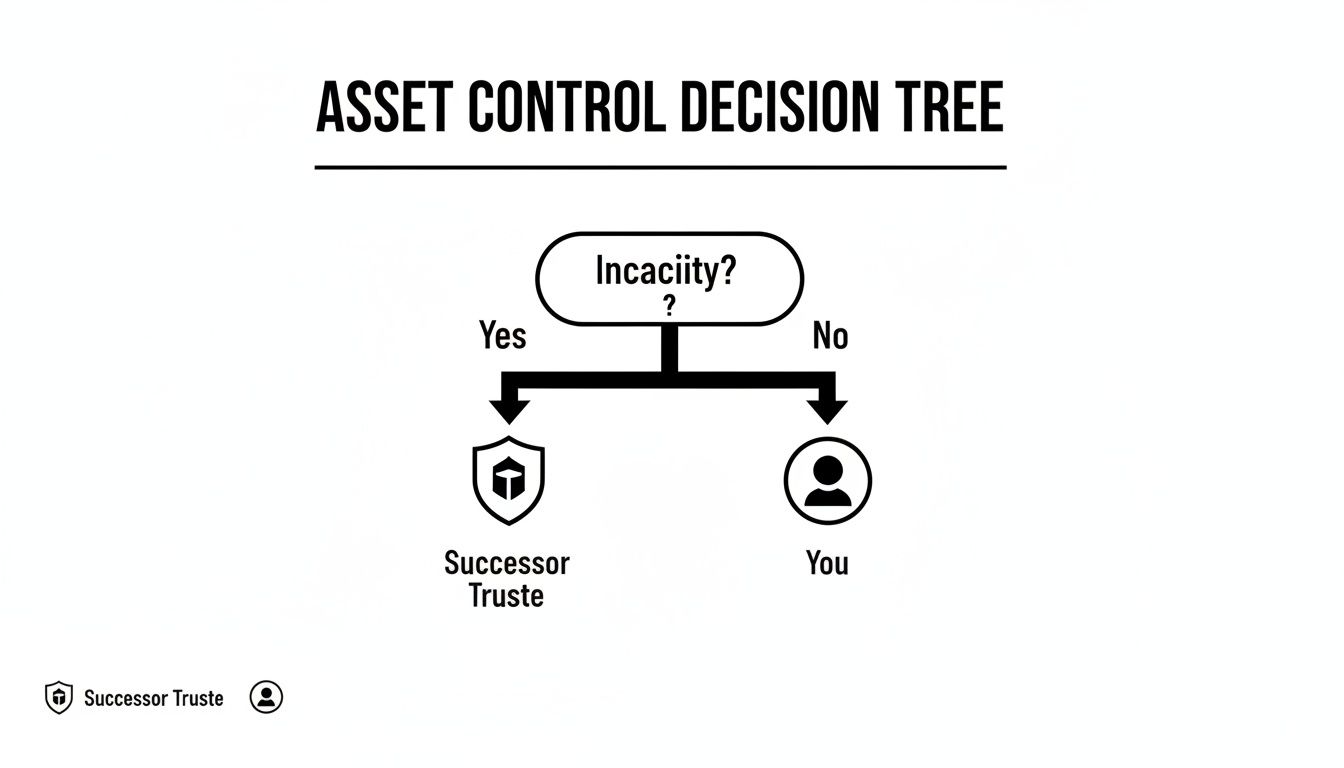
As you can see, a trust allows a successor trustee you've chosen to step in seamlessly. Without one, your assets are left vulnerable, and your family is forced into court. Ultimately, having a solid plan in place is the most important step you can take for your loved ones.
For a deeper dive, check out our detailed guides on Wills & Trusts and the Texas Probate Process.
Key Insight Takeaway
Probate is a public lawsuit you file against yourself, for the benefit of your creditors, with your family’s money. Trust administration is a private process that follows your exact instructions, keeping your affairs confidential and your assets out of court. A trustee’s power is a direct extension of your wishes, coming from the trust document you create. It allows for immediate and private action. An executor’s power comes from a judge, requiring a public court process that guarantees significant delays. While a will ensures your estate goes through probate, a trust is designed to avoid it entirely.
A Few Common Questions We Hear About Texas Trusts and Estates
When families start digging into estate planning, a lot of questions pop up. It’s completely normal. Below, we’ve tackled some of the most frequent concerns we hear, offering straightforward, plain-English answers to help you see the real-world differences between a trust and an estate.
Why Do I Need a Will if I Already Have a Trust?
This is a fantastic question, and the answer gets to the heart of smart estate planning. Even if you have a perfectly crafted trust, you still need a special type of will called a "pour-over will." Think of it as your ultimate safety net.
Life is busy, and it's easy to forget to formally transfer an asset—a newly purchased car, a small bank account—into your trust. A pour-over will is designed to "catch" any of those forgotten assets after you pass away and "pour" them into the trust where they belong. Without one, those overlooked assets get stuck in your probate estate and are handed out according to rigid Texas intestacy laws, which could completely contradict your wishes and drag your family into court.
How Can a Trust Help with Estate Taxes in Texas?
First, the good news: Texas doesn't have a state-level estate or inheritance tax. However, your estate could still get hit with federal estate taxes. The federal exemption is quite high as of 2024, but that number is always subject to change with new legislation.
For families with significant assets, this is where certain irrevocable trusts become powerful tools. By moving assets into a specially designed trust, you can legally shift them outside of your taxable estate. This strategy effectively reduces your estate's value to a level below the federal exemption threshold, protecting your legacy from a hefty tax bill. Our Wills & Trusts services are designed to help you figure out if this is the right move for you.
What Happens if I Don’t Have a Will or a Trust?
Dying in Texas without any estate plan is known as dying "intestate." This is a scenario you want to avoid at all costs. When you die intestate, you give up all control over who gets your property. The state steps in and makes those decisions for you.
The Texas Estates Code, Title 2, Chapter 201, lays out a strict, one-size-fits-all formula for distributing your assets to relatives based on their legal relationship to you. This court-managed process is almost always slow, public, and expensive. Worse, it often sparks bitter family fights and can lead to Probate Litigation. Creating a plan isn't just about paperwork; it's about keeping control and protecting your family from unnecessary conflict.
If you’re facing probate in Texas, our team can help guide you through every step — from filing to final distribution. Schedule your free consultation today.