Skip to content
In Texas, most assets a couple acquires during their marriage belong equally to both of them. This is the heart of our community property system. Think of it as a shared family pot where paychecks, real estate, and investments are all combined. For any family planning their estate or navigating the probate process after a loss, understanding this rule is the crucial first step. Dealing with a loved one's estate is an emotional journey, and our goal is to provide clear, compassionate guidance to help you through it.
What Every Texas Family Should Know About Community Property
When you're grieving or managing a significant life event, the last thing you need is a lecture filled with confusing legal jargon. While "community property" sounds technical, it’s a system built on a simple, compassionate idea: marriage is a partnership.
This isn’t a new legal trend. Texas has been a community property state since the Republic era in 1841, making us one of only nine states with these kinds of laws. This system, outlined in Texas Family Code §3.003, establishes that almost everything you or your spouse acquire while married is owned 50/50 by both of you. You can even explore the historical context of these long-standing Texas laws to see how deeply these principles are rooted in our state's history.
Let's break this down with a plain-English explanation.
- Community Property: Imagine a "shared family savings jar." Every dollar earned, every home purchased, and every investment made by either spouse during the marriage goes straight into this jar. Both partners have an equal claim to everything inside it.
- Separate Property: Now, picture a "personal lockbox." This holds anything you owned before you were married. It also holds assets you received as a personal gift or an inheritance specifically for you during the marriage. These items remain yours alone.
This distinction is the bedrock of how a family’s assets are managed after a death. During an emotional time, knowing what’s in the shared jar versus a personal lockbox brings much-needed clarity. The law presumes that everything is in the shared jar, so the responsibility falls on the person claiming an asset is separate to prove it.
Community Property vs. Separate Property at a Glance
When an executor is settling an estate, one of their most critical jobs is to correctly sort the property. Getting this right determines what the surviving spouse owns outright and what part of the estate will pass to the heirs named in the will, as guided by the Texas Estates Code.
Here’s a simple table to help you see the differences at a glance.
| Characteristic | Community Property | Separate Property |
|---|---|---|
| When Acquired? | During the marriage | Before marriage, or as a gift or inheritance during marriage |
| Examples | Income, home bought during marriage, retirement funds earned during marriage | Inheritance, property owned before the wedding, personal injury awards |
| Ownership | Owned 50/50 by both spouses | Owned 100% by one spouse |
| During Probate | Surviving spouse keeps their 50%; the deceased's 50% goes through the will | Does not enter the deceased spouse's probate estate unless specifically gifted |
This simple chart cuts through the legal noise. For families trying to make sense of an estate, this is the starting point for figuring out who gets what and why, bringing a measure of peace during a difficult time.
How to Classify Your Marital Property Correctly
In Texas, the law starts with a powerful default setting: any property a married couple acquires is presumed to be community property. This means that unless you can prove otherwise, the courts will automatically view that asset as part of the shared marital pot, owned 50/50 by both spouses.
For grieving families and executors stepping in to manage an estate, this presumption is the starting line. The responsibility—what lawyers call the burden of proof—lands squarely on the shoulders of anyone trying to argue an asset belongs in a personal lockbox instead of the shared family savings jar.
Proving an Asset is Separate Property
To challenge the community property presumption, you must provide clear and convincing evidence that an asset is, in fact, separate. This isn't a simple "he said, she said" situation. It's a higher legal standard that means your proof must be so solid it leaves no serious doubt in the court's mind.
Simply stating, "My mother gave me that money," won't be enough. You absolutely need the paperwork to back it up. Meticulous record-keeping is your best friend when it comes to preventing separate property from being accidentally swept into the community pile.
- Bank Statements: Show the clear trail of inherited funds landing in a separate, non-joint account.
- Gift Letters: A letter from the person giving the gift that explicitly states it was intended for only one spouse.
- Deeds and Titles: Property titles that clearly label the asset as being acquired through a gift or inheritance.
- Financial Records: Anything that traces money from a separate source directly to the purchase of a specific asset.
Understanding the Inception of Title Rule
One of the cornerstone concepts in this area is the inception of title rule. This rule, rooted deep in Texas law, says that the character of an asset—whether it's separate or community—is locked in at the exact moment you acquire it. What happens later doesn't change its original character.
Key Insight: The character of an asset is determined the moment you gain rights to it. If you later use community funds to make payments on that asset, it might create a claim for reimbursement for the community estate, but it won’t transform the asset’s original separate or community nature.
Let's walk through a realistic scenario to illustrate this legal procedure.
Scenario: A Home Purchase with Inherited Funds
Imagine Sarah and Tom buy a house together after they get married. Sarah uses $100,000 she inherited from her grandmother for the down payment. The monthly mortgage payments for the remaining balance are paid from Tom's salary.
Years later, when Tom’s estate is being settled, how is the house classified? Under the inception of title rule, Sarah has a powerful claim that a significant portion of the home is her separate property because she can trace that down payment directly back to her inheritance. The rest of the home's value, built up using mortgage payments from community income, is community property. Without her bank records showing the inheritance and the wire transfer for the down payment, the entire house would be presumed community property. The process of untangling these assets is crucial for ensuring fairness after a spouse passes away.
Avoiding Commingling Your Assets
The single biggest threat to keeping your separate property separate is commingling—a legal term for mixing separate and community funds together. When you deposit inherited money into the same joint checking account where both your paychecks land, it becomes almost impossible to trace which dollar belongs to whom.
Once funds are so jumbled that they can’t be clearly identified, the law defaults back to that powerful community property presumption. Protecting your separate assets requires intentional effort. The simplest and most effective strategy is often the best: keep a separate bank account exclusively for gifts and inheritances.
This decision tree helps visualize the basic questions that determine how marital assets are classified.
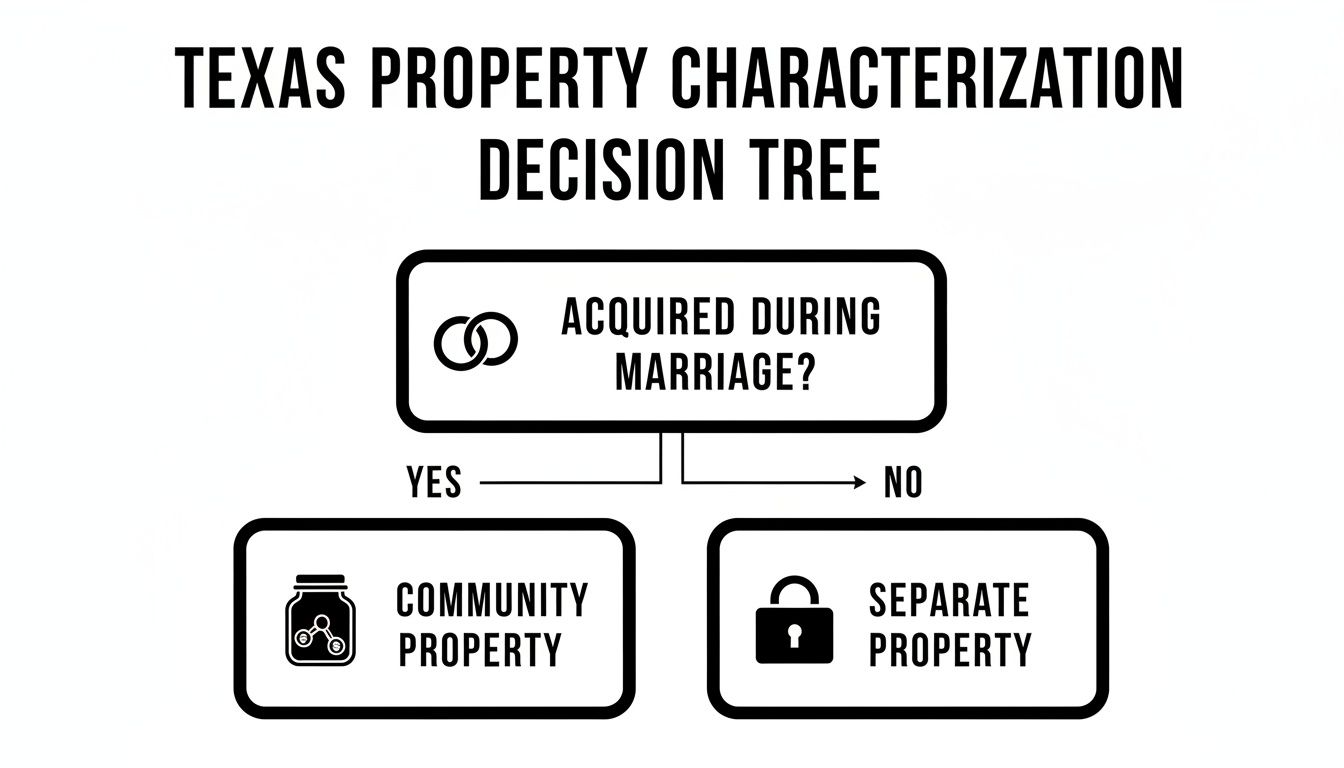
As the graphic shows, the first and most important question is always whether the property was acquired during the marriage. That single fact determines the legal starting point for everything that follows.
How Community Property Shapes Your Will and Probate
When a spouse passes away, the concept of community property becomes a hard reality that directly impacts a grieving family. This is often where things get confusing and emotional, as families try to honor their loved one’s wishes while navigating the strict rules of the Texas Probate Process.
The single most important principle to grasp is this: a will only controls the deceased person's share of the property. For a married Texan, that means their will can only give away their 50% interest in the community estate, plus 100% of their separate property.
The surviving spouse automatically keeps their own 50% share of the community property. That half never goes through probate, isn't touched by the deceased’s will, and can't be claimed by the estate's other beneficiaries. It's theirs, period.
The Executor’s Role in Dividing the Estate
Once an executor is appointed by the probate court and receives their Letters Testamentary (the official document granting them authority), their first major task is to take an inventory of the estate. This isn't just making a list. It’s a legal duty to correctly identify, value, and categorize every single asset.
Guided by the principles in Title 2 of the Texas Estates Code, the executor must meticulously sort everything into three buckets:
- The Deceased Spouse's Separate Property: Assets they owned before the marriage or received as a gift or inheritance.
- The Surviving Spouse's Separate Property: The survivor’s own pre-marriage assets, gifts, and inheritances.
- The Community Property: Everything else acquired by either spouse while they were married.
Getting this sorting process right is critical. One mistake can ignite serious family disputes and even lead to Probate Litigation. For example, if a home is community property, the executor can only manage and distribute the deceased's 50% interest. The surviving spouse holds onto their 50% ownership stake.
Takeaway: Think of the community estate as being sliced in two the moment a spouse dies. One half belongs to the survivor instantly, outside of probate. The other half becomes the "probate estate," which the executor manages according to the will.
A Practical Scenario Unpacking Probate
Let’s walk through a realistic step-by-step example to see how this plays out.
Maria and David were married for 30 years. Their biggest asset is their home, which they bought together, now valued at $500,000. They also share a savings account with a $100,000 balance. David's will leaves "all his property" to their two adult children.
When David passes away, what actually happens?
- The Home: The house is community property. Maria automatically keeps her $250,000 (50%) share. David's $250,000 share is the only part that passes through his will. His children now co-own the house with their mother, Maria.
- The Savings Account: This is also community property. Maria is immediately entitled to $50,000. David’s $50,000 share becomes part of his probate estate and will be distributed to his children as his will directs.
You can see how this division can create real-world challenges. The children might want to sell the home to access their inheritance, but Maria wants to continue living there. Understanding these rules ahead of time is absolutely vital for effective estate planning. Our firm often helps families create Wills & Trusts to prevent these exact kinds of conflicts. You can learn more by exploring our detailed guide to community property in Texas probate.
Navigating the Probate System
The way community property works in Texas probate creates unique challenges. The system is designed to automatically dissolve the community estate when one spouse dies, giving the survivor full control of their half while the decedent's half enters probate. Statistics show that Texas probates over 70,000 estates each year, and community property disputes fuel 30% of litigation—especially when informal marriages or out-of-state heirs are in the mix. You can discover more insights about these community property rules and their impact on Texas families.
Properly identifying and managing these assets is a fiduciary duty. Executors must act with care, making sure the surviving spouse’s rights are protected while faithfully carrying out the terms of the will for the deceased's share. It’s a delicate balance that underscores why getting compassionate, experienced legal guidance during such a difficult time is so important.
Managing Debts and Liabilities in a Community Estate

When an estate is being settled, it’s natural to focus on the assets—the house, the car, the bank accounts. But Texas community property law applies just as much to what you owe as it does to what you own. This is a common source of anxiety for a surviving spouse, who is often left wondering which of their late partner's debts are now their responsibility.
The rules for debt mirror the rules for assets, which helps simplify things. As a general rule, any debt taken on by either spouse during the marriage is considered a community debt. This means the entire community estate is responsible for paying it back.
A separate debt, on the other hand, is one a spouse brought into the marriage. Think of student loans taken out years before the wedding or a business loan from a prior venture. These debts are typically paid from the debtor spouse's separate property or their half of the community property.
How an Executor Handles Estate Debts
When a person passes away, their executor has a legal duty to settle all valid debts before any assets can be distributed to heirs. This is a non-negotiable part of the Texas Probate Process. The executor’s first job is to review the financials and determine which debts are community and which are separate.
This process involves a few key steps:
- Identifying All Liabilities: The executor acts like a financial detective, reviewing bank statements, credit reports, and mail to create a complete list of every outstanding debt.
- Classifying Each Debt: Using loan agreements and other financial documents, they determine when each debt was incurred—before or during the marriage—to classify it correctly.
- Paying Debts from the Correct Source: The executor uses estate funds to pay off liabilities, but they must follow strict rules about which property can be used for which type of debt.
Key Insight: A surviving spouse’s separate property—like an inheritance they received or a house they owned before the marriage—is generally shielded from the deceased spouse's separate debts. Creditors cannot come after the survivor's personal assets to pay for debts that were never part of the community.
A Real-World Example of Debt Management
Let’s put this into a practical scenario. Robert passed away, leaving his wife, Susan. During their marriage, they took out a joint credit card, which has a $10,000 balance. Before they married, however, Robert took out a $5,000 personal loan to buy a motorcycle.
Here’s how the executor would sort this out:
- The $10,000 credit card balance is a community debt. It was incurred during the marriage, so the executor can use assets from the community estate (like a joint savings account) to pay it off.
- The $5,000 personal loan is Robert's separate debt. The creditor can make a claim against Robert's separate property or his 50% share of the community property. They cannot, however, force Susan to use her separate property or her 50% share of the community property to satisfy that debt.
This careful separation is designed to protect the surviving spouse’s financial standing during an incredibly vulnerable time. Understanding these community property laws in Texas is critical for executors to act correctly and for surviving spouses to feel secure. The process can be tricky, and professional guidance is often needed to ensure all claims are handled properly without infringing on the survivor's rights.
Using Marital Agreements for Proactive Estate Planning

While Texas community property laws provide a default framework, you don’t have to let the state dictate your family’s financial future. Instead of leaving things to chance, you can take control with proactive planning. Marital agreements are powerful legal tools that let you and your spouse create your own set of rules for your property.
These agreements give you the power to define what is community and what is separate, effectively overriding the standard legal presumptions. For blended families, business owners, or anyone with specific assets to protect, this can provide immense peace of mind and clarity.
Defining Your Own Property Rules
In Texas, you have two main options for marital agreements: prenuptial agreements, which are signed before marriage, and postnuptial agreements, signed after you're already married. Both are legally binding contracts designed to let you customize your financial life together.
With one of these agreements in place, you can accomplish several critical estate planning goals:
- Reclassify Property: You can decide that certain assets earned during the marriage, like the income from a family business, will remain one spouse’s separate property.
- Protect Inheritances: An agreement can guarantee that future inheritances meant for one spouse will always stay their separate property, shielded from any community claims.
- Clarify Ownership: For complex assets, an agreement can spell out the exact ownership percentages, heading off potential disputes down the road in probate.
The ability for spouses to make these agreements wasn't always so clear-cut. Historically, Texas courts were reluctant to let couples change the character of their property by simply agreeing to it. But that changed in the early 1960s with landmark Supreme Court of Texas decisions in Hailey v. Hailey and Hilley v. Hilley, which built on constitutional changes empowering couples to partition their assets.
A Scenario for Blended Families
Consider a common situation where a marital agreement is invaluable. Mark is getting married for the second time and has two children from his previous marriage. He owns a successful consulting business he built from the ground up years ago. His new wife, Lisa, has her own established career and savings.
To protect his children’s inheritance, Mark and Lisa sign a postnuptial agreement. They agree that Mark’s business—and all the future income it generates—will remain his separate property. This ensures that when he passes away, the full value of the business can pass directly to his children through his will, just as he intends.
Without this agreement, all the income and growth from the business during the marriage would be considered community property. That would give Lisa a 50% claim, potentially forcing a sale of the business to satisfy her share and creating friction between her and Mark’s children. If you want to dive deeper, you can check out our guide on understanding prenups and postnups in modern relationships.
Takeaway: A marital agreement isn't about expecting a marriage to fail; it's about creating a clear financial roadmap that protects everyone involved. It works hand-in-hand with your Wills & Trusts to build a comprehensive estate plan that honors your wishes and prevents confusion for your loved ones.
Key Takeaways for Your Texas Estate
Navigating Texas community property laws, especially while you're grieving, is a heavy burden. After exploring the legal details, it’s helpful to summarize the most critical points—the things every Texas family, executor, and heir needs to remember. Think of these as the foundational pillars for protecting your family’s assets and ensuring your loved one’s wishes are honored with clarity and compassion.
- The Community Property Presumption is Strong: Always remember that Texas courts start from one simple place: if it was acquired during the marriage, it’s community property. The responsibility falls on the person claiming an asset is separate to prove it.
- Your Paperwork is Your Protection: Meticulous record-keeping is the only defense against the community property presumption. Bank statements, property deeds, and gift letters are the hard evidence you’ll need to prove an asset was separate property and protect it from being divided.
- Probate Only Touches the Deceased's Half: A will only has power over the deceased spouse's 50% share of the community estate, plus 100% of their separate property. The surviving spouse automatically keeps their half of the community assets, which sits completely outside of the Texas Probate Process.
- Proactive Planning Puts You in Control: Don't let the state's default rules make these important decisions for you. Tools like prenuptial or postnuptial agreements, combined with comprehensive Wills & Trusts, allow you to create your own rulebook. This is how you prevent disputes and ensure your final wishes are followed.
- Expert Guidance Provides Peace of Mind: The emotional and legal complexities of probate can be overwhelming. Working with an experienced attorney can provide reassurance, prevent costly mistakes, and ensure the process is handled with care. Unexpected issues like Probate Litigation or the need for a Guardianship can arise, and having a compassionate guide makes all the difference.
If you’re facing probate in Texas, our team can help guide you through every step — from filing to final distribution. Schedule your free consultation today.
Straight Answers to Your Texas Community Property Questions
When you're dealing with the loss of a loved one, the last thing you need is more legal jargon. The details of community property can feel urgent and overwhelming, so let’s cut through the confusion. Here are some plain-English answers to the questions we hear most often from Texas families.
Our goal is to give you reassurance and clarity, helping you understand how these laws might affect your family.
What Happens to Community Property if There Is No Will in Texas?
When a person dies in Texas without a will, it's called dying "intestate," and the state has a clear process for how property is divided. The Texas Estates Code (specifically Title 2, Subtitle E) lays it all out. For community property, the rule is straightforward.
The surviving spouse keeps their own 50% share and also inherits the deceased spouse's entire 50% share. In short, the surviving spouse receives 100% of the community property. But there’s a crucial exception: this only applies if the deceased person didn’t have children from a relationship outside the marriage. If they did, the deceased’s 50% share passes to those children.
How Do Community Property Laws Apply to Common-Law Marriages?
Texas law does not distinguish between a formal, ceremonial marriage and a common-law one (which the courts call an “informal marriage”). Once a common-law marriage is legally established, it’s treated exactly the same, and all the standard community property laws in Texas apply.
This means any property acquired by either partner during the informal marriage is automatically considered community property, owned 50/50. If one partner dies, the surviving common-law spouse has the same inheritance rights as any other surviving spouse. The biggest challenge is often proving the marriage existed, which requires showing you both agreed to be married, lived together in Texas as spouses, and represented yourselves to others as a married couple.
Can My Spouse Sell Community Property Without My Consent?
When it comes to major community assets, the answer is generally no. While each spouse has the right to manage community property, Texas law prevents one spouse from making major decisions alone. This is especially true for the family home.
One spouse cannot sell, mortgage, or otherwise transfer ownership of community real estate without the signature and consent of the other. This important rule protects both partners from one person making a significant financial decision that could harm the community estate without the other's knowledge or agreement.
Can I Give My Half of the Community Property to Someone Else in My Will?
Absolutely. This is one of the most powerful and fundamental aspects of Texas estate planning. Your will gives you complete control over your 50% share of the community property. You have the freedom to leave that share to whomever you choose—your children, a favorite charity, a close friend, or anyone else.
Your surviving spouse automatically keeps their 50%, but they have no legal claim to your half if your will directs it to someone else. This is an essential tool for providing for children from a previous marriage or ensuring that other family members and causes you care about are supported after you are gone.
If you’re facing probate in Texas, our team can help guide you through every step — from filing to final distribution. Schedule your free consultation today.