A parent dies. The family is still arranging the funeral, clearing out voicemail, and trying to figure out who will handle the house, the bank accounts, and the paperwork. Then someone reads the will and the room changes.
One child expected to share equally but was left out. A new executor appears. A last-minute change benefits the person who had the most access in the final months. What starts as grief turns into suspicion, hurt, and arguments over what the parent really wanted.
That's where probate battles between heirs usually begin in Texas. Not with legal theory, but with a family trying to make sense of something that feels wrong.
Texas probate courts don't resolve these conflicts like family meetings. They resolve them through a structured legal process under the Texas Estates Code, especially the parts of the code dealing with probate administration, wills, heirship, and court supervision in Titles 2 and 3. The court's job is to bring order to a situation that feels highly personal. Judges look for proof, procedure, and legal authority. They don't decide cases based on who is most upset or who tells the most moving story.
When a Loved One's Will Causes Family Conflict
A common scene goes like this. Three siblings gather after their mother's death. For years, everyone believed the estate plan was straightforward. Then the will presented for probate leaves nearly everything to one sibling who had been handling appointments, medications, and mail. The other two siblings are stunned. They don't know whether the will is valid, whether they can object, or whether it's already too late.
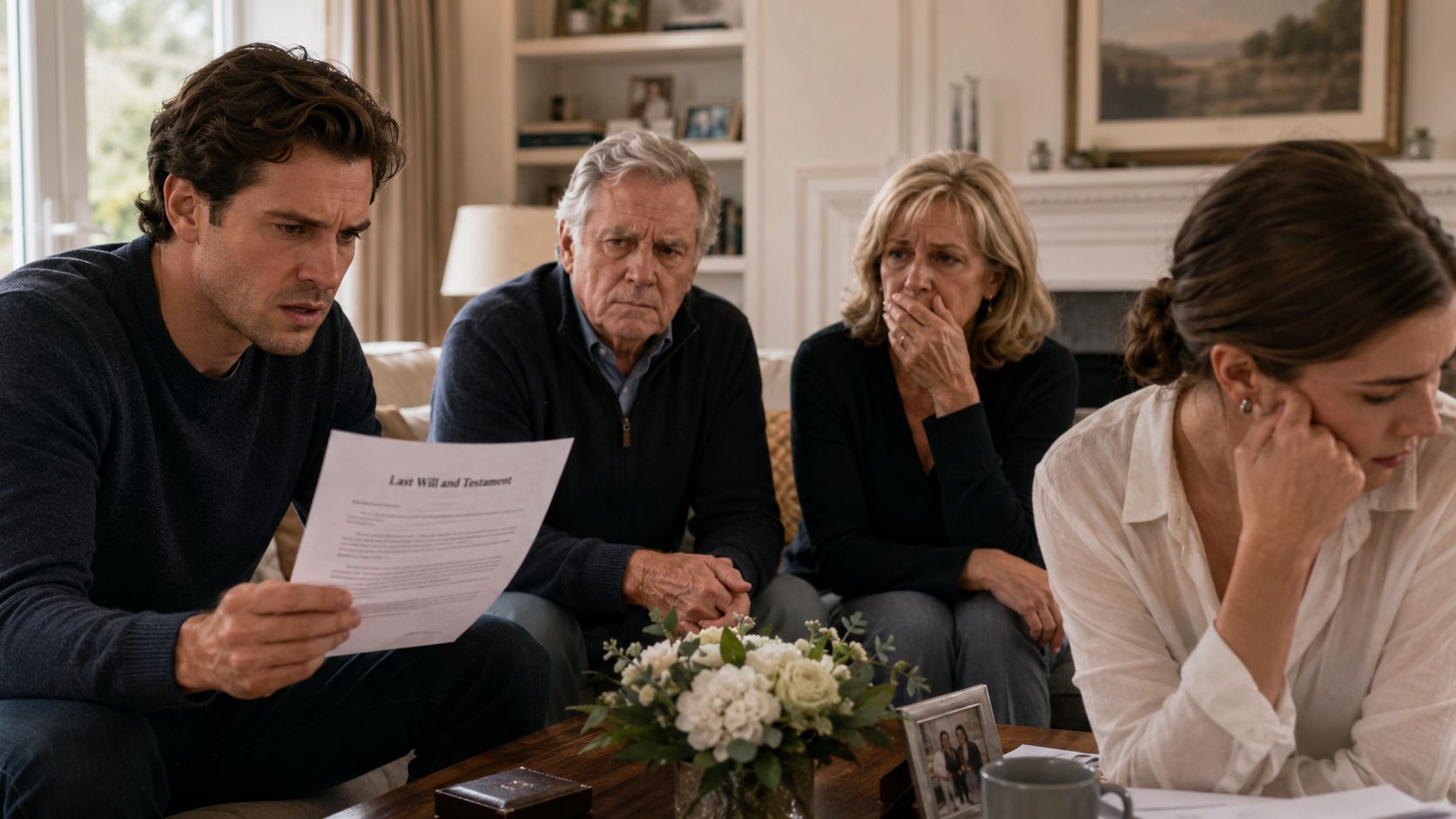
That moment is emotionally heavy because two different problems arrive at once. The family is grieving, and the legal system suddenly demands deadlines, filings, evidence, and careful decisions. A probate dispute can feel like trying to solve a puzzle while the pieces are still moving.
Texas courts are built for exactly this kind of conflict. If you're dealing with siblings fighting over a Texas estate, the court doesn't assume one side is right because the dispute is intense. It asks narrower questions. Who has the legal right to object? Was the will executed properly? Is there admissible evidence of incapacity, undue influence, fraud, or some other legal defect?
The court brings structure to family chaos
Probate litigation is formal. That matters. Families often hope the judge will intuitively “see what happened,” but judges decide cases through pleadings, records, testimony, and rules of evidence.
Practical rule: Probate court is less like a family discussion and more like building a case file brick by brick.
The Texas Estates Code gives the court the framework. Titles 2 and 3 address matters such as estate administration, probate of wills, heirship, and the powers and duties of personal representatives. Those rules are what turn raw conflict into a process the court can manage.
A roadmap matters when emotions are high
Most families aren't prepared for how procedural these fights become. The helpful shift is this. Instead of asking, “Why is this happening to us?” start asking, “What will the court need to decide this correctly?”
That change in mindset often lowers the temperature. It helps heirs focus on preserving records, identifying witnesses, and understanding the path ahead.
Common Grounds for Probate Battles in Texas
Probate courts in Texas do not resolve family conflict in the abstract. They decide specific legal disputes. The question is not merely who feels wronged. The question is what claim the court can test with documents, testimony, and the Estates Code.
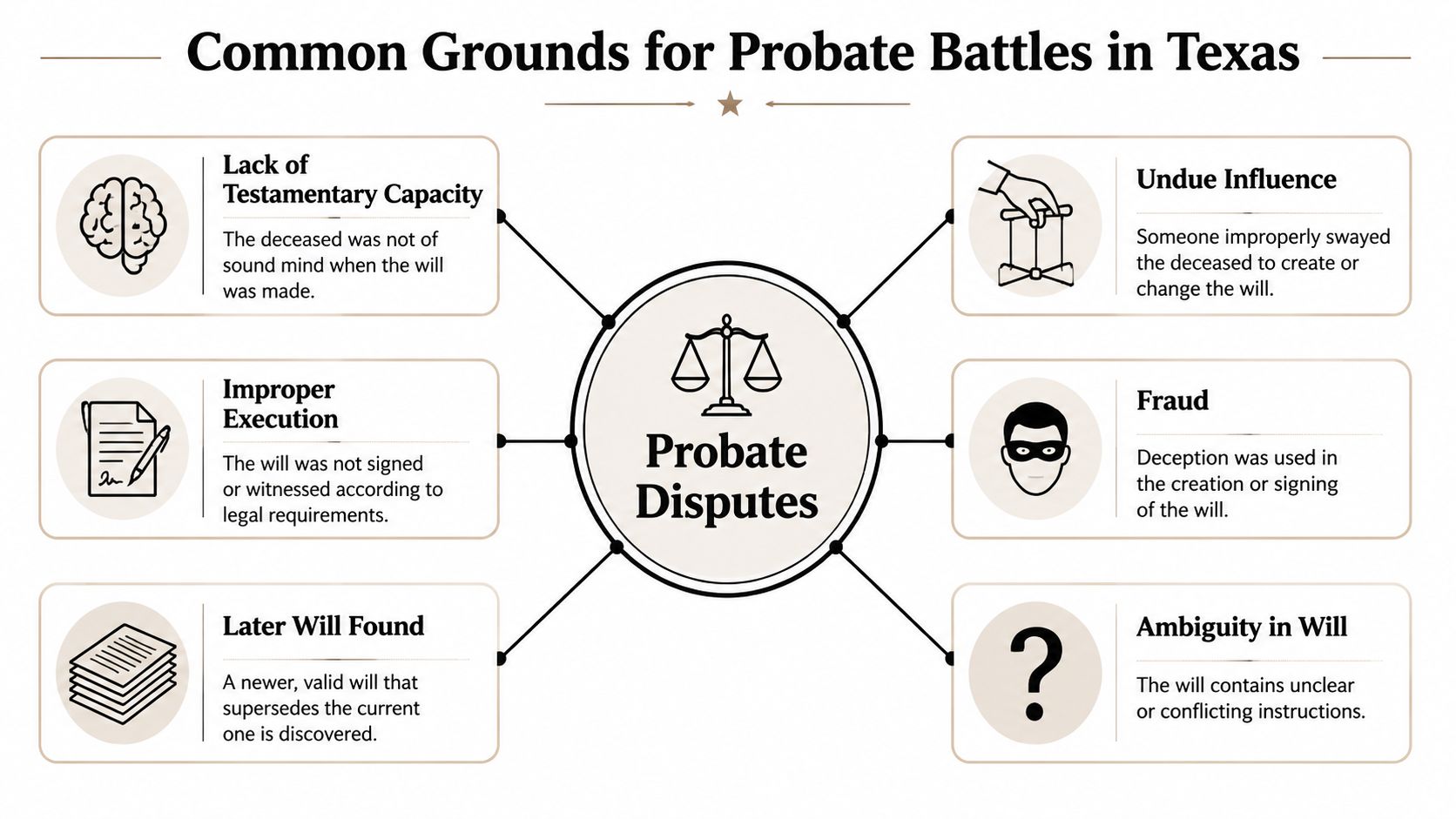
A useful way to view this section is as a map of the disputes judges sort into legal lanes. Some cases attack the validity of the will. Others accept the will exists but challenge how the estate is being managed or what property even belongs in the probate estate.
Challenges to the will itself
Many probate fights begin with the document itself. Before the court can rely on a will, it has to be satisfied that the will reflects a legally valid final expression of the decedent's intent.
Common grounds include:
Lack of testamentary capacity. The court examines whether the person signing the will understood they were making a will, understood the general nature of their property, and recognized the people who would ordinarily be the objects of their bounty. In practice, these cases often turn on timing. A diagnosis alone usually does not decide the issue. The sharper question is the person's mental condition when the will was signed.
Undue influence. This claim alleges pressure or manipulation strong enough to substitute someone else's intent for the decedent's own. Courts usually look for more than suspicion or family closeness. They look for a chain of facts, such as dependency, opportunity to control access, active participation in the will's preparation, and a result that appears unnatural in light of prior plans or relationships.
Fraud. Fraud cases involve deception used to procure a signature or alter the terms of the estate plan. These claims can be hard to prove because the key witness is often gone, so the case may depend on surrounding records, inconsistent statements, and testimony from the drafting attorney or witnesses.
Improper execution. Texas law sets formal requirements for executing a will. If those requirements were not followed, the court may refuse to admit the will to probate. Sometimes the fight is not over intent at all. It is over whether the legal steps were completed correctly.
A later valid will. A newer document can change the entire case. If someone produces a later will, the court must determine whether it was properly executed and whether it revoked the earlier one in whole or in part.
Disputes about administration and fiduciary conduct
Other probate battles start after the will is admitted. At that point, the court's focus shifts from "Is the will valid?" to "Is the estate being handled according to law?"
Executors and administrators do not get unlimited discretion. They act in a fiduciary role, which means the court can examine whether they are protecting estate property, keeping accurate records, providing required information, paying proper claims, and distributing assets according to the governing documents and Texas law.
That is where many families are surprised. A case may center on missing accountings, unexplained transfers, delayed distributions, self-dealing, or favoritism in the handling of estate assets. Those claims require a different kind of proof than a will contest. Bank records, inventories, receipts, appraisals, correspondence, and transaction histories often matter more than family recollections.
Property classification can change the whole dispute
Some of the hardest probate fights are really ownership fights.
A will only controls property the decedent had the legal power to transfer at death. If heirs are arguing over a house, ranch interest, brokerage account, or business share, the court may first need to decide whether the asset was separate property, community property, or a nonprobate asset that passes outside the will.
That issue can reshape the case quickly. A surviving spouse may already own a community property interest regardless of what the will says. Accounts with beneficiary designations may pass outside probate. Property placed in a trust may raise a different set of questions than property titled solely in the decedent's name.
Families often experience these disputes as arguments about fairness. Courts treat them as tracing and title questions. That distinction matters because the winning side is usually the one that can show where the asset came from, how it was titled, and whether any later agreement changed its character.
The Legal Ground Rules for Estate Disputes
Before a judge hears accusations about manipulation, favoritism, or bad conduct, the court usually asks a threshold question. Do you have standing?
Standing means the legal right to bring the dispute in the first place. Being angry, being related, or being disappointed isn't always enough. Texas probate courts first determine whether the challenger has standing and then move the case into an evidence-driven process. The degree of court control also changes depending on the type of administration. Independent administration leaves the executor broad authority, while supervised administration gives the court more direct authority over sales, distributions, and accountings, which can materially affect the balance of power in a family dispute (Texas probate litigation rights and court control).
Who usually has standing
In practical terms, the people most likely to have standing are those with a financial or legal interest in the estate. That can include heirs at law, named beneficiaries, and sometimes creditors.
A simple way to think about standing is this. If the result of the case would not change your legal or financial position, the court may decide you're not the right person to bring the challenge.
Here are common standing questions families ask:
| Situation | Why standing may exist |
|---|---|
| Disinherited child | If setting aside the challenged will would let the child inherit under an earlier will or intestacy, standing may exist |
| Omitted spouse | Standing may exist if marital rights or property classification affect distribution |
| Named beneficiary under prior will | Standing may exist if invalidating the current will would revive an earlier one |
| Relative with no financial interest | Family relationship alone may not be enough |
Independent and dependent administration
Texas families often hear these phrases early in the probate process. They matter because they shape how much freedom the executor has and how much day-to-day control the court keeps.
- Independent administration usually means the executor can act with less court involvement.
- Dependent or supervised administration means the court monitors more closely and may require approvals, accountings, or additional oversight.
This distinction appears throughout the Texas Estates Code, especially in Title 2, which addresses estate administration procedures and court-supervised processes. It can change strategy in a contested case. If the family believes the executor is acting unfairly, a more supervised setting may provide more transparency. If the estate needs to move efficiently and conflict is limited, independent administration may preserve flexibility.
Why these rules matter early
Families often want to jump straight to the story of what happened. Courts usually won't. They first sort out who is legally in the room, what kind of administration is in place, and what procedural path applies.
That's why reviewing the Texas probate process early can make a major difference. It helps heirs and executors understand whether they're dealing with a routine administration that became contentious or a true probate lawsuit from the start.
Walking Through a Texas Will Contest
A will contest often feels sudden to the family, but in court it unfolds in a sequence. Once that sequence is clear, the process becomes less mysterious.
Consider a realistic example. A father signs a new will near the end of his life. Two adult daughters had long believed the estate would be divided among all three children. The new will leaves nearly everything to their brother, who had moved in with the father and managed his appointments. The daughters believe their father was vulnerable and pressured. The brother says he only helped an aging parent. That dispute moves into probate court through a formal timeline.
A visual overview helps before looking at the details.
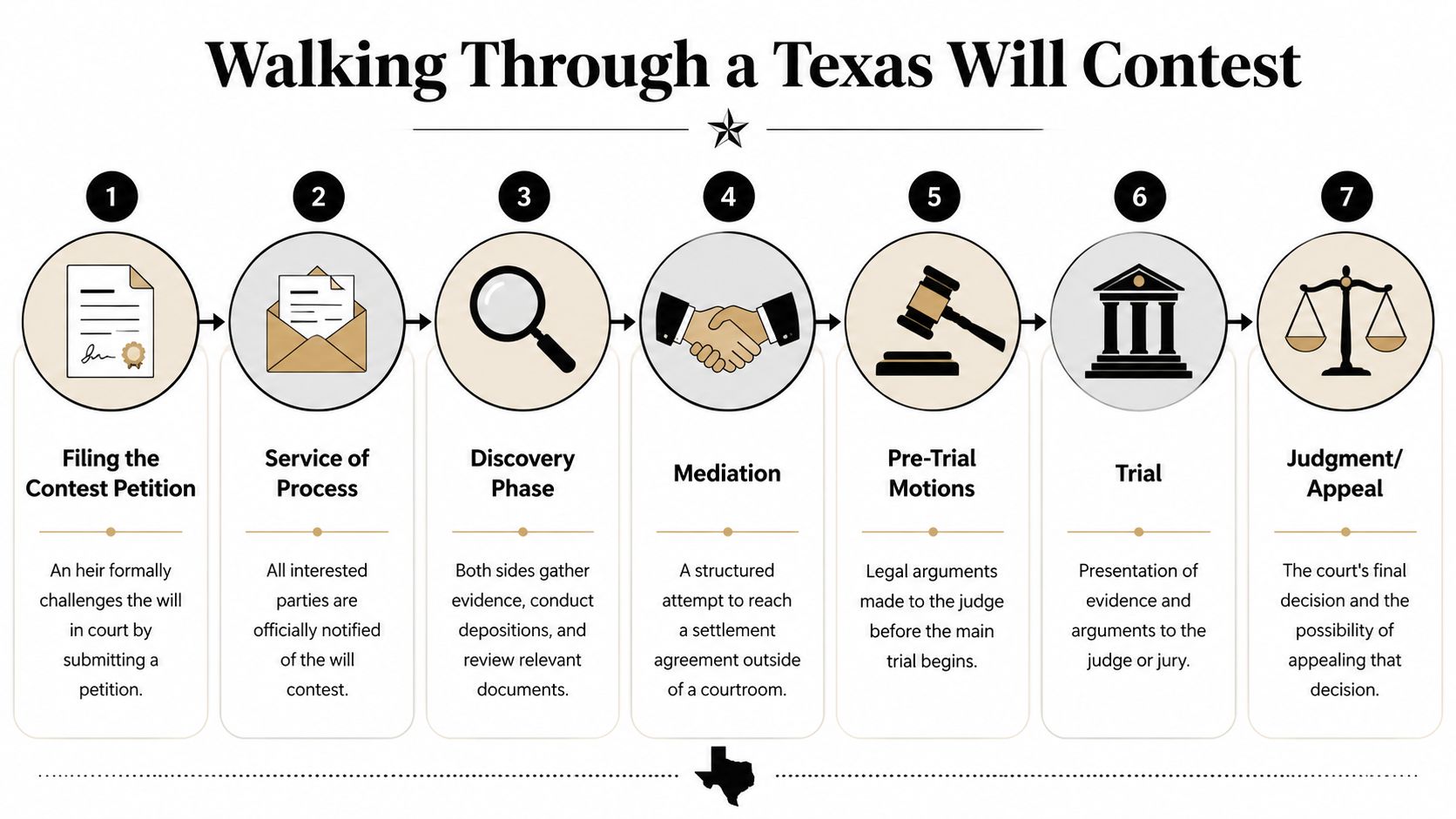
Filing comes first, and timing matters
In Texas, a will contest is generally subject to a 2-year deadline after the will is admitted to probate, and that deadline often determines whether heirs can preserve their claims at all because parties must quickly gather evidence of undue influence or fraud before discovery becomes time-consuming and expensive (Texas heir disputes and probate conflict guidance).
That means the daughters in the example can't wait for family tensions to cool. If they intend to challenge the will after probate admission, they generally need to file in the same probate court that handled the original matter. Delay can close the courthouse door.
Discovery turns suspicion into evidence
After filing, the case enters a phase lawyers call discovery. In plain English, discovery is the formal exchange of information. It's where each side gathers documents, asks written questions, requests records, and takes testimony under oath.
The daughters might seek:
- Medical records that show cognitive decline or confusion
- Financial records that reveal unusual transfers or sudden changes
- Prior estate documents that show a consistent earlier plan
- Witness testimony from neighbors, caregivers, or office staff
- Communications such as emails, texts, calendars, or notes
The brother may gather his own proof, such as evidence that the father met with counsel privately, understood the document, and acted consistently with long-held concerns or family realities.
For families trying to understand what formal probate litigation looks like in practice, the Probate Litigation resources offered by Law Office of Bryan Fagan, PLLC describe the court filing, discovery, hearing, mediation, and trial path involved in contested estates.
The process often looks like this in real life.
Mediation is often the pressure valve
Texas courts often encourage mediation before trial. Mediation is a structured settlement meeting with a neutral third party. It isn't therapy, and it isn't a private courtroom. It's a guided negotiation designed to test whether the parties can reach a practical resolution.
Settlement insight: Mediation works best when both sides have enough information to assess risk, but before trial costs and family hostility become even harder to contain.
Possible outcomes might include agreeing to a revised distribution, narrowing the issues for trial, approving a resignation of the executor, or resolving disputes over particular assets.
If no agreement happens, the judge decides
When mediation fails, the case proceeds through motions, hearings, and trial. At trial, the judge evaluates admissible evidence and decides whether the will should stand.
Many families learn a hard truth: Probate litigation is not an informal family review. It's a civil contest governed by pleadings, proof, objections, and legal standards.
Gathering the Right Evidence to Prove Your Case
Probate judges don't decide these cases by guessing who seems more believable at the dinner table. They decide them by weighing admissible evidence. In Texas will contests, the main technical battleground is usually proof, not rhetoric. Contestants must build a record around capacity, undue influence, or fraud using medical records, document trails, and witness statements, because probate judges are deciding whether the will reflects the decedent's true intent rather than which heir tells the most sympathetic story (what evidence matters in a Texas contested will).
That principle cuts both ways. Evidence can support a challenge, and evidence can defend a will against one.
What courts tend to find persuasive
The strongest probate cases usually create a clean timeline. They show what changed, when it changed, who was involved, and what records support that story.
Useful evidence often includes:
- Medical records that show memory problems, diagnosis history, medication issues, or mental decline near the signing date
- Witness statements from people without a personal stake in the outcome, such as neighbors, caregivers, office staff, or long-time friends
- Document trails including drafts, letters, emails, text messages, and appointment logs
- Financial records that show unusual withdrawals, transfers, or account changes
- Prior legal documents such as earlier wills, powers of attorney, and beneficiary designations
- Heirship records like birth certificates, adoption records, affidavits, cohabitation evidence, or DNA-related proof when identity or family status is disputed
- Guardianship-related materials when questions about capacity had already surfaced before death
A family that believes “everyone knew Dad wasn't himself” still needs records and testimony that a court can admit. If you're sorting through what documents may help, this guide on Texas probate dispute evidence is a useful starting point.
Suspicion alone usually isn't enough
Families often bring a case built around patterns they find troubling. One sibling was always present. Another stopped getting updates. A new will appeared late in life. Those facts may matter, but only if they connect to legally relevant proof.
A helpful comparison is a bridge. Suspicion may tell you there's a gap. Evidence is what gets you across it.
Courts usually look for a coherent timeline, not isolated red flags.
The burden sits with the challenger
Texas heir disputes follow a structured hierarchy of proof. The challenger must first establish standing as an interested party, then prove recognized grounds with admissible evidence. In heirship disputes, the burden falls on the person contesting the court's earlier determination, and the evidence may include records such as birth certificates, adoption papers, genealogical materials, affidavits from disinterested witnesses, cohabitation proof for common-law spouse claims, and DNA testing. These cases also can turn on whether property is community or separate, because classification affects what the estate can distribute under the Estates Code.
That's why early record preservation matters so much. Don't delete texts. Don't discard calendars. Don't assume the nursing file, hospital records, or prior lawyer correspondence will be easy to recreate later.
How Texas Courts Can Remedy an Unfair Situation
A probate court does not exist to referee family feelings. It exists to enter orders that change who controls the estate, what document governs, and where property goes.
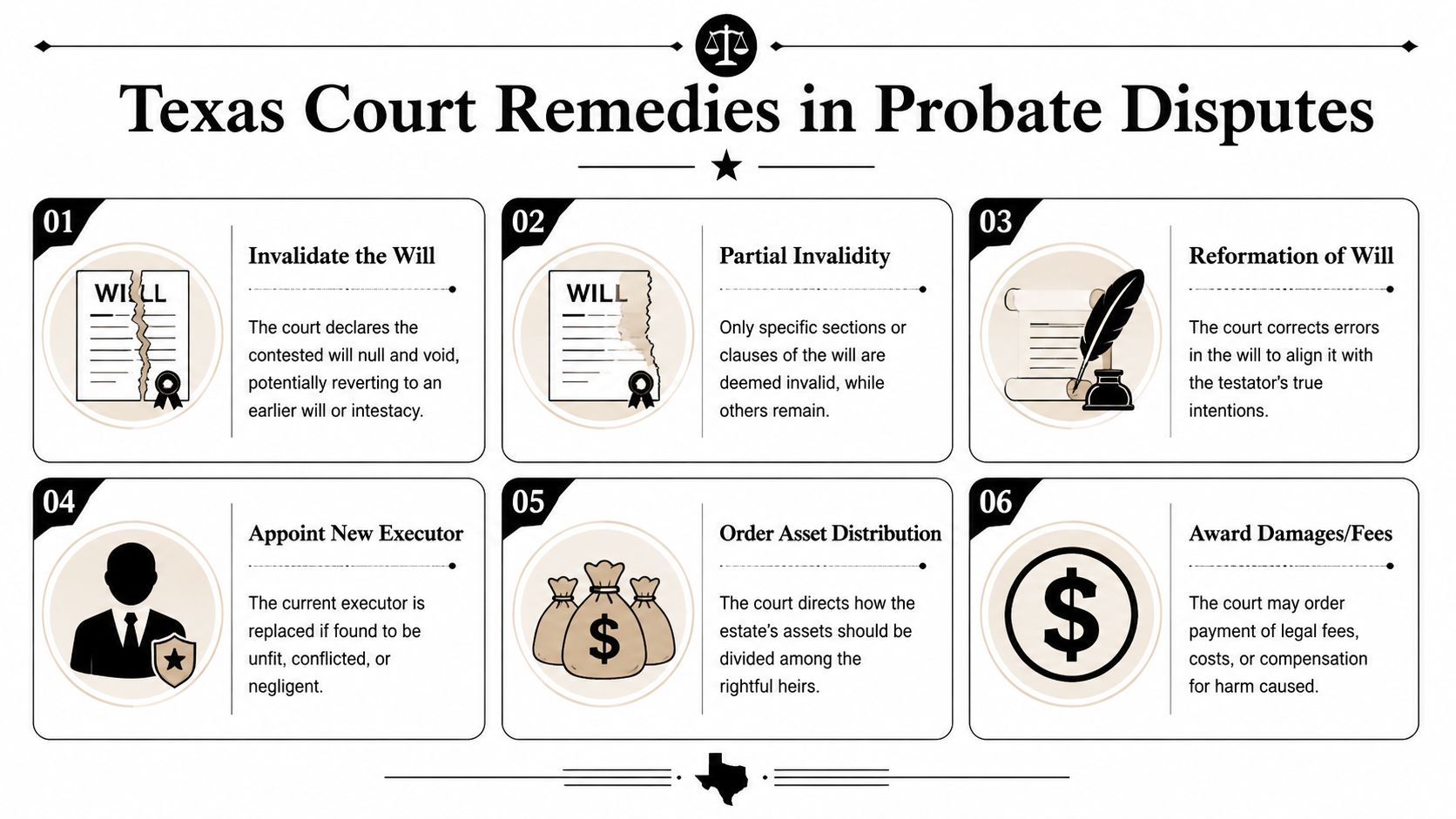
That distinction matters. Many heirs come to court wanting the judge to declare that something felt wrong. Texas judges usually focus on a narrower question. What legal fix matches the problem proven by the evidence?
The court can change who is in charge and what rules apply
If the court finds that a will is invalid, it can deny probate of that document. An earlier valid will may control instead. If no valid will exists, the estate passes under Texas intestacy rules.
The court can also address problems in the administration itself. If an executor has a conflict, mishandles estate funds, ignores required duties, or refuses to provide information the law requires, the judge can limit that person's authority, require a bond, order an accounting, or remove and replace the executor.
That process works a lot like replacing a trustee on a job site. If the person holding the keys is not protecting the project, the court can hand those responsibilities to someone who will.
Some remedies focus on property, not blame
In many cases, the actual dispute is not whether someone behaved badly. It is whether a particular asset belongs to the estate at all, or whether it belongs partly to a surviving spouse, a beneficiary, or another owner.
That is where classification matters. Texas courts may decide whether property is community or separate, whether an account passed by beneficiary designation, or whether a transfer made before death should be set aside. Those rulings can sharply change the final distribution without any dramatic courtroom moment.
Families often find this frustrating because the result can feel technical. In practice, technical issues decide estates every day.
Settlement is often part of the court's solution
A judge may never need to hold a full trial if the parties reach an agreement the court can approve. That is one reason lawyers spend real time assessing mediation versus litigation in Texas probate. Mediation can preserve estate assets, narrow the issues, and give the family more control over timing and terms.
It is not the right fit for every case. If one side is hiding records, refusing to cooperate, or pushing a claim with no factual support, court intervention may be the only way to get answers. But in the right dispute, settlement can solve the problem faster and with less damage to family relationships.
Lawyers who spend time handling complex probate disputes see this pattern often. The best result is not always a courtroom win. Sometimes it is a court-approved agreement that ends the fight before fees and delay consume the estate.
Remedies usually match the defect the court finds
| Problem the court finds | Possible court response |
|---|---|
| Invalid will | Deny probate of that will, admit a prior valid will, or apply intestacy rules |
| Executor misconduct or incapacity | Remove or replace the executor, require an accounting, increase supervision, or require a bond |
| Dispute over who owns an asset | Classify the property and order distribution based on ownership rights |
| Family agreement reached | Approve the settlement and fold it into the probate case |
Texas courts make targeted corrections. They do not issue broad moral verdicts about who was the better child, the more attentive sibling, or the relative with the strongest opinions. They identify the legal problem, choose the remedy the Estates Code and case law allow, and enter orders that move the estate toward closure.
Key Insights for Navigating a Probate Dispute
The hardest probate disputes usually become manageable when families stop treating them like a personal showdown and start treating them like a legal process with specific gates, deadlines, and proof requirements.
One of the most overlooked issues is standing. Many people are really asking, “Can I fight this will if I was left out?” Texas guidance makes clear that a challenger must first show a legally recognized financial interest before the court will even reach the merits of the dispute (Texas will contest standing guidance). That threshold question can decide a case before testimony ever starts.
Takeaway
If you're dealing with probate battles between heirs in Texas, keep these points in front of you:
- Check whether you have standing. Being a relative doesn't always mean the court will hear your challenge.
- Treat documents like evidence, not clutter. Preserve records, messages, account statements, prior wills, and medical information.
- Expect formality. Probate court is a civil process governed by the Texas Estates Code, especially the parts of Titles 2 and 3 dealing with wills, administration, heirship, and representative duties.
- Use mediation where it makes sense. Some families need a judge. Others need a structured negotiation that narrows the fight.
- Get legal guidance early. Delay usually makes proof harder, positions harder, and costs harder to control.
What usually works and what usually doesn't
What works is early case assessment, disciplined record gathering, and a realistic understanding of what the court can prove. What doesn't work is waiting for the family to “come around,” relying only on suspicion, or assuming the judge will sort out missing evidence for you.
Families facing especially technical issues may also benefit from outside reading on handling complex probate disputes when they want another practical perspective on how contentious estate cases are analyzed and resolved.
The strongest position in probate court usually belongs to the party who prepared early, documented carefully, and understood the rules before the conflict hardened.
If you're an heir, executor, or family member caught in this kind of dispute, the most useful next step is often a focused review of the will, the probate filings, the asset picture, and your legal status under Texas law.
If you're facing probate in Texas, our team can help guide you through every step from filing to final distribution. The Law Office of Bryan Fagan, PLLC works with families, heirs, and executors on probate administration, contested estates, wills, trusts, and related matters. Schedule your free consultation today.