A week after the funeral, the family finally sits down to look at the paperwork. Someone opens a folder and finds a will that doesn’t match what everyone expected. A child who had always been included is suddenly left out. A caregiver appears as a major beneficiary. An executor won’t answer basic questions. At that moment, grief mixes with suspicion, and it becomes hard to tell whether something is merely painful or unlawful.
That’s where many beneficiary disputes begin in Texas.
A beneficiary dispute is a conflict over who should receive property after someone dies, or how that property is being managed and distributed. Sometimes the dispute is about the will itself. Sometimes it’s about assets that never pass through the will at all, such as life insurance, retirement accounts, or payable-on-death accounts. Sometimes the problem isn’t the document. It’s the person handling the estate.
If you’re searching for answers about beneficiary dispute probate texas, you’re probably not looking for legal theory. You want to know whether what happened is contestable, how much time you have, what proof matters, and whether pursuing the dispute will protect your family or deepen the damage.
Those are fair questions.
Texas probate law gives beneficiaries, heirs, and executors tools to address real wrongdoing. It also sets strict rules about timing, standing, evidence, and procedure. That can feel cold when you’re mourning. Still, structure can help. A clear process gives families a way to separate grief, anger, unfairness, and legally actionable conduct.
A probate dispute isn’t automatically a fight over money. Often, it’s a search for the truth about what your loved one actually wanted and whether the estate is being handled lawfully.
The good news is that there is a path forward. You can evaluate the problem step by step. You can gather records before memories fade. You can decide whether to negotiate, mediate, or litigate. And you can do all of that without losing sight of the human side of the situation.
Navigating Family Conflict After a Loss
Families rarely enter probate at their best. People are tired, grieving, and often working from half-complete information. One sibling may have lived nearby and handled doctor visits, bills, and appointments. Another may have lived out of state and learned the details only after death. Those different roles can create very different narratives about what happened.
Consider a common situation. A mother signs a new will late in life. The new document benefits one child much more than the others, or leaves property to a caregiver who became closely involved near the end. The excluded family members feel shocked. The favored beneficiary insists the decedent knew exactly what she was doing. The executor says everyone needs to be patient, but won’t provide documents. Tension rises fast.
Why these disputes feel so personal
Inheritance disputes cut deeper than ordinary legal conflicts because the property often represents more than money. It may be the family home, a parent’s savings, or an account meant to care for children or grandchildren. People often hear a change in inheritance as a final statement of love, trust, or rejection.
That’s why it helps to separate two questions:
- Was the result emotionally painful
- Was the result legally improper
Those questions sometimes overlap, but not always. Texas courts don’t set aside wills because a distribution feels unfair. Courts look for legal defects, such as incapacity, undue influence, forgery, fraud, or serious misconduct in administration.
What families often need first
Before deciding whether to challenge anything, many families need a calmer framework.
A helpful starting point is this short list:
- Identify the asset involved: Is the dispute about a will, a bank account, life insurance, or something else?
- Confirm who is acting: Is there an executor, administrator, trustee, or insurance company involved?
- Gather the paper trail: Wills, beneficiary forms, medical records, emails, texts, and financial statements often matter more than family opinions.
- Watch the calendar: Probate deadlines in Texas can be unforgiving.
For many readers, the hardest part is accepting that both things can be true at once. You can love your family and still need legal intervention. You can want peace and still need answers. You can hope a misunderstanding gets cleared up, while preparing for the possibility that it won’t.
Understanding the Landscape of Beneficiary Disputes
The easiest way to understand Texas estate conflicts is to think of a loved one’s property as sitting in two separate buckets. If you put everything into one mental pile, the process becomes confusing fast.

The probate bucket
The first bucket is probate property. This usually includes assets owned solely by the deceased person that don’t have a built-in transfer mechanism. A house titled only in the decedent’s name, a bank account with no payable-on-death designation, or personal property may fall here.
This bucket is controlled by the will if there is one. If there isn’t a valid will, Texas intestacy rules in Texas Estates Code Title 2 help determine who inherits. Probate court oversees the process of validating the will, appointing the personal representative, addressing debts, and distributing what remains.
The non-probate bucket
The second bucket is non-probate property. These assets pass directly to a named beneficiary and usually bypass the will. Common examples include life insurance, retirement accounts, and payable-on-death accounts.
That surprises many families. A will may say, “I leave everything equally to my children,” but a life insurance policy with one named beneficiary can still pass outside the will. In Texas, disputes over these assets are common, and they matter because non-probate assets can make up 50% or more of an estate’s net worth, according to this discussion of hidden estate disputes in Texas.
If you want a plain-language overview of that issue, this explanation of how life insurance affects your estate is a useful companion to the probate questions families often ask.
One of the biggest sources of confusion is this. The will doesn’t control every asset.
Where families get tripped up
A beneficiary dispute can happen in either bucket.
A few examples make that easier to see:
- Probate dispute: A son claims the will was signed when his father lacked mental capacity.
- Non-probate dispute: A daughter believes a caregiver pressured her mother to change a life insurance beneficiary form.
- Administration dispute: All beneficiaries agree on the will, but they believe the executor is hiding assets or refusing to account for money.
Here’s the practical point. You can’t assume that winning a will contest solves every inheritance problem. If major assets pass by beneficiary designation, those assets may need separate analysis and, in some situations, separate legal action.
A simple road map for the first review
When someone comes into a probate consultation, one of the first jobs is building an asset map. A basic review usually looks like this:
| Asset type | Usually probate or non-probate | Common source of dispute |
|---|---|---|
| House in decedent’s sole name | Probate | Will validity, heirship, sale disputes |
| Bank account with POD beneficiary | Non-probate | Capacity, undue influence, fraud |
| Life insurance policy | Non-probate | Competing beneficiaries, slayer issues, beneficiary changes |
| Retirement account | Non-probate | Beneficiary designation disputes, divorce issues |
| Personal property | Probate | Executor control, valuation, distribution conflict |
That map matters because it tells you where the legal road may be blocked. Once you know which bucket the property belongs in, the next question is why the dispute arose at all.
Common Causes of Probate Disputes in Texas
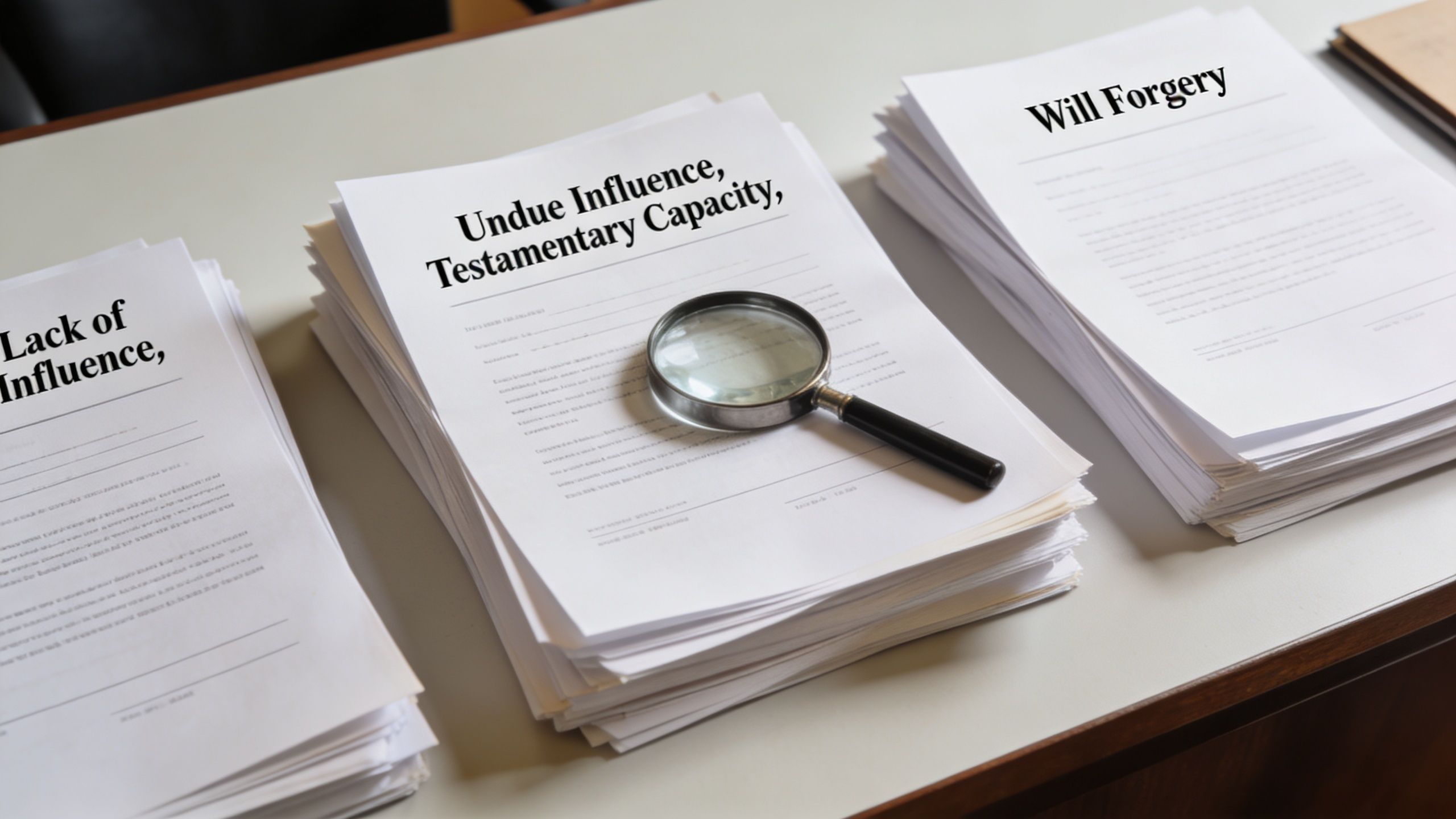
Not every suspicious situation becomes a valid case. Texas law recognizes certain grounds for challenging a will or related transfer. According to the Texas law library guide on will contests, valid grounds include improper execution, lack of testamentary capacity, undue influence, and fraud or forgery. The same source notes that successful challenges often turn on evidence such as medical records and witness testimony.
Lack of testamentary capacity
This ground focuses on the decedent’s mental ability when the document was signed. The legal question isn’t whether the person was elderly, ill, forgetful, or dependent on others. The question is whether the person understood the nature of making a will, the general extent of their property, and the people who would ordinarily receive it.
A realistic example: an elderly father with documented memory decline signs a new will during a period when he no longer recognizes major assets or consistently identifies his children. If medical records from that time support confusion or cognitive impairment, the capacity issue becomes more than family speculation.
Capacity cases often stand or fall on timing. A diagnosis alone usually isn’t enough. What matters is the decedent’s condition at or near the signing.
Undue influence
Undue influence means someone overpowered the decedent’s free will. This often comes up when a vulnerable person becomes isolated or dependent on one individual who then benefits from a sudden estate change.
Take a familiar pattern. A caregiver begins managing transportation, medications, and communication. Longtime family members lose access. Soon after, a new will or beneficiary form appears that heavily favors the caregiver. That sequence doesn’t automatically prove wrongdoing, but it raises the kind of questions courts take seriously when there is supporting evidence.
Signs families often notice
- Isolation from relatives: Visits or calls suddenly become limited
- Abrupt legal changes: A longstanding plan is replaced without a clear reason
- Heavy involvement by the beneficiary: The person receiving the benefit helps arrange meetings, paperwork, or signatures
- Contradictory explanations: Different people give different accounts of how the change happened
Practical rule: Suspicion starts a conversation. Documents, timelines, and witness testimony build a case.
Improper execution and forgery
Texas requires a will to meet legal formalities. Problems can arise if the will wasn’t properly written, signed, or witnessed. A forged signature creates an even more serious issue.
Sometimes the family conflict is simple and document-based. The signature looks wrong. The witnesses can’t be identified. Pages appear inconsistent. The original can’t be located. Those facts don’t prove invalidity by themselves, but they can justify a closer legal review.
This category is often easier for families to understand because it feels concrete. The dispute centers on the paper itself rather than the decedent’s state of mind.
Executor misconduct
Some disputes don’t challenge the will at all. The problem is what happens after the court appoints the personal representative.
An executor has legal duties to the estate and its beneficiaries. If that person refuses to communicate, withholds information, fails to protect property, or uses estate assets for personal purposes, beneficiaries may need to act. This kind of conflict can be especially frustrating because the will may be perfectly valid while the administration is going badly.
Common complaints about administration
- No accounting of money received or spent
- Unexplained delays in selling or distributing assets
- Missing property
- Favoritism toward one beneficiary
- Self-dealing or personal use of estate funds
The thread connecting all four causes is proof. Families often come to court with strong emotions and fragmented stories. Courts look for records, witnesses, and credible timelines. That’s why early fact-gathering matters so much.
The Legal Clock Your Rights and Deadlines
Time matters in every probate matter, but it matters most when you think a will or transfer was improper. Many families lose their advantage not because their concerns were baseless, but because they waited too long to act.
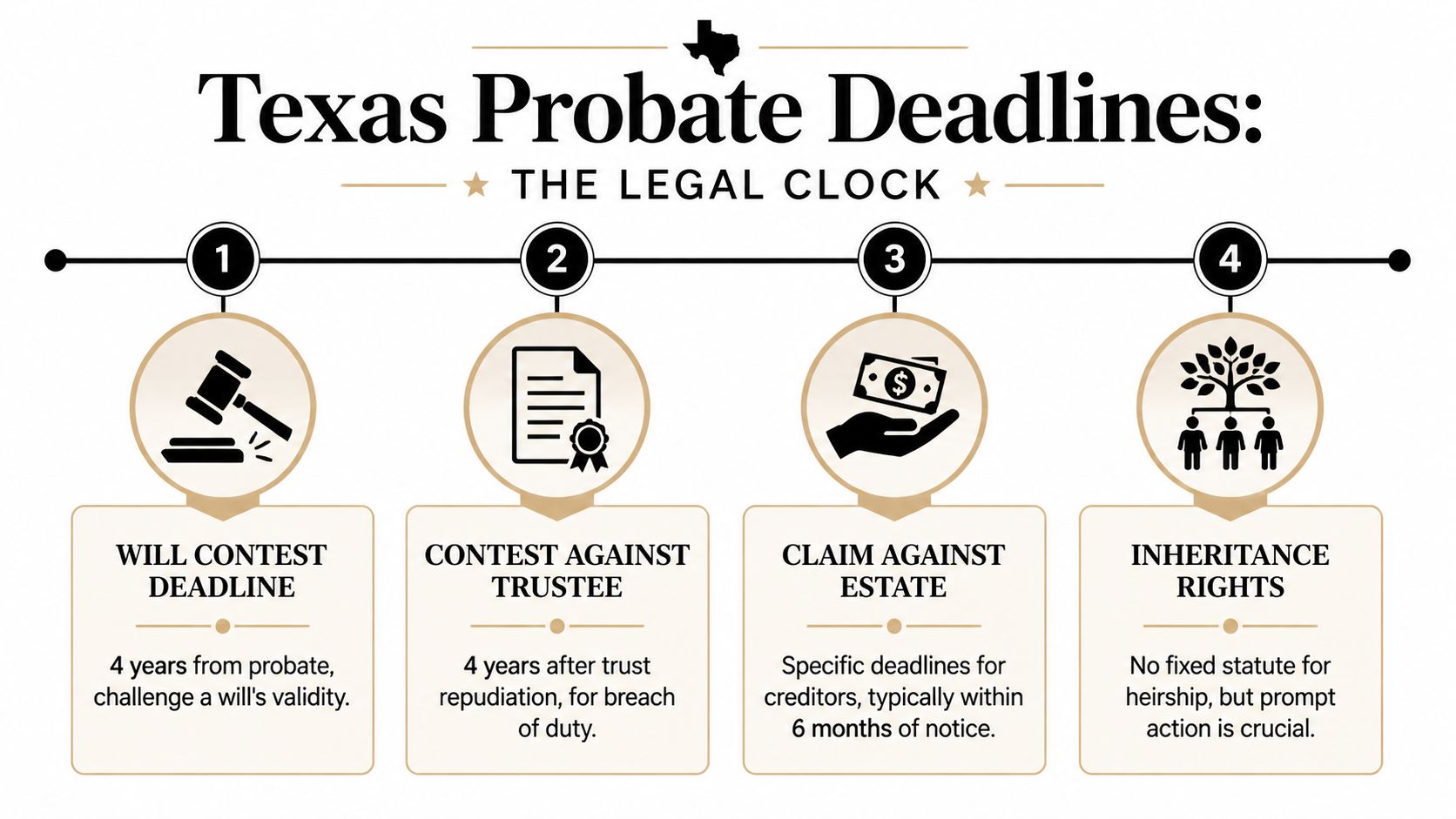
Under Texas Estates Code § 256.204, a beneficiary has a strict two-year statutory deadline from the date a will is admitted to probate to file a contest, and failure to act within that window usually bars the claim unless a narrow exception applies, as explained in this discussion of Texas probate court contest outcomes.
What admitted to probate means
A will is “admitted to probate” when the probate court accepts it as the document that will govern the estate administration. For many families, that’s the point when the legal clock starts running. It doesn’t start when the family first becomes suspicious. It starts from the court event that gives the will legal effect.
That distinction catches people off guard. Someone may spend months trying to keep the peace, only to discover that valuable time has already passed.
Here is a focused discussion of the Texas will contest deadline if you want to look more closely at how timing issues arise in practice.
Narrow exceptions still require urgency
Texas law recognizes limited exceptions in some circumstances, such as fraud or forgery that could not have been discovered earlier, or situations involving legal incapacity. But “exception” doesn’t mean “safe to wait.” It means the legal analysis becomes more technical and fact-specific.
A person who thinks an exception may apply should still move quickly. Delay can make witnesses harder to find, records harder to obtain, and facts harder to prove.
What to do immediately if you suspect a contest may be needed
Get the probate filing information
Confirm the county, cause number, and date the will was admitted.Secure the documents
Obtain the will, prior estate planning documents, and any notices you received.Preserve outside evidence
Medical records, text messages, emails, and calendars may become important later.Avoid family “agreements” that create more delay
Informal promises to sort it out later can cost you rights.
A short video can help make the timing issue easier to understand in practical terms.
Courts may listen patiently to a family’s explanation for delay. They still enforce filing deadlines.
The lesson here isn’t to panic. It’s to act while your options are still open.
Your Legal Remedies as a Beneficiary
Once you identify the problem, the next question is what tool fits it. Not every dispute calls for the same response. A will contest, an accounting demand, and a petition to remove an executor solve different problems.
Filing a will contest
Use this remedy when you believe the will itself is invalid. That may be because of incapacity, undue influence, fraud, forgery, or improper execution. The goal is to ask the court to reject the challenged will or determine that another valid document should control.
This is usually the most direct remedy when the core issue is, “This isn’t the document my loved one freely and lawfully made.”
Demanding an accounting
Use this when the main problem is lack of information. If an executor is handling estate money but beneficiaries can’t tell what has been collected, paid, sold, or distributed, an accounting may force a clearer picture.
An accounting can answer basic but important questions:
- What property came into the estate
- What debts or expenses were paid
- What remains
- Whether money appears to be missing or mishandled
For many families, this is the first practical move because it replaces suspicion with records.
Seeking removal of an executor
Use this when the personal representative is actively harming the estate, breaching duties, or making fair administration impossible. Removal is serious. Courts generally want evidence of misconduct, inability, conflict, or failure to perform required duties.
If your concern centers on concealment, self-dealing, or misuse of estate assets, this kind of claim may be more appropriate than a will contest. A focused review of executor breach of fiduciary duty in Texas can help families understand the difference.
Challenging non-probate transfers
Some beneficiaries assume they have no recourse if the disputed asset was life insurance, a retirement account, or a payable-on-death designation. That’s not always true. Beneficiaries can contest non-probate designations by proving lack of mental capacity, undue influence, or fraud, and divorce automatically voids ex-spouse designations under Texas Family Code § 9.302, as explained in this Texas beneficiary dispute overview.
That matters because some of the most valuable assets never pass through the will.
Use this remedy when the facts look like this
- A beneficiary change happened late in life: especially during illness, decline, or isolation
- A former spouse still appears on an account: divorce may affect that designation
- The account paperwork looks irregular: missing pages, unusual signatures, or inconsistent instructions
- A financial institution won’t release funds because claims conflict: an interpleader or related litigation may follow
Reclaiming improperly transferred assets
In some cases, the estate lost property before death or during administration through improper transfers. The remedy may involve asking the court to return assets, freeze further transfers, or sort out who has the legal right to possession.
Probate litigation can overlap with trust disputes, fiduciary claims, and broader estate recovery issues under Texas Estates Code Titles 2 and 3.
Matching the remedy to the real problem
If you use the wrong legal tool, you can spend time and money without fixing the issue. A simple matching exercise helps:
| If your main problem is | The likely remedy to discuss |
|---|---|
| The will should never have been accepted | Will contest |
| The executor won’t explain the finances | Accounting |
| The executor is harming the estate | Removal or surcharge-type relief |
| A life insurance or POD beneficiary change looks improper | Challenge the designation |
| Property disappeared before distribution | Asset recovery claim |
One practical option families often consider is working with a probate litigator who handles both will contests and administration disputes, such as the Law Office of Bryan Fagan, PLLC, because these issues often overlap in a single estate.
Paths to Resolution Mediation vs Litigation
Most families ask the same question after learning their options. “Do we really have to go to court?”
Sometimes yes. Often not immediately.
Texas beneficiary disputes usually move toward resolution in one of two ways: mediation or litigation. They are not the same. One is a guided negotiation. The other is a formal court process that may involve pleadings, discovery, hearings, and possibly trial.
What mediation looks like
Mediation places the parties in a structured settlement process with a neutral third party. The mediator does not decide who wins. The mediator helps each side evaluate risk, exchange information, and work toward an agreement.
This path can be especially useful when the family wants privacy, flexibility, and a chance to preserve some working relationship. It can also help when the dispute is fueled by misunderstanding as much as misconduct.
A helpful starting point for families weighing that option is this discussion of probate mediation in Texas.
What litigation looks like
Litigation is the court-driven path. It can produce a binding ruling when the parties can’t agree, when someone refuses to disclose information, or when immediate judicial authority is needed to protect the estate.
The tradeoff is significant. As noted in this discussion of resolving beneficiary disputes in probate, trials are described as expensive, emotionally taxing, and unpredictable, and families should weigh whether legal fees and emotional strain may outweigh the disputed inheritance.
That doesn’t mean litigation is a mistake. It means the decision should be deliberate.
Sometimes the strongest legal move is not the most aggressive one. It’s the one that protects the estate without draining it.
Mediation vs Litigation in a Texas Probate Dispute
| Factor | Mediation | Litigation (Court Trial) |
|---|---|---|
| Decision maker | The parties control settlement terms | The judge or court decides disputed issues |
| Privacy | Usually more private than trial | Court filings and hearings are more public |
| Flexibility | Can include creative family-centered solutions | Limited to remedies the court can order |
| Emotional impact | Often less adversarial | Often deepens conflict |
| Need for formal evidence | Still important, but the process is more flexible | Evidence rules and procedure matter heavily |
| Best fit | Ongoing relationships, partial misunderstandings, room to compromise | Fraud allegations, entrenched conflict, refusal to cooperate |
A practical decision framework
Families often benefit from asking four questions before committing to a long fight:
What is the actual asset in dispute
A sentimental object, a home, an account, or control over administration may call for different strategies.How strong is the evidence
Medical records, witness accounts, and financial documents matter more than instinct.What result do you need
Information, removal of an executor, reversal of a designation, or a formal ruling are not the same objective.What will the process cost emotionally
Some disputes destroy sibling relationships beyond repair. Others can be resolved with a candid session and a revised distribution agreement.
Mediation is often attractive when the evidence is mixed, the family wants closure, or the estate should be preserved rather than consumed by conflict. Litigation may be necessary when one side won’t produce records, when abuse is suspected, or when a legal ruling is the only way forward.
The hard truth is that being legally right doesn’t automatically make a case financially or emotionally wise. That’s why probate decision-making has to include both law and lived reality.
Key Insights and When to Contact a Probate Attorney
The clearest way to approach a beneficiary dispute is to stay grounded in three realities. First, the law cares about evidence more than family assumptions. Second, deadlines can close the door even when concerns are legitimate. Third, not every unfair outcome is an illegal one.
Key Insight
Key Insight: In a Texas beneficiary dispute, your strongest early moves are to identify which asset bucket is involved, preserve records, and get legal advice before delay turns a difficult case into a barred one.
That idea sounds simple, but it changes how families respond. Instead of arguing in circles about motives, you focus on documents, timing, and remedies. Instead of asking only, “Was this wrong,” you also ask, “What can a court do about it?”
Red flags that should prompt a call
Some situations need legal review right away. If any of these sound familiar, it may be time to move from research to action:
- A surprise will appears late in life: especially one that sharply changes a long-standing plan
- A caregiver or new companion becomes the main beneficiary: particularly if the decedent was isolated or medically vulnerable
- The executor won’t communicate: silence often makes a manageable issue much worse
- Financial records don’t match the story: missing funds, unexplained withdrawals, or vanished property deserve scrutiny
- A beneficiary form conflicts with everything the family was told: life insurance and retirement assets often trigger these disputes
- You suspect elder financial abuse, forgery, or pressure: waiting rarely improves proof
- Someone says “don’t involve a lawyer yet” while controlling the documents: that’s often a warning sign, not reassurance
Where broader probate guidance fits
A dispute rarely exists in isolation. The family may also need help with the broader Texas Probate Process, especially if administration is already underway. Some families discover that weak planning caused the conflict, which is why Wills & Trusts work matters long before a dispute arises. Others uncover incapacity issues affecting a living relative, where Guardianship may become part of the conversation. When the matter becomes adversarial, focused help with Probate Litigation is often essential.
A probate attorney can help you sort out whether your situation calls for a contest, an accounting, a removal action, mediation, or a careful document review. Just as important, good counsel helps you decide whether pursuing the dispute makes practical sense for your family.
You don’t have to know the answer before you call. You only need enough information to recognize that something may be wrong.
If you’re facing probate in Texas, our team can help guide you through every step, from filing to final distribution. The attorneys at Law Office of Bryan Fagan, PLLC work with Texas families, heirs, and executors on probate administration, estate disputes, wills, trusts, and related matters. Schedule your free consultation today.