Skip to content
When a loved one passes away, the last thing your family needs is a complicated, stressful legal battle. We understand that you're navigating a difficult time, and the legal responsibilities that follow a loss can feel overwhelming. In Texas, settling an estate often comes down to two very different paths: a formal court process called probate or a simpler alternative for specific situations, the Affidavit of Heirship. Making the right choice isn't just a matter of preference; it hinges entirely on the estate's assets, its debts, and whether every family member is on the same page.
This guide is designed to offer Texas families clear, compassionate direction when you need it most. Our goal is to cut through the legal jargon and help you understand which path truly fits your family’s unique circumstances, providing reassurance and clarity.

Whether you're handling a family home in Houston or a piece of rural land, understanding the fundamental differences between these two legal tools is the critical first step.
Quick Comparison: Affidavit of Heirship vs. Formal Probate
| Factor | Affidavit of Heirship | Formal Probate |
|---|---|---|
| Court Involvement | No court supervision is required. It is filed directly in public property records. | A formal court process is mandatory and overseen by a judge. |
| Best For | Simple estates where the only significant asset is real estate (like a house), there are no debts, and all heirs agree. | Estates with various assets (bank accounts, stocks, vehicles), outstanding debts, or family disagreements. |
| Legal Authority | Establishes a presumption of ownership that title companies may accept, but it can be challenged. | Provides a conclusive court order (Letters Testamentary) giving an executor full authority to manage all assets. |
| Timeline | Typically much faster, often completed within a few weeks. | Can take several months to over a year, depending on the estate's complexity. |
| Creditor Claims | Offers no formal process to handle or cut off creditor claims, leaving heirs exposed. | Provides a legal framework for notifying creditors and settling all estate debts, offering finality and protection. |
As you can see, the main trade-offs are speed versus finality. An Affidavit of Heirship delivers a quick solution for very specific, uncomplicated situations. On the other hand, formal probate provides the legal certainty and structure needed to handle more complex estates. Now, we'll explore each of these in greater detail to help you move forward with confidence.
What Is an Affidavit of Heirship in Plain English?

When someone in Texas passes away without a will, their family is often left in a tough spot, especially when it comes to property like a house. An Affidavit of Heirship is a legal document created for this exact scenario. Put simply, it’s a sworn statement that identifies the deceased person’s legal heirs and acts as a bridge to transfer ownership of their real estate without going to court.
Instead of navigating the formal probate court system, this affidavit is filed directly in the property records of the county where the real estate is located. Its main purpose is to create a clean, public record of who the new owners—the heirs—are. This helps establish a "clear chain of title," which is essential if the family later wants to sell, refinance, or transfer the property.
The Role of Disinterested Witnesses
For an Affidavit of Heirship to be valid, Texas law requires that the family history it contains must be confirmed by two disinterested witnesses. This is one of the most crucial parts of the process.
So, what exactly is a disinterested witness? It’s someone who:
- Knew the deceased person and their family history personally.
- Will not inherit anything from the estate. In other words, they have no financial stake in the outcome.
These witnesses must swear under oath to key facts about the deceased’s life—their marriages, divorces, children, and other relevant family details. Their testimony provides essential third-party verification, giving the affidavit the credibility it needs. Often, a close family friend, a long-time neighbor, or a fellow church member can serve in this role.
The Five-Year Rule and Its Legal Weight
An Affidavit of Heirship gains strength over time. Under Texas Estates Code § 203.001, once the affidavit has been on file in the county records for five years or more, it is considered prima facie evidence of the facts it states.
That legal term, prima facie, simply means the affidavit is presumed to be true unless someone comes forward with evidence to prove otherwise. After this five-year milestone, title companies become much more willing to insure the property's title, making a future sale far smoother for the heirs. For more details on the form itself, you can learn more about the specifics of the affidavit of heirship form.
Realistic Expectations and Limitations
While the affidavit is a cost-effective tool for transferring real estate, it's vital to understand its limits. This document is almost exclusively for handling real property, like a house or land.
It is not an all-access pass to other assets. You can’t walk into a bank with an Affidavit of Heirship and expect them to release funds from a checking account, 401(k), or stock portfolio. Financial institutions almost always require a formal court order from a probate proceeding—known as Letters Testamentary or Letters of Administration—to protect themselves from liability. If the estate includes more than just real estate, an affidavit alone will not be enough.
Understanding the Formal Texas Probate Process
While an Affidavit of Heirship can seem like a simple shortcut, many estates demand the legal authority and structure that only the formal Texas probate process can provide. It’s easy to think of probate as a difficult ordeal, but it’s actually a court-supervised system designed to protect everyone involved—from family members to creditors—by settling a loved one’s final affairs in a transparent and orderly way.
At its core, probate is a methodical, step-by-step process. First, the court must legally confirm that the deceased person's will is their genuine last testament. Once the will is validated, the court officially appoints the person named in it—the executor—to manage the estate. This court approval gives the executor the legal power they need to act.
Testate vs. Intestate: The Two Roads of Probate
The probate journey looks very different depending on one critical detail: whether your loved one left a valid will.
Testate: This is the legal term for when someone dies with a will. In this scenario, the probate process focuses on carrying out the specific instructions your loved one laid out. The will acts as the roadmap for the executor.
Intestate: This term applies when someone dies without a will. When this happens, the court oversees the estate's settlement according to a strict legal formula defined in the Texas Estates Code (Title 2, Subtitle E, Chapter 201).
In an intestate case, the court appoints an "administrator" instead of an executor. This person has the same duties—gathering assets and paying debts—but the final distribution of property is dictated by state law, not by your loved one’s personal wishes.
A Realistic Scenario: Imagine a father passes away in Austin with a will that clearly leaves his classic car to his son, his investment portfolio to his daughter, and the rest of his estate to be split equally. Probate ensures his son gets the car and his daughter receives the portfolio—just as he intended. If he had died without a will, a judge would follow Texas intestacy laws, which would likely result in all assets being divided among both children, regardless of the father's verbal promises or specific wishes.
Receiving Your Authority from the Court
One of the biggest points of confusion for families is understanding how an executor or administrator gets the power to manage the estate. You can't just show up at the bank with a will and expect to access an account. You need an official order from the probate court.
This court order comes in the form of Letters Testamentary (for an executor in a testate case) or Letters of Administration (for an administrator in an intestate case). These "Letters" are not mail; they are a one-page certificate issued by the court clerk that serves as absolute proof of your legal authority. Banks, title companies, and financial institutions will all ask for this document before they will work with you. You can learn more about the Texas probate process in our detailed guide.
From filing the initial application to inventorying assets, notifying creditors, and finally distributing what’s left to the rightful heirs, the entire process can take anywhere from a few months to over a year. While it demands patience, formal probate delivers unmatched legal finality, ensuring the estate is settled correctly and completely.
Comparing an Affidavit of Heirship vs Probate in Detail
When settling a loved one's estate, one of the first and most critical decisions your family will face is whether to use an Affidavit of Heirship or go through formal probate. The path you choose will dictate the cost, time, and legal burdens involved in transferring property. Let’s break down the real-world differences.
The probate process itself has a clear starting point, depending on whether a will exists. The flowchart below shows how this single question directs the entire court process.
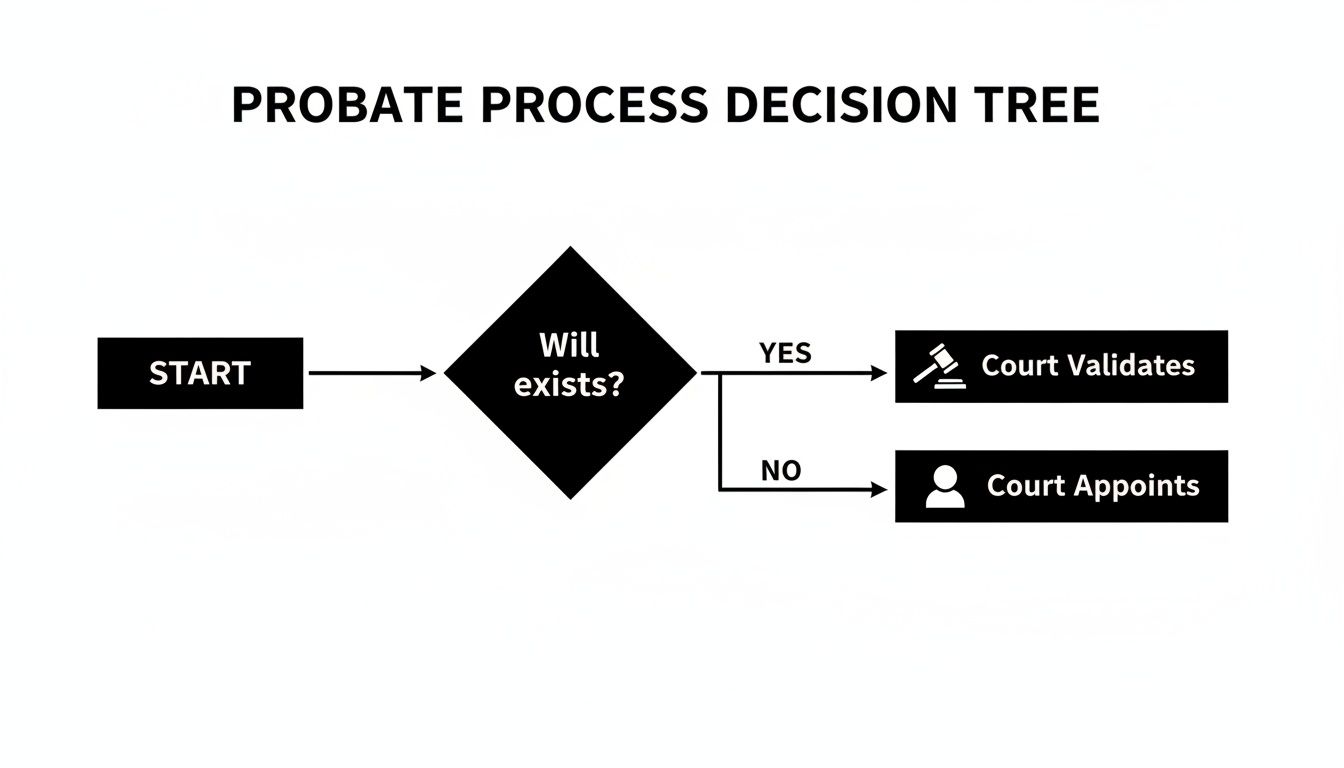
As you can see, the court's role is either to validate a will or, if there isn't one, to appoint an administrator. Both paths lead to a structured, court-supervised settlement. The Affidavit of Heirship, however, bypasses this entirely.
Cost and Financial Predictability
The financial difference is often a deciding factor. An Affidavit of Heirship is almost always the cheaper path. The costs are straightforward: attorney fees for drafting the document, notary fees, and a minor fee for recording it in the county property records.
Probate comes with a longer list of expenses: court filing fees, mandatory costs for posting legal notices, and sometimes a bond for the executor or administrator. The most significant cost is often the attorney fees required to guide a family through a court process that can last for months.
Timeline and Speed to Resolution
If speed is your priority, the comparison is clear. An Affidavit of Heirship is fast. Once you've gathered the necessary family history and secured signatures from two disinterested witnesses, the document can be prepared, signed, and filed in just a few weeks.
Probate is a marathon, not a sprint. There are mandatory waiting periods and statutory deadlines. A simple, uncontested probate can take four to six months at a minimum. If there are any disagreements or complexities, it can easily stretch for a year or more.
Court Involvement and Supervision
Here lies a fundamental difference. An Affidavit of Heirship is an out-of-court procedure. It's a sworn statement of facts filed in the public record. No judge ever sees it, and no court approval is needed.
Probate is, by its nature, a formal court proceeding. A judge oversees every critical step, from confirming the will to approving the final distribution of assets. This judicial oversight is there to protect everyone involved, but it also adds time and formality.
Handling Creditor Claims
How an estate deals with debts is a critical area where probate has a clear upper hand. The probate process establishes a formal, legally defined method for notifying creditors under the Texas Estates Code. They are given a specific timeframe to file a claim, and once that window closes, they are generally barred from coming after the assets. This gives heirs complete finality and protection.
An Affidavit of Heirship offers no such protection. The estate's debts follow the property to the heirs. Creditors can potentially sue heirs for payment long after the affidavit is on file, creating a lingering financial risk.
Types of Assets Transferred
The type of property left behind often makes the decision for you. An Affidavit of Heirship is a very specific tool designed primarily to transfer title to real estate.
If the estate includes almost any other type of asset, probate is generally unavoidable. Financial institutions will not release funds without an official court order. Probate is required to manage an estate that includes:
- Bank or credit union accounts
- Stocks, bonds, or investment accounts
- Retirement funds like 401(k)s or IRAs
- Vehicles with titles
- Contents of a safe deposit box
For some estates with a valid will and no debts, a simpler court process like a Muniment of Title in Texas might be an alternative, but it still requires going to court.
Legal Finality and Authority
Finally, the two processes grant very different levels of legal authority. A probate court order provides immediate and undeniable legal finality. The Letters Testamentary grant an executor unquestioned power to act on the estate's behalf.
An Affidavit of Heirship only creates a presumption of who the heirs are. Its legal weight grows stronger over time, but it never offers the same ironclad certainty as a court order. It can always be challenged by a forgotten heir or an unpaid creditor, leaving the property's title vulnerable.
Real-World Scenarios: When an Affidavit of Heirship Makes Sense
Knowing the textbook differences is one thing; seeing them in real-life situations is another. The Affidavit of Heirship is a perfect fit in very specific circumstances, usually when an estate is clean and the family is united.
Scenario One: The Straightforward Family Home
Picture this: A mother passed away in Houston. She never wrote a will, and her only real asset was the family home she owned outright—no mortgage or liens. She leaves behind three adult children who all get along and agree the best plan is to sell the house and split the money.
In this case, a full probate would be costly and time-consuming. Instead, they can use an Affidavit of Heirship. The steps are clear:
- Work with an attorney to draft the affidavit, detailing their mother's family history.
- All three children sign the document.
- They find two family friends who knew their mother for decades and will not inherit anything to act as disinterested witnesses.
- Once signed and notarized, the affidavit is filed in the Harris County property records.
This creates a clear chain of title, allowing a title company to insure the property so the siblings can sell the house and move forward.
Scenario Two: The Will That Was Never Probated
Here’s a situation we see often. A father died over ten years ago, leaving a valid will that gave his land to his two daughters. For one reason or another, the family never probated the will. Now, the daughters want to build on the land, but the title is still in their father’s name.
In Texas, there’s a strict four-year statutory deadline to probate a will (Texas Estates Code § 256.003). Since that window has closed, the Affidavit of Heirship becomes their best and possibly only option. The law essentially treats the father as having died intestate for title transfer purposes. The daughters, as his legal heirs, can file an affidavit to correct the public record and claim their inheritance.
Key Insight: The success of an Affidavit of Heirship hinges entirely on total family cooperation. If even one heir disagrees or refuses to sign, the process stops dead in its tracks. This tool is built for unity, not for resolving family fights.
In both of these stories, success was possible because of unanimous agreement among all heirs and a lack of significant estate debt.
When Probate is the Only Answer
While an Affidavit of Heirship is a useful shortcut, some situations are too complex or too risky for it to be the right choice. In these cases, formal probate isn’t just a better idea—it’s the only legally sound way to protect everyone involved. Knowing when the debate between affidavit of heirship vs probate in Texas is over and probate becomes unavoidable is crucial.
Scenario One: The Estate Involves More Than Just a House
Think about this: Your loved one owned a home, but also had a checking account, a 401(k), and a stock portfolio. You can't just walk into a bank or brokerage firm with an Affidavit of Heirship and expect access to those accounts.
Financial institutions have strict rules to protect themselves from liability. They require an official court order—Letters Testamentary (with a will) or Letters of Administration (without a will)—before releasing a deceased person’s assets. These documents can only be issued by a probate judge. Without them, those financial accounts will remain frozen and out of reach. Probate is the only key that can unlock them.
Scenario Two: Heirs Can't Agree
Grief and stress can unfortunately lead to family disagreements. Let's imagine a father passes away without a will, leaving three adult children. Two want to sell the family home and split the proceeds. The third objects, insisting their dad promised they could live there.
This disagreement makes an Affidavit of Heirship impossible. For an affidavit to be valid, every single heir must agree on the facts and sign it.
This is exactly where the probate process provides a solution. The court offers a neutral forum to resolve disputes under a judge's guidance. The judge will hear all sides, apply Texas law, and issue a binding order on how the estate must be settled. In these situations, engaging in probate litigation can prevent a family disagreement from spiraling into a bitter, multi-year feud.
Scenario Three: The Deceased Left Behind Significant Debts
An Affidavit of Heirship offers no formal way to deal with creditors, leaving heirs exposed. If your loved one died with medical bills, credit card balances, or a mortgage, probate is the only responsible way to handle those liabilities.
The Texas Estates Code provides a clear, step-by-step framework for managing debts. The executor is required to publish a legal notice, officially notifying creditors to submit their claims by a specific deadline. Any creditor who misses that deadline is usually barred from collecting later.
Key Insight: This creditor claim process in probate acts like a legal firewall. It protects heirs from being personally pursued for the estate's debts years later, offering a clean break and priceless peace of mind. It ensures all legitimate debts are paid from the estate's assets before anything is distributed to the heirs.
Your Next Steps in Settling a Texas Estate
Choosing between an Affidavit of Heirship and formal probate is a critical decision that can save your family stress, time, and money during an already painful period.
An Affidavit of Heirship often makes sense for straightforward situations: the only major asset is a house, there are no creditors, and all heirs are in complete agreement.
But when things get complicated, formal probate is usually the only path forward. This is the route you’ll need to take if the estate holds a mix of assets like bank accounts and investments, if there’s any disagreement among heirs, or if there are debts to be settled.
Takeaway: Getting this first step right is the single most important thing you can do to protect your family’s inheritance and avoid future legal battles. Don’t leave a decision this critical to guesswork. For a wider look at the entire journey, you may want to learn how to settle an estate.
Navigating these legal waters requires a solid grasp of Texas law. Whether you need help with the Texas Probate Process, establishing a Guardianship, or creating a strong foundation with Wills & Trusts, getting advice tailored to your unique situation is key.
Our compassionate team is here to provide the clarity and support you need. We can help you understand your options and choose the right path for your family with confidence.
If you’re facing probate in Texas, our team can help guide you through every step — from filing to final distribution. Schedule your free consultation today.
Frequently Asked Questions About Texas Heirship and Probate
When you're trying to settle an estate, the path forward isn't always clear. Here are some of the most common questions families ask when choosing between an Affidavit of Heirship and probate.
Can an Affidavit of Heirship Be Challenged?
Yes, and this is one of its biggest risks. An Affidavit of Heirship creates a presumption of who the heirs are, not a final, court-ordered fact. It can be challenged at any time by a forgotten heir, an unknown creditor, or the discovery of a valid will. If a challenge succeeds, it can cloud the property's title and force the estate into a more complicated probate proceeding.
What Happens if a Will Is Found After We File an Affidavit?
Discovering a valid will after an Affidavit of Heirship has been filed can create a legal tangle. In Texas law, a valid will almost always trumps an affidavit. If the will is found within the four-year window for probate, the correct step is to submit it to the court. A judge will then determine the rightful heirs based on the will's instructions, likely invalidating any property transfers made using the affidavit.
How Long Do I Have to Start Probate in Texas?
This is a critical deadline. In Texas, you generally have four years from the date of a person’s death to file their will for probate. As outlined in the Texas Estates Code, missing this deadline usually means the will can no longer be probated in the standard way, though a few narrow exceptions exist. For estates without a will (intestate estates), there isn't a strict deadline to start the process, but waiting too long can make things much more difficult.
Do All Assets Have to Go Through Probate?
No, and understanding this can save time and effort. Certain types of assets, often called non-probate assets, are designed to pass directly to a named beneficiary without court involvement. These bypass the will and probate process entirely and commonly include:
- Life insurance policies with a designated beneficiary.
- Retirement accounts like 401(k)s and IRAs with a beneficiary.
- Payable-on-death (POD) bank accounts.
- Property held jointly with a right of survivorship.
Identifying which assets are part of the probate estate is one of the first steps in choosing the right path for settling an estate.
If you’re facing probate in Texas, our team can help guide you through every step — from filing to final distribution. Schedule your free consultation today.