A Texas last will and testament form is a legal document that allows you to direct how your property should be distributed after your passing. It is the fundamental tool for ensuring your wishes are honored, your assets are protected, and your family is cared for according to your plan, not one determined by a court. Creating a will is a profound act of care, providing clarity and peace of mind for the loved ones you leave behind.
Why a Texas Will Is Your Family's Shield
Thinking about the future can feel overwhelming, but creating a will is one of the most important and compassionate actions you can take for your family. It is far more than a legal formality; it’s a shield that protects the people you love from uncertainty and potential conflict during an already painful time of grief.
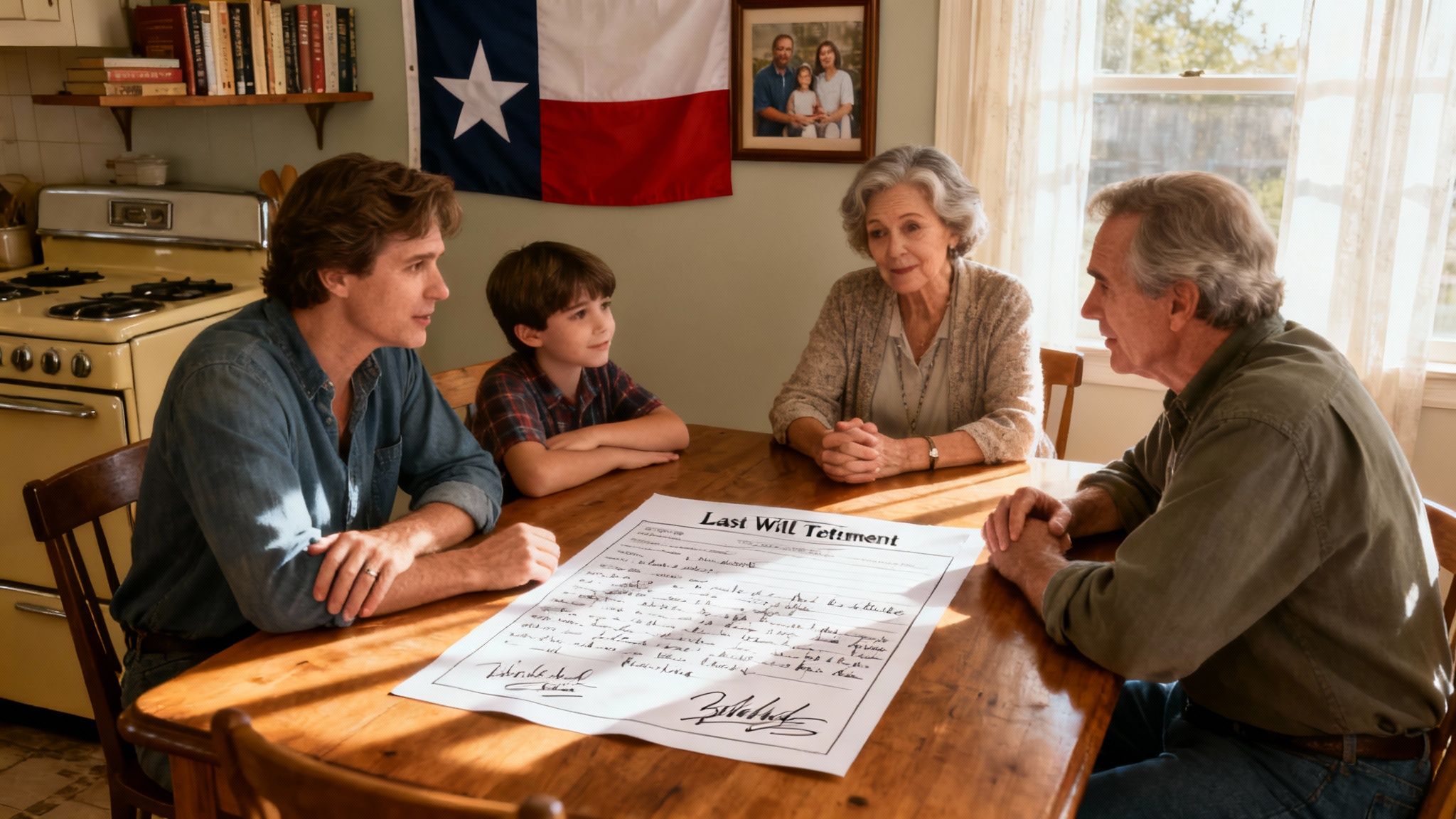
If you pass away without a will, Texas law considers you to have died "intestate." When this happens, the state steps in to make decisions on your behalf. A probate court, following the strict succession rules outlined in the Texas Estates Code, Title 2, will determine who inherits your property and, critically, who will be appointed to raise your minor children. This rigid, one-size-fits-all approach rarely aligns with a person’s true wishes, often creating immense stress and hardship for the very people they intended to protect.
The Cost of Having No Plan
Dying intestate initiates a court-supervised process that can be both lengthy and expensive, leaving your family navigating legal complexities while grieving. This proceeding can easily last for months, sometimes over a year, entangling your loved ones in court hearings and financial strain. In a worst-case scenario, if no legal heirs can be located, your hard-earned assets could even go to the State of Texas.
A properly executed Texas will prevents this from happening. It puts you in control, allowing you to name an executor—a trusted individual to manage your affairs—and clearly identify your beneficiaries. Most importantly, for parents, it allows you to nominate a guardian for your children, one of the most significant decisions you will ever make. You can learn more about the importance of wills in Texas estate planning on our blog.
Your Legacy: With a Will vs. Without One
The difference between having a clear plan and leaving things to chance is stark. Here’s a comparison of who makes the critical decisions for your estate in each scenario.
| Key Decisions | With a Valid Will (Testate) | Without a Will (Intestate) |
|---|---|---|
| Who Gets Your Property | You decide. You name specific beneficiaries for your assets. | Texas law decides based on a rigid formula of heirship. |
| Who Manages Your Estate | You choose a trusted executor to carry out your wishes. | The court appoints an administrator, who may be a stranger. |
| Who Cares for Minor Children | You nominate a guardian you know and trust. | The court chooses a guardian, which may not align with your choice. |
| Cost & Time | Generally a more streamlined and less expensive probate process. | Often a longer, more costly, and more stressful court process. |
| Family Harmony | Clear instructions reduce the potential for family disputes. | Ambiguity can easily lead to conflicts and legal battles. |
A will serves as your personal instruction manual for the court, ensuring your voice is heard long after you are gone.
A Realistic Scenario: A Blended Family
Consider a blended family in Houston. A husband has two children from a previous marriage, and his wife has one. They own their home jointly and have separate retirement accounts. If the husband passes away without a will, Texas intestacy laws would divide his share of their community property between his wife and his children from the prior marriage. This could force the sale of the family home simply to distribute the children's inheritance share, displacing his surviving spouse.
A will transforms this potentially chaotic outcome into an orderly plan. The husband could have used his will to specify that his wife receives the home and a portion of his retirement funds, while perhaps setting up a trust to provide for his children’s future. This forethought prevents painful legal battles and helps preserve family relationships. It also clarifies how other assets are managed, a need highlighted when considering the complications of life insurance without a will.
Decoding the Texas Last Will and Testament Form
Before you begin drafting, it is crucial to understand the components of a Texas last will and testament form. Each section serves a specific purpose, working together to create a legally sound set of instructions for your family and the probate court. Think of it as building a house—every part must be correctly placed to ensure the final structure is solid and secure.
Key Roles and Designations in Your Will
At its core, a will is about making three critical appointments: naming an executor, defining your beneficiaries, and, if you have young children, establishing guardianship.
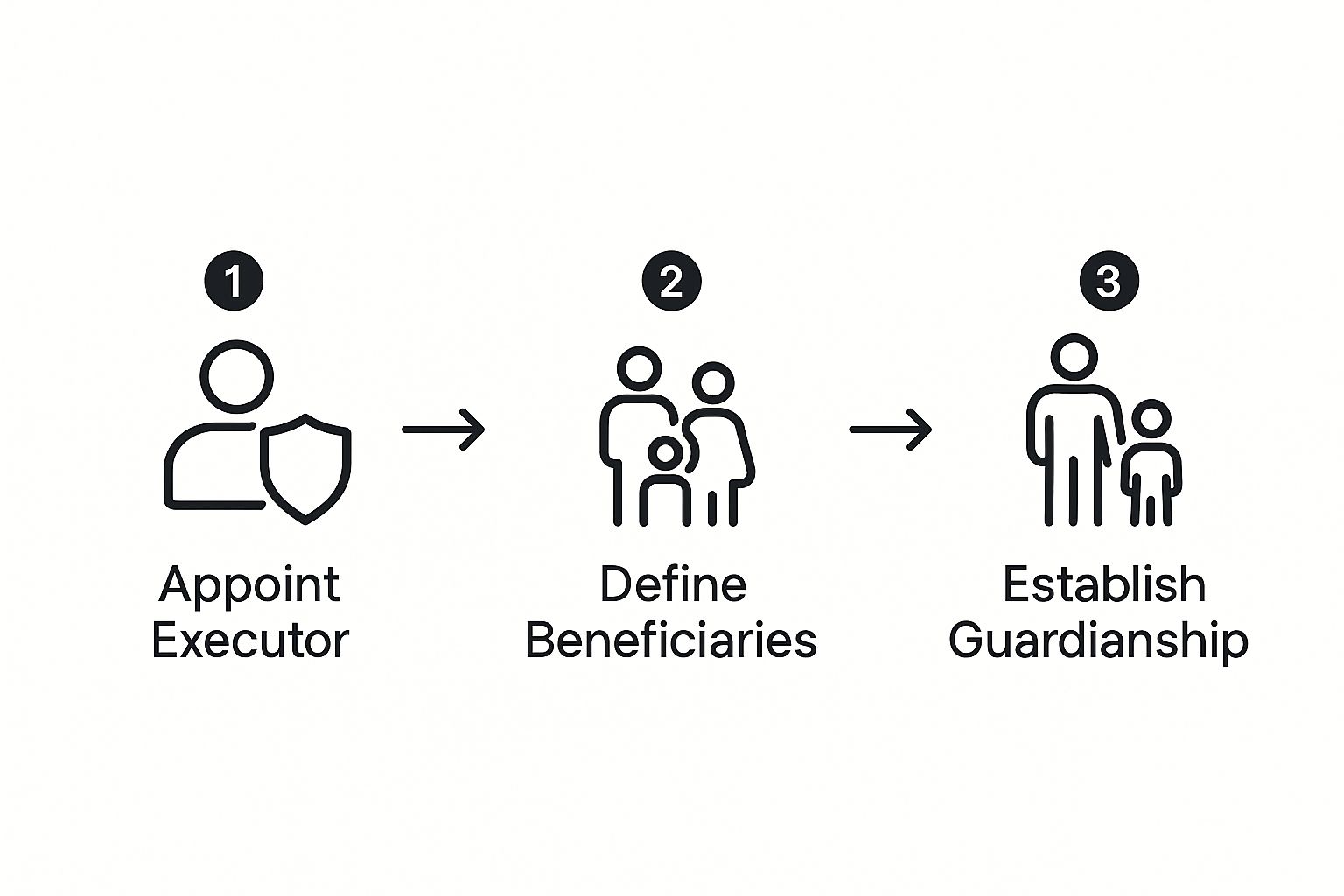
These roles are fundamental to protecting the people and property you care about most. Let's explore each one.
First, you will appoint an executor. This is the person (or an institution like a bank) you trust to carry out your will’s instructions. Their responsibilities include gathering your assets, paying any debts, and distributing the remaining property to your heirs. This role requires integrity and diligence, so choose someone who is both trustworthy and organized.
Next are your beneficiaries—the people, charities, or other entities who will inherit your property. The Texas Estates Code requires absolute clarity here. For example, instead of writing "I leave my car to my son," you should be specific: "I leave my 2022 Ford F-150, VIN [insert number], to my son, John A. Doe." This level of detail helps prevent confusion and the potential for difficult probate litigation. It is also helpful to understand how other documents, like a Texas Deed of Trust, can affect how your real estate is transferred outside of the will.
Finally, and most importantly for parents, your will is the place to nominate a guardian for your minor children. This is arguably the most critical decision in your estate plan. If you fail to name a guardian in a valid will, a court must decide who will raise your children—a scenario no parent would ever choose for their family. This designation is a cornerstone of our Guardianship services.
Takeaway
A will is more than a list of your possessions. It is a legal instrument that empowers trusted individuals to act on your behalf. Choosing the right people for these roles is just as important as deciding who inherits your assets. These designations are your way of ensuring your family is guided by people you know and trust.
Step-by-Step: How to Confidently Complete Your Will
Putting your wishes into a formal document is where your estate plan takes shape. While completing a Texas last will and testament form can seem formal, breaking it down into steps makes the process manageable. Let's walk through it with a realistic example to illustrate how each part functions.
Imagine a family from San Antonio—the Garcias. They have two young children, own a home, and have retirement savings. Their primary goal is to ensure their children and each other are protected if something unexpected happens.
Step 1: Identifying Yourself and Your Family
The first step is the simplest: clearly state who you are. This section of the form requires your full legal name and address to establish your identity as the testator (the legal term for the person making the will). You must also formally declare that you are of sound mind and not under duress—a standard but critical legal statement.
Maria Garcia would list her full name, "Maria Elena Garcia," and her San Antonio address. Using complete and accurate legal names for everyone mentioned is crucial to avoid confusion. You will also list your immediate family, such as your spouse and children, with their full names and birthdates.
Step 2: Appointing Your Executor and Guardian
Next, you will name your executor. This is the person you trust to manage your estate, pay debts, and distribute your property. Maria appoints her husband, David. However, life is unpredictable, so she also names a backup, or successor executor—her sister, Sofia. This simple step ensures someone is ready to step in if David is unable to serve.
Because the Garcias have minor children, their next designation is the most important: choosing a guardian. After careful consideration, they agree that Sofia would be the best person to raise their children. Naming her as guardian provides stability and loving care for their children in a worst-case scenario.
Step 3: Detailing Your Bequests
This is where you specify who gets what. The law allows for two main types of gifts in a will:
- Specific Bequests: These are particular items left to a specific person. Maria wants her grandmother's jewelry to go to her daughter, so she will write, "I give my gold locket necklace and matching earrings to my daughter, Isabella Garcia." Be as descriptive as necessary.
- General Bequests: These are usually gifts of money or a percentage of your estate.
After specific gifts, you must address the residuary estate. This legal term refers to everything left over after debts are paid and specific items are distributed. Maria and David decide the residuary estate should go to the surviving spouse. If they were to pass away together, it would be divided equally between their two children.
Step 4: Signing and Witnessing
Finally, the will must be signed according to the strict rules in the Texas Estates Code, Title 2, Chapter 251. This requires signing it in front of two credible witnesses, who then also sign it in your presence.
To make the probate process much smoother for your family, you should also include a self-proving affidavit. This is a separate statement that you and your witnesses sign in front of a notary. It can dramatically speed up the court’s acceptance of the will. Understanding the role of notaries in Texas legal procedures is key to executing this step correctly.
Making Your Will Legally Binding in Texas
You have meticulously filled out your Texas last will and testament form, outlining your wishes to protect your family. This is a significant accomplishment. However, the document has no legal power until it is "executed" according to the precise rules set forth in the Texas Estates Code. This final step transforms your written plan into an official, legally binding document.
The signing process itself is a formal ceremony, but it demands absolute precision. You, the testator, must sign the document in the physical presence of two credible witnesses. Those witnesses must then sign the will in your presence. Every part of this ceremony is essential for the will to be considered valid by a probate court.
Choosing the Right Witnesses
Who can serve as a witness? According to the Texas Estates Code § 251.051, a credible witness must be at least 14 years old, competent, and able to sign their name. Crucially, a witness cannot be a beneficiary in the will.
- Why is this so important? If someone who stands to inherit from you also signs as a witness, it creates a conflict of interest that can seriously complicate the probate process. While it might not invalidate the entire will, it could void the gift to that specific person.
- Best Practice: Choose neutral, disinterested parties. Neighbors, coworkers, or friends who are not named in the will are excellent choices. This simple precaution prevents any appearance of undue influence and helps ensure a smooth probate process for your family.
Failing to follow these signing requirements is one of the most common reasons a will is challenged in court. For more information, read our guide on what invalidates a will in Texas.
The Power of a Self-Proving Affidavit
Texas law provides an invaluable tool to simplify the probate of your will: the self-proving affidavit. This is a separate statement attached to the will, which you and your witnesses sign before a notary public. In signing it, you are all swearing under oath that the will was executed correctly according to Texas law.
Key Insight
A self-proving affidavit essentially pre-validates the signatures on your will for the court. When it is time for probate, the court can accept the will as valid without requiring the original witnesses to be located and testify in person. This can save your family a significant amount of time, money, and emotional stress during an already difficult period.
Common Pitfalls When Using a Will Form
Using a pre-made Texas last will and testament form online can seem like a quick and easy way to plan for your family's future. While these templates offer convenience, they are filled with potential traps that can cause the very confusion and conflict you are trying to prevent. A small error made today can easily grow into a significant family dispute and costly legal battle in the future.

Understanding these common mistakes is the best way to craft a will that is clear, legally sound, and effectively carries out your wishes.
The Danger of Vague Language
One of the most frequent and damaging errors is the use of ambiguous language. You might think leaving your "personal property" to your children is clear, but in a courtroom, that phrase is a recipe for conflict. Does "personal property" include your classic car, your valuable art collection, or only the funds in your checking account?
When you are not specific, you force a probate judge to interpret your intentions, which can fuel arguments among your loved ones. Your best defense is precision. Instead of a blanket statement, spell it out: “I leave my 2022 Ford F-150 to my son, Mark,” or “I leave the contents of my Bank of America savings account ending in 1234 to my daughter, Sarah.”
Forgetting the Residuary Estate
You’ve listed your major assets—the house, car, and investments. But what about everything else? This leftover property is called the residuary estate, and failing to name a beneficiary for it is a critical oversight.
If you do not include a residuary clause, any asset not specifically mentioned will be divided according to Texas intestacy laws—the very government-mandated inheritance plan you sought to avoid by writing a will.
Not Updating After Life Changes
A will is a living document that should evolve with your life, not something to be signed and forgotten. Major life events can fundamentally alter your estate plan, and failing to update your will can lead to unintended and often painful consequences.
Consider these common scenarios:
- Marriage or Divorce: Under the Texas Estates Code, a divorce automatically nullifies any gifts you left to your ex-spouse. However, a new marriage does not automatically include your new spouse, potentially disinheriting them by accident.
- Birth of a Child: If you have a child after your will is signed and do not update it, that child (a "pretermitted child" in legal terms) may still have a legal right to a portion of your estate, which can disrupt your entire distribution plan.
- Death of a Beneficiary: If a named beneficiary passes away before you, and you haven't named an alternate, that gift could "lapse" and fall into your residuary estate, potentially going to someone you did not intend.
Takeaway
Review your will every three to five years and always after a major life event like a marriage, divorce, birth, or death in the family. This simple practice ensures your will accurately reflects your current wishes and circumstances. It is the best way to keep your assets directed to the right people and avoid the stress of Probate Litigation.
What to Do After Your Will Is Signed
Congratulations on completing your Texas last will and testament form. You have taken one of the most important steps to protect your family’s future by creating a clear roadmap for your loved ones. However, a few final steps are crucial to ensure your wishes are followed seamlessly.
The single most important step now is to store your will in a safe place. The probate court requires the original, signed document. A copy is not sufficient without a complex legal proceeding to prove its validity. Losing the original can cause significant delays and may force your family into the very court-supervised process you worked to avoid.
Storing Your Will Securely
Where should you keep this vital document? You need a location that is both safe from damage and accessible to your executor when the time comes.
Common and reliable options include:
- A Fireproof Safe at Home: This is a convenient option. Just be certain your executor knows its location and has the combination or key.
- A Safe Deposit Box: While very secure, this can create access issues. If your executor is not a joint owner of the box, they may need a court order to open it, causing delays.
- With Your Attorney: Our firm, like many estate planning attorneys, will store original Wills & Trusts for clients. This is often the safest option, as law firms have secure storage and understand the importance of the document.
No matter where you choose to store it, you must inform your executor of its location. Hiding your will too well is almost as bad as not having one at all.
Understanding the Next Step: Probate
After you pass away, your will begins its journey through the Texas Probate Process. This is the formal, court-supervised procedure that validates your will, officially appoints your executor, and grants them the legal authority to manage your estate.
Key Insight
Probate is not something to be feared; it is the legal process that gives your will its power. A well-drafted will, especially one with a self-proving affidavit, is designed to make the Texas Probate Process as smooth and efficient as possible for your family.
Your executor will file your will with the appropriate county probate court. The court then formally recognizes their authority by issuing Letters Testamentary. This document serves as the executor’s official permission to act—it allows them to gather assets, pay final bills, and distribute your property exactly as you instructed.
By creating and properly storing your will, you have given your family a final gift of clarity and peace, ensuring your voice will be heard and your loved ones will be spared unnecessary stress during a difficult time.
If you’re facing probate in Texas, our team can help guide you through every step — from filing to final distribution. Schedule your free consultation today.