Skip to content
A death in the family can turn ordinary paperwork into something that feels impossible. One day you're trying to find passwords, bills, and insurance papers. The next, you're staring at a court notice saying someone objects to the will, or a creditor says the estate owes money.
That moment rattles people. Executors worry they've done something wrong. Heirs fear they're being cut out unfairly. Creditors wonder if time is running out. In Texas, those concerns often fall under one broad phrase: a probate claim dispute texas matter. In plain English, that means a formal disagreement about the estate during probate.
Some disputes center on who should inherit. Others focus on what debts must be paid before anything can be distributed. Both can slow the process, increase stress, and create tension inside a family that is already grieving. Still, these disputes follow rules. They're not random, and they don't have to leave you feeling helpless.
When Grief and Legal Matters Collide
Maria had just begun handling her father's estate in Harris County. She'd gathered the mail, located the will, and started the probate process. Then a certified letter arrived. Her brother claimed the will wasn't valid. A separate notice from a medical provider said the estate also owed a debt.
She wasn't just grieving anymore. She was suddenly managing a legal conflict from two directions.

That's how probate disputes usually feel. They don't arrive as neat legal issues. They show up as family pressure, fear of making a mistake, and a flood of unfamiliar terms.
What a probate claim dispute means
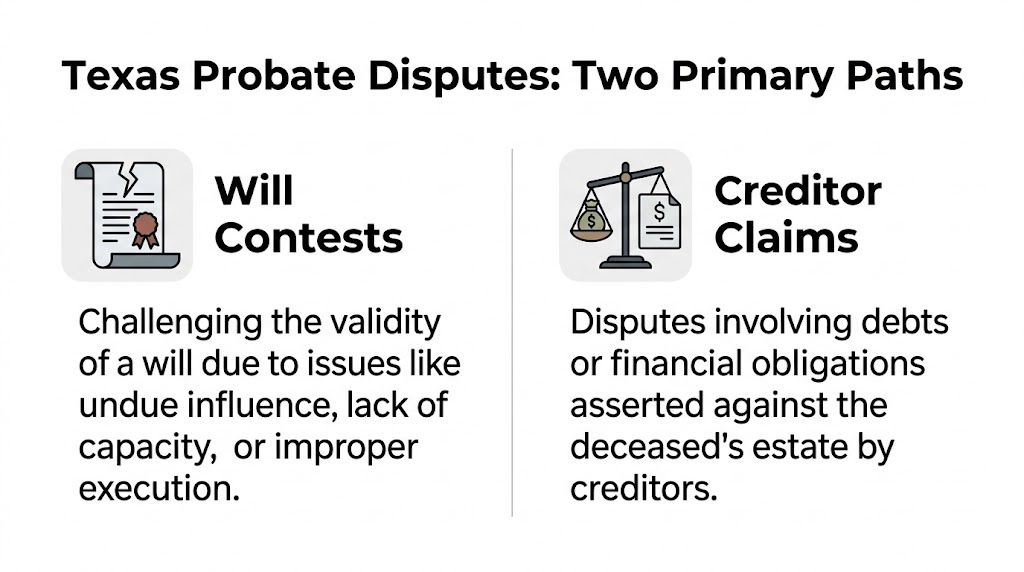
A probate claim dispute is a disagreement handled through the probate court after someone dies. The dispute usually falls into one of two groups:
- A will-related dispute, where someone challenges the validity of the will or objects to how the estate is being handled
- A debt-related dispute, where a creditor seeks payment from the estate or the executor disputes whether a debt is valid
Texas probate courts deal with these matters regularly. The process is structured by the Texas Estates Code, especially the rules governing estate administration, creditor claims, and contested matters in Titles 2 and 3. The names may sound technical, but the basic idea is simple: the court decides unresolved estate issues under a set process.
Why families get overwhelmed
Individuals don't become executors because they wanted legal responsibility. They became executors because someone trusted them.
That trust can feel heavy when a dispute begins. Executors often ask:
You can be both grieving and responsible at the same time. The court process doesn't expect you to know everything on day one, but it does expect timely action.
Heirs and beneficiaries have their own worries. They may suspect a parent was pressured late in life, or they may feel the estate is being handled behind closed doors. Creditors may believe they provided legitimate services and now have no clear point of contact.
The first useful step is naming the problem correctly. Once you know whether you're dealing with a will contest, a creditor claim, or a dispute over how the executor is acting, the situation usually becomes easier to evaluate. It may still be painful, but it becomes more understandable.
Two Paths of Dispute Will Contests and Creditor Claims
A probate dispute often starts with one painful question. Is someone challenging the will itself, or is someone saying the estate owes money?
That distinction matters because these cases grow in different directions, much like two roads that begin at the same courthouse door but lead to different proof, deadlines, and defenses.
Will contests
A will contest asks the court whether the document being offered should control the estate at all. In Texas, only an interested party can bring that challenge. That usually includes heirs, beneficiaries, someone who stood to inherit under an earlier will, or in some situations a creditor with a direct stake in the outcome.
The court is not deciding whether the will felt kind or fair. The court is deciding whether the will is legally valid.
Here are the grounds families raise most often:
| Ground for challenge | Plain-English meaning |
|---|---|
| Lack of capacity | The person signing the will did not understand the nature of making a will, their property, or the people affected by it |
| Undue influence | Someone exerted pressure strong enough to override the person's free choice |
| Fraud or forgery | The document was fake, altered, or procured through deception |
| Improper execution | The will was not signed or witnessed as Texas law requires |
That difference can be hard to accept during grief. A child may say, "Mom would never have done this." Sometimes that feeling points to a valid legal concern. Sometimes it reflects shock, family history, or information the child did not have. A will contest needs evidence that can be shown to a judge, such as medical records, witness testimony, handwriting concerns, or facts surrounding how the document was signed.
Executors face a different problem. If you are defending the will, your job is usually to show that the required formalities were met and that the decedent acted freely and with understanding. In practical terms, that means gathering the signing ceremony records, contacting witnesses, preserving communications, and avoiding informal statements that sound dismissive or defensive.
Timing often decides whether the court will hear the dispute
Texas sets firm deadlines for challenging a will after it has been admitted to probate. Creditor claims can move even faster. Unsecured creditors may have a short window to act after notice issues arise, which is why a guide on how to file a probate claim in Texas can be useful early, before paperwork mistakes narrow your options.
Families are often surprised by how quickly delay becomes a legal problem. People spend weeks trying to keep the peace, gather siblings, or sort through boxes in the garage. Meanwhile, the calendar keeps running.
If you suspect fraud, forgery, or hidden facts, there may be arguments about whether more time should apply. Those arguments are fact-specific and usually need prompt legal review.
Creditor claims
A creditor claim usually does not attack the will. It asks a different question. Does the estate legally owe this debt, and was the claim presented the right way?
Some claims are straightforward. Others become disputes because memory, paperwork, and family relationships do not line up. Common examples include medical bills, personal loans, unpaid contract work, business obligations, and secured debts tied to specific property.
For claimants, the task is to show more than "money was owed." The claimant needs enough documentation to prove the debt and to show the estate received a proper claim in the required form and within the required time.
For executors, the job is a balancing exercise. You have to protect estate assets, treat creditors fairly, and avoid paying claims that are inflated, stale, or unsupported. Handling this well often depends on records. A household inventory, account statements, loan documents, and property records can all matter. Even a planning tool like Home Inventory For Estate Planning can help families understand what property exists and what debts may be tied to it.
The same dispute looks different from each side
A claimant usually starts with three practical questions:
- Do I have standing or a legal right to bring this issue to court?
- What documents, witnesses, or records support my position?
- Did I act before the deadline expired?
An executor or estate representative usually asks a different set of questions:
- Was the claim or contest filed correctly?
- Is the evidence reliable, or is it mostly suspicion and family tension?
- Should the estate fight, negotiate, or ask the court for guidance?
That dual perspective matters. Many articles speak only to the person bringing the dispute. In Texas probate, the defense side matters just as much. A strong claim can fail because procedure was ignored. A weak claim can become expensive if an executor responds slowly, loses records, or misses a notice issue.
Probate litigation feels personal because it is personal. Still, courts decide these cases through proof, deadlines, and procedure. Once you know which path you are on, the dispute usually becomes easier to evaluate and easier to handle one step at a time.
Navigating the Texas Probate Litigation Process
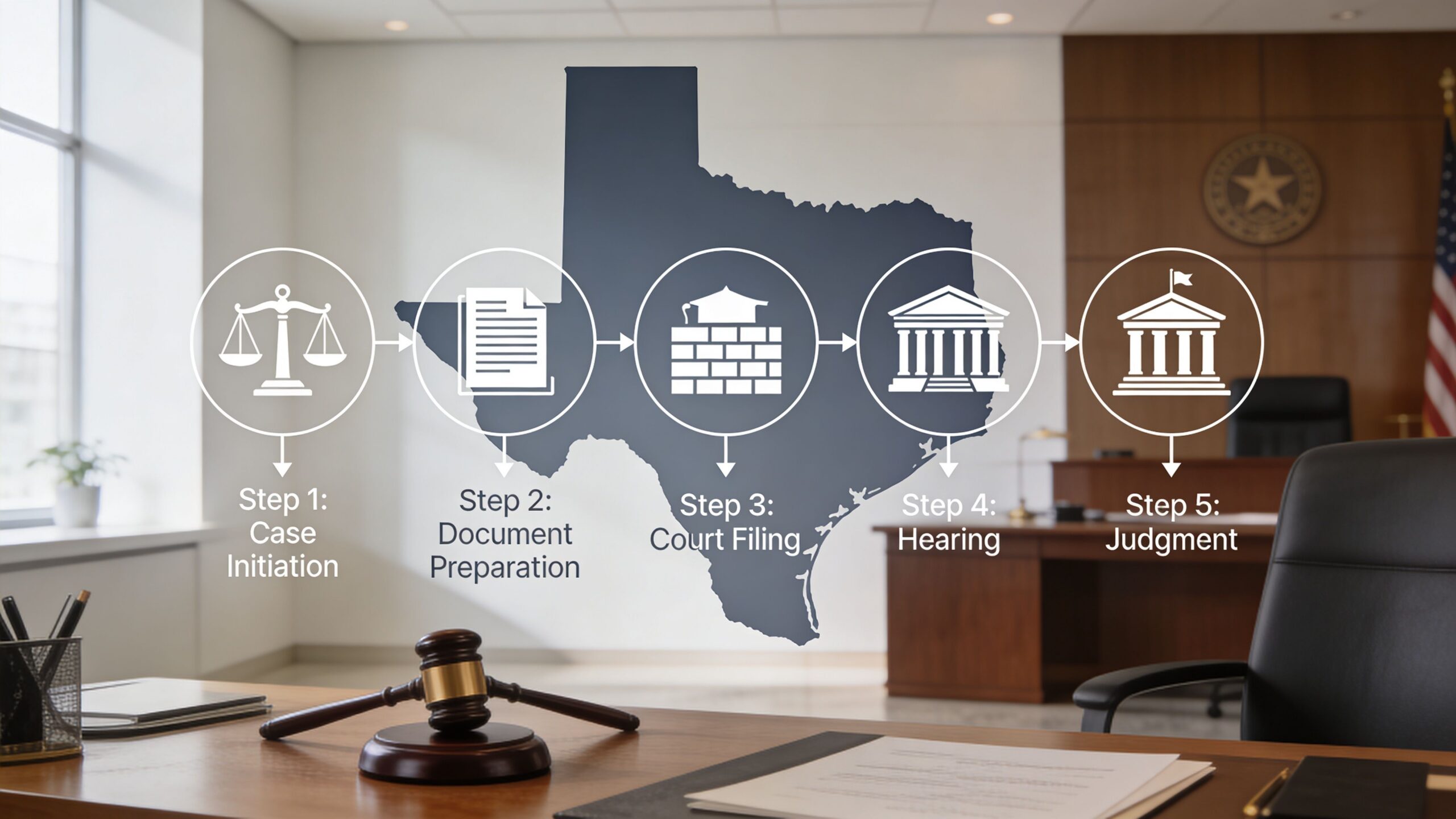
Once a dispute becomes formal, the process starts to look less like family disagreement and more like litigation. That shift can be unsettling, but it also brings structure. The court has a sequence, deadlines, and required filings.
Step one begins with a petition
A probate dispute usually starts when someone files a petition or formal objection in the probate court handling the estate. That filing tells the court what the person wants and why.
In a will contest, the petition might allege incapacity, undue influence, or improper execution. In a creditor dispute, it may ask the court to recognize or reject a debt. For an executor misconduct claim, it may seek instructions, an accounting, or even removal.
The filing has to be in the correct court. In Texas, probate matters may be heard in a statutory probate court, county court at law, or county court, depending on the county and the kind of estate proceeding involved under the Texas Estates Code.
Then everyone must be formally notified
After filing, the other side must receive formal notice. Lawyers call this service, but the idea is simple: you cannot ask a court to decide rights without giving the affected people a chance to respond.
Executors often learn about a dispute at this stage. Heirs may receive notice that another beneficiary has challenged the will. Creditors may be told the estate disputes the debt.
That notice is one reason people should avoid casual responses. A frustrated text message or emotional email can become part of the larger conflict. Once the court case begins, communication should be careful, factual, and documented.
Discovery is where the real case is built
The probate litigation process starts with filing a formal petition and then moves into discovery, where parties exchange evidence such as medical records or financial documents. Many contested matters end before a verdict, with probate litigators reporting 80-90% resolution through settlement or mediation, as discussed in this explanation of the Texas contested probate case process.
Discovery sounds intimidating, but it's really the evidence-gathering phase. In this phase, each side learns what the other can prove.
Common discovery materials include:
- Medical records that may show memory problems, confusion, or cognitive decline near the time a will was signed
- Financial documents that can reveal unusual transfers, account changes, or dependence on a particular relative
- Witness statements and depositions from the lawyer who prepared the will, neighbors, caregivers, and family members
- Handwriting analysis when forgery is alleged
- Estate inventories and accountings if the dispute involves missing property or executor conduct
For families, this phase often changes the emotional temperature of the case. Some claims become stronger once records are reviewed. Others weaken quickly.
If you're alleging undue influence, the strongest evidence usually isn't a sibling saying, "She manipulated Dad." It's records and testimony showing isolation, dependency, abrupt changes, and suspicious involvement in the will's preparation.
A realistic example
Suppose a son believes his mother's final will was signed when she no longer understood her finances. He remembers confusion, missed medications, and a caretaker suddenly being named as a major beneficiary.
His lawyer may request:
- Medical records from the months around the signing
- The drafting file from the attorney who prepared the will
- Bank records showing whether someone else had begun controlling money
- Witness testimony from people who saw her condition firsthand
The executor defending the will might respond with different evidence. Perhaps the mother met privately with her lawyer, identified her children correctly, explained her property, and confirmed her wishes clearly. Those facts can matter just as much.
Good records can prevent unnecessary fights
Even families who aren't yet in litigation benefit from organizing information early. A clear asset list helps separate real concerns from assumptions about "missing" property. A practical tool like a Home Inventory For Estate Planning can make it easier to document household contents, valuables, and ownership details before or during estate administration.
That kind of recordkeeping doesn't solve every dispute. It does reduce confusion, which is often the spark that turns grief into accusation.
Hearings and trial
If the dispute doesn't settle, the court may hold hearings on temporary issues or move toward a final trial. At a hearing, the judge may consider evidence, arguments, and procedural issues such as standing, deadlines, or whether an executor should provide more information.
At trial, the court decides the contested issue. That may be a judge alone or, in some cases, a jury.
The court isn't deciding who loved the decedent more. It is deciding legal questions such as:
| Issue before the court | What the judge or jury evaluates |
|---|---|
| Validity of a will | Capacity, influence, execution, authenticity |
| Validity of a debt | Documentation, timeliness, legal basis for payment |
| Executor conduct | Whether the executor followed fiduciary duties and protected the estate |
A short explainer can help if you want a visual overview of how these disputes move through court:
What executors should do right away
An executor doesn't need to panic, but they do need to act.
- Preserve documents: Keep the will, notices, emails, account statements, and records in one place.
- Pause informal promises: Don't promise distributions while a dispute is pending.
- Avoid side deals: Agreements with one heir can create new problems with others.
- Get legal guidance early: The Law Office of Bryan Fagan, PLLC handles probate litigation and administration issues, including disputes involving wills, claims, and estate procedure in Texas.
The most important thing to understand is that probate litigation is not chaos. It's a sequence. Once you know where your case sits in that sequence, the next step usually becomes clearer.
Finding Common Ground Through Mediation and Settlement
Not every probate fight has to end in a courtroom ruling. In many Texas estate disputes, the better outcome is a negotiated one.

Why mediation matters
Mediation is a confidential settlement process led by a neutral third person. That mediator doesn't decide the case. Instead, the mediator helps the parties test their positions, exchange proposals, and look for a result they can all accept.
In Texas probate practice, mediation isn't just a soft option for families who want to avoid conflict. It's often a practical strategy. Probate disputes consume time, emotional energy, and estate resources. Mediation gives the parties a chance to solve the problem without asking a judge to impose a result after months of discovery.
A useful primer on that process appears in this discussion of probate mediation in Texas.
What mediation can accomplish
Mediation works especially well when the parties don't fully trust each other but still want control over the outcome.
A mediated settlement might address:
- Who receives specific property when the will language leaves room for disagreement
- How a creditor claim is resolved without extended motion practice
- Whether an executor stays in place with added reporting requirements
- How family communication will happen for the rest of the administration
Sometimes the dispute isn't really about one legal point. It's about fear, lack of information, and family history. A courtroom can decide a legal claim, but it usually can't repair communication. Mediation at least gives people a space to speak through counsel in a structured setting.
Settlement isn't surrender. In probate, it often means preserving more of the estate for the people the decedent intended to benefit.
Family settlement agreements
Texas law also allows family settlement agreements in many estate situations. In plain terms, that means heirs and beneficiaries may agree to resolve disputes and distribute property by agreement, even when the arrangement differs from what strict litigation might produce.
This can be helpful in situations like these:
| Situation | How settlement may help |
|---|---|
| Blended family tension | Parties agree on a division that reduces future conflict |
| Disputed personal property | Heirs trade items instead of fighting over valuation |
| Executor mistrust | Parties create reporting rules and deadlines |
| Questionable but hard-to-prove claims | The estate resolves uncertainty without trial risk |
That flexibility matters. Families often assume probate gives only two choices: fight or give up. In reality, there is often a third path. Resolve enough of the dispute to let the estate move forward.
Mediation from both sides
If you're bringing the claim, mediation lets you present your concerns without the full cost and delay of trial. If you're defending the estate, mediation can contain risk, avoid publicity, and protect assets from being consumed by the dispute itself.
Good preparation still matters. Bring the important records. Know what outcome you can live with. Understand what issues are negotiable and which ones aren't.
People sometimes avoid mediation because they think agreeing to attend makes them look weak. It doesn't. It shows that you're focused on resolution, not just escalation.
Outcomes Costs and When to Call a Probate Litigator
By the time a dispute reaches this stage, families usually want to know two things. How can this end, and what is it going to cost us?
The outcome depends on the kind of dispute. In a will contest, the court may uphold the will or invalidate it. In a creditor matter, the claim may be approved, denied, or resolved for a different amount through negotiation. In an executor dispute, the court may leave the executor in place, require action, or remove that person if the facts justify it under the Estates Code.
What each outcome can mean
If a will is upheld, the estate usually continues under that document. If a will is invalidated, the court may look to a prior valid will or to Texas intestacy rules, which are the default inheritance rules when there is no enforceable will.
If a creditor claim is approved, the debt may need to be paid before distributions are made. If it's denied, heirs may receive a larger share. If the dispute involves executor conduct, the remedy may be less dramatic but still important, such as requiring a full accounting or correcting how estate assets are managed.
The cost isn't only financial
The direct costs of probate litigation can include filing fees, attorney time, document gathering, and experts such as medical or handwriting professionals. But families also feel indirect costs.
Those indirect costs often include:
- Delay in distribution while the dispute remains pending
- Strain on family relationships that continues long after the case ends
- Stress on executors who are trying to comply with duties while being criticized
- Lost clarity when memories fade and documents become harder to locate
Texas probate courts saw a 19% increase in estate cases filed in Fiscal Year 2021, reflecting growing complexity in estate administration, and mediation resolved approximately 70% of contested probate cases before trial, according to this review of Texas contested probate hearings.
That increase matters because crowded dockets can make even straightforward disputes feel slower and more expensive.
When legal help stops being optional
Some probate disagreements can be handled with limited court involvement. Others need a litigator quickly.
You should strongly consider probate litigation counsel when:
- A will's validity is being challenged
- You received formal court papers and a hearing may follow
- An executor is accused of misconduct or self-dealing
- A creditor claim could materially affect the estate
- You live out of state and must respond in a Texas probate court
- Family communication has broken down completely
The need for counsel also grows when the facts are emotionally loaded. Cases involving dementia allegations, caregiver influence, missing funds, or blended family conflict often produce strong feelings and weak communication. That's exactly when careful legal handling matters most.
Key Insight: In a probate claim dispute texas case, the most important issues are usually not volume or emotion. They are deadline, standing, evidence, and strategy. Miss the filing window, fail to prove your legal interest, or rely on suspicion instead of records, and even a deeply felt claim can fail. On the defense side, disorganization and delay can expose the estate to avoidable loss. Early evaluation often protects both rights and relationships.
A simple decision test
Ask yourself three questions:
- Is there a court deadline approaching?
- Do I have records that support my position, or do I only have concern and family stories?
- Could a wrong step reduce the estate or harm my rights permanently?
If the answer to any of those is yes, it makes sense to get a probate litigator involved before the case hardens. Early advice often helps families decide whether to fight, settle, or narrow the dispute to one issue that matters.
Take the Next Step with Confidence
Probate disputes rarely begin when people are rested, objective, and ready for legal conflict. They begin after a loss, in the middle of grief, when paperwork, deadlines, and family emotions all collide at once.
A daughter may be trying to honor her father's wishes while defending his will. A son may believe something happened in the final months that changed everything. An executor may want to finish the job correctly without being accused of hiding information. Those are different positions, but they all share the same need for clarity.
Texas probate law gives structure to these situations. The Estates Code sets the path, the court provides a forum, and the dispute usually turns on very practical questions: who has standing, what evidence exists, and what action must happen now. Once those questions are answered, people often feel calmer because the uncertainty starts to shrink.
You don't have to solve every issue at once. Start by identifying the type of dispute, protecting records, and understanding what deadlines apply. Then decide whether the matter should be contested, defended, or resolved through settlement. That approach gives grieving families something valuable during a hard season: a sense of direction.
If you're facing a probate dispute in Texas, our team can help guide you through every step, from filing to final distribution. We are here to protect your rights and your family’s legacy. Schedule your free consultation today.
If you’re facing probate in Texas, our team can help guide you through every step, from filing to final distribution. Schedule your free consultation today with the Law Office of Bryan Fagan, PLLC.