Skip to content
Dealing with the legal aftermath of a loved one’s passing is a difficult and often confusing task, especially when you are grieving. The first terms you’ll likely encounter are estate and probate. In plain English, a person’s estate is everything they owned when they died—their house, car, bank accounts, and even sentimental belongings. Probate is the formal, court-supervised process Texas uses to wrap up that estate, ensuring everything is handled legally and fairly.
We understand this can feel overwhelming. Our goal is to provide compassionate, step-by-step guidance to help Texas families, executors, and heirs navigate this journey with confidence and clarity.
What Probate and Estate Settlement Really Means in Texas
When someone passes away, their financial life doesn’t just stop. There are loose ends to tie up, and their final wishes need to be honored. Think of their estate as the last chapter of their financial story. Probate is the structured process Texas courts use to make sure that chapter is concluded correctly, protecting everyone involved—from the family members who stand to inherit to creditors who are rightfully owed money.
The probate and estate settlement process is designed to accomplish a few key things:
- Prove the Will is Valid: The court’s first job is to confirm that the deceased’s will is authentic and meets all legal requirements under Texas law.
- Appoint an Executor: The court officially grants the person named in the will—the executor—the legal authority to manage the estate. This person is now responsible for the estate's affairs.
- Inventory All Assets: The executor is tasked with finding, cataloging, and valuing everything the person owned. This creates a clear picture of the estate.
- Settle Final Debts and Taxes: Before any property can be passed on, all legitimate debts and taxes must be paid from the estate’s funds.
- Distribute the Property: Once all obligations are handled, the remaining assets are transferred to the heirs and beneficiaries exactly as the will directs.
The Role of the Texas Estates Code
This entire journey is guided by a specific set of state laws, primarily found in Titles 2 and 3 of the Texas Estates Code. This code is the official rulebook for executors, courts, and families. It lays out all the required steps, deadlines, and duties, ensuring a loved one’s final wishes are respected and that property changes hands in an orderly, transparent way.
A Real-World Example
Let’s imagine a father in Houston passes away, leaving behind his home, a savings account, and two adult children. His will names his oldest daughter as the executor. Through probate, she goes to court and receives official authority to act—a document called "Letters Testamentary." Armed with this, she can now access his bank account to pay the final mortgage payment. After settling any other debts, she can legally transfer the house’s title to herself and her brother, just as the will specified. This court-approved process provides a clear legal record, preventing future disputes. Many people wonder about how long this can take; timelines can vary, and some places even have specific rules like a deceased estate 3 year rule that sets certain expectations.
Key Insight
Probate isn't a punishment; it's a protection. It creates an undeniable legal record of who now owns the deceased’s property, which helps prevent family disputes down the road. While the path may seem filled with legal jargon, it is entirely manageable when you have clear, experienced guidance.
Choosing the Right Path for a Texas Estate
When a loved one passes away, the family is immediately faced with a crossroads. Settling an estate in Texas isn't a one-size-fits-all process. The route you take depends almost entirely on the level of planning your loved one put in place, the size of their estate, and whether all family members are in agreement.
Understanding these different routes is the first step to demystifying the probate and estate settlement process and finding a clear way forward. This decision tree lays out the fundamental choice: whether the estate needs a formal, court-supervised process or if it can be settled more simply.
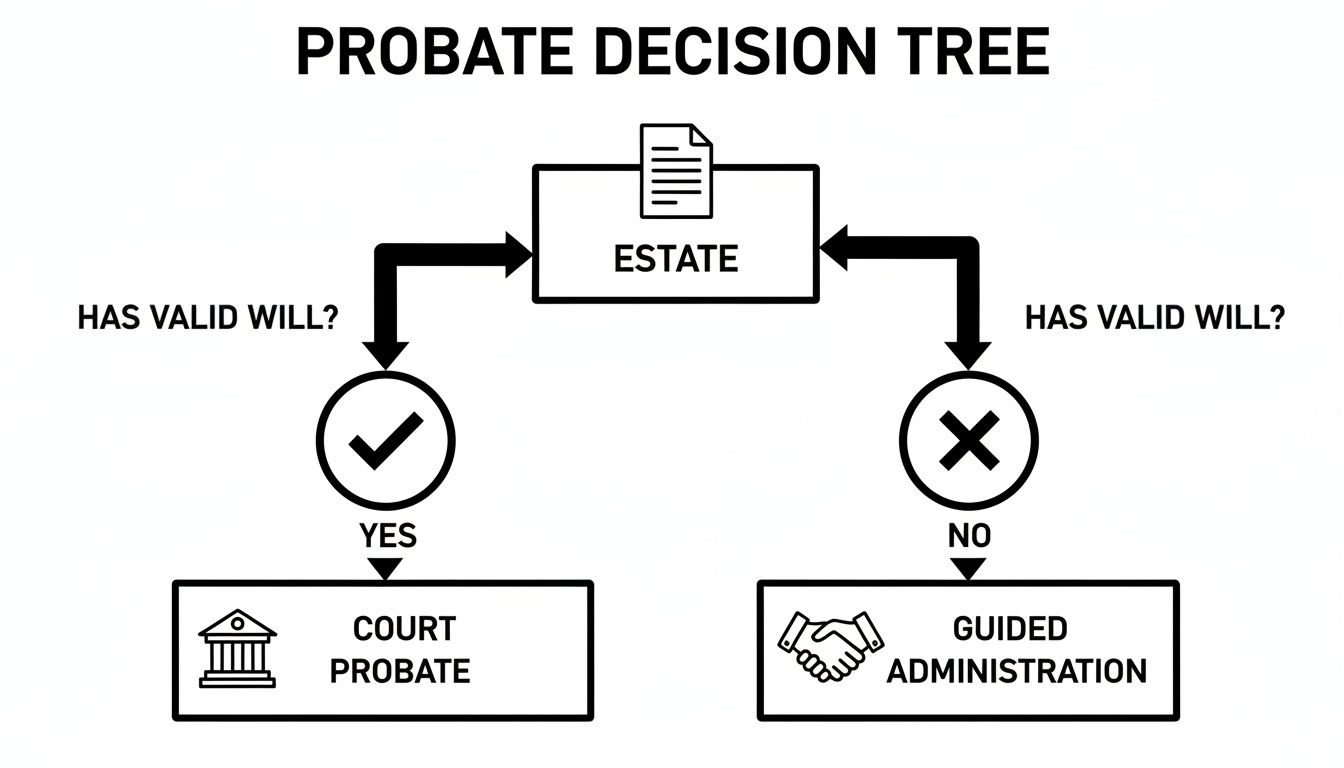
The biggest takeaway here is that a valid will and other planning tools are like a good GPS—they can steer an estate toward a much more efficient, streamlined settlement and help you avoid the longer, more complicated legal detours.
Independent Administration: The Preferred Texas Route
If there’s an "express lane" for probate in Texas, this is it. Independent Administration is, by far, the most common and efficient way to settle an estate. This path is available when the deceased left a valid will that specifically calls for it, or when all the heirs and beneficiaries unanimously agree to it.
The executor in an independent administration has the freedom to pay bills, sell property, and distribute assets to the heirs without asking the judge for permission at every turn. This autonomy not only speeds up the entire process dramatically but also keeps legal costs down. This route is perfect for families who are on the same page and are guided by the clear instructions left in a well-drafted will. It’s built on trust—trust that the executor will do their job responsibly.
Dependent Administration: When Court Oversight Is Needed
On the other end of the spectrum is Dependent Administration. Think of this as having a referee watch every single play of the game. Here, the probate court closely supervises the entire process. This is typically required when:
- The person died without a will (intestate).
- The will exists but doesn’t name an independent executor.
- Beneficiaries are fighting, or there’s a real concern that the estate is being mismanaged.
Every action, from paying a utility bill to selling the house, requires the court’s pre-approval. While this makes the process much slower and more expensive, that oversight provides a critical layer of protection when there are disputes or a lack of trust. It ensures every decision is transparent and legally sound. This level of judicial oversight is a core feature of the Texas Probate Process.
Texas Probate Options at a Glance
To help families quickly see how these options stack up, here is a simple comparison.
| Probate Path | Ideal For | Key Requirement | Court Supervision Level |
|---|---|---|---|
| Independent Administration | Estates with a valid will and cooperative heirs. | Will must request it, or all heirs must agree. | Minimal |
| Dependent Administration | Disputed estates, no will, or when heirs don't agree. | Required by default in certain high-conflict or intestate cases. | High |
| Muniment of Title | Estates with a will but few debts (besides a mortgage). | A valid will and no unsecured debts. | Very Low |
| Small Estate Affidavit (SEA) | Very small estates with no will. | Estate valued at $75,000 or less (excluding homestead), per Texas Estates Code § 205. | None (after approval) |
Simpler Alternatives to Full Probate
For many families, a full-blown probate administration isn’t necessary. Texas law provides several simpler, faster, and cheaper alternatives for less complicated estates.
Here are two of the most common alternatives:
Muniment of Title: This is a unique Texas procedure and a fantastic tool when there's a valid will, but the estate’s only major debts are secured by real estate, like a home mortgage. The court essentially just validates the will, which then acts like a deed to officially transfer property to the new owners. It's a quick and clean way to establish a clear chain of title without needing a full administration.
Small Estate Affidavit (SEA): For truly modest estates, the Small Estate Affidavit is a lifeline. Under Section 205 of the Texas Estates Code, if an estate's value is $75,000 or less (not counting the homestead and other exempt property) and there's no will, the heirs can use an SEA. It's a sworn statement filed with the court that, once approved, allows heirs to collect assets directly from banks and other institutions. It's a compassionate and practical solution for families with limited resources.
Figuring out which of these paths applies to your family’s situation is the first step toward gaining peace of mind. Whether the estate needs formal administration, can be handled with a simpler tool like an SEA, or even requires a Guardianship, knowing your options is the key to moving forward with confidence.
Key Insight
The Texas Estates Code recognizes that a one-size-fits-all approach to settling estates doesn't work. These simplified procedures are designed to save families time, money, and needless stress when the situation allows for it.
If you’re facing probate in Texas, our team can help guide you through every step — from filing to final distribution. Schedule your free consultation today.
Your Responsibilities as an Executor in Texas
Being named the executor of a loved one’s estate is a huge sign of trust, but it also comes with serious legal duties. In Texas, these are called fiduciary responsibilities, and they demand honesty, fairness, and a sharp eye for detail. We know this role can feel overwhelming, especially when you're also grieving. Our job is to give you a clear, step-by-step guide to confidently navigate the process.
Let's walk through a real-world scenario. Imagine Maria, a teacher from Dallas whose father just passed away. His will names her as the executor. She feels honored but also a wave of anxiety, asking herself, "Okay, now what am I supposed to do?"

The Executor's Step-by-Step Journey
For Maria, and for any executor in Texas, the path forward is a series of legal steps designed to settle the estate properly. Think of it as a project plan for closing out your loved one's final chapter. A core duty of an executor is to ensure sound and effective estate management, which means juggling assets, debts, and beneficiaries without missing a beat.
Here’s what that journey looks like:
Filing the Will with the Probate Court: Maria’s first official task is taking her father's original will and filing it with the correct county court in Texas. The Texas Estates Code generally requires this to be done within four years of the person's death. This is the action that formally kicks off the probate process.
Attending the Court Hearing: Once the will is filed, the court sets a hearing. In that hearing, a judge will confirm the will is valid and officially appoint Maria as the executor. This is when she'll receive a critical document called Letters Testamentary, which is her legal pass to manage the estate.
Notifying Beneficiaries and Creditors: Within 60 days of her appointment, Maria must send a formal notice to every beneficiary named in the will. She also has to publish a notice in a local newspaper. This alerts any potential creditors—like credit card companies or hospitals—that the estate is open and gives them a window to submit claims for payment.
Managing and Protecting the Estate's Assets
With your Letters Testamentary in hand, your role shifts from legal filings to hands-on management. This phase is all about organization.
- Create a Detailed Inventory: Maria’s next job is to find and list every single asset her father owned—the house, car, bank accounts, stocks, and valuable personal items. This complete "Inventory, Appraisement, and List of Claims" must be filed with the court, typically within 90 days of being appointed.
- Pay Final Debts and Taxes: Once she knows what the estate owns, Maria will use the estate’s cash to pay all legitimate debts. This includes final utility bills, credit card balances, medical bills, and funeral costs. She’ll also need to file a final income tax return on her father's behalf.
- Distribute the Assets: After all debts, taxes, and administrative costs are settled, Maria can finally carry out her father’s last wishes. She will distribute the remaining assets to the heirs exactly as the will instructs, whether that means transferring a property title or cutting checks from the estate’s bank account.
Through it all, keeping meticulous records of every transaction is non-negotiable. Every dollar that comes in and every dollar that goes out must be accounted for. Organization isn't just a good idea; it's an executor's best defense against legal challenges and family disputes. Our guide on the duties of an executor of an estate breaks these responsibilities down even further.
Key Insight
Letters Testamentary are your golden ticket as an executor. This court order is the official proof you need to show banks, financial institutions, and title companies that you have the legal power to act for the estate.
Understanding the Costs of Probate in Texas
When a loved one passes away, the emotional weight is often quickly followed by financial questions. One of the first and most practical concerns Texas families face is, "How much is all of this going to cost?" The fear of overwhelming legal bills can add a significant layer of stress during an already difficult time.
The good news is that settling a probate and estate matter is often not as expensive as many people fear. There isn't a single, fixed price tag. Instead, the final cost depends on a few key factors—think of it like a home renovation, where the final bill is shaped by the size and complexity of the project.
The Key Factors That Drive Probate Costs
The cost to probate an estate in Texas is primarily determined by three things: the estate's complexity, its size, and whether any disputes flare up among family members. A straightforward estate with a clear will and cooperative heirs will always be less expensive to settle than a large, complicated estate tangled in family infighting.
Most of the expenses fall into a few main categories:
- Court Filing Fees: Every probate case starts by filing paperwork with the county court. This comes with a standard fee, usually a few hundred dollars, to officially open the case.
- Attorney Fees: This is typically the largest expense. For very simple cases, like a Muniment of Title, an attorney might charge a flat fee. For more involved administrations, they will likely charge an hourly rate. The more work required, the higher the fee.
- Executor Compensation: The Texas Estates Code allows executors to receive a commission for their work, typically 5% of the funds they manage. However, it's very common for a family member serving as executor to waive this fee to preserve more of the estate for the heirs.
Why Professional Guidance Is an Investment
We are standing on the edge of a massive generational wealth transfer. The U.S. Trusts & Estates industry has seen significant growth, with revenue climbing at an annual rate of 8.8% between 2020 and 2025. This boom is fueled by strong markets and rising property values, all lining up with a projected $105 trillion wealth transfer over the next two and a half decades. This trend is only increasing the demand for expert guidance to handle probate, protect assets, and minimize tax burdens.
For Texas families, this means the value of getting the probate process right the first time has never been higher. A skilled attorney ensures every legal requirement under the Texas Estates Code is met, deadlines are honored, and assets are protected from start to finish. You can read a more detailed breakdown in our guide on the cost of probate in Texas.
Key Insight
It’s critical to view legal guidance as an investment, not just a cost. An experienced probate attorney prevents expensive mistakes, helps navigate disputes to avoid costly probate litigation, and ultimately works to preserve the estate’s value for the rightful heirs.
If you’re facing probate in Texas, our team can help guide you through every step — from filing to final distribution. Schedule your free consultation today.
Why Estate Planning Is a True Act of Love
Dealing with probate often feels like an emergency drill—something families are forced to navigate in the immediate aftermath of a loss. But what if you could give your family one last gift: the gift of peace and clarity? That’s what estate planning is all about. It is the single most loving and thoughtful thing you can do for the people who matter most.

This isn’t about dwelling on your own mortality. It’s about taking control of your legacy and shielding your loved ones from unnecessary chaos, expense, and conflict while they are grieving. It's the process of deciding, on your own terms, who gets what and how it all happens.
Turning Good Intentions Into Action
Most people know they need a plan, but there’s a huge gap between knowing and doing. A stunning 83% of Americans agree that estate planning is critically important. Yet, the 2025 Trust & Will Estate Planning Report found that only 31% have actually made a will. That leaves a shocking 55% of people with no estate documents whatsoever.
This disconnect often stems from a simple misunderstanding: the belief that estate plans are only for the wealthy. Nothing could be further from the truth. An estate plan isn't about the size of your bank account; it's about providing a clear set of instructions. For families of all means, a good plan is a roadmap that keeps your loved ones from getting lost in court procedures, saving them time, money, and emotional exhaustion.
How a Plan Simplifies Probate
A well-thought-out estate plan is the best tool you have for making the probate and estate process smoother for your family. A clear, valid will can open the door to an Independent Administration—the most efficient and least expensive form of probate in Texas. Even better, some planning tools can help your assets bypass probate entirely.
Here’s how a solid plan makes a difference:
- Wills & Trusts: A plan built around legally sound Wills & Trusts guarantees your assets are distributed exactly the way you want, minimizing the chance of family fights and steering clear of the state's default inheritance rules.
- Minimizing Court Involvement: By using simple tools like beneficiary designations on bank accounts and life insurance, or by placing assets into a trust, you ensure those assets pass directly to your loved ones without ever seeing the inside of a courtroom.
- Preventing Probate Litigation: When your wishes are unclear, it’s an open invitation for disputes. A well-drafted plan is your clearest and most powerful voice after you’re gone, dramatically cutting the risk of costly probate litigation among your heirs.
Imagine leaving behind a simple will that clearly names an executor and says how your property should be divided. Instead of your family facing months of uncertainty and legal bills in a dependent administration, they can move forward with a streamlined independent administration. You’ve given them clarity, not confusion. This proactive approach is a core principle we cover in our guide to Estate Planning 101.
Key Insight
You don't create an estate plan for yourself—you do it for them. It is an act of love that provides certainty when your family needs it most.
If you’re facing probate in Texas, our team can help guide you through every step — from filing to final distribution. Schedule your free consultation today.
Key Takeaways for Texas Families and Executors
The world of probate and estate law can feel like a maze, full of legal terms and court deadlines that seem designed to confuse. But after walking through the details of Texas law, a few simple truths should stand out. Let's boil it all down to the most important lessons for any family or executor facing this journey.
Our hope is that you walk away from this guide feeling less overwhelmed and more prepared for what comes next.
Probate Is a Manageable Process
First and foremost, probate isn't a monster to be feared. While it is a formal process laid out in the Texas Estates Code, it’s not meant to be a punishment. Think of it as a roadmap—a court-supervised system created to make sure a loved one's final wishes are respected and their affairs are settled properly and legally.
The Executor Role Is Demanding but Achievable
Taking on the role of an executor is a serious job that requires organization, diligence, and patience. But it’s a role you can absolutely handle if you understand your duties and stay on top of your record-keeping. Your main jobs will be to inventory assets, notify beneficiaries, pay debts, and finally, distribute what's left according to the will. Success comes down to organization and communication. You don't have to figure it all out alone; getting professional advice is crucial.
The Best Gift Is a Proactive Estate Plan
If there's one lesson that matters more than any other, it's this: the easiest way to get through probate is to plan for it ahead of time. Creating a solid estate plan now is the greatest gift you can give your family. A clear, well-written plan, perhaps using tools like Wills & Trusts, takes the guesswork and stress off their shoulders during what is already a painful time.
Key Insight
At its core, probate creates a clear, legal transfer of property that prevents fights down the road. With an experienced legal team by your side, each part of the process—from filing the will to distributing assets—becomes a clear, step-by-step task.
If you’re facing probate in Texas, our team can help guide you through every step — from filing to final distribution. Schedule your free consultation today.
Frequently Asked Questions About Texas Probate
When a loved one passes away, the last thing you want to deal with is a mountain of legal questions. But probate often brings just that, especially during such an emotional time. We’ve found that getting straight, clear answers can bring a sense of comfort and control.
Here are some of the most common questions we hear from Texas families, answered in plain English to help you know what’s ahead.
How Long Does Probate Take in Texas?
This is usually the first question on everyone's mind. For a straightforward estate with a clear will and cooperative family members—what we call an Independent Administration—the process typically wraps up in about 6 to 12 months.
However, that timeline is just a starting point. Things can drag on much longer if the estate is particularly large or complex. If the court has to step in and supervise every action in a Dependent Administration, or if heirs start fighting, the clock keeps ticking. A contested estate can stretch on for years, which is why family cooperation and solid legal guidance are so critical.
What If Someone Dies Without a Will in Texas?
When someone passes away without a will, Texas law doesn’t just let the assets sit in limbo. The courts step in and follow a rigid legal formula called intestate succession, which is spelled out in the Texas Estates Code.
This court-driven process almost always means a more involved Dependent Administration. That translates to higher costs, a longer timeline, and more stress for a grieving family. Getting ahead of this with simple planning tools like Wills & Trusts is the single best way to protect your family from this scenario.
Key Insight
Without a will, your loved one loses their voice in how their legacy is handled. The court, not them, will decide who gets what. This is based on a strict hierarchy of family relationships—spouse, children, parents, and so on. A will is the only way to make sure their specific wishes are honored.
Do All Assets Go Through Probate?
No, and this is a point that brings a lot of relief to families. Certain assets are designed to skip the probate process entirely. They transfer directly to the person named as the beneficiary as soon as the death certificate is presented. These are known as non-probate assets.
Here are the most common examples:
- Life insurance policies with a named beneficiary.
- Retirement accounts like 401(k)s and IRAs with a designated beneficiary.
- Bank accounts with a "payable-on-death" (POD) or "transfer-on-death" (TOD) form on file.
- Property held in a living trust, which is handled by a successor trustee completely outside of court.
These assets are not considered part of the probate estate, so they aren't under the executor's control. Setting up your accounts and policies this way is a powerful estate planning strategy that can make life much simpler for your loved ones. Any assets not structured this way will almost certainly have to go through the Texas probate process to be legally transferred.
If you’re facing probate in Texas, our team can help guide you through every step — from filing to final distribution. Schedule your free consultation today.