Skip to content
When you’re named as the executor in a loved one's will, you might feel a sense of duty, but you don't yet have any real power. The will itself is just a piece of paper—it’s not a magic key that unlocks bank accounts or gives you the right to sell property. To get that legal authority in Texas, you need a specific court-issued document: Letters Testamentary.
Think of it as the court’s official green light. It’s a one-page certificate that proves you are the legally appointed executor, empowered to act on behalf of the estate. We understand that this process often begins during a difficult time of grieving, and our goal is to provide clear, compassionate guidance to help you navigate your responsibilities.
What Exactly Are Letters Testamentary in Texas?
After someone passes away, their assets are essentially frozen. Banks, title companies, and financial institutions won't speak to you just because you have a copy of the will. They need proof that a Texas court has officially recognized your role. That proof is the Letters Testamentary.
Without this crucial document, your hands are completely tied. In plain English, you won’t be able to perform even the most basic duties, such as:
- Accessing the deceased’s bank accounts to pay bills and funeral expenses.
- Selling a house, car, or other property to distribute the proceeds to heirs.
- Negotiating with creditors to settle the estate's debts.
- Transferring stocks, bonds, or retirement funds to the rightful beneficiaries.
In short, Letters Testamentary are what transform you from the named executor into the acting executor. It’s the court’s way of saying, "We’ve reviewed the will, confirmed its validity, and we now officially grant you the authority to carry out its instructions."
Letters Testamentary at a Glance
| Aspect | Plain-English Explanation | Why It Matters |
|---|---|---|
| What It Is | An official, one-page certificate from a Texas probate court. | This is the only document banks, creditors, and others will accept as proof of your authority. |
| Who Gets It | The person named as the executor in a valid will. | Only the court-appointed executor can legally manage and distribute estate assets. |
| When It's Issued | After a will is admitted to probate and the executor is formally appointed by the court. | You can't start your duties until the court hearing is complete and the letters are in your hand. |
| Its Purpose | To give the executor the legal power to act on behalf of the estate. | It "unlocks" frozen assets and allows you to settle the deceased's final affairs. |
This document is the foundation of the entire probate process.
The Purpose Behind the Paperwork
So why all this legal red tape? It boils down to one thing: protection. Letters Testamentary create a clear, legal chain of command, preventing fraud and ensuring that only one court-approved individual can manage the deceased person's assets. This protects the estate from unauthorized access and gives beneficiaries peace of mind.
The journey to get these letters starts by filing an Application to Probate Will and for Issuance of Letters Testamentary in the county court where your loved one lived. In Texas, you generally have four years from the date of death to start this process, as outlined in the Texas Estates Code.
Once filed, the court schedules a hearing to confirm the will is valid. In a straightforward case, this can happen surprisingly fast. For example, Harris County handles over 2,500 probate cases each year, and in an uncontested hearing, an executor can often walk out with their Letters Testamentary the very same day. Public records show that about 65% of estates with a will result in these letters being issued.
It’s also important not to confuse this document with its counterpart, Letters of Administration, which are issued when someone dies without a will. You can learn more about the key distinctions in our guide on Letters Testamentary vs. Letters of Administration.
Key Insight
Letters Testamentary aren’t just a formality; they are the bedrock of an executor's legal authority. Without this court-issued certificate, you have no power to act, and the process of settling an estate cannot legally begin. It provides certainty and legal standing during an uncertain time.
If you’re facing probate in Texas, our team can help guide you through every step — from filing to final distribution. Schedule your free consultation today.
Your Roadmap to Obtaining Letters Testamentary
Getting Letters Testamentary from a Texas court might sound intimidating, but it’s a process with a clear and predictable path. Once you understand the steps, it feels a lot less like a legal maze and more like a straightforward roadmap. We are here to simplify this for you and your family.
Let's walk through the entire journey, from filing the first piece of paper to the moment the judge grants you the legal authority you need to manage the estate.
The whole thing can really be broken down into three core stages.

It all starts with filing the application, moves to a short court hearing, and ends with the clerk issuing your official Letters.
Step 1: Filing the Application and the Waiting Period
The process kicks off when your attorney files a document called an Application to Probate Will and for Issuance of Letters Testamentary. This is filed with the probate court in the county where your loved one resided. It’s a formal request that asks the court to do two things: legally validate the will and officially appoint you as executor.
Once that application is on file, the clock starts on a mandatory waiting period. The county clerk posts a public notice, called a citation, at the courthouse. This isn't just red tape; it's a critical legal step required by the Texas Estates Code (Title 2, Subtitle C) to ensure transparency.
This notice lets the public know a will has been submitted for probate. It gives anyone with a potential claim—like a creditor or a disinherited heir—a chance to step forward and contest the will. This waiting period usually lasts about 10 to 14 days.
Step 2: The Court Hearing: What to Expect
After the waiting period is over, the court schedules a hearing. This is the part that makes most people nervous, but for the vast majority of uncontested cases, it's a quick and simple formality. You'll need to be there, and your attorney will be right beside you.
The whole point of the hearing is for the judge to verify a few basic facts:
- That the person who made the will has passed away.
- The court has proper jurisdiction (i.e., you filed in the right county).
- The will is valid and was signed correctly.
- You are qualified to serve as the executor.
The judge will place you under oath and ask a handful of straightforward questions. Don't worry—your attorney will prep you for these ahead of time. They usually just cover your relationship to the deceased and confirm you're willing to take on the executor role with integrity.
A Real-World Scenario: Maria’s Experience
Take Maria, for example. Her father passed away in Travis County, and his will named her as the independent executor. Here’s the key part: when her father worked with an attorney to create his will, he included a "self-proving affidavit."
This is a separate, notarized statement that the person making the will and their witnesses all sign. Under Texas Estates Code, Section 251.101, this affidavit is considered solid proof that the will was executed with all the proper legal formalities.
Because of that one document, Maria’s hearing was incredibly smooth. The judge didn't need the original witnesses to come to court and testify that they saw her father sign the will—the affidavit did that job for them. Maria just answered a few questions, took her oath, and the judge signed the order. Simple as that.
It just goes to show how a bit of smart planning, like including a self-proving affidavit, can make the letters testamentary Texas process so much easier for the people you leave behind. Getting professional guidance on Wills & Trusts ahead of time can make a world of difference.
Step 3: Receiving Your Letters Testamentary
As soon as the judge signs the order admitting the will to probate and you’ve taken your Oath of Executor, the clerk will issue your Letters Testamentary. This is the official, one-page document with the court's seal that you've been working toward. It's the key that unlocks your authority, empowering you to finally start managing and settling the estate.
Key Insight
A probate hearing isn't a trial. In an uncontested case, it’s just a procedural step to get the judge's formal approval. Most hearings are over in just a few minutes, providing a swift and reassuring conclusion to the appointment process.
Gathering the Essential Documents and Information
Before you even think about stepping into a Texas probate court, the most important work happens at your own desk. Getting your paperwork in order for the letters testamentary Texas process isn't just about checking boxes; it's about building a solid foundation to make everything that follows smoother and less stressful.
Think of it this way: a little organization now can save you from a world of frustration and delay down the road. It gives you a sense of control during what is often a chaotic and emotional time.
The Non-Negotiable Documents
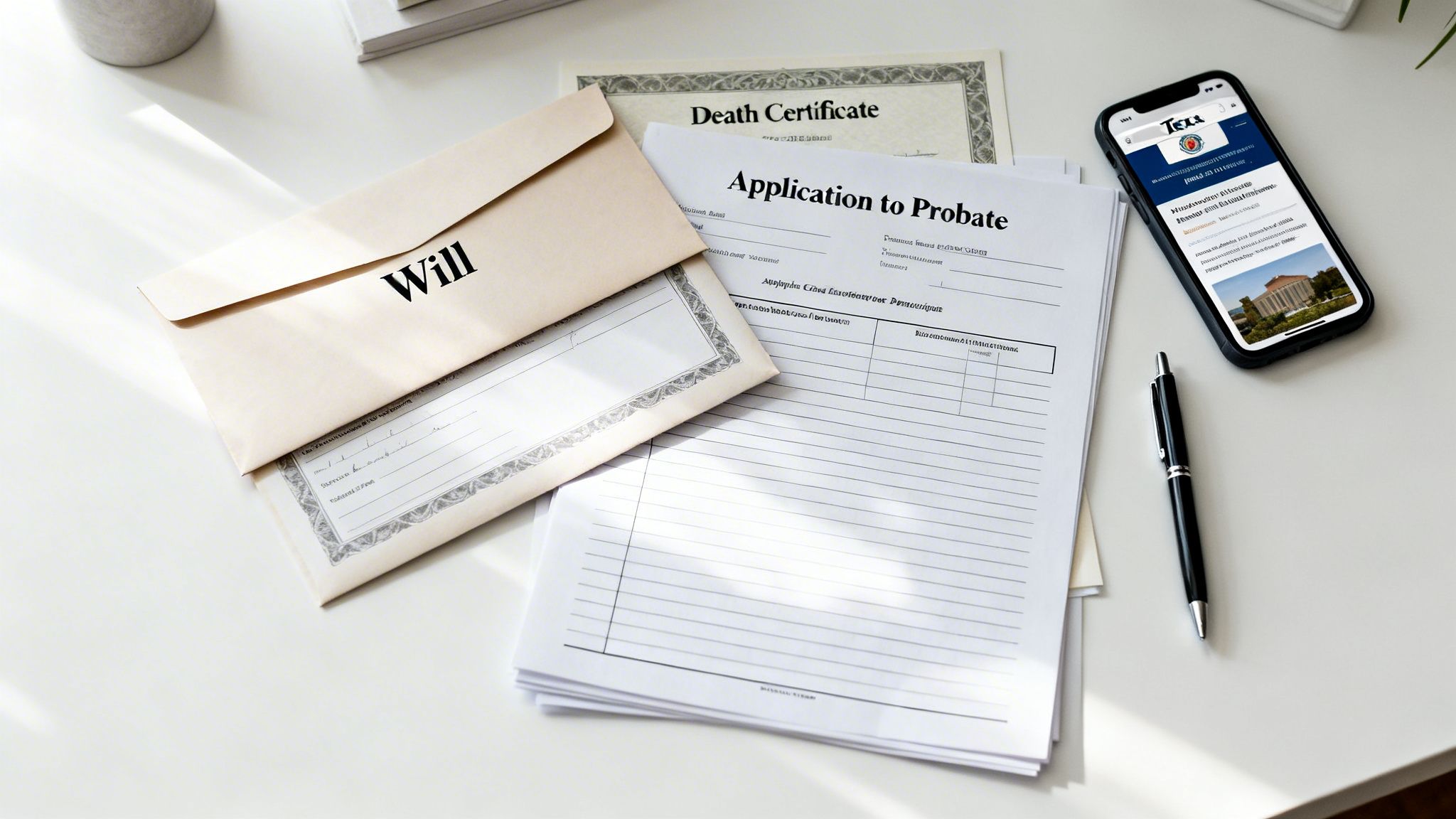
Let's start with the absolute must-haves. Without these three items, the probate court won't even consider your application.
The Original Will: The court needs the real deal—the original, signed document. While you can sometimes probate a copy, it’s a much more complicated and expensive fight. Keep that original will somewhere safe.
A Certified Death Certificate: This is the official proof of death, and you'll need more than one. Banks, insurance companies, and government agencies all require a certified copy, not a photocopy. It's best to order several from the Texas Department of State Health Services right away.
A Completed Application to Probate: This is the formal petition to the court. It's usually prepared by an attorney and lays out all the key facts about the deceased, the will, the proposed executor, and the heirs. Accuracy is everything here; a simple mistake can get your filing kicked back.
These documents have been a cornerstone of Texas law since the Republic era, with records dating back to 1836. In 2023 alone, Texas courts issued around 45,000 sets of these letters, with 60% originating in major hubs like Houston and Dallas, according to the Texas Judicial Council's official report.
Information to Compile Before You File
Beyond the official documents, there’s some homework you can do to speed things up for you and your attorney. Pulling this information together now will prevent a last-minute scramble when you're trying to get the application filed.
Full Names and Addresses of All Heirs: Texas law is strict about this. Every single beneficiary named in the will must be formally notified that the will has been filed for probate. An accurate, complete list is non-negotiable.
A Preliminary List of Assets and Debts: You don’t need a perfect, forensic accounting just yet, but a general snapshot is incredibly useful. Jot down major assets like real estate, bank accounts, and vehicles. On the other side, list significant debts like a mortgage, car loan, or large credit card balances.
Social Security Number and Personal Information: For the application and dozens of other forms, you’ll need the decedent’s full legal name, date of birth, Social Security number, and their last known address.
This preparation phase is about more than just paperwork; it’s about setting the stage for a clear and organized estate administration. For a complete list to help you stay on track, our probate document checklist for executors is an invaluable tool to guide you through these first critical steps.
Key Insight
The more information you can hand your attorney on day one, the faster they can get your application drafted and filed. This upfront legwork directly translates into a less stressful, more efficient probate process for your family.
You Have The Letters Testamentary—Now The Real Work Begins
Getting the Letters Testamentary from the court is a huge step. It’s the official moment you transform from the person named in the will to the person legally empowered to manage the estate. Think of it as being handed the keys to the kingdom.
But with those keys comes a heavy set of responsibilities. This is where the Texas Probate Process truly kicks into gear, and your role shifts from a grieving family member to a legal fiduciary.

What Does It Mean to Be a Fiduciary?
Fiduciary duty might sound like dense legal jargon, but its meaning is simple and serious. It means you are legally and ethically bound to act in the best interests of the estate and its beneficiaries. Period.
You must manage the estate's assets with complete loyalty, care, and transparency, putting everyone else’s financial interests ahead of your own. Every decision you make from here on out is guided by this core principle.
Your First Tasks Under Texas Law
The Texas Estates Code (Title 2, Subtitle F) doesn't leave you guessing. It lays out a specific to-do list you must tackle right after you're appointed. These aren't suggestions—they are legal requirements designed to protect the estate, the beneficiaries, and you from personal liability.
Here are the first three things you absolutely must do:
- Notify All Beneficiaries: You have 60 days from the day the will is probated to send a copy of the will and the court order to every single beneficiary named in it. This makes sure everyone is officially in the loop.
- Publish a Notice to Creditors: Within one month of getting your letters, you must publish a notice in a local newspaper. This is the formal announcement to any potential creditors that the estate is open and gives them a window to file claims.
- Send Direct Notice to Secured Creditors: If the estate has known debts secured by property (like a mortgage or a car loan), you have two months to send a formal, direct notice to that specific creditor.
Missing these deadlines can cause major headaches, inviting disputes and even legal action down the road.
Maria’s Story Continues: Putting the Letters to Work
Let’s check back in with Maria, who now holds the Letters Testamentary for her father’s estate. With her attorney's help, she’s already taken care of the required notices. Now, she can finally start the hands-on work.
Her first stop is her father's bank. The branch manager, who previously couldn't even talk to her about the account, now reviews the certified copy of the Letters. He promptly closes her father’s checking account and gives her a cashier's check for the full balance, made payable to "The Estate of [Her Father's Name]." Maria takes that check and opens a new estate bank account.
Next, she uses the Letters to hire a realtor to sell her father’s home. The title company won’t move forward without seeing that document—it’s their proof that she has the legal authority to sign a listing agreement and, eventually, the sales contract. She then uses funds from the new estate account to pay his final medical bills, keeping a meticulous record of every single transaction.
Creating the Official Estate Inventory
One of your most critical duties is to prepare and file an Inventory, Appraisement, and List of Claims. This is a detailed report submitted to the court, usually within 90 days of your appointment.
This document must list every piece of property in the estate, along with its fair market value on the date the person passed away. It’s the official snapshot of what the decedent owned and what it was worth.
The inventory becomes the cornerstone of the rest of the probate process, serving as the baseline for paying off debts and, ultimately, distributing what's left to the heirs. As you sort through these duties, you'll also need to consider the financial bigger picture, including understanding inheritance tax implications which could affect the estate or its beneficiaries.
Managing all this requires serious organization. If beneficiaries start to disagree about how assets are being handled, things can get contentious fast. If you find yourself in a disputed situation, getting advice on Probate Litigation is the best way to protect both the estate and yourself.
Key Insight
Your Letters Testamentary are your credentials. You’ll need to show a certified copy for nearly every task, from closing a small bank account to selling a house. It's wise to order several certified copies from the county clerk right after your hearing.
Navigating Roadblocks and Simpler Alternatives
While the formal probate process is a well-trodden path for many Texas estates, it’s not the only route on the map. Sometimes, the journey to getting Letters Testamentary hits unexpected detours. In other cases, a simpler, more direct approach makes far more sense for a family’s needs.
Knowing all your options can save you a tremendous amount of time, money, and emotional energy. The goal isn't to force every estate into the same legal box, but to find the most efficient and compassionate path forward. This is where experienced guidance on matters like Guardianship can also become relevant.
When the Process Gets Complicated
Even when you have a valid will, things can get messy. A common roadblock is a will contest, where an heir or beneficiary challenges the document's validity. This can kick off lengthy and expensive litigation, putting the issuance of Letters Testamentary on hold indefinitely.
Another hurdle is an estate with heavy or complex debts. If the deceased had numerous creditors, or if the estate might be insolvent (meaning debts could outweigh assets), the court will likely require a "dependent administration." This adds layers of court oversight, expense, and delay compared to a simpler independent administration.
The Power of Probate Alternatives
Fortunately, the Texas Estates Code provides some powerful alternatives to formal probate for estates that qualify. These streamlined procedures can achieve the same goal—transferring property to the rightful heirs—with much less hassle.
And they get used a lot. In Bexar County, for example, 75% of the 3,200 Letters Testamentary granted last year were processed within 30 days, often because simpler methods were used. Digging deeper, about 25% of Texas estates valued under $75,000 use a Small Estate Affidavit, which bypasses the need for letters entirely. You can explore more on these options through the State of Texas Law Library's probate resources.
Muniment of Title: A Uniquely Texas Solution
One of the most effective alternatives is probating a will as a Muniment of Title. This process is unique to Texas and is a perfect fit when the deceased had a valid will and no debts, aside from a mortgage on their home.
Instead of appointing an executor, the court issues an order that essentially blesses the will as the legal document transferring property ownership. This court order, once filed in the county’s property records, acts like a deed, clearing the title. It’s a much faster and less expensive way to get real estate into the hands of beneficiaries. We cover this in great detail in our guide to the Texas Muniment of Title process.
The Small Estate Affidavit
For smaller estates, the Small Estate Affidavit (SEA) is another fantastic tool. Under Texas Estates Code Chapter 205, if an estate’s value is $75,000 or less (not counting the homestead and other exempt property) and there's no will, the heirs can use an SEA.
This sworn affidavit is filed with the court. Once a judge signs off on it, you can take that approved document to banks and other institutions to collect and transfer the assets directly to the heirs. It completely avoids formal administration.
Probate Alternatives in Texas Compared
It can be tough to visualize how these different paths stack up. To make it clearer, here’s a quick comparison of the common approaches to settling an estate in Texas.
| Procedure | Best For | Typical Timeline | Key Limitation |
|---|---|---|---|
| Full Probate | Larger or complex estates with debts and multiple asset types. | 4 months to 1 year+ | Requires court hearings, executor appointment, and formal notices. |
| Muniment of Title | Estates with a valid will, no debts (except secured), and real estate to transfer. | 4 to 8 weeks | Does not appoint an executor, which can be an issue for out-of-state banks. |
| Small Estate Affidavit | Estates under $75,000 (excluding homestead) with no will. | 3 to 6 weeks | Cannot be used to transfer real property other than the homestead. |
As you can see, choosing the right procedure from the start can make a world of difference. The standard probate process has its place, but for many Texas families, a more streamlined alternative is the smarter, faster, and more cost-effective choice.
Key Insight
Full probate isn't always the answer. Texas law provides faster and more affordable tools for straightforward estates. An experienced attorney can quickly tell you if your family's situation qualifies, ensuring you choose the most efficient path.
Common Questions About Letters Testamentary in Texas
When you're dealing with the loss of a loved one, the legal side of things can feel overwhelming. Families we work with often ask the same questions—the practical, real-world concerns that keep people up at night. They worry about how long it will take, what it will cost, and what happens if things don't go smoothly.
Let’s tackle some of the most common questions we hear about getting Letters Testamentary in Texas, so you have the clear, straightforward answers you need.
How Long Does the Letters Testamentary Texas Process Usually Take?
This is almost always the first question on everyone's mind, and for good reason. The honest answer is: it depends. The timeline can vary quite a bit based on the county court’s caseload and how complicated the estate is.
In a best-case scenario—an uncontested will where all the paperwork is perfect—you could have your Letters Testamentary in hand within four to six weeks after filing the application. That includes a mandatory 10 to 14-day waiting period where the case is publicly posted.
But if snags appear, the clock can really slow down. A contested will, trouble tracking down an heir, or a problem with the will itself can stretch the process out for several months. Our focus is always on meticulous preparation from day one to help avoid those delays and keep things moving for your family.
What Is the Average Cost to Get Letters Testamentary in Texas?
The total cost is really a mix of a few different things: court fees, attorney fees, and a few other administrative expenses.
Here’s a general breakdown:
- Court Filing Fees: Expect this to be somewhere between $300 and $500. It varies from one Texas county to another.
- Attorney Fees: This is the biggest variable. Many probate attorneys, including our firm, often handle straightforward, uncontested probate matters on a flat-fee basis. This gives families a predictable cost during an already stressful time.
- Other Costs: You might have smaller expenses, like the fee to publish a notice to creditors in a local newspaper or the cost of getting certified copies of the Letters.
It's also important to know that a dependent administration—which requires a lot more court supervision—is going to be significantly more expensive than an independent administration.
Can I Get Letters Testamentary If I Live Outside of Texas?
Yes, absolutely. You don't have to be a Texas resident to serve as an executor for a Texas estate. The important thing is that the probate case itself has to be filed in the Texas county where the person who passed away lived.
There is one key requirement, though. The Texas Estates Code says an out-of-state executor must appoint a resident agent. This is simply someone who lives in Texas and can officially accept legal notices for the estate. Trying to manage court filings and hearings from another state is tough, which is why most non-resident executors hire a local Texas probate attorney to be their guide on the ground.
What Happens If I Cannot Find the Original Will?
Losing the original will definitely complicates things, but it’s not necessarily a deal-breaker. Texas law has a process for probating a copy of a will, but you'll have to clear a higher legal bar.
You’ll need to provide clear and convincing evidence to the court that explains what happened to the original will and proves the person who wrote it didn’t intentionally destroy it to revoke it. This usually involves testimony from witnesses who can confirm the copy is accurate and talk about the circumstances of the original's disappearance.
If you can't prove the validity of a copy (or find any will at all), the estate will likely be handled as if the person died "intestate," meaning without a will. In that case, Texas law has a completely different set of rules for who inherits the property.
Key Insight
It’s tempting to try and save money by handling probate on your own, but that can backfire badly. Small mistakes can lead to major delays and expenses that far exceed the cost of hiring an experienced attorney to get it done right the first time. Professional guidance provides peace of mind and ensures compliance with Texas law.
If you’re facing probate in Texas, our team can help guide you through every step — from filing to final distribution. Schedule your free consultation today.