Skip to content
When a loved one passes away, the last thing you want to deal with is a mountain of confusing legal paperwork. But to manage their final affairs, you'll need the court's permission. In Texas, that permission comes in the form of official documents called Letters of Testamentary or Administration.
We understand this is a difficult time, and legal processes can feel overwhelming while you're grieving. Think of these letters as the legal keys to the kingdom—the official authority that lets you step into your loved one’s shoes to handle their estate. Without them, you can't access their bank accounts, pay their final bills, or pass their property on to the rightful heirs. This guide will walk you through what to expect, step-by-step, in plain English.
Your Compassionate Guide to Texas Estate Administration

Settling a family member's estate can feel like navigating a maze in the dark, especially while you're grieving. This guide is designed to be your flashlight, starting with the two most important documents in any Texas probate case: Letters of Testamentary and Letters of Administration.
Getting a handle on what these documents are and why they matter is the first step toward settling an estate with confidence. Our goal here isn't to bury you in legal jargon but to make the process feel manageable so you can focus on what's truly important: honoring your family member’s wishes with clarity and care.
Why These Letters Are So Important
You can have the will in your hand, but banks, mortgage lenders, and other financial institutions won’t talk to you without one of these court-issued letters. They are the undeniable proof that you are the court's chosen representative, armed with the legal power to act on behalf of the estate.
These letters are essential for almost every task you'll face, including:
- Accessing and closing the deceased’s bank accounts.
- Paying off final bills, credit card debts, and taxes owed by the estate.
- Selling a house or other property to settle the estate.
- Distributing what's left to the heirs or beneficiaries named in the will.
Simply put, these letters are the bridge between your duty to your loved one and the legal authority you need to fulfill it. The one you need—either Testamentary or Administration—boils down to a single question: did your loved one leave a valid will? This journey requires patience and the right support. By understanding how the process works from the start, you can carry out your duties with respect and efficiency, knowing you're handling things the right way. We'll walk you through every step.
Letters Testamentary vs. Letters of Administration Explained
When you’re tasked with settling a loved one's estate in Texas, one of the first and most critical questions you’ll face revolves around a single document: a valid will. Whether a will exists or not determines which type of official "letters" you'll need from the probate court to legally manage the estate.
Think of it this way: a will is your loved one’s final instruction manual. If they left one, the court’s job is to empower their chosen representative to follow it. If they didn’t, the court has to appoint someone to follow the state's default rulebook instead. These two paths lead to two very different, but equally powerful, legal documents.
When There Is a Will: Letters Testamentary
If your loved one passed away with a valid will, that document almost certainly names an executor. This is the person or institution they hand-picked and trusted to carry out their final wishes.
But just being named in the will isn't enough. Before an executor can legally touch a bank account or sell a house, the will must be admitted to probate. A Texas court will review the will and, if it’s valid, issue Letters Testamentary to the named executor. This document is the court's official stamp of approval, granting the executor the legal authority to act on behalf of the estate as outlined in the Texas Estates Code, Title 2.
In short, Letters Testamentary activate the will. They are the legal key that turns the executor's designated role into a real-world power to manage and distribute the estate exactly as the deceased intended.
When There Is No Will: Letters of Administration
So what happens if someone dies without leaving a will? In legal terms, this is called dying intestate. Without a will, there are no instructions and no pre-named executor. This is where the court must step in to appoint someone to manage the estate. This court-appointed person is called an administrator.
To learn more about the specific duties of each role, check out our guide on the difference between an executor and an administrator.
Once appointed, the court grants the administrator Letters of Administration. This document gives them the legal power to wrap up the estate—gathering assets, paying off debts, and distributing what's left over. But instead of following a will, they must follow Texas intestacy laws, which are a strict, predetermined formula for who inherits property, as specified in Texas Estates Code, Title 2, Chapter 201.
Unfortunately, dying intestate is becoming more common. In the 2023/24 financial year, England and Wales saw a record 51,136 Grants of Letters of Administration issued, a 17.3% jump from the prior year. This trend, detailed by Anglia Research, shows a 34% increase in intestate deaths in just two years, highlighting a growing need for families to understand this probate path.
Letters Testamentary vs. Letters of Administration at a Glance
To make it even clearer, let's break down the key differences between these two crucial probate documents side-by-side.
| Feature | Letters Testamentary | Letters of Administration |
|---|---|---|
| Triggered By | A valid will exists. | No valid will exists (intestacy). |
| Issued To | The Executor named in the will. | A court-appointed Administrator. |
| Source of Authority | The deceased's instructions in the will. | Texas state law (intestate succession). |
| Primary Goal | To carry out the specific wishes of the deceased. | To distribute assets according to legal heirship rules. |
| Governing Texas Statute | Primarily guided by Texas Estates Code, Title 2. | Governed by Texas Estates Code, Title 2, Chapter 201. |
Knowing which path your family needs to take is the foundational first step in the Texas Probate Process. Whether you end up with Letters Testamentary or Letters of Administration, obtaining the correct document is what ultimately unlocks your ability to settle your loved one's affairs responsibly and legally.
The Powers You Gain with These Official Letters
Getting letters of testamentary or administration from a Texas probate court is the moment everything changes. These aren't just pieces of paper; they're your legal keys to the kingdom—the official authority you need to step in and manage a loved one's final affairs. Without them, you're effectively on the sidelines, unable to do much of anything.
Once those letters are in hand, your role shifts. You're no longer just a family member named in a will or chosen by law. You become a fiduciary, legally empowered to step into the shoes of the person who has passed and untangle their financial life in an organized, transparent way.
Your Legal Authority as an Executor or Administrator
The authority these letters grant is broad, covering every task required to settle an estate. While every estate is different, the core powers you receive are clearly laid out in the Texas Estates Code.
Think of it as a legal to-do list. Your main responsibilities will include:
- Gathering and Securing Assets: You now have the right to track down and take control of all estate property. This means everything from bank accounts and investments to cars, real estate, and personal keepsakes.
- Paying Debts and Taxes: You are officially authorized to use the estate's money to pay off the deceased’s final bills, clear any outstanding debts, and handle all tax matters, including filing their final income tax return.
- Opening an Estate Bank Account: To keep the estate's finances separate and clean, you can open a new bank account in the name of the estate. All incoming money goes in, and all expenses are paid out from this account.
- Managing and Selling Property: You have the power to maintain, manage, and if necessary, sell estate property. For real estate, these letters give you the legal standing needed for tasks like navigating a probate sale.
- Distributing Assets to Heirs: Once all the debts and expenses have been settled, your final job is to distribute what's left to the beneficiaries named in the will or the legal heirs determined by state law.
A Real-World Example of These Powers in Action
Let’s look at a realistic scenario. Sarah is named the executor in her father's will. His main asset is his home in Houston, and the will says the money from its sale should be split equally between Sarah and her two siblings.
Even though the will is crystal clear, Sarah can't just call a real estate agent and put the house on the market. The title is still in her father’s name. To do anything legally, she first has to go to probate court and get Letters Testamentary.
Once the court issues those letters, Sarah is empowered to:
- Hire a real estate agent and sign a listing agreement on behalf of the estate.
- Review offers and sign a sales contract to accept one.
- Sign all the closing paperwork to transfer the deed to the new buyer.
- Deposit the sale proceeds directly into the estate's bank account.
- After paying any final estate expenses, distribute the remaining funds to herself and her siblings.
Without those letters, the whole process would be stuck. They are the non-negotiable legal key that unlocks her ability to carry out her father's final wishes.
The use of official documents to settle estates is a practice with deep historical roots. From the late 1570s, probate records in England and Wales saw a significant increase, with testamentary documents like wills and Letters of Administration becoming more common. Learn more about the historical rise of these probate records.
How to Get Letters of Testamentary or Administration in Texas
So, you know you need these official letters. Now what? The next step—actually getting them—can feel pretty intimidating, but it’s a structured journey with a clear roadmap. Think of it less like a maze and more like a series of manageable steps that lead you to the legal authority you need.
The whole process unfolds in the county probate court where your loved one lived. Here’s a straightforward, step-by-step breakdown of what to expect as you work to obtain letters of testamentary or administration in Texas.
Step 1: The Initial Filing (Application for Probate)
It all starts with a formal document called an "Application for Probate." This is your official request to the court, asking it to either recognize a will as valid or, if there's no will, to open an estate administration.
This document is where you lay out all the key information the court needs to get the ball rolling, including:
- The deceased person's full name, date of death, and where they last lived.
- The names and addresses of all known heirs or beneficiaries.
- A clear statement on whether a valid will exists.
- If there is a will, the original document must be filed right along with the application.
Filing this application is what officially kicks off the legal process and sets the stage for everything that follows.
Step 2: The Waiting Period and Public Notice
After you file the application, you can't just walk into a hearing the next day. Texas law requires a brief waiting period. During this time, the county clerk will post a public notice at the courthouse, a step known as "posting citation."
This isn't just a formality. This step, laid out in the Texas Estates Code, is all about transparency. It gives anyone with a legal interest in the estate—like other family members or creditors—a chance to see that a probate case has been opened and have their voice heard if necessary.
Step 3: The Court Hearing
Once the waiting period is over, your attorney will get a court hearing on the calendar. This is where you, as the applicant, will appear before a judge. Don’t picture a dramatic courtroom battle; this hearing is usually a formal proceeding to verify the facts laid out in your application.
If there's a will, you will "prove up the will." This typically just involves giving testimony that the will is, in fact, the last true testament of the person who passed away. If there's no will, the hearing will focus on establishing heirship—legally identifying who the heirs are according to Texas law. The judge listens to the testimony, and if everything is in order, they'll sign an order officially appointing you as the executor or administrator.
The infographic below gives you a bird's-eye view of the core duties you'll have the power to perform once you have your letters.
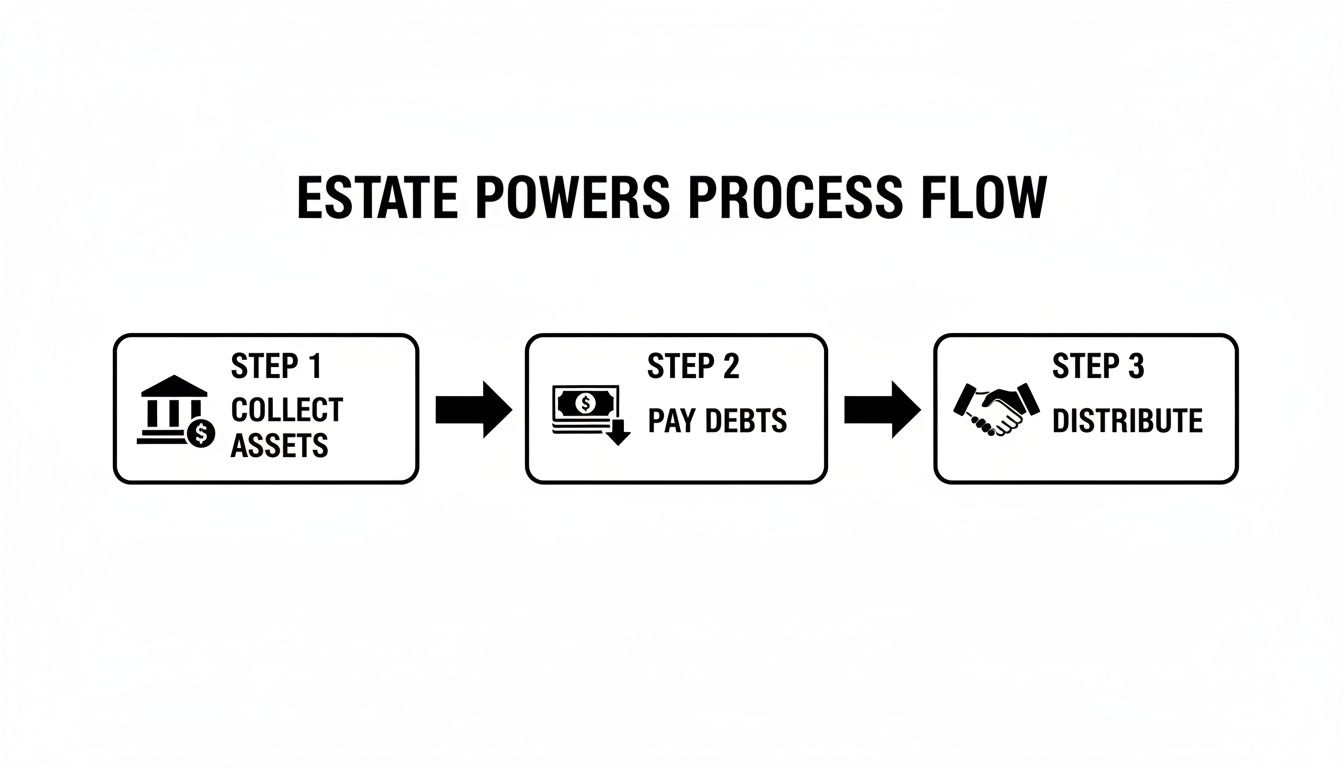
As you can see, your new authority allows you to systematically gather assets, handle any outstanding bills, and finally, make sure what's left gets to the right people.
Step 4: Taking the Oath and Posting Bond
You're almost at the finish line. After the judge signs the order, you have to take an oath of office. By signing this oath, you are formally swearing to faithfully carry out your duties according to the will and the laws of Texas. It’s your promise to the court and the heirs.
In some situations, especially when there's no will, the court might also require you to post a bond. Think of a bond as an insurance policy that protects the estate’s heirs and creditors from any potential mistakes or mismanagement on your part. The cost of the bond is paid from the estate's funds, not your own pocket.
Once you've taken the oath and posted any required bond, the clerk has everything they need. They will then issue your official Letters of Testamentary or Letters of Administration, and you'll be ready to get to work.
Navigating Common Hurdles in the Probate Process

Even with the best of intentions and what seems like a simple estate, the path to getting letters of testamentary or administration can be full of surprises. Grieving families are rarely prepared for the delays that can pop up, adding a layer of frustration to an already heavy time.
Knowing what these potential roadblocks look like ahead of time can help you prepare, both legally and emotionally. The good news is that most of these issues can be untangled with clear communication and experienced legal guidance, stopping small disagreements from spiraling into full-blown family feuds. This is especially true if you are concerned about future Guardianship matters or complex Wills & Trusts.
Will Contests and Validity Challenges
One of the biggest wrenches that can be thrown into the process is a challenge to the will itself. A family member might step forward to contest the will, arguing it’s invalid because the person who signed it lacked mental capacity, was pressured by someone else (undue influence), or didn't follow the proper signing and witnessing rules.
When a will is contested, everything grinds to a halt. The court won't issue Letters Testamentary until the dispute is resolved. This often turns into a formal court proceeding where both sides have to present their evidence, a situation that really highlights why you need skilled counsel in cases of potential probate litigation.
Difficulties Identifying and Locating Heirs
When someone passes away without a will, Texas law demands a thorough search to find and notify all legal heirs. This process, called a determination of heirship, can get messy fast. It’s especially true for blended families, relatives who have been out of touch for years, or children born outside of a marriage.
Any snag in officially identifying every single heir directly delays the court's ability to appoint an administrator and issue Letters of Administration. In some cases, the court might even appoint an attorney ad litem—a neutral third-party lawyer—to protect the interests of any heirs who are unknown or can't be found, adding yet another step to the process.
The idea behind Letters Testamentary and Letters of Administration isn't new; it has roots reaching all the way back to England’s Probate of Testament Acts of 1357. These laws were foundational, moving the control of estates from the church to court-appointed officials—a principle that still shapes modern probate today. You can read more about the historical origins of probate documents.
Family Disputes Over Assets or Executor Choice
Grief has a way of magnifying old family tensions, and unfortunately, arguments are common during probate. Fights can break out over how property should be managed, who ought to be in charge, or what the will’s instructions actually mean.
Even if an executor is named loud and clear in the will, another family member might object, claiming that person is untrustworthy or unfit for the job. These conflicts don't just cause delays; they create lasting emotional damage. It's in these moments that having an attorney to mediate and advocate for a fair resolution in court becomes absolutely crucial.
The Named Executor Is Unable or Unwilling to Serve
So, what happens if the person named as executor in the will has already passed away, is too sick to handle the duties, or just flat-out says, "No, thanks"? This is a surprisingly common curveball that can stall the whole process if you don't know how to handle it.
If the will names an alternate or successor executor, that person can step up to the plate. But if there’s no backup named, or if the backup can't serve either, the beneficiaries might have to agree on someone else. If they can't agree, the court will appoint an administrator based on a legal order of priority. The key is to address this issue with the court right away to keep things moving.
Trying to face these challenges on your own can feel overwhelming. A compassionate probate attorney does more than just handle the legal paperwork; they act as a buffer, shielding you from much of the conflict so you can focus on what matters most—your family.
Key Takeaway: Your Role and Responsibilities
Navigating an estate after a loved one passes away can feel like trying to read a map in the dark, especially when you're grieving. We've walked through a lot of the legal steps in this guide, but the most important thing to remember is simple: you can get through this, and you don’t have to do it alone. At the end of the day, this process is about honoring your loved one’s legacy.
The Legal Foundation for Your Authority
At the very heart of estate administration are Letters of Testamentary or Administration. Think of these documents as more than just legal paperwork; they are the bedrock that makes an orderly settlement possible. They represent the court’s official trust in you to act ethically and responsibly for everyone involved—beneficiaries and creditors alike. With them, you have the clear, undeniable authority to do your job.
Embracing the Human Element of Probate
While the legal process follows a logical structure laid out in the Texas Estates Code, it’s critical not to lose sight of the human element. The journey through loss is different for every family. This is where patience, clear communication, and compassion become your most valuable tools.
Key Insight: The probate process provides a necessary legal framework, but its success often hinges on clear communication and empathy. Acknowledging the emotional weight of your role is just as important as fulfilling the legal duties outlined in understanding the duties of an executor of an estate.
Reaching out for professional guidance isn't a sign of weakness; it's a smart, strategic move to protect both the estate’s assets and your family’s well-being. A skilled probate attorney can prevent expensive mistakes and step in to mediate family disputes before they escalate. Most importantly, it gives you the mental space you need to focus on healing.
If you’re facing probate in Texas, our team can help guide you through every step — from filing to final distribution. Schedule your free consultation today.
Frequently Asked Questions
When you're stepping in to settle a loved one's estate, the questions can feel endless. It's a path few of us are prepared for. This section cuts through the noise to give you straightforward answers to some of the most common hurdles families face with letters of testamentary or administration in Texas, helping you get a clearer picture of the road ahead.
How Long Does It Take to Get Letters of Testamentary in Texas?
There's no magic number, but a realistic timeline is anywhere from four to eight weeks after you file the probate application. Of course, this can shift depending on how busy the court is and how straightforward the estate is.
The whole process has a few built-in steps: filing the application, a mandatory waiting period for public notice, and then getting a hearing scheduled with the judge. Delays usually pop up when there are mistakes in the paperwork, if it's tough to track down all the heirs, or—worst-case scenario—if someone decides to contest the will. The best way to keep things moving is to make sure your application is perfect right from the start.
What If the Named Executor in the Will Cannot Serve?
This happens more often than you'd think. The person named as executor might have passed away, become too ill to handle the job, or simply decide they don't want the responsibility. Fortunately, most well-written wills have a backup plan and name an alternate or successor executor to step in.
If a successor is named, they can file for probate just like the first choice would have. But if there’s no alternate listed, the beneficiaries might have to come to an agreement on who should apply for the role. If they can't agree, the court will step in and appoint an administrator based on a priority list laid out in the Texas Estates Code.
A will that names at least one successor executor is a critical piece of smart estate planning. Think of it as a safety net that prevents frustrating delays and potential family fights if your first choice isn't available.
Can an Estate Be Handled Without These Letters?
Yes, but only in very specific, limited situations. For truly small estates in Texas, a Small Estate Affidavit (SEA) might be an option. It's a simpler process that lets heirs collect property without going through a full-blown probate, but the rules are incredibly strict.
To even qualify for an SEA, the situation must meet these conditions:
- The person must have died without a will (intestate).
- The estate's assets (not counting the homestead) must be worth $75,000 or less.
- The value of the assets has to be more than what the estate owes in debts.
- The only real estate owned can be the decedent's primary home (homestead).
Even if an estate is small, an SEA isn't always the right tool. If you're dealing with complicated assets, significant debts, or the hint of a family squabble, getting formal letters of testamentary or administration is the only way to legally and safely settle the estate.
If you’re facing probate in Texas, our team can help guide you through every step — from filing to final distribution. Schedule your free consultation today.