Skip to content
When you start planning for your family’s future, the legal jargon can feel overwhelming. One term you'll encounter is inter vivos trust, which is simply the formal name for a living trust. It's a legal arrangement you create while you're alive—"inter vivos" is just Latin for "among the living." Think of it as a powerful tool for managing your assets today and ensuring they get to your loved ones tomorrow with clarity and compassion.
Understanding the Inter Vivos Trust Meaning in Plain English

Imagine a living trust as a protective container you build for your most important assets—your home, savings, and investments. By placing these items inside this container, you ensure they are managed exactly according to your wishes, both during your lifetime and after you're gone.
The Key People Involved
Every trust has three essential roles. Sometimes, one person can wear multiple hats, but these three jobs always exist:
- The Grantor (or Settlor): This is you—the person who creates the trust and transfers assets into it.
- The Trustee: This is the person or institution you pick to manage the trust's assets. While you're alive and well, you will almost certainly be your own trustee.
- The Beneficiary: These are the loved ones—your spouse, children, or others—who will ultimately receive the assets from the trust.
This structure gives you total control over your property while you’re living. You can buy, sell, or manage assets just like you always have. The real benefit comes when you can no longer manage your own affairs or after you pass away. At that point, your chosen successor trustee steps in to follow your instructions without needing a judge’s permission, a process outlined in the Texas Estates Code, Title 3.
How a Living Trust Differs from a Will
Most Texas families are familiar with a Last Will and Testament, but a living trust offers major advantages, especially for privacy and efficiency. A will only becomes active after your death and must go through the public Texas Probate Process. A living trust, on the other hand, is active the moment you create it and operates completely privately. This distinction is a huge reason families are increasingly choosing them to protect their loved ones.
To make the choice clearer, here’s a quick comparison:
Inter Vivos (Living) Trust vs. A Will at a Glance
| Feature | Inter Vivos (Living) Trust | Last Will and Testament |
|---|---|---|
| When it's Active | Immediately upon creation and funding. | Only after your death and probate court approval. |
| Probate | Avoids the Texas probate process for trust assets. | Must go through the public probate court system. |
| Privacy | Kept private. Your asset details are not public record. | Becomes a public court record, open to anyone. |
| Incapacity Planning | Allows your successor trustee to manage assets if you are unable. | Does not provide a plan for managing your assets if you become incapacitated, potentially leading to a Guardianship proceeding. |
Understanding the fundamental difference between a will and a trust is the first step toward building a secure estate plan that truly protects your family. Each has its place, but for many, the control and privacy offered by a living trust are invaluable.
Choosing Between Revocable and Irrevocable Trusts

Once you've decided that a living trust makes sense for your family, the next big decision is which kind to create. Broadly speaking, living trusts fall into two main categories: revocable and irrevocable. Getting this choice right is absolutely critical, as it dictates how much control you'll have over your assets down the road.
A helpful analogy is to think of a revocable trust as a document written in pencil. As the creator, you can amend it, add assets, remove beneficiaries, or even erase it and start over whenever you want. An irrevocable trust, on the other hand, is written in permanent ink. Once it's signed, making changes is incredibly difficult, if not impossible.
The Flexibility of a Revocable Trust
For the vast majority of Texas families we work with, the revocable living trust is the workhorse of their estate plan. Its primary goals are to keep your assets organized, plan for a time when you might be unable to manage them yourself, and—most importantly—help your loved ones sidestep the public and often frustrating Texas Probate Process.
With a revocable trust, you call all the shots. You can name yourself as the trustee, manage your property exactly as you do today, and update the trust as life unfolds. A new marriage, the birth of a grandchild, or a major financial shift are all perfect reasons to make changes. This adaptability is precisely why it’s the go-to tool for probate avoidance and basic estate management.
When an Irrevocable Trust Makes Sense
While a revocable trust offers flexibility, an irrevocable trust provides powerful protections that a revocable one simply can't match. The trade-off is control. By permanently transferring ownership of your assets to the trust, you can unlock specific and advanced estate planning goals.
Why would anyone willingly give up that much control? It usually comes down to two major scenarios:
- Asset Protection: Because you no longer legally own the assets inside the trust, they can be shielded from future creditors or lawsuits, a strategy often considered in Probate Litigation.
- Long-Term Care Planning: For individuals planning for future medical needs, moving assets into a specially designed irrevocable trust can be a key strategy for qualifying for government benefits like Medicaid to pay for nursing home care.
We can explore the nuances of a revocable vs. irrevocable trust in much greater detail to figure out the right fit for you. Making the correct choice here is a foundational step in securing your family’s legacy.
How a Living Trust Helps You Avoid Texas Probate
For most Texas families, the single biggest reason to set up a living trust is to sidestep the probate process. It’s a simple but powerful motivator. When you pass away with only a will, your estate is legally required to go through probate court. This is a public affair, dictated by the Texas Estates Code, and it can drag on for months, costing your family time, money, and stress while they're already grieving.
But here’s the game-changer: assets held inside an inter vivos trust are not considered part of your probate estate. Because the trust—a separate legal entity—legally owns the property, those assets can be passed to your loved ones privately and efficiently. Your chosen successor trustee takes the reins without court supervision, mandatory waiting periods, or a public record of your family’s inheritance.
A Tale of Two Paths: The Martinez Family
Let's walk through a realistic scenario. The Martinez parents, Maria and Carlos, worked with an attorney to create a revocable living trust. They were diligent, carefully retitling their Houston home, their primary checking account, and a brokerage account into the name of the Martinez Family Trust.
When Carlos passed away, and Maria followed a few years later, their adult children were heartbroken. But because the main assets were already in the trust, their eldest daughter—the successor trustee—could get to work right away. She had the authority to pay final bills, manage investments, and get the house ready to sell without ever having to step foot in a courtroom.
Now, imagine if the Martinez parents had only used a will. Their kids would have had to hire a lawyer, file the will with the court, attend hearings, and wait for a judge to grant them permission before they could do anything. All their family's financial details would have become public record. Instead, the trust gave them the power to handle things privately and on their own timeline—a massive relief during an incredibly tough time.
This is a key reason why so many people are exploring how a trust helps avoid probate in Texas. It’s about making a difficult transition as smooth as possible for the people you love most.
Key Insight: Probate vs. Trust Administration
To really grasp the difference, it helps to see the timelines side-by-side. While every situation is unique, settling a trust is almost always faster than trudging through a formal probate.
| Milestone | Typical Probate Process | Trust Administration |
|---|---|---|
| Initial Steps | File will with court, wait for hearing (30-90 days) | Successor trustee takes control immediately |
| Asset Management | Executor waits for "Letters Testamentary" from court | Trustee can manage/sell assets right away |
| Creditor Notice | Formal public notice to creditors is required | Private notice to known creditors is handled by trustee |
| Distribution | Assets distributed only after court approval (6-12+ months) | Assets distributed per trust terms (often within weeks or months) |
| Privacy | The will and asset inventory are public records | The trust and its assets remain private |
As you can see, the difference isn't just a matter of weeks; it can be months or even over a year. The trust administration path is designed for privacy and efficiency, whereas the probate process is a public, court-supervised affair that moves at the speed of the legal system. For families looking to move forward without unnecessary delays and public scrutiny, the choice is often clear.
Step-by-Step: Creating and Funding Your Texas Living Trust
An estate plan is only as good as the work you put into making it real. For an inter vivos trust, this means doing more than just signing a document. It's a hands-on process of designing, signing, and—most importantly—funding the trust so it can do its job. Let's walk through the steps to make sure your living trust performs exactly how you expect it to.
This diagram shows the two very different paths your estate can take. One winds through the public probate court system, while the other moves through the private administration of a trust.
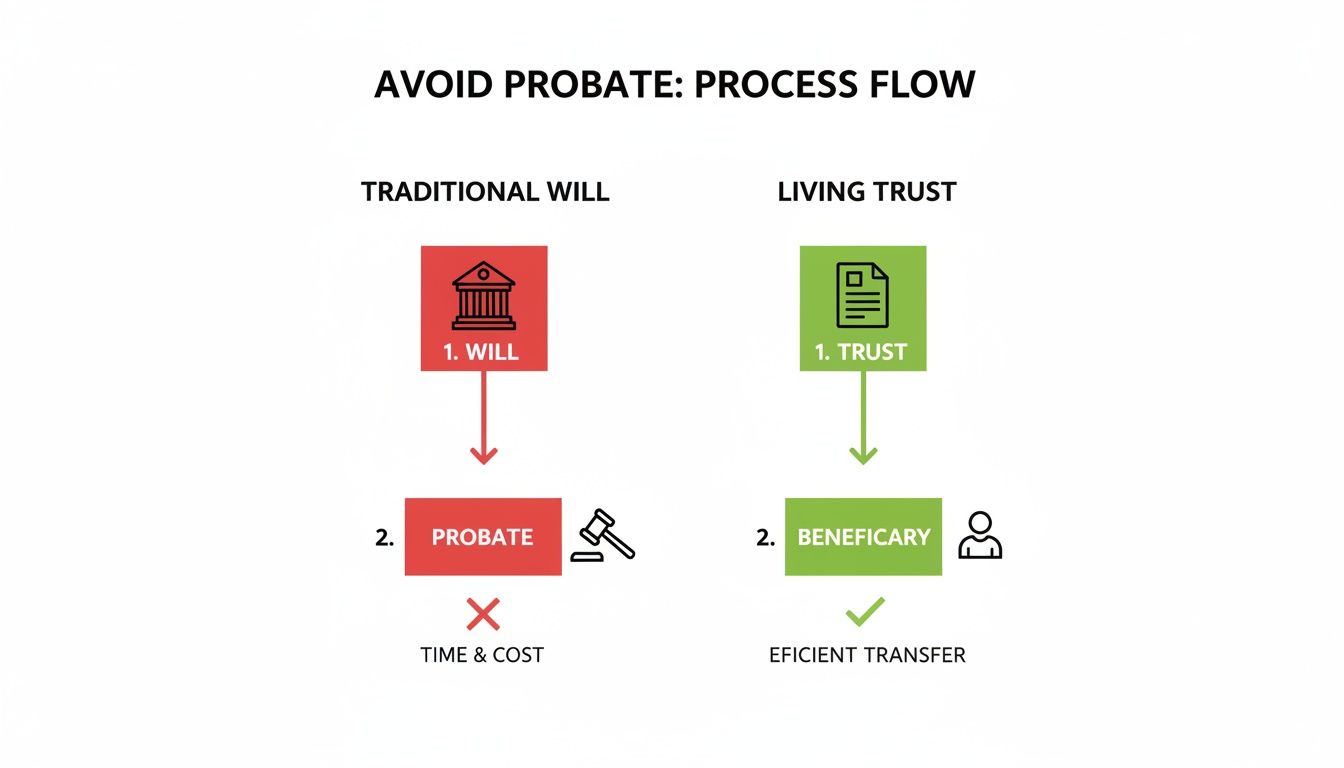
As you can see, the trust creates a direct and private route for your assets to reach your beneficiaries, steering clear of the courthouse completely.
Step 1: Designing and Executing the Trust Document
The first step is bringing the legal document to life. This isn't a generic, fill-in-the-blank form. It’s a personalized instruction manual that reflects your unique family, your specific financial picture, and your long-term goals.
This is where working with an experienced estate planning attorney becomes essential. Together, you will:
- Name Your Key Players: You’ll identify the grantor (that's you), the initial trustee (usually also you), the successor trustee(s) who will step in later, and the beneficiaries who will inherit your assets.
- Define Your Instructions: You'll lay out exactly how your assets should be managed if you become incapacitated and how they should be distributed when you're gone.
- Sign and Notarize: Once the document is drafted exactly to your liking, it must be signed according to Texas law, typically in front of a notary public. This makes it a legally binding agreement.
Step 2: The Critical Step of Funding Your Trust
Pay close attention here, because this is the single most important—and most frequently missed—part of the process. A trust is like an empty box; it can’t do anything to protect your assets until you actually put them inside it. Funding the trust is simply the act of retitling your assets from your individual name into the name of the trust.
An unfunded or partially funded trust is one of the most common and costly mistakes in estate planning. Any assets left outside the trust will almost certainly have to go through the Texas Probate Process, defeating one of the main reasons for creating it.
For your trust to work as intended, you have to legally transfer ownership of your property. The process looks different for various types of assets:
- Real Estate: The deeds to your home or other properties must be updated to show the trust as the new owner.
- Bank Accounts: Your checking and savings accounts need to be retitled in the trust's name.
- Non-Retirement Investment Accounts: Brokerage accounts must be formally transferred.
- Business Interests: Your ownership interest in an LLC or other business can often be assigned to the trust.
Creating and funding a living trust demands careful attention to detail. When it’s done right, you ensure your plan to avoid probate and protect your family will succeed when they need it most. Our team can help you navigate both the legal drafting and the practical steps of funding your Wills & Trusts.
More Than Just Probate Avoidance: The Real Power of a Living Trust
While avoiding the public, often sluggish Texas probate process is a huge benefit, the true value of an inter vivos trust goes far beyond what happens after you're gone.
It’s a powerful tool designed to protect you and your family right now, during your lifetime. Think of it less as a death plan and more as a life plan—one that tackles the tough "what if" questions every family should be asking. Two of the most significant advantages are planning for incapacity and protecting your family’s privacy.
A Plan for Incapacity
A sudden illness or a serious accident could leave you unable to manage your own financial affairs. Without a plan, your family would be forced to go to court and ask a judge to appoint a guardian for you. This is a public, expensive, and emotionally taxing process that strips you of your autonomy.
A living trust offers a seamless and completely private alternative. If you become incapacitated, the successor trustee you hand-picked steps in immediately to manage the trust's assets on your behalf. There's no court intervention needed. They can pay your mortgage, handle investments, and make sure your financial life continues without a hitch, avoiding a stressful Guardianship proceeding.
Protecting Your Family's Privacy
When a will goes through probate, it becomes a public court record. This means every detail—your assets, your debts, and who you left everything to—is available for anyone to look up. For a grieving family, this lack of privacy can feel like a profound violation.
A trust, on the other hand, is a completely private document. Its terms, assets, and distributions are never filed with a court or made part of any public record. Your successor trustee simply follows your private instructions, shielding your family's financial matters from public curiosity.
Exploring Wills & Trusts can help you build this kind of holistic protection for your family.
Takeaway: Key Insights on Inter Vivos Trusts
Navigating estate planning can feel complex, but understanding the core purpose of a living trust provides peace of mind. Here are the key points to remember:
- It's a "Living" Document: An inter vivos trust is created and managed during your lifetime, giving you continued control over your assets.
- It Avoids Probate: Properly funded trusts allow your assets to pass to your heirs privately and efficiently, without court involvement.
- It Protects You During Incapacity: A trust ensures your chosen successor can manage your finances if you are unable, avoiding a public guardianship.
- Funding is Not Optional: A trust is only effective if you transfer your assets into it. An empty trust provides no protection.
- It's for Families, Not Just the Wealthy: Any Texan who owns a home or has assets they want to protect can benefit from a living trust.
Common Questions We Hear About Living Trusts
As you think about what an inter vivos trust could mean for your family, it's natural for questions to arise. Let's tackle some of the most common ones we hear, breaking them down into clear, straightforward answers.
Do I Still Need a Will If I Have a Living Trust?
Yes, you absolutely do. A complete estate plan almost always includes a special type of will called a pour-over will. Think of it as a safety net. If you forget to transfer a new asset—like a car you just bought—into your trust, the pour-over will is designed to "catch" any forgotten assets and pour them into your trust after you pass. Without one, any assets left outside the trust will have to be distributed according to Texas's default inheritance rules (intestacy laws found in the Texas Estates Code), which might not align with your wishes.
Can My Trust Reduce Estate Taxes?
A standard revocable living trust, on its own, will not reduce federal estate taxes. From the IRS's perspective, because you still control the assets, they are still considered part of your taxable estate. However, for families with significant wealth, we can use certain types of irrevocable trusts. These specialized trusts are specifically designed to move assets out of your taxable estate, which can minimize or even eliminate estate tax liability.
Isn't Creating a Living Trust Expensive?
It’s true that the upfront investment for setting up a living trust is higher than a simple will. But it’s crucial to look at the bigger picture—the total cost to your family down the road. A properly funded trust is designed to avoid the probate process entirely. That means you're often saving your loved ones thousands of dollars in future court costs, administrative expenses, and legal fees. Think of it less as an expense and more as a proactive investment in making a difficult time simpler, faster, and more private for your family.
Our attorneys who specialize in Wills & Trusts can walk you through every detail with clarity and compassion.
If you’re facing probate in Texas, our team can help guide you through every step — from filing to final distribution. Schedule your free consultation today.