Skip to content
When you decide to create a living trust in Texas, you’re taking a powerful step to protect your family and your assets. The process involves three key actions: working with an attorney to draft the legal document, officially transferring your property into the trust, and then signing everything in front of a notary. This thoughtful planning allows your estate to bypass the often slow, expensive, and public probate court system, providing peace of mind for you and your loved ones.
Understanding a Texas Living Trust and How It Works

Diving into estate planning can feel overwhelming, but a living trust is a straightforward and effective tool. Think of it as a private instruction manual for everything you own. It becomes effective the moment you create it, managing your assets while you're alive and ensuring they are distributed according to your wishes after you're gone.
A traditional will only becomes active after you pass away and must go through the court-supervised Texas Probate Process. A living trust, on the other hand, is active as soon as you create and fund it, making it a powerful tool for seamless estate management.
Key Roles Within a Living Trust
Every trust operates with three essential players. When creating your trust, you will assign these roles.
- Grantor: This is you—the person creating the trust and placing your assets into it.
- Trustee: This is the manager. The trustee is the person or institution responsible for managing the trust's assets according to the rules you’ve set. While you are alive and well, you will almost always serve as your own trustee, maintaining full control.
- Beneficiary: These are the people, charities, or organizations who will ultimately inherit the assets from the trust. During your lifetime, you are the primary beneficiary.
For most people setting up a revocable living trust, you will fill all three roles at the start: you create it (Grantor), you manage it (Trustee), and you benefit from it (Beneficiary). You will also name a successor trustee—a trusted person or institution to step in and manage the trust if you become incapacitated or pass away. This ensures a smooth transition of control without court intervention.
The Core Benefit: Avoiding Probate
For most Texas families, the primary motivation for creating a living trust is to avoid probate. The probate process can be lengthy, often lasting for months, and it can be expensive. Estates frequently lose 3-7% of their total value to attorney’s fees, court costs, and other administrative expenses.
A trust also preserves your family’s privacy. Probate filings are public records, available for anyone to view. By placing your home, bank accounts, and other property into a trust, you ensure they can be passed to your loved ones quickly, privately, and precisely as you intended. You can learn more about the many revocable living trust benefits available to Texas families.
Living Trust vs. Traditional Will in Texas
| Feature | Living Trust | Traditional Will |
|---|---|---|
| Probate Process | Bypasses probate entirely for funded assets. | Must go through the public probate court process. |
| Privacy | Kept private; terms are not public record. | Becomes a public court record. |
| Asset Management During Incapacity | Successor trustee takes over immediately without court. | Requires a court to appoint a conservator. |
| Effective Date | Becomes effective as soon as it's signed and funded. | Only becomes effective upon death. |
| Cost to Create | Higher upfront cost to draft and fund. | Generally lower upfront cost to draft. |
| Contestability | More difficult to successfully challenge in court. | More frequently challenged by disgruntled heirs. |
While a will has its place, a living trust offers a level of control, privacy, and protection that a will simply cannot match, especially for managing your affairs if you become unable to do so yourself. For more information, explore our comprehensive guide on Wills & Trusts.
Choosing Between a Revocable and Irrevocable Trust
When you sit down to create a living trust in Texas, one of the first and most important decisions is whether to make it revocable or irrevocable. This choice defines your relationship with your assets, dictating how much control you retain, how protected your assets are, and how flexible your plan can be.
There is no one-size-fits-all answer. The right choice depends on your unique family situation, your financial goals, and what you want to achieve with your estate plan.
The Flexibility of a Revocable Trust
For the vast majority of Texas families, the revocable living trust is the foundation of their estate plan. Think of it as a flexible, living document that you can change as your life evolves.
With a revocable trust, you remain in complete control. As the grantor, you can modify its terms, change beneficiaries, or even dissolve the trust entirely at any time. Life is unpredictable—a marriage, the birth of grandchildren, or a significant financial change—and this trust is designed to adapt with you.
The primary purpose of a revocable trust is to manage your property during your lifetime and, most importantly, to keep your estate out of the public and often costly probate court after you pass away. While you are healthy, you act as your own trustee, managing your assets just as you always have.
If you become incapacitated, your chosen successor trustee can step in to manage your affairs seamlessly, without needing a court's permission. For many, that peace of mind is invaluable.
Here’s what makes it so popular:
- Complete Control: You can amend or revoke the trust at any time.
- Probate Avoidance: Assets held in the trust pass directly to your heirs, skipping court.
- Privacy: Unlike a will, a trust keeps your family’s affairs private.
- Incapacity Planning: It provides a built-in plan for who takes over if you can't manage things yourself.
The Permanence of an Irrevocable Trust
An irrevocable trust is designed for permanence and powerful asset protection. Once you create this type of trust and transfer assets into it, you generally give up your right to change the terms or reclaim the assets. You are relinquishing control and ownership.
Why would anyone do this? The main reason is asset protection. Because the assets are no longer legally yours, they can be shielded from potential creditors, lawsuits, and even help you qualify for long-term care benefits like Medicaid.
For a deeper dive into these differences, our guide on revocable vs. irrevocable trusts breaks down the nuances to help you decide.
Realistic Scenario:
Imagine a small business owner in Houston who is concerned about future liabilities from her company. By placing her personal home and savings into a properly structured irrevocable trust, she creates a protective barrier between her personal wealth and her business risks. If her business ever faces a lawsuit, the assets held in the trust would generally be protected. This is an advanced strategy often used for significant asset protection or complex tax planning, and it's not a decision to be made lightly.
How Texas Law Influences Your Choice
As a community property state, Texas law adds another layer to this decision. Under the Texas Estates Code, most assets acquired by you and your spouse during your marriage are considered community property, meaning you both own them equally. Your trust must respect these laws to function correctly.
For instance, transferring community property into an irrevocable trust typically requires the consent and signature of both spouses. Overlooking this requirement can create significant legal complications. This is one of many reasons why creating a living trust in Texas requires professional guidance to ensure your plan is legally sound and achieves your goals.
Drafting Your Texas Trust Document Correctly
Once you have decided on the right type of trust, it’s time to create the legal document that brings it to life. The trust document is the heart of your estate plan; it contains the official instructions that will govern how your assets are managed and distributed for years to come.
A precisely drafted trust does more than just list who gets what. It anticipates potential family conflicts, provides clear authority to your trustee, and builds a legal fortress around your legacy. The specific language used by an experienced attorney can mean the difference between a smooth transition and a costly family dispute, which could lead to Probate Litigation.
The Essential Components of a Texas Trust
Every Texas trust must include several core elements to be legally valid.
- Clear Identification of Parties: The document must clearly name the Grantor (you), the initial Trustee (usually you), the Successor Trustee (your backup manager), and all Beneficiaries. Using full legal names and clarifying relationships prevents future confusion.
- A Statement of Intent: The document must include clear language stating your intention to create a trust and transfer property into it. This formal declaration is a legal necessity.
- Specific Instructions for Distribution: This section outlines the "who, what, and when" of your plan. You can specify who receives which assets and under what conditions. For example, instead of a 22-year-old inheriting a large sum at once, you can instruct the trustee to distribute the inheritance in stages (e.g., at ages 25, 30, and 35) to encourage financial maturity.
- Powers of the Trustee: Your trust must grant your successor trustee the legal authority needed to manage the trust. This includes the power to buy, sell, and invest trust property and distribute it according to your instructions, all within the framework of the Texas Property Code, particularly Title 9.
The Critical Role of Your Successor Trustee
Choosing your successor trustee is one of the most important decisions in your estate plan. This is not a ceremonial title; it is a demanding job with significant legal and financial responsibilities. This person or institution will manage your financial life if you become incapacitated or after you pass away. Your choice should be based on trustworthiness, financial competence, and a genuine commitment to following your instructions.
Realistic Scenario:
Imagine Sarah, a widow in Dallas with two adult children. Her son is a talented artist but has always struggled with managing money. Her daughter is a CPA with a strong sense of responsibility. Sarah loves both children equally and names them as equal beneficiaries in her trust. However, she wisely appoints her daughter as the sole successor trustee. This is not about favoritism; it is a practical decision to place the most qualified person in charge of the complex financial and administrative tasks, ensuring the trust is managed competently for the benefit of both children.
Executing Your Trust: The Final Step
Once the document is drafted to your satisfaction, it's time to make it legally binding. In Texas, the signing requirements for a trust are more flexible than those for a will.
The primary requirement is that you, the grantor, must sign the trust document in the presence of a notary public. The notary verifies your identity, witnesses your signature, and applies their official seal.
While the Texas Estates Code does not require witnesses for a living trust (unlike a will), many experienced attorneys strongly recommend it. Having two disinterested witnesses also sign the document adds a powerful layer of protection, making it much harder for a disgruntled relative to challenge the trust later on grounds of fraud or undue influence. Our firm takes this extra step for every trust we draft to provide peace of mind and fortify your plan.
The Critical Step: Funding Your Texas Living Trust
Signing your trust document is a major accomplishment, but an unfunded trust is like an empty safe—it can’t protect anything. The process of moving your assets from your individual name into the name of the trust is called funding.
An unfunded trust is one of the most common and devastating mistakes in DIY estate planning. If an asset is not legally titled in the name of the trust, it remains outside the trust's protection and will almost certainly have to go through the public and costly probate process. This defeats a primary reason for creating the trust in the first place.
This process flow shows the basic steps for formalizing a trust document, a necessary precursor to funding.
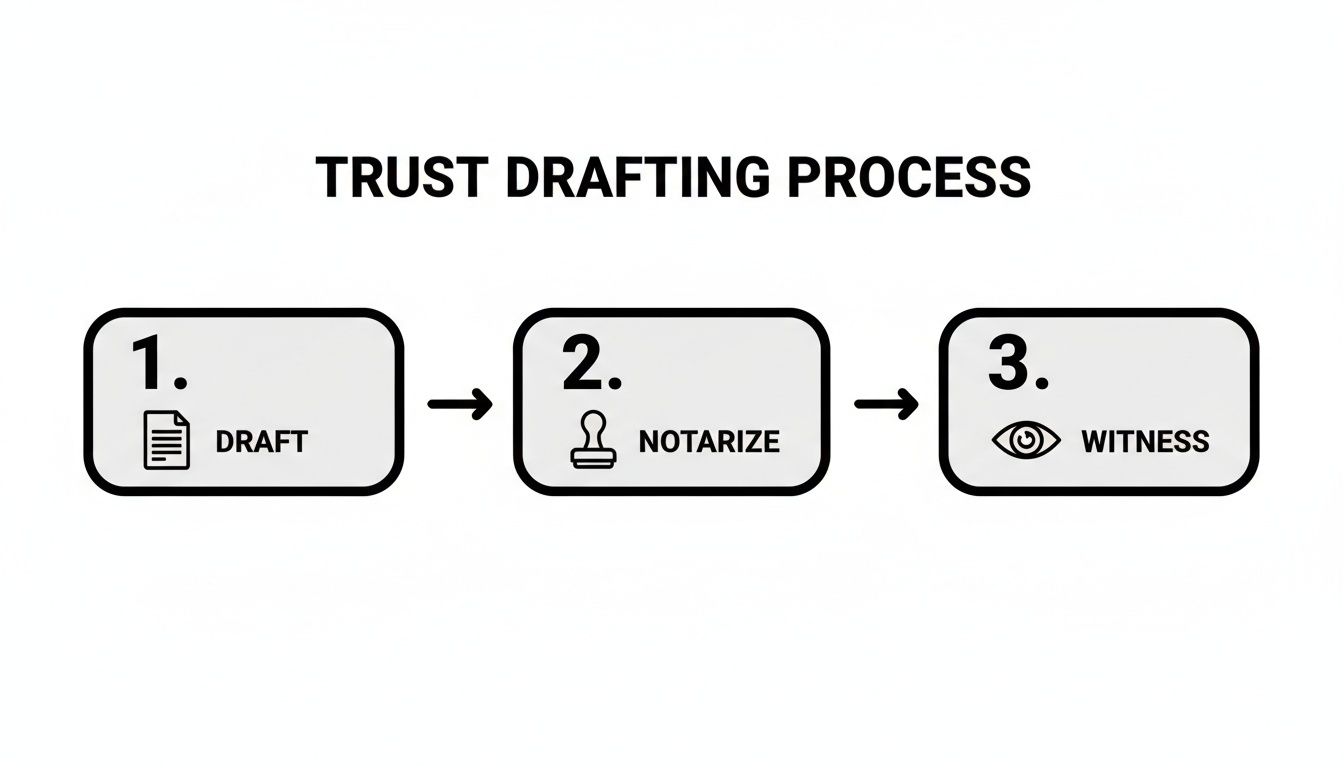
While drafting and signing are the foundational legal steps, funding is what makes your trust effective.
How to Transfer Real Estate Into Your Trust
For most Texas families, their home is their most valuable asset. To transfer your home into your living trust, you must prepare and file a new deed with the county clerk where the property is located. This deed legally changes the owner from you as an individual to you as the trustee of your trust.
For example, the ownership on the deed might change from "John and Jane Doe" to "John Doe and Jane Doe, Trustees of the Doe Family Revocable Living Trust dated January 15, 2024." This seemingly small wording change is legally significant. It means the trust now owns the home, allowing your successor trustee to manage or transfer it without court involvement. Our detailed guide explains how to change a deed on a house in Texas.
Moving Financial Accounts and Other Assets
Beyond your home, you must systematically transfer your other significant assets into the trust. This involves more than just listing them in the trust document; you must change the legal ownership of each account.
- Bank and Brokerage Accounts: Contact each financial institution to retitle your accounts into the name of the trust. You will typically need to provide a copy of your Certificate of Trust.
- Business Interests: If you own an interest in an LLC or partnership, you must formally assign your ownership to the trust, following the rules in your company's operating agreement.
- Valuable Personal Property: For items like art, jewelry, or collectibles, you can use an "Assignment of Personal Property." This document formally declares the transfer of ownership of these items to your trust.
Realistic Scenario: A Fort Worth Family's Funding Journey
A Fort Worth couple had a paid-off home, a sizable stock portfolio, and a collection of valuable Texas art. After working with an attorney to create a comprehensive living trust, they took the following crucial funding steps:
- Their attorney prepared a new General Warranty Deed, transferring their home from their individual names into the name of their new trust. They signed it, and it was filed with the Tarrant County Clerk.
- Next, they visited their bank and brokerage firm. They completed the necessary forms and provided a Certificate of Trust to retitle their accounts.
- Finally, they signed an Assignment of Personal Property that specifically listed the art collection, officially moving it under the trust's ownership.
By taking these administrative steps, they ensured their entire estate was properly funded. Now, their successor trustee can manage and distribute these assets seamlessly and privately, without the delay and expense of Texas probate courts.
Integrating Your Trust Into a Complete Estate Plan

Creating and funding your living trust is a monumental step, but it is not the end of the process. A trust is the powerful centerpiece of your plan, but it works best when supported by other key documents. These supporting documents create a comprehensive safety net, ensuring every angle is covered—from a forgotten bank account to an unexpected medical emergency. Together, they form a cohesive strategy that protects you during your lifetime and provides clarity for your loved ones after you’re gone.
The Pour-Over Will: Your Vital Backup Plan
No matter how diligent you are, it is easy to acquire a new asset and forget to formally title it in the trust's name. A pour-over will is an essential backup for this exact situation.
A pour-over will is a special type of will that works with your living trust. Its sole purpose is to "catch" any assets left outside of your trust when you pass away and "pour" them into it. While these assets will still have to go through probate, the will ensures they ultimately end up in your trust, governed by your private instructions. Without it, those assets would be distributed according to Texas intestacy laws, which might not align with your wishes.
Powers of Attorney: Planning for Incapacity
A living trust manages the assets held within it, but what about decisions outside its scope, like filing your taxes or making medical choices? This is why powers of attorney are indispensable.
- Durable Power of Attorney (Financial): This document grants a trusted person (your "agent") the authority to manage your financial affairs not held in the trust, such as handling government benefits or signing tax returns.
- Medical Power of Attorney: This empowers an agent to make healthcare decisions on your behalf if you are unable to communicate them yourself, ensuring your medical care aligns with your values.
These documents work alongside your trust to provide seamless management of your entire life, preventing the need for a court-ordered Guardianship, which is a public and often stressful process. As you finalize your plan, it's also wise to understand the distinction between death tax and estate tax, as trusts can play a role in managing these liabilities.
Your Complete Texas Estate Planning Checklist
| Document | Primary Purpose | When It's Used |
|---|---|---|
| Living Trust | Manages and distributes assets, avoids probate. | During your lifetime (for incapacity) and after death. |
| Pour-Over Will | Catches any assets left outside the trust and transfers them in. | After your death, during the probate process. |
| Financial POA | Authorizes an agent to handle non-trust financial matters. | Only when you are incapacitated and cannot act for yourself. |
| Medical POA | Authorizes an agent to make healthcare decisions for you. | Only when you are unable to communicate your own wishes. |
| HIPAA Release | Allows doctors to share your medical information with your agents. | When your agents need to access your health records. |
| Advance Directive | States your wishes for end-of-life medical care. | When you have a terminal or irreversible condition. |
Having all these documents in place creates a comprehensive plan that minimizes stress, conflict, and legal hurdles for your loved ones during an already difficult time.
Key Benefits of Creating a Living Trust in Texas
Creating a living trust in Texas is a proactive and compassionate act of planning that protects your family from the public, costly, and time-consuming probate process. The process involves three main stages: professionally drafting the trust document, formally signing it, and meticulously funding it by retitling your assets. A trust works best as part of a complete estate plan that includes a pour-over will and powers of attorney, ensuring you are protected during incapacity and that your legacy is transferred smoothly and privately according to your exact wishes.
What to Expect: The Real Costs and Timelines for Your Texas Trust
When families explore creating a living trust, two questions always arise: "How much will this cost?" and "How long will this take?" Understanding the investment of time and money upfront helps you recognize the immense value a well-crafted trust provides.
While the initial cost of a trust is higher than a simple will, it should be viewed as an investment in avoiding a much larger financial and emotional cost for your family later. Cheap online DIY services are tempting but often fail to account for Texas-specific laws, like community property, leading to invalid documents and costly legal battles.
Weighing Upfront Costs Against Future Savings
A professionally drafted living trust is a smart financial decision when compared to the cost of probate.
While a comprehensive, attorney-drafted revocable living trust package in Texas typically ranges from $1,500 to $4,000, the cost of probate can easily consume 5-10% of an estate's total value. On a $500,000 estate, that could mean $25,000 or more in legal fees and court costs—far exceeding the one-time cost of creating a trust. You can discover more insights about these costs and see how they compare.
Key Insight: Paying a few thousand dollars now for a legally sound trust can save your family tens of thousands of dollars and months of stress by bypassing the probate process. It’s a trade-off between a predictable cost today and a significant, unpredictable loss to your estate tomorrow.
A Realistic Timeline for Getting Your Trust Done Right
Creating a trust is a thoughtful process that doesn't need to be lengthy. With an experienced attorney, the timeline is straightforward.
- Initial Consultation & Design (1-2 Weeks): You will meet with your attorney to discuss your goals, family dynamics, and assets. This is where the blueprint for your plan is designed to reflect your exact wishes.
- Drafting & Review (2-3 Weeks): Your attorney will draft the trust and supporting documents. You will have a chance to review everything, ask questions, and request revisions.
- Execution & Funding (Ongoing): Once the documents are finalized, you will sign them before a notary. The final, critical step is funding the trust. This process is often ongoing as you work to retitle your house, bank accounts, and other property.
This structured approach provides peace of mind, knowing your investment is creating the protection your family deserves.
Common Questions About Texas Living Trusts
As you delve into estate planning, questions are bound to arise. Here are answers to some of the most common inquiries we receive from Texas families.
Can I Just Create a Living Trust Myself Online?
While you can use online forms, it is a significant risk in Texas. Our state has unique laws, particularly concerning community property, that generic templates often fail to address correctly. A single error in drafting or funding can render the entire trust ineffective, leaving your family to face the very probate process you sought to avoid. Working with a Texas estate planning attorney ensures your trust is legally sound and will function as intended when it matters most.
Will a Living Trust Shield My Assets from Medicaid?
A standard revocable living trust offers no protection from Medicaid. Because you retain control over the assets, they are still considered yours for Medicaid eligibility purposes. If long-term care planning is a goal, you would need a specific type of irrevocable trust. This is a complex area of elder law that requires guidance from an attorney specializing in Medicaid planning.
What Happens If I Move Out of Texas After Creating My Trust?
A trust created in Texas is generally considered valid in other states due to the "full faith and credit" clause of the U.S. Constitution. However, your new state will have its own laws regarding estate planning and taxes. It is always wise to have your entire estate plan reviewed by an attorney in your new state of residence to ensure it remains effective and compliant, preventing any future complications.
If you’re facing probate in Texas, our team can help guide you through every step — from filing to final distribution. Schedule your free consultation today.