Skip to content
When you're named the executor of a will in Texas, you're stepping into a role of immense trust and legal responsibility, often while grieving a profound loss. It's completely normal to feel overwhelmed. The good news is that the process is manageable if you take it one step at a time, starting with a few immediate priorities that lay the groundwork for everything else.
Our goal here is to give you a clear, practical roadmap for the journey ahead. We'll cut through the legal jargon and focus on what you actually need to do, helping you feel confident and supported from day one. We understand this is a difficult time, and we're here to provide clarity and reassurance.
Before you can do anything else, it helps to understand some basic terms, explained in plain English. The estate is simply all the property, assets, and debts the person left behind. A beneficiary (or heir) is anyone named in the will to receive property. And probate is the court-supervised process of validating that will, paying off debts, and distributing what's left. Getting these basics down is the first step toward clarity.
Step 1: Find the Will and Identify the Heirs
Your first and most important task is to locate the deceased's original will. It could be in a safe deposit box, a home office, or filed with their attorney. Once you have it, read it carefully to understand their final wishes. The will officially names you as the executor and, just as importantly, identifies who inherits the estate.
Make a comprehensive list of every heir and beneficiary mentioned. This list becomes your go-to document for keeping everyone informed and for the final distribution of assets. You can get a deeper look into all the duties this role entails by reviewing the full scope of an executor's responsibilities.
Step 2: Figure Out Which Assets Go Through Probate
One of the most critical tasks you'll handle early on is separating probate assets from non-probate assets. This distinction is everything—it determines how property legally changes hands and which assets you are responsible for managing.
- Probate Assets: These are assets owned only in the deceased person’s name. Think of a house, a car, or a bank account with no beneficiary listed. These assets are "stuck" until the probate court gives you, the executor, the legal authority to transfer them.
- Non-Probate Assets: These assets get to skip the probate line. They pass directly to a named beneficiary outside of the will and the courtroom. Common examples include life insurance policies, retirement accounts like 401(k)s or IRAs, and bank accounts designated as "payable-on-death" (POD).
This infographic breaks down those essential first moves for any Texas executor.
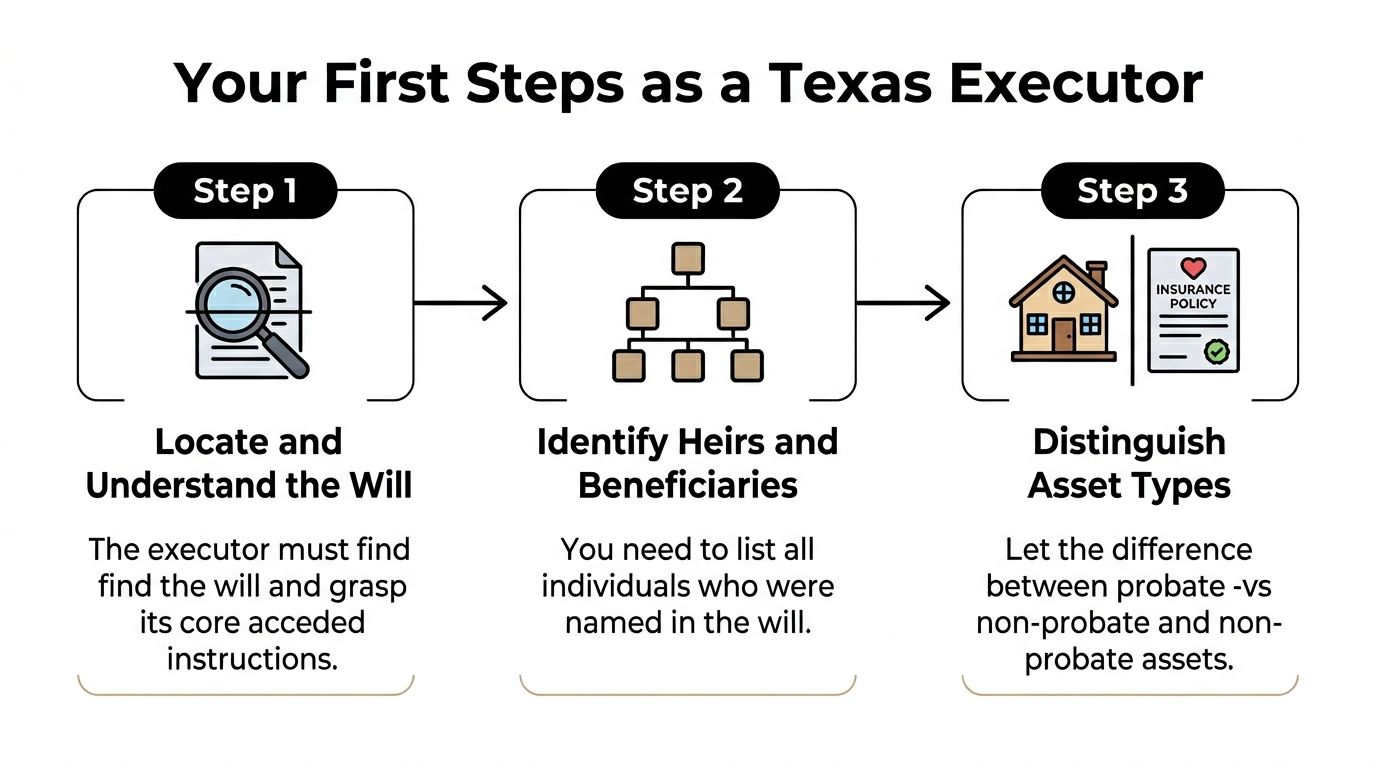
As the visual guide shows, a successful start comes down to a methodical approach. You need to find the will, identify the people involved, and get a clear picture of the property you'll be managing.
Choosing the Right Texas Probate Path for the Estate
Once you've taken on the role of executor, one of your first—and most critical—decisions is figuring out which legal path the estate will follow. This isn't just a bit of legal paperwork; your choice will dictate the speed, cost, and amount of court supervision required. It's one of the biggest forks in the road you'll face.
You’re not alone in this. Texas courts handle a massive volume of these cases, with roughly 165,000 probate filings each year. As of 2026, that amounts to managing around $6 billion in estate assets annually. The good news is that the Texas Estates Code is designed to favor efficiency when possible.
That's why Independent Administration is the go-to for about 80% of Texas probates. It cuts down on court supervision, letting executors settle things without constantly asking a judge for permission. This is especially useful when dealing with assets like a family home or bank accounts that don't have a designated beneficiary and must go through probate. You can see how these trends fit into the bigger picture by looking at probate statistics in the United States.
Comparing Your Texas Probate Options
Making sense of the different paths can feel overwhelming. To simplify it, here’s a quick comparison of the most common routes available to you as an executor in Texas, based on the Texas Estates Code.
| Probate Method | Best For | Typical Timeline | Court Supervision |
|---|---|---|---|
| Independent Administration | Estates with a clear will or where all heirs agree. The most common and preferred method. | 6-12 months | Minimal |
| Dependent Administration | Estates with no will, heir disputes, or complex debts. | 12-24+ months | High (every step requires court approval) |
| Muniment of Title | Estates with a will but no debts (other than a mortgage on a home). | 2-3 months | Very Low (one court hearing) |
| Small Estate Affidavit | Very small estates (under $75,000) with no will, meeting strict criteria. | 1-2 months | Low (requires court approval of the affidavit) |
This table gives you a high-level view, but the right choice always depends on the specifics of the estate you're managing. Let's dig into what these options really mean for you and your family.
Independent vs. Dependent Administration
The most common decision you'll face is whether to pursue an Independent or Dependent Administration. Often, the will itself points you in the right direction, and thankfully, Texas law nudges estates toward the simpler option whenever possible.
Independent Administration is the gold standard in Texas for good reason. It’s faster, less expensive, and keeps court oversight to a minimum. Once you’re appointed and the estate inventory is filed, you can act “independently” to pay off debts and hand out assets to the beneficiaries. This path is open to you if the will specifically asks for it or if all the beneficiaries are on the same page and agree to it in writing.
Dependent Administration, on the other hand, puts the court in the driver's seat. As the executor, you have to get a judge’s sign-off for nearly everything—from paying the deceased's final electricity bill to selling their car. This adds months, if not years, to the process and drives up costs significantly. It's generally the default path when there’s no will, the heirs are fighting, or the estate is tangled in complex debts that need a judge's oversight.
Key Insight: The core difference is autonomy. In an Independent Administration, the court trusts you to manage the estate responsibly. In a Dependent Administration, the court basically looks over your shoulder for every major decision. This compassionate approach by Texas law, favoring independence, is meant to help families settle estates more efficiently during a difficult time.
Simpler Alternatives for Specific Situations
For many Texas families, a full-blown probate isn't even necessary. The Texas Estates Code offers a few shortcuts that can save you a mountain of time and thousands of dollars.
Muniment of Title
This is a uniquely Texan solution, and it’s a lifesaver for simple estates. A Muniment of Title is perfect when there's a valid will and the only major debt is a mortgage on real estate. Instead of a full administration, you're essentially asking the court to officially recognize the will as the legal document that transfers ownership.
Think of it as a legal bridge. The court order, paired with the will, gets filed in the public record and acts as the new deed, proving the beneficiaries are the rightful owners. It's a clean, quick process. To see if this might fit your situation, it’s worth understanding how a Muniment of Title works in Texas.
Small Estate Affidavit (SEA)
What if there's no will and not much money involved? If the estate's value is $75,000 or less (not counting the primary residence) and it meets other strict requirements, a Small Estate Affidavit may be your best bet. An SEA lets the heirs sidestep a formal probate administration entirely.
It’s a sworn document filed with the court that lays out the estate’s assets, any debts, and who the legal heirs are under Texas law. Once a judge signs off on it, the heirs can take that approved affidavit directly to banks and other institutions to collect the assets themselves. For small, straightforward estates, it’s a game-changer.
An Executor's Checklist for Managing Assets and Debts
Before a single dollar goes to a beneficiary, you, as the executor, step into a crucial role: the temporary steward of your loved one's financial world. Think of it less as a checklist and more as a legal duty to secure the estate. This phase is all about gathering, protecting, and accounting for everything before you can begin the process of distributing estate assets in Texas probate. Getting this right protects the estate, the beneficiaries, and you from personal liability down the road.
Your first and most significant job is to build a detailed inventory. This isn't just a casual list for your own records; it's a formal document the court demands. Under Texas Estates Code § 309.051, you have 90 days from your appointment to file an "Inventory, Appraisement, and List of Claims" unless the court grants you more time.
This inventory needs to capture every probate asset, from the big-ticket items to the things people often forget.
- Real Estate: This includes the family home, any rental properties, or undeveloped land.
- Bank Accounts: Any checking, savings, or CD accounts held solely in the decedent’s name.
- Vehicles: Cars, trucks, boats, and RVs all need to be accounted for.
- Personal Belongings: Jewelry, art, antiques, and valuable furniture must be listed.
- Investments: Stocks, bonds, or mutual funds that aren't in a transfer-on-death (TOD) account are part of the probate estate.
For every single item, you’ll need to pin down its fair market value as of the date of death. This is non-negotiable. For things like real estate, collectibles, or a business, this will almost certainly mean hiring a professional appraiser. Accuracy here is everything, as this inventory becomes the financial foundation for the entire estate administration.

Notifying Creditors and Handling Claims
Once you have a firm grasp on what the estate owns, the focus immediately shifts to what it owes. Texas law is very clear: you are required to formally notify potential creditors. You can't just ignore this step. Within one month of being appointed, you must publish a general "Notice to Creditors" in a local newspaper.
But it doesn't stop there. As required by the Texas Estates Code, you also have to send a specific, direct notice via certified mail to any known secured creditors—think mortgage lenders or companies that financed a car. This action officially starts the clock for them to make a formal claim. Unsecured creditors, like credit card companies and hospitals, also have a strict window to file their claims once they receive notice.
Key Insight: Paying debts isn't a choice; it's a legal command. As executor, your fiduciary duty is to the creditors first and the beneficiaries second. Distributing assets before all legitimate debts are settled can leave you personally on the hook for those unpaid bills.
Prioritizing and Paying Estate Debts
When creditor claims arrive, you can’t just pay them as they come in. The Texas Estates Code (Title 2, Subtitle G) sets up a very specific pecking order for how estate funds must be used to settle claims. This classification system ensures the most critical expenses are handled first, and you must follow it precisely.
Let's walk through a realistic scenario to make this clear.
Scenario: You are the executor for an estate in Houston with assets totaling $400,000. The debts include a $150,000 mortgage on the home, $10,000 in credit card debt, $5,000 in final medical bills, and funeral costs of $12,000.
Here’s the step-by-step payment priority required by Texas law:
- Funeral Expenses & Last Illness Costs: The very first money out the door goes to the funeral bill and the final medical expenses, with a priority of up to $15,000 for each category.
- Family Allowance: A family allowance set by the court for a surviving spouse and minor children is next in line.
- Administration Costs: The costs of probate itself, including your attorney's fees, are paid after family and final expenses.
- Secured Debts: The $150,000 mortgage on the house must be addressed.
- Unsecured Debts: Finally, if there’s anything left, you can pay the credit card companies and any other unsecured claims.
Only after this entire waterfall of payments is finished can you begin to think about distributing what's left to the heirs. For a deeper dive on this crucial topic, our guide on managing estate assets and prioritizing debt repayment is a must-read.
Beyond these legal hurdles, executors often face the practical challenge of clearing out a lifetime of belongings. For logistical support in handling physical property, you might find that specialized Estate Cleanout Services can be a tremendous help. Managing the tangible assets is just as much a part of an executor’s role as managing the finances, especially when preparing a home or property for sale or transfer.
How to Make the Final Distribution to Heirs
You’ve made it through the hardest parts—valuing the assets, paying the bills, and settling the debts. Now comes the moment everyone has been waiting for: distributing the remaining estate assets to the rightful heirs. This is where your careful work as an executor pays off, bringing both closure to the family and legal finality to your role.
But this isn't as simple as handing over car keys or writing a personal check. Each transfer must be done by the book, creating a clear and legal paper trail. How you do it depends entirely on what you’re transferring.

Transferring Different Types of Assets Correctly
The mechanics of distribution can vary wildly. Distributing cash is usually straightforward—you’ll write a check from the estate’s bank account. But for everything else, there’s a specific legal process you have to follow.
Real Estate: To transfer a house or land, you’ll need to prepare and file a "Distribution Deed" or an "Executor's Deed." This is a new deed that officially moves the title from the estate to the beneficiary. It absolutely must be recorded in the county property records.
Vehicles: For cars, trucks, or motorcycles, you'll use the Texas Department of Motor Vehicles' "Application for Texas Title and/or Registration" (Form 130-U). You’ll sign this form on behalf of the estate to complete the ownership transfer.
Bank & Investment Accounts: If an account didn't have a payable-on-death (POD) beneficiary, you’ll need to provide the bank or brokerage firm with a copy of your Letters Testamentary (the court document proving your authority). You then give them written instructions to transfer the funds or securities directly to the heir.
Every single transfer needs to be documented with perfect clarity. The goal is to leave no room for future questions about who owns what.
Calculating Each Heir's Share
Before you sign a single deed or write a check, you must calculate exactly who gets what. If there’s a valid will, your path is clear: follow its instructions to the letter. The will might dictate specific dollar amounts, percentages of the total estate, or even particular items.
If there’s no will, you must follow the Texas Estates Code Chapter 201, which lays out the laws of intestate succession. These rules can get complicated fast, as they depend entirely on the deceased’s family tree. For instance, in blended families with a spouse and children from a prior relationship, the spouse keeps their half of community property, while the children from the prior marriage split the decedent's half. You can find more scenarios and details in the complex rules for Texas's descent and distribution rules.
Key Insight: Your job is to be an impartial administrator, whether you’re following a will or state law. Never deviate from the legal requirements, even if you think a different split would be "fairer." Your legal protection comes from following the rules—period.
The Non-Negotiable Receipt and Release
This is your final, and arguably most important, act as executor. Before you close the estate, you must get a signed "Receipt and Release" from every single beneficiary. This document is your legal shield.
It serves two crucial purposes:
- It’s a Receipt: The beneficiary officially acknowledges that they have received every asset they were entitled to.
- It’s a Release: The beneficiary formally releases you, the executor, from any further liability or claims related to their inheritance or how you managed the estate.
Do not, under any circumstances, distribute an asset without getting this document signed first. We always advise clients to have beneficiaries sign this form at the exact moment they receive their check or title documents. It creates a clean, legally sound conclusion and protects you from any "what ifs" down the road.
Common Mistakes to Avoid When Distributing Assets
You’re at the finish line. After months of navigating court filings, creditor notices, and asset inventories, the end of the Texas probate process is finally in sight. It’s tempting to rush through this last step—distributing the assets—to finally close this chapter for your family.
But this is where some of the most costly and irreversible mistakes happen. A simple misstep here can undo all your hard work, creating legal headaches, personal financial liability, and deep family rifts. Let’s walk through the common traps we've seen executors fall into, and more importantly, how you can sidestep them with compassion and care.
The Rush to Distribute: Paying Heirs Before Creditors
One of the most dangerous mistakes an executor can make is distributing assets too early. We understand. Grieving families are anxious for closure, and it feels good to give an heir their inheritance as soon as the money is in the estate’s bank account. But this is a critical error.
Under Texas law, creditors always get paid before beneficiaries. Always. If you give an heir their share and a legitimate debt—like a final hospital bill or an unexpected IRS tax liability—pops up later, the estate might not have the cash to cover it.
In that scenario, who’s on the hook? You are. As the executor, you could be held personally liable for that shortfall. You’ll either have to awkwardly ask the heir to return the money or, worse, pay that debt out of your own pocket.
Key Insight: Never distribute a single dollar to an heir until all creditor notice periods have expired and all legitimate debts and taxes have been paid in full. Patience here protects you and ensures you are honoring your loved one’s obligations correctly.
A Simple Word, A Huge Mistake: Misinterpreting the Will
Wills are legal documents, and they often contain technical language that looks simple but has a very specific legal meaning. A classic example we see all the time is the confusion between "per stirpes" and "per capita" distribution clauses. These little Latin phrases completely change who gets what if a beneficiary passes away before the person who wrote the will.
- Per Stirpes ("by the branch"): The deceased beneficiary's share flows down to their children or heirs.
- Per Capita ("by the head"): The deceased beneficiary's share gets split up equally among the other surviving beneficiaries named in the will.
Misreading a single term like this can lead to you accidentally disinheriting an entire branch of the family. The result? Hurt feelings, accusations, and a potential lawsuit from the family members who were wrongly cut out. This is just one reason why having a legal expert review the will with you isn't just a good idea—it's essential protection against a simple misunderstanding that could unravel the entire estate plan.
Silence Is Not Golden: Failing to Communicate with Heirs
When it comes to probate, a lack of communication is a breeding ground for suspicion and conflict. If heirs are left in the dark for weeks or months, their minds will start to fill in the blanks. They might assume the worst—that you’re hiding something, mismanaging funds, or deliberately dragging your feet.
This is often the first step on the road to expensive and painful Probate Litigation.
As the executor, you have a fiduciary duty to keep beneficiaries "reasonably informed." This doesn’t mean you need to call them daily. But a proactive email update every few weeks, even if it’s just to say there’s no news, can stop misunderstandings from festering into full-blown legal battles. Transparency builds trust and shows everyone that you’re acting in good faith.
Not Knowing What’s In and What’s Out: Confusing Probate and Non-Probate Assets
Another major source of confusion is simply not understanding which property is actually part of the probate estate. A huge portion of the $6 billion managed yearly across Texas's 165,000 probate cases involves sorting this out.
You can't distribute what you don't control. Assets like life insurance policies or retirement accounts with named beneficiaries pass outside of the will. Jointly owned bank accounts with rights of survivorship do, too. You, as executor, don't touch them.
On the other hand, a house owned solely in the decedent's name or a bank account with no beneficiary absolutely requires probate to transfer title. Failing to distinguish between these categories can lead you to improperly transfer property or, conversely, create huge delays by trying to probate an asset that shouldn't be. For small estates under $75,000, you might even be able to use a simplified affidavit and bypass formal probate altogether. Knowing how Texas probate laws apply to different assets on texasprobateattorney.com is fundamental to getting distribution right.
Navigating these landmines—from premature distributions to complex legal terms and tense family dynamics—is precisely where experienced legal counsel proves its worth. An attorney ensures you interpret the will correctly, manage communications effectively, and comply with every requirement of the Texas Estates Code, shielding you from personal liability and helping the family finally find peace.
Takeaway: A Clear Process is Your Best Protection
Stepping into the role of an executor in Texas is more than just a legal duty—it's a final, profound act of service for someone you cared about. From the moment you start taking inventory to the day you write the final checks, the entire process rests on a few solid principles that protect both you and the legacy you're managing.
Think of your greatest allies in this journey: a methodical approach, unwavering compliance with the Texas Estates Code, and open, honest communication with every heir involved. It’s a demanding job, no question. But you don't have to navigate it blind or alone. Getting the right legal guidance from the start is the key to handling each step correctly and respectfully. It’s the difference between a smooth process and one that creates family stress and opens the door to legal headaches.
Your best defense against delays, family disputes, and personal liability is a structured, well-documented plan. A clear process for distributing estate assets in Texas probate isn't just about following rules—it's about faithfully honoring your loved one's wishes and meeting your legal obligations without a misstep.
Whether you're dealing with the details of Wills & Trusts, facing the formal Texas Probate Process, or trying to head off potential Probate Litigation, diligence is everything. In some cases, you may even need to understand the nuances of Guardianship for an incapacitated person.
A Few Common Questions About Distributing an Estate
Once the initial probate filings are done, the questions from executors and heirs really start to ramp up. It's the stage where the theoretical process of settling an estate becomes very real, and everyone wants to know what comes next.
Here are some of the questions we hear almost every day from Texas families navigating this final stretch.
How Long Until We Can Actually Distribute the Assets?
There's no single answer to this, but in a straightforward Independent Administration, you're often looking at a four to six-month timeframe before you can start distributing assets. This wait is non-negotiable, as it allows the mandatory creditor notice period under the Texas Estates Code to run its course.
But that’s a best-case scenario. If the estate is more complex—involving business assets, real estate that needs to be sold, tax issues, or disagreements among the heirs—it can easily take a year or even longer to get everything settled and ready for distribution.
Can an Executor Just Sell Property Without Asking the Heirs?
This really hinges on the will's instructions and the type of administration. In an Independent Administration, if the will specifically gives the executor the "power of sale," they can generally sell estate property without needing to get a unanimous vote from all the heirs.
A Word of Advice: Even with that power, it's always smart to keep the heirs in the loop. Open communication prevents a world of hurt, misunderstandings, and potential Probate Litigation. In a court-supervised Dependent Administration, the answer is a hard no—the executor must get a judge’s permission before selling anything.
What If We Can’t Find One of the Heirs?
This happens more often than you'd think. If an heir has gone missing, the executor has a legal duty to perform a diligent search. This isn't a casual Google search; it means digging into public records, reaching out to every known relative, and sometimes even hiring a professional heir search firm.
If, after all that effort, the heir is still nowhere to be found, the Texas Estates Code has a specific procedure. The executor may be required to pay that person's share of the estate to the Texas State Comptroller. The missing heir (or their descendants) then has a set amount of time to come forward and claim the funds from the state.
Am I Forced to Accept an Inheritance I Don’t Want?
Absolutely not. You have the right to refuse an inheritance. This is formally known as "disclaiming" your interest in the property.
It’s not as simple as just saying "no, thanks," though. You must file a specific legal document within a certain timeframe (usually nine months) as outlined in the Texas Estates Code. When you properly disclaim an asset, the law treats it as if you had passed away before the decedent. The property then goes to the next person in line, according to either the will or Texas inheritance law.
If you’re facing probate in Texas, our team can help guide you through every step — from filing to final distribution. Schedule your free consultation today.