Skip to content
When a loved one dies, grief rarely arrives alone. It often comes with a mailbox full of statements, loan coupons, collection letters, and questions no one feels ready to answer. You may have just been named executor, and now you're staring at a mortgage statement, a car note, and a pile of bills wondering which ones matter first, which ones can wait, and whether any of this could become your problem personally.
That anxiety is normal. Texas probate can feel technical even when the estate is simple. It feels even heavier when the debts involve property your family wants to keep, sell, or distribute.
The first thing to know is reassuring. Not every debt is treated the same way in Texas probate. Some debts are tied to a specific asset, like a home or vehicle. Others are just claims for money. That distinction changes everything about timing, notice, and how the estate handles payment.
Navigating a Loved One’s Debts After They're Gone
A common moment of panic happens right after Letters Testamentary arrive. The executor opens a desk drawer and finds a house payment book, a car loan statement, property tax mail, and credit card bills. It can look like every creditor has equal rights against the estate.
They do not.

A secured debt is a debt backed by property. In plain English, the lender has a legal claim against a specific asset if the debt isn't paid. A mortgage is secured by the house. A car loan is secured by the vehicle. By contrast, a credit card bill usually isn't attached to any particular asset. That's unsecured debt.
A simple way to think about it is this. With secured debt, the creditor holds a legal handle on the property itself. With unsecured debt, the creditor only has a claim for payment.
Why families get stuck here
People often assume the executor should just keep paying every bill to avoid trouble. That can create new problems. Some debts require formal notice. Some creditors must make an election. Some assets may need to be sold, refinanced, surrendered, or protected while probate moves forward.
If a house may need to be sold, it helps to understand how a probate sale works in practice, especially when a mortgage lien must be addressed at closing.
For a broader plain-English discussion of estate obligations, this guide on debt after death in Texas probate is a useful starting point.
Practical rule: The estate owes valid debts. You, as executor or family member, do not automatically become personally responsible just because the bills are arriving at your home.
The question to ask first
Before paying, disputing, or ignoring anything, ask one question about each debt:
Is this debt tied to a specific piece of property?
If the answer is yes, you're likely dealing with secured creditor claims texas probate rules, and those claims follow a stricter path than ordinary bills.
Understanding Secured Claims Versus Unsecured Debt
A lot of executor mistakes start here. A bill arrives, the family feels pressure, and someone assumes every creditor has the same rights against the estate. Texas probate does not treat them the same.
A secured claim is tied to a specific asset. An unsecured debt is not.
The easiest way to sort them is to ask, "If this debt is not paid, what property can the creditor go after?" If the answer is a particular house, car, tract of land, or other identified property, you are likely dealing with a secured claim. If the creditor can only ask to be paid from estate funds generally, you are usually looking at unsecured debt.
Secured debt works like a lender holding a legal claim against one item in the estate. The classic examples are familiar:
- Mortgage debt: the home stands behind the loan.
- Car loans: the lender has a lien noted on the vehicle title.
- Other lien-backed obligations: some real estate, equipment, or personal property may also be pledged as collateral.
Unsecured debt sits in a different category. Credit cards, many personal loans, and medical bills are common examples. Those creditors may have a valid claim, but they do not begin with rights in one specific asset.
That difference shapes nearly every decision the executor makes.
For example, if an estate includes a home with a mortgage, the executor cannot treat that debt like an ordinary utility bill. The lien affects what can be done with the property. It may influence whether the house is kept, sold, refinanced, or surrendered. By contrast, a credit card company usually cannot point to the house and claim it as its collateral.
Why the distinction matters so much in probate
Secured creditors often have stronger rights because their claim is attached to property, not just to the decedent's promise to pay. In practical terms, that means the executor has two jobs at once. First, protect the estate. Second, protect or resolve the lien tied to the asset.
This is why families get confused. They hear "debt" and assume the rule is simple: pay bills if money is available. Probate is more technical than that. A secured debt can affect title, possession, sale proceeds, monthly payments, and the timing of distributions to heirs.
A good roadmap starts with classification. Before making payments, list each debt in one of two buckets:
| Type of debt | Tied to specific property | Creditor can look to that property first | Common example |
|---|---|---|---|
| Secured debt | Yes | Yes | Mortgage, car note, tax lien |
| Unsecured debt | No | No | Credit card, medical bill, signature loan |
That table looks simple because it should be. Executors need a practical sorting tool before they need legal jargon.
A point that often causes confusion
Some claims sound secured but need closer review. Judgment liens, tax liens, and other recorded claims may affect property rights in ways that are not as straightforward as a mortgage or car lien. The safe approach is to confirm what document created the lien, what property it attaches to, and whether it was properly recorded.
If you want a plain-English overview of how classification fits into the larger Texas probate creditor claims process, start there before responding to individual creditors.
For families who are still getting oriented to the bigger picture, Navigating the Probate Process in Texas gives helpful background on how debt issues fit into administration as a whole.
The first goal is not to pay fast. The first goal is to correctly identify which debts are attached to property, because that choice affects every step that follows.
The Executor’s First Steps Notifying Secured Creditors
On Tuesday morning, you find a mortgage statement on the kitchen counter, a truck payment drafting from your father's bank account, and a stack of mail you have barely had the heart to open. You have just been appointed executor. At that moment, your job is to create order.
That starts with notice.
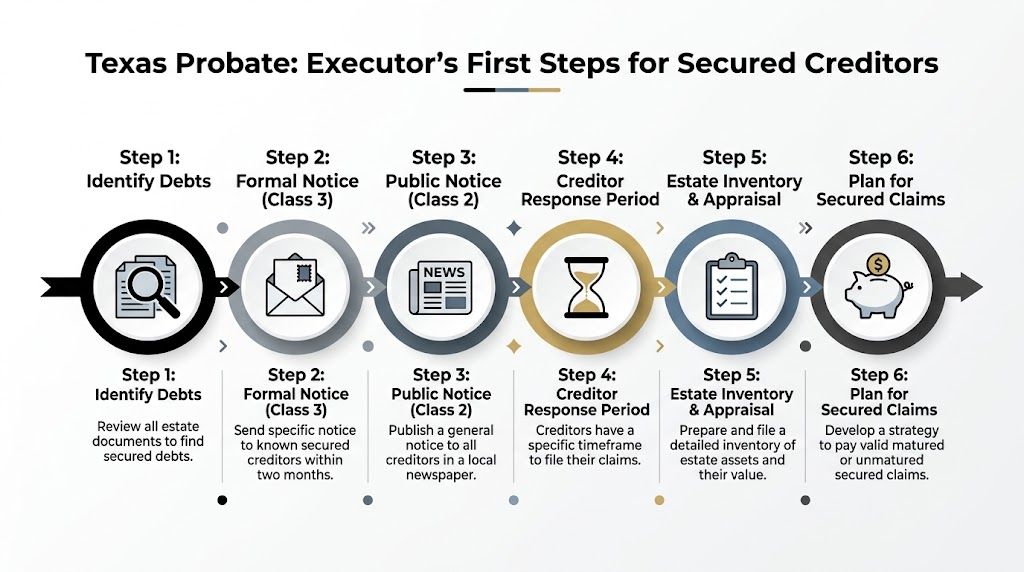
Texas probate gives executors two separate notice jobs, and they serve different purposes. One is public notice that an estate is open. The other is direct notice to secured creditors you already know about, such as a mortgage lender or vehicle lienholder. Families often blend those together, which is understandable, but they are not the same step and they do not work the same way.
The notice deadlines that matter
The executor generally must publish notice to creditors soon after qualification. In an independent administration, the executor also must send direct notice by certified mail to known secured creditors within the required period after appointment. As noted earlier, these deadlines are part of the probate claim process, and missing them can create delay, disputes, and extra expense.
A simple way to remember it is this: public notice tells the world an estate exists. Direct notice tells a specific lienholder, "The estate is open, and you need to respond through the probate process."
What to do in the first few days
Start with the records that show what property may be tied to a lien. Look through monthly statements, loan coupons, online account access, county tax notices, vehicle titles, deed records, and automatic bank drafts. If a payment keeps coming out each month, that is a clue worth checking.
Then build a short working list for each secured debt:
- Name of the creditor. Use the lender's legal name if you can confirm it from the statement or lien document.
- Property tied to the debt. Note the house, vehicle, or other asset that serves as collateral.
- Account number and mailing address. You will need both for proper notice.
- Date you qualified as executor. Your deadlines run from appointment, not from the day you locate the paperwork.
- Proof of mailing. Keep the certified mail receipt, tracking, and a copy of what you sent.
This is less about bureaucracy and more about building a clean paper trail. Probate often turns on records.
Why certified mail matters
Certified mail gives the estate a way to prove notice was sent and received. If a creditor later argues that deadlines never started because it did not receive notice, your file should answer that question quickly.
That protection matters for the estate and for you personally as executor. A careful file can prevent a small notice issue from turning into a larger fight over timing, lien rights, or property sales.
A side-by-side look at the executor’s two notice tasks
| Notice type | Who receives it | How it is sent | Why it matters |
|---|---|---|---|
| General notice to creditors | The public | Publication | Announces the estate administration generally |
| Direct notice to known secured creditors | Identified lienholders | Certified mail | Starts the creditor's deadline to respond and make its election |
One more point causes confusion. Sending notice does not mean you are admitting the debt amount is correct, agreeing to immediate payment, or giving up the estate's right to review the claim. It means you are following the process in the right order.
If you need a broader overview of the probate timeline around these early steps, the Texas Probate Process page offers a broader roadmap.
A realistic first week example
Suppose your mother died owning a home in Harris County and an SUV with a loan balance. You qualify as executor, gather the mail, and confirm both lenders. You also see that insurance and loan payments are still being drafted automatically.
Your first week should focus on three things. Identify each secured creditor. Preserve the property tied to the debt. Send proper notice on time and keep proof in the file.
That early discipline protects the estate from preventable mistakes and gives you a clearer path for the decisions that come next.
Matured Claim vs Preferred Debt A Creditor's Critical Choice
After notice, the secured creditor faces an important election under Texas Estates Code §355.102. Many executors often feel lost concerning this election, because its terms sound technical and its consequences are very real.
A secured creditor must elect between preferred debt and lien and matured secured claim within the later of 4 months after notice or 6 months after letters testamentary issue, and if the creditor fails to elect, the claim defaults to preferred debt and lien, as explained in the Texas Bar article on secured claims under Estates Code §355.102.
What the two choices mean in plain English
A preferred debt and lien claim means the creditor looks to the collateral. The lender keeps its lien rights against the house, car, or other encumbered asset, but recovery is generally limited to that property.
A matured secured claim takes a different path. The creditor seeks treatment through the estate in a way that can reach beyond the collateral if the law and estate circumstances allow.
For families, the practical difference is simple. One choice tends to protect general estate assets more strongly. The other may expose the estate's broader funds.
Comparing Creditor Claim Elections in Texas Probate
| Feature | Preferred Debt and Lien Claim (Default) | Matured Secured Claim |
|---|---|---|
| Basic recovery path | Limited to the collateral | Seeks payment through the estate |
| Effect on general estate assets | Helps shield them for other priority matters | May affect broader estate funds |
| Lien rights | Preserved against the property | Handled differently through the election process |
| If creditor fails to elect | This is the default | Not automatic |
| Estate impact | Often narrows the dispute to one asset | Can expand the financial issue for the executor |
A story that makes this clearer
Consider Elena, serving as executor for her mother's estate. The estate includes a house with a mortgage and modest liquid funds in a bank account. The heirs want to sell the home because no one plans to live there.
The mortgage lender receives proper notice. If the lender proceeds as a preferred debt and lien claimant, the estate usually focuses on the house itself. The lien gets addressed through payments, payoff, sale, or foreclosure rights tied to the property.
If the lender elects a matured secured claim, the conversation changes. Elena now has to evaluate not only the home's value and sale timeline, but also whether estate funds outside the property may become part of the resolution. That can affect what remains for administration expenses, allowances, and later distributions.
Why executors should care, even though the creditor makes the election
The election belongs to the creditor, but the executor has to respond intelligently. That means you need to know:
- Which asset secures the debt
- Whether the estate wants to keep or sell the asset
- Whether ongoing payments are necessary to preserve value
- Whether there is enough liquidity in the estate if the claim takes a broader form
An executor who doesn't understand the election can make bad assumptions. For example, a family may think a mortgaged house can be distributed quickly to heirs, only to discover the creditor's position makes that impossible until the lien issue is resolved.
The election doesn't just define the creditor's rights. It shapes the executor's strategy for the entire asset.
One point that reduces confusion
People often ask whether a matured secured claim is "better" or "worse." That's the wrong question. It depends on whose perspective you're considering and what the collateral is worth. For the estate, preferred debt and lien treatment often narrows exposure. For the creditor, the strategic choice depends on the debt, the collateral, and the estate's financial picture.
That is why careful review of the notice, the deadlines, the loan documents, and the estate inventory matters so much.
How to Handle Mortgages and Liens During Administration
Mortgages and liens create the most stress because they involve property with emotional value. It may be the family home. It may be the truck your son hopes to keep. It may be a rental property that still has tenants. Legal rules matter here, but so does timing and practical judgment.

Start with the asset, not the bill
When a mortgage statement arrives, don't think only in terms of debt collection. Think in terms of asset management. The executor's job is to preserve estate property while the estate decides whether to keep, sell, surrender, or distribute that asset according to Texas law.
That usually means answering these questions early:
- Is anyone living in the property
- Is the loan current or behind
- Does the estate have funds to maintain payments temporarily
- Does the will direct who should receive the property
- Would a sale solve the problem more cleanly
For focused guidance, this article on dealing with mortgaged property in Texas probate can help you think through the next steps.
A realistic home example
Suppose your mother owned a home with a mortgage. You are executor, and no heir can afford to take over the property immediately. The home still needs insurance, utilities, upkeep, and attention to the lender's notices.
In that situation, the executor typically looks at three practical options.
First, the estate may continue necessary payments for a limited period if doing so preserves value and avoids a rushed foreclosure. Second, the estate may market the property and satisfy the lien from the sale proceeds. Third, if keeping the property isn't realistic, the estate may decide not to preserve it long term and instead prepare for the lender to enforce its rights.
Independent administration and dependent administration
The path can look different depending on the type of administration.
In an independent administration, the executor often has broader authority to act without returning to court for every routine step. In a dependent administration, court involvement is heavier, and actions involving estate property may require approval before they happen.
That difference becomes especially important if the estate wants to sell real property, negotiate with a lender, or resolve a lien dispute while the probate remains open.
A good executor doesn't treat a secured asset like a stack of mail. The executor manages it like a project, with deadlines, documents, and a clear decision path.
What a sale usually involves
If the estate sells mortgaged property, the lien is typically addressed through the closing process. The title company, lender payoff, deed authority, and probate paperwork all need to line up. Problems arise when an executor signs a contract before confirming authority, overlooks probate-specific sale requirements, or assumes the lender can wait indefinitely.
This overview is useful if you'd like a visual explanation of related probate issues:
Vehicles and other titled property
Car loans are often easier emotionally but trickier administratively than families expect. If the estate wants to keep the vehicle, someone must eventually deal with both title transfer and the outstanding lien. If the estate wants to sell it, the payoff and title release need to be coordinated properly.
If the loan balance is a problem, the executor still shouldn't improvise. Selling or transferring a vehicle without addressing the lien correctly can create disputes with the lender and complications for the buyer.
Planning helps more than people realize
Many of these problems are easier when a person planned ahead with beneficiary designations, a clear will, or trust-based instructions. Families thinking about future prevention often benefit from learning more about Wills & Trusts, because good planning can reduce confusion around debts, authority, and property transfers.
Common Pitfalls and Costly Executor Mistakes
Most executor errors don't happen because someone is careless. They happen because grief, pressure from relatives, and fast-moving deadlines lead people to act before they understand the rules.

Mistake one paying before verifying
A son finds his father's car loan statement and pays it from his own account because he's afraid of repossession. That may feel responsible, but it can blur the line between estate obligations and personal money. It can also create reimbursement disputes later if other heirs question the payment.
Better practice is to document the debt, preserve the vehicle, and make decisions through the estate process whenever possible.
Mistake two ignoring notices
Some executors freeze when a lender letter arrives. They put it in a drawer and hope the estate lawyer or court will deal with it later. That delay can be expensive.
Secured claims are deadline-driven. Ignoring notice issues doesn't make the claim disappear. It usually shortens the estate's room to respond wisely.
Mistake three selling collateral without clearing the lien
This one causes real trouble. An executor lists a house, signs a contract, and only later learns the lien payoff, election issue, or administration authority hasn't been handled correctly. At that point, the closing may stall, the buyer may walk, and family conflict often follows.
If disagreements escalate over debt handling, sale authority, or distributions, the matter can turn into Probate Litigation.
Mistake four treating estate property like family property
Heirs often say, "Mom wanted me to have the car," or "Dad said the house is mine." Maybe so. But if that asset carries a lien, the estate has to resolve the secured debt before distribution can happen cleanly.
Intent does not erase a lien.
Mistake five trying to manage everything alone from another state
Out-of-state executors face special friction. They may be coordinating mail, title documents, property access, and local deadlines from hundreds of miles away. Texas real estate, local filing requirements, and creditor notices still move on Texas timelines, even when the executor lives elsewhere.
Families who are also handling vulnerable loved ones or broader incapacity concerns sometimes need help beyond probate alone. In those situations, Guardianship services may become part of the larger legal picture.
A short list to keep close
- Don't mix funds: Keep estate money and personal money separate.
- Don't guess about liens: Verify them with statements, title records, and payoff information.
- Don't distribute too early: Property subject to debt needs a complete plan first.
- Don't assume family agreement solves legal issues: A lender's rights still matter.
- Don't wait until foreclosure pressure rises: Early action gives you more options.
Problems with secured debt usually start small. A missed letter, a casual payment, an unsigned notice. They become serious when no one corrects them quickly.
Key Insights for Texas Families and Executors
If you're carrying the weight of an estate right now, keep these points in front of you.
Takeaway
- Secured debt is different from ordinary bills. If a debt is tied to a house, car, or other collateral, the property itself is part of the legal analysis.
- Deadlines matter early. Notice obligations and creditor response periods shape what happens next. Missing them can limit options and complicate administration.
- The estate pays estate debts. You are managing the process. You are not automatically stepping into personal liability for your loved one's obligations.
- Preserve first, decide second. With mortgaged homes and financed vehicles, the first priority is usually protecting value while you gather facts and authority.
- Paperwork protects you. Certified mail receipts, account statements, title records, inventories, and written decisions help the executor show careful compliance.
- Don't force a quick family solution. A promise to an heir doesn't override a lien, and an emotional deadline rarely beats a legal one.
Questions people often still have
If probate hasn't opened yet, families often ask whether they should keep paying a mortgage or car note. The answer depends on the estate's authority, available funds, and risk to the asset. The safe move is usually to pause, gather documents, and get advice before using personal funds.
If foreclosure activity started before death, the estate may still have options, but speed matters. The file needs immediate attention because the lender's timeline may keep moving while the family is still arranging the funeral.
Frequently Asked Questions About Secured Debt in Probate
What if a lender starts foreclosure before we can open probate
Move quickly. Gather the deed of trust or loan paperwork, the default notices, and proof of death, then speak with probate counsel as soon as possible. Probate authority may be needed so someone can communicate formally for the estate, preserve the property, and evaluate whether payments, a sale, or another response is possible.
Can I pay my mom’s mortgage from my own bank account
You can, but that doesn't mean you should. Personal payments can create confusion about reimbursement, gift issues, and accounting to the heirs. In most cases, it is safer to document the problem first and decide on a strategy through the estate.
What happens if the car loan is more than the car is worth
That often changes the practical decision, but not the need to handle the lien correctly. The executor still needs to evaluate whether keeping the vehicle makes sense, whether a sale is worthwhile, and what the secured creditor's position will be. The answer is usually strategic, not emotional.
Is a hospital lien the same as a mortgage for probate purposes
Not necessarily. The label "lien" can mislead families. The nature of the claim, the property involved, and the legal basis for the lien all matter. Some claims are secured against identified property. Others are not treated the same way in probate. That distinction should be reviewed carefully before the executor acts.
Do heirs inherit property subject to the debt
Sometimes, but not free and clear just because they are heirs. If the property passes through probate and carries a valid lien, that lien still has to be addressed. The estate can't hand over clean title while ignoring the creditor's secured rights.
Do I need court permission to deal with a secured debt
It depends on whether the estate is in independent or dependent administration and on what action is proposed. Routine communication and information gathering may not require much court involvement. A sale, dispute, or contested claim may require more formal steps.
What if we discover a secured debt late
Act promptly once you find it. Late discovery doesn't erase the lien. The executor should collect the account records, confirm the collateral, and assess whether notice, election, payment, sale, or litigation issues are now in play.
Is the executor personally liable for the deceased person’s secured debts
Not solely because the debt exists. Personal liability usually becomes a concern when an executor mishandles estate property, ignores required duties, or distributes assets improperly. Careful administration reduces that risk.
If you’re facing probate in Texas and need clear answers about secured creditor claims, Law Office of Bryan Fagan, PLLC can help guide you through every step with compassion and practical direction. Whether you’re dealing with a mortgage, vehicle lien, creditor notices, or a dispute over estate property, our team can help you protect the estate and move forward with confidence. If you’re facing probate in Texas, our team can help guide you through every step, from filing to final distribution. Schedule your free consultation today.