When you lose someone you love, the last thing you want to think about is paperwork and court dates. But in the midst of grief, certain legal tasks can’t wait. We understand that the word “probate” can sound intimidating, but it’s simply the court’s way of making sure a person’s final wishes are honored, their debts are settled, and their property is legally passed on to the right people.
For most families in Texas, this is a necessary step. Our goal is to walk you through where to begin, turning what feels like a mountain of confusion into a clear, manageable path forward. This guide is written with compassion and clarity to help you and your family during this transition.
Your First Steps After Losing a Loved One
The very first actions you take will set the stage for how smoothly the entire Texas Probate Process goes. We know this is a difficult time, but getting organized and understanding the timeline are crucial first steps.
Find the Will and Get the Death Certificates
Your first two missions are to locate the original will and order certified copies of the death certificate. The will is the legal roadmap for the estate, and the court will only accept the original, not a copy. You’ll want to check the most common places first: a home safe, a safe deposit box, or with the attorney who drafted it.
At the same time, you need to order death certificates. You will need these for many tasks, from closing bank accounts to claiming life insurance benefits. A good rule of thumb is to order at least 10 copies right away. It’s a small step that saves a lot of headaches later.
Don't Ignore the Four-Year Deadline
This is critical. Texas law has a strict timeline for probating a will. According to Texas Estates Code § 256.003, you generally have just four years from the date of death to submit the will for probate.
If you miss this deadline, things get complicated—fast. The court might refuse to recognize the will, which could completely upend your loved one’s intentions. This four-year window is precisely why you can’t afford to wait, even when you’re grieving. Starting the process of filing a probate application in Texas sooner rather than later is the best way to protect the estate and the beneficiaries.
A Realistic Scenario for Texas Families
Imagine a family in Houston, gathered around their late father's desk. They’re staring at a jumble of bank statements, property deeds, and what looks like an old copy of a will. They feel lost and overwhelmed. This is a moment thousands of Texas families face every year.
With professional guidance, they can learn to sort the immediate needs—finding that original will and ordering death certificates—from the tasks that can wait. That initial feeling of being overwhelmed gives way to a clear plan. You are not alone in this, and there is a structured, compassionate way forward.
The probate courts are incredibly busy, which makes filing your paperwork accurately and on time even more important. For perspective, one Harris County Probate Court handled a staggering 9,866 motions and signed 12,244 orders in a single year, all while conducting over 3,000 hearings. These numbers show just how many families are navigating this system and why avoiding simple mistakes that cause delays is so crucial. You can read more about the demands on Texas probate courts from jsimoneaux.substack.com.
Whether you're dealing with a straightforward will or a more complex situation that might involve a Guardianship or the potential for Probate Litigation, getting these initial steps right is the foundation for everything to come. A solid understanding of Wills & Trusts is also a key piece of the puzzle.
Key Takeaway
Probate isn't just about filing forms; it's about honoring a legacy. When you approach it with a clear, step-by-step plan, you reduce the stress and ensure your loved one's wishes are carried out correctly and with dignity.
If you’re facing probate in Texas, our team can help guide you through every step — from filing to final distribution. Schedule your free consultation today.
Choosing the Right Kind of Texas Probate
When you hear the word "probate" in Texas, you might picture a single, one-size-fits-all legal ordeal. But that's not really how it works. The reality is much more nuanced, and designed to fit different family needs.
Think of it like having a full toolbox—you need to pick the right tool for the job to get it done efficiently. The Texas legal system offers several different probate methods, each designed for specific family and financial situations. Knowing your options is the first critical step to a smoother process. Let's walk through the most common paths families take in plain English, so you can have an informed conversation with your attorney.
Exploring the Main Probate Pathways in Texas
The Texas Estates Code lays out a few different ways to settle an estate. Most families will find themselves on one of four main paths: Independent Administration, Dependent Administration, Muniment of Title, or using a Small Estate Affidavit.
Independent Administration: This is the preferred method in Texas when there's a valid will and family members are cooperative. The executor gets to handle the estate’s business—paying debts, gathering assets, and distributing property—with very little court supervision. It's faster and far less expensive because you aren't constantly asking a judge for permission.
Dependent Administration: This is the opposite. It involves heavy court oversight, where the administrator needs a judge's approval for nearly every action, from selling a car to paying a credit card bill. While more expensive and time-consuming, it is the right choice when heirs are in conflict, there are concerns about the administrator's actions, or the estate faces significant debt.
Muniment of Title: Think of this as a shortcut for a very specific situation. If there’s a valid will and the estate has no debts (other than a mortgage on a house), a Muniment of Title can be used. The court simply validates the will, which then acts like a deed, officially transferring ownership of property to the beneficiaries. No executor is appointed.
Small Estate Affidavit (SEA): This option is for smaller estates where the person died without a will. If the estate's value is $75,000 or less (not counting the homestead), this sworn affidavit can be used to collect and distribute assets, completely bypassing the formal probate court process.
This simple flowchart helps visualize that crucial first step: the four-year window you have to start the process after a loved one's passing.
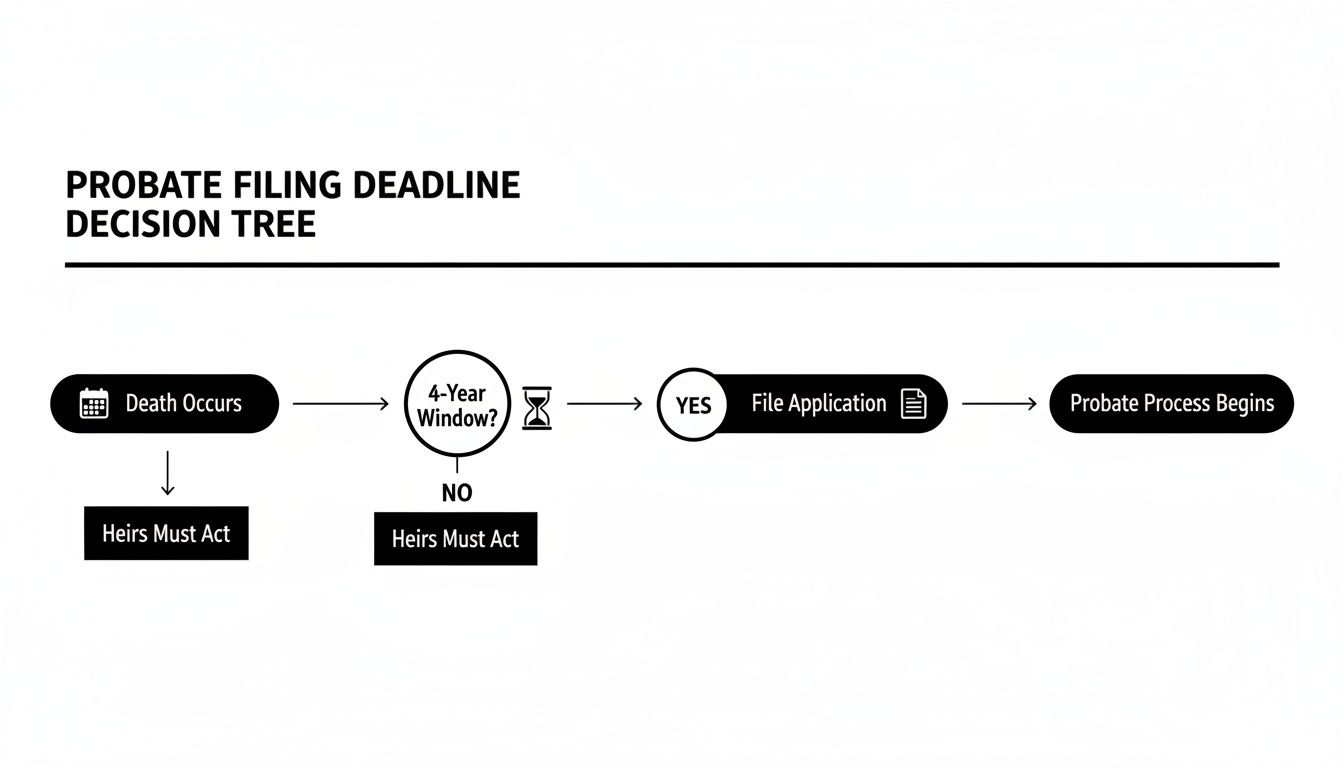
Missing this deadline can complicate things significantly, so it’s a timeline you absolutely have to respect.
Comparing Common Texas Probate Procedures
To make it even clearer, this table breaks down the key differences between the most common types of probate in Texas. It should help you get a quick sense of which one might fit your family’s situation.
| Probate Type | Best For | Court Supervision Level | Typical Timeline |
|---|---|---|---|
| Independent Administration | Estates with a valid will and cooperative heirs. | Low. The executor acts without court approval for most tasks. | 6-12 months |
| Dependent Administration | Estates with disputes, significant debts, or no will. | High. A judge must approve almost all actions. | 12-24+ months |
| Muniment of Title | Estates with a valid will and no debts (except real estate liens). | Very Low. The court just recognizes the will as a title document. | 2-3 months |
| Small Estate Affidavit | Very small estates (under $75,000) with no will. | None. An affidavit is filed, but there's no court administration. | 1-2 months |
As you can see, the path you take has a huge impact on the time, cost, and stress involved in settling an estate.
A Real-World Example
Let's imagine a family in Austin. Their mom just passed away, leaving a straightforward will that gives everything equally to her three adult children. They all get along well. Her estate is simple: her house, a checking account with around $20,000, and her personal belongings. The only debt is the mortgage on the home.
They sit down with a probate attorney to go over the options. Because there’s a clear will and no family drama, the lawyer immediately recommends an Independent Administration. This lets the executor (the oldest sibling, in this case) handle everything efficiently without running to the courthouse for permission slips, saving the family a ton of time and money.
Now, let's flip the script. If their mom had died with a lot of credit card debt and no will, or if the siblings were at odds over who should get what, the attorney would likely have pushed for a Dependent Administration. The judge's supervision in that scenario would be a necessary safeguard to protect the estate and all parties involved.
Key Takeaway
The goal is to choose the least restrictive and most efficient probate method that the law allows for your family's unique situation. A good probate lawyer will assess the facts and guide you to the path that best protects the estate and, just as importantly, family harmony.
Understanding these differences is also crucial when it comes to the legal authority someone is granted to manage the estate. To dig deeper into that, you may want to read our article on the differences between Letters Testamentary vs. Letters of Administration. These are the official court documents that give an executor or administrator the power to act.
If you’re facing probate in Texas, our team can help guide you through every step — from filing to final distribution. Schedule your free consultation today.
How to Prepare and File the Probate Application
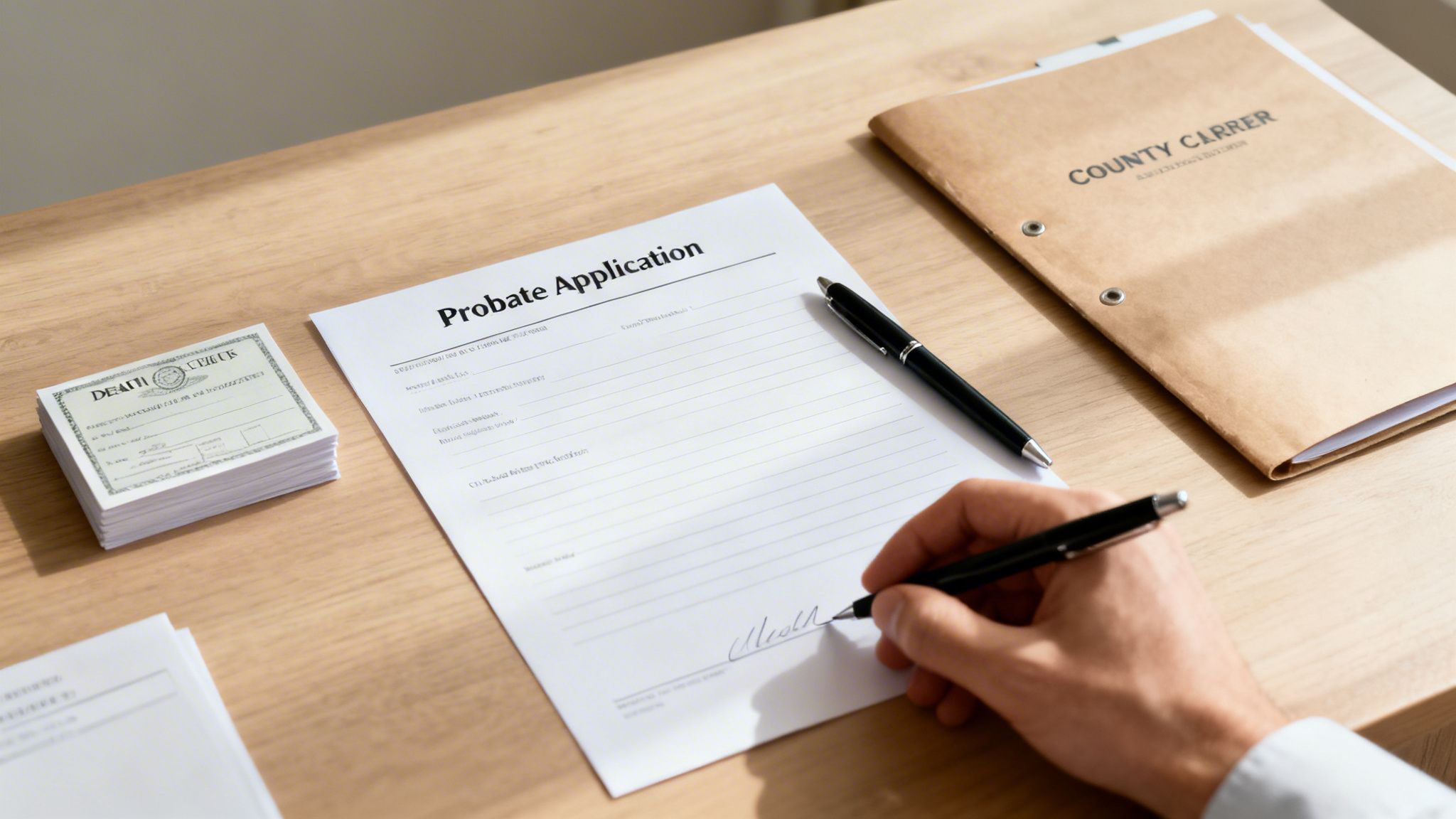
Once you’ve decided which type of probate is the right fit, it’s time to roll up your sleeves and get to the paperwork. This is where the practical work of filing a probate application in Texas really begins. The application is the official document that kicks off the court process, and its accuracy is the foundation for everything that follows.
Think of this document as the legal cornerstone for settling the estate. If the information isn't right, the whole structure can become unstable down the road. Let’s walk through what it takes to get this crucial document prepared and filed correctly.
Gathering the Essential Information for the Application
The probate application is a detailed form that asks for specific facts about your loved one, their family, and their assets. While the exact layout might differ slightly from one county to the next, the core information required is consistent across Texas.
Before you even start filling out the form, you’ll want to have this information handy:
- The Applicant's Details: Your full name, address, and your legal interest in the estate (e.g., as the executor named in the will or as an heir).
- The Decedent's Details: Their full legal name, the last four digits of their Social Security number, and the specific date and location of their death.
- Jurisdiction and Venue: This is where you confirm you're filing in the right county, which is almost always where the decedent had their permanent home. Filing in the wrong county is a common mistake that will get your case dismissed, forcing you to start over and pay new fees.
- A Statement About the Will: You must state whether a valid will exists and attach the original document to your application. If there’s no will, you'll need to explain that the person died "intestate" (without a will).
- An Overview of the Estate: This is a general description and estimated value of the property in the estate. You don’t need a detailed inventory yet, but the court needs a ballpark idea of the estate's size and complexity.
You'll also need to round up all the supporting documents. For a complete picture of what to gather, check out our guide on the required documents for a probate case.
Identifying and Listing All Heirs
This is one of the most critical parts of the application, and it’s where many people stumble. Under Texas Estates Code, Title 2, Subtitle E, you are legally required to provide the name, age, relationship, and address for every single person who has a legal right to inherit.
This holds true whether there's a will or not. If a will exists, the heirs are the beneficiaries named within it. If there is no will, Texas intestacy law determines who the heirs are based on family lines—think spouses, children, parents, and siblings.
A Real-World Example:
Let's say Maria is the executor for her late mother's estate in Harris County. Her mother’s will leaves everything to Maria and her two siblings. When Maria fills out the application, she must list her own details plus the full names, current addresses, and ages of both her siblings—even if one lives in another country. Forgetting to list just one heir will bring the entire probate process to a grinding halt until it's corrected.
Filing the Application and Next Steps
With the application completed and verified for accuracy, the next step is to file it with the county clerk in the proper court. This is also when you'll pay the initial filing fees, which typically run between $300 and $500, though this can vary by county.
If you're handling this yourself, getting familiar with how to file court documents is a good idea, as many counties now prefer or require e-filing.
Once the application is officially filed, two key legal notifications must happen:
- Posting: The county clerk will post a public notice at the courthouse, announcing that a probate application has been submitted for the estate. This notice has to stay up for at least 10 days before any hearing can take place.
- Service: For certain probate types, like a Dependent Administration or probating a will as a Muniment of Title, all heirs must be formally "served." This isn't just a friendly email; it's a legal notice delivered to them personally or by a certified process, ensuring they are officially aware of the court case.
These are not just bureaucratic hoops to jump through; they are fundamental legal requirements designed to protect the rights of everyone involved. An error in posting or service can invalidate the entire proceeding, forcing you to go back to square one.
Key Takeaway
The initial probate application is your first and best chance to make a good impression on the court. Taking the time to double-check every detail—from the spelling of a beneficiary's name to the county where you file—prevents frustrating delays, saves money, and dramatically reduces the risk of future legal fights, like Probate Litigation. A clean, accurate application sets the stage for a much smoother process.
If you’re facing probate in Texas, our team can help guide you through every step — from filing to final distribution. Schedule your free consultation today.
What to Expect After You File the Application

So you’ve filed the application. You've taken that first big step, and now you’re probably wondering, "What happens next?" It’s a common question, because the period between filing the paperwork and stepping into a courtroom can feel like you’re in limbo.
This quiet period is a normal and necessary part of the Texas probate process. It’s not a delay or a sign of trouble. By law, after you file, the county clerk must post a public notice, known as a "citation," at the courthouse. This notice must stay up for at least 10 days before any hearing can happen.
The purpose is transparency. This posting gives anyone with a potential interest in the estate—like a long-lost heir or a creditor—a fair chance to see that a probate case has started. While you wait, your attorney isn’t just sitting idle; they're working to secure a hearing date on the judge's busy docket and prepping you for what comes next.
The First Court Hearing: Proving Up the Will
Your first trip to the courthouse will be for what’s called a "proving-up" hearing. This is where the judge officially reviews your application. It’s usually quick and straightforward, but it's the moment the probate process gets the green light from the court. You'll need to be there with your attorney.
The judge simply wants to verify the basic facts stated in your application. You'll be sworn in, and your lawyer will guide you through a short series of questions. This is a formality, not an interrogation.
Common Questions at the Hearing
Your attorney will have you prepared, but you can expect to answer questions like:
- "Did the decedent live in this county at the time of their death?"
- "Is the document presented to the court their last will?"
- "Are you the person named as executor in that will?"
- "As far as you know, was the will ever revoked?"
- "Are you qualified to serve as the executor?"
These questions aren't designed to trip you up. They are a formality to confirm that everything lines up with the Texas Estates Code. With your attorney by your side, there will be no surprises.
A Real-World Scenario
Think of a client we worked with in San Antonio. She filed to probate her father’s will and found the two-week waiting period agonizing. We explained it was just the system doing its job to ensure all legal requirements were met.
When her hearing day came, she was a bundle of nerves. But we had already run through the questions. In the courtroom, she answered everything her lawyer asked directly and truthfully. The entire hearing took less than 15 minutes. When the judge signed the order, the look of relief on her face was immediate.
What Is an Attorney Ad Litem?
Occasionally, a judge will appoint an attorney ad litem. This is an independent lawyer tasked by the court with a specific job: to represent the interests of any potential heirs who are unknown, can't be found, or are legally unable to represent themselves (like minors).
If this happens in your case, it does not mean you did anything wrong. It is simply the court being extra cautious to protect everyone’s rights, just as the law requires. The ad litem will conduct their own investigation to find these heirs and then report back to the judge.
Once the hearing is over and the judge signs the order, you’re almost there. Within a few days, the clerk will issue Letters Testamentary (for an estate with a will) or Letters of Administration (if there’s no will). These documents are your golden ticket—they are the official proof you need to show banks, title companies, and anyone else that you are legally in charge of the estate. Each of these steps plays a role in how long probate takes in Texas, but they are all part of a well-defined path to settling the estate.
Key Takeaway
The proving-up hearing isn’t a trial or an interrogation. It’s a formal step to validate the will and confirm you’re the right person for the job. Good preparation with a compassionate attorney makes it a simple, stress-free part of the process.
If you’re facing probate in Texas, our team can help guide you through every step — from filing to final distribution. Schedule your free consultation today.
Common Probate Pitfalls and How to Avoid Them
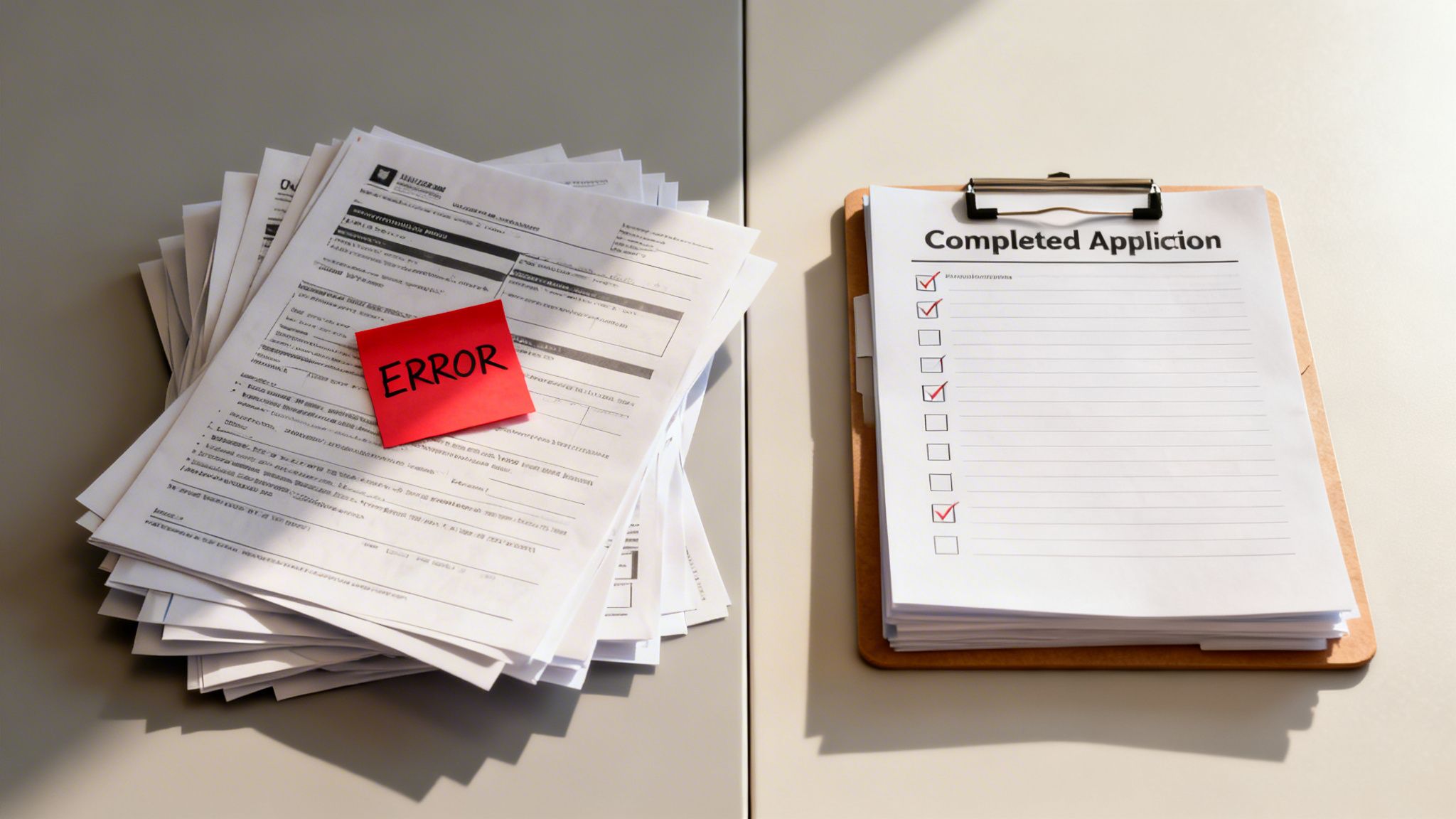
A smooth probate process isn't a myth. It’s absolutely possible, especially when you know what pitfalls to steer around. While filing a probate application in Texas is a structured legal process, a few common missteps can quickly turn a straightforward task into a source of family friction and spiraling costs.
The journey through probate is filled with both legal deadlines and emotional hurdles. From navigating strict timelines to managing family dynamics, getting it right requires a sharp eye for detail. Let's walk through the most frequent issues we see families run into and, more importantly, how you can avoid them entirely.
Missing the Four-Year Filing Deadline
This is one of the most unforgiving mistakes you can make. As laid out in Texas Estates Code § 256.003, you generally have just four years from the date of death to submit a will for probate. Miss that window, and the consequences are severe.
After four years, a Texas court will typically refuse to accept the will. The estate is then treated as if the person died intestate (without a will). This means your loved one's specific wishes get thrown out, and their property is divided according to rigid state laws—a formula that could easily cut out intended beneficiaries. The only defense is to act quickly.
Family Disagreements and Probate Litigation
Grief has a way of pouring salt on old family wounds. Disagreements over an estate are painfully common, and what often starts as a minor dispute can explode into full-blown Probate Litigation. These court battles are not only expensive, draining the estate's resources, but they can also permanently shatter family relationships.
Common sources of conflict usually boil down to a few things:
- Perceived unfairness: An heir feels they were slighted or unfairly treated in the will.
- Executor actions: Beneficiaries don't agree with how the executor is managing assets or communicating with the family.
- Will contests: Someone claims the will is invalid, often alleging undue influence or that the person wasn't of sound mind when they signed it.
The best way to head this off is with open and honest communication from day one. An experienced attorney can help manage everyone's expectations and treat all heirs with respect, diffusing tension before it has a chance to ignite.
Complications from Poorly Written or Non-Existent Wills
A vague, outdated, or sloppily drafted will is a recipe for disaster. When language is ambiguous, it invites different interpretations, forcing a judge to try and guess what the decedent actually wanted. And if there's no will at all (intestacy), the entire process is left to state law, which almost never aligns perfectly with your loved one’s true intentions.
Real-World Scenario: We once saw a case where a father had handwritten a note saying he wanted his daughter to "take care of everything" and "share with her brother." That informal note is not a valid Texas will. The court had no choice but to follow intestacy laws, which led to a property distribution he never would have wanted. A proper will, drafted with an attorney's help, would have prevented all of it. Sometimes these situations can even require a more complex Guardianship proceeding if minors are involved.
Practical Issues That Cause Delays
Beyond the major legal hurdles, a handful of practical slip-ups can bog down the entire process:
- Failing to Notify Creditors: Texas law is clear: you must publish a notice to creditors and, in some cases, send certified mail to known lenders. If you don't do this correctly, you can extend the probate timeline and even expose the executor to personal liability.
- Difficulty Locating Assets: If your loved one wasn't an organized record-keeper, finding all their bank accounts, investment portfolios, and properties can feel like a frustrating treasure hunt. This stalls the inventory and delays the final distribution to heirs.
- Not Managing Heir Expectations: Heirs often have no idea that probate takes time. They hear "probate" and think the money will be in their account next week. Clearly communicating the steps and realistic timelines from the start prevents those constant "Is it done yet?" phone calls and builds crucial trust.
Key Takeaway
Proactive planning and professional guidance are always less stressful and less expensive than a courtroom battle. An experienced probate attorney's job isn't just to file paperwork; it's to anticipate these pitfalls and help you sidestep them from day one, preserving both the estate's assets and family harmony. Taking the time to review your own Wills & Trusts can also prevent these very issues for your family down the road.
If you’re facing probate in Texas, our team can help guide you through every step — from filing to final distribution. Schedule your free consultation today.
Final Thoughts: Putting It All Together
We’ve walked through the A-to-Z of filing for probate in Texas, from choosing the right legal path to getting your application into the right hands at the courthouse. It’s a lot to take in, especially when you’re dealing with the stress of losing a family member. So let’s take a moment to connect the dots and give you a clear path forward.
Remember, the very first decision you make—whether to pursue a streamlined Independent Administration or a court-supervised Dependent Administration—sets the stage for everything that follows. That choice will directly impact the cost, timeline, and stress level for your entire family.
Why Getting the Application Right Is Non-Negotiable
A perfect, complete application isn't just paperwork; it’s your single best tool for avoiding a probate nightmare. Every detail, from correctly identifying every heir under the Texas Estates Code to filing in the right county, is crucial.
Think of it like building a house. A sloppy foundation leads to cracks down the road. In probate, a sloppy application leads to frustrating delays, court rejections, and even family disputes. Taking the time to get it right from the start is the best investment you can make in a smooth process.
You Don't Have to Do This Alone
We’ve seen families in Dallas and across Texas feel completely frozen by grief and legal uncertainty. But we’ve also seen that confusion turn into a clear, step-by-step plan once they had the right guidance. They understood their options, filed an accurate application, and navigated the process with a sense of control they didn’t think was possible.
This process, while detailed, is manageable. You now have a much clearer map of the road ahead, and with it, the power to move forward without being overwhelmed by the unknown.
Key Takeaway
The probate process is not a journey you have to take alone. Partnering with a compassionate professional transforms an intimidating legal requirement into a manageable series of steps, ensuring you honor your loved one's wishes while protecting your family’s well-being.
Your focus should be on healing, not on trying to decipher complex legal codes. While this guide gives you a solid roadmap, nothing replaces professional counsel from a firm experienced in the Texas Probate Process. An attorney can help you steer clear of common pitfalls, including messy Probate Litigation. Whether you're dealing with complex Wills & Trusts or a potential Guardianship issue, expert guidance is the key to getting it right.
If you’re facing probate in Texas, our team can help guide you through every step — from filing to final distribution. Schedule your free consultation today.
Frequently Asked Questions About Filing for Probate in Texas
When you're navigating the probate process in Texas, it’s natural for questions—and anxieties—to pile up. Families often come to us with the same core concerns, looking for straight answers during a difficult time.
Here are some of the most common questions we hear, answered with the kind of direct, practical advice you’d get sitting across the desk from an experienced probate attorney.
How Much Does It Cost to File for Probate?
This is the big one, and the honest answer is: it depends. The total cost varies widely based on the county you’re in and, more importantly, the complexity of the estate.
The baseline expenses are pretty standard. You'll have court filing fees, which typically run between $300 and $500. Then there are costs for formally notifying heirs and creditors. But the biggest variable is usually attorney fees.
The best way to control costs is to pursue the most efficient process possible. An Independent Administration, for example, can save the estate a significant amount of money because it minimizes court oversight and, by extension, the legal hours needed to close the estate.
What if I Cannot Find the Original Will?
First, don't panic. This happens more often than you'd think, and Texas law has a built-in solution. You’re not necessarily out of luck.
The Texas Estates Code allows for a copy of a will to be probated, but you'll have to go to court and prove its validity. If you can’t find a copy or can't prove it's legitimate, the estate will likely proceed as if no will ever existed. This is called an "intestate" administration, where the court determines the legal heirs based on Texas law.
Do I Have to Hire an Attorney for Texas Probate?
In almost every probate case in Texas, the answer is yes. It's not just a recommendation; it's a legal requirement.
A Texas probate court views an estate as its own legal entity, and that entity cannot represent itself in court—much like a corporation can't. The person named as the executor or administrator is there to represent the interests of the beneficiaries and creditors, a role that legally requires counsel.
While there are a couple of extremely simple proceedings that might be handled alone, hiring an attorney is a crucial safeguard. It ensures everything is done correctly and protects you from personal liability and the estate from expensive errors or future Probate Litigation.
A Lawyer’s Perspective: Many people worry about the cost of hiring a probate attorney, but we’ve seen firsthand how the cost of not hiring one can be far greater. A missed deadline, an improperly notified heir, or a mistake in a filing can trigger expensive delays and legal challenges that a good lawyer would have helped you avoid from the start.
If you’re facing probate in Texas, our team can help guide you through every step — from filing to final distribution. Schedule your free consultation today.