Skip to content
Creating a living trust is one of the most powerful and compassionate things you can do to protect your family from the stress and expense of Texas probate court. It's a private legal tool that holds your assets for you during your lifetime and ensures they pass directly to your loved ones when you're gone—often skipping court intervention entirely.
Think of it less as a legal task and more as an act of profound care. This guide will walk you through, step-by-step, how to create a living trust to provide your Texas family with the clarity and security they will need down the road.
Why Texas Families Should Consider a Living Trust

When a loved one passes away in Texas, their estate often has to go through a court-supervised process called probate. In plain English, probate is the formal legal procedure for validating a will, paying off debts, and distributing what’s left to the rightful heirs. While it's necessary in many cases, the Texas Probate Process can be a long, public, and expensive affair, freezing assets for months and adding a heavy burden to a grieving family.
A living trust offers a powerful alternative. It's essentially a private instruction manual for your assets that operates completely outside the courtroom. When you create a living trust, you’re not just signing a document; you’re building a protective shield around your legacy.
The Compassionate Alternative to Probate Court
For many Texas families, estate planning feels overwhelming. It brings up tough conversations and confusing legal jargon. But what if you reframe it as an act of profound care for the people you love most? Instead of leaving them to untangle the complexities of the Texas Estates Code on their own, you can give them a clear, private, and direct path forward.
A lack of planning creates huge burdens. The 2025 Trust & Will Estate Planning Report highlights that just 11% of Americans have any kind of trust. For Texas families, this often means an estate gets tied up in court for 6-18 months, with legal and administrative fees consuming 3-7% of its total value.
Key Insight: Creating a living trust isn’t about navigating legalities; it's about giving your family the gift of peace of mind. It allows them to grieve without the added weight of court dates, public filings, and financial uncertainty.
A living trust is a well-established, effective alternative to a traditional will. To help you see the differences clearly, we've put together a simple comparison.
Living Trust vs. Will at a Glance for Texas Residents
This table breaks down how each tool handles the key parts of an estate, so you can quickly see why a trust is often the preferred choice for Texas families looking to avoid probate.
| Feature | Living Trust | Will |
|---|---|---|
| Probate Required? | No, assets in the trust bypass probate. | Yes, the will must be validated by a probate court. |
| Privacy | Private, terms are not public record. | Public, the will is filed with the court and becomes public. |
| Asset Access | Immediate, trustee can manage assets at once. | Delayed, assets are frozen until the court grants authority. |
| Incapacity Plan | Yes, successor trustee manages assets if you can't. | No, may require a separate, court-ordered Guardianship. |
| Cost to Settle | Generally lower, avoids most court/legal fees. | Can be costly due to court fees, attorney fees, and other expenses. |
| Time to Settle | Typically fast (weeks or a few months). | Can take 6-18 months or longer in Texas. |
As you can see, a living trust provides a more direct, private, and efficient way to transfer your assets, giving you and your family greater control over the process. A comprehensive plan often includes both Wills & Trusts to cover all contingencies.
Practical Benefits for Your Family's Future
A properly funded living trust ensures a smooth and immediate transition of your assets. Here’s what that really means for your loved ones:
- Immediate Access to Assets: Your beneficiaries won't have to wait for a judge's permission to access funds needed for daily living expenses or to manage inherited property.
- Complete Privacy: Unlike a will, which becomes a public record once it's filed with the court, a trust is a private document. Your family’s financial affairs stay confidential.
- Continuity During Incapacity: If you become unable to manage your own affairs, your chosen successor trustee can step in immediately to pay bills and handle your assets without needing a court-ordered guardianship.
Ultimately, establishing a living trust is about maintaining control—over your assets during your lifetime and how they're distributed after you’re gone. For a deeper dive into the specific advantages, take a look at our guide on why you should set up a trust in Texas.
Step 1: Gathering Your Assets and Naming Beneficiaries

Before you can draft a living trust, you must know exactly what you’re putting into it and who you want to receive it. This foundational step is about taking a clear-eyed inventory and making thoughtful decisions. This process forces you to get organized, creating a complete picture of your life’s work, which is invaluable not just for your attorney but for the person you eventually choose to manage everything.
Creating Your Personal Asset Inventory
Let’s start by cataloging your property. The goal is simply to create a comprehensive list. Breaking everything down into categories helps keep it manageable.
- Real Estate: Jot down the addresses of your home, any vacation properties, or rental properties you own, whether they're in Texas or out of state.
- Financial Accounts: List all your checking and savings accounts, CDs, and money market accounts. It's helpful to note the bank and account numbers.
- Investments: Detail your stocks, bonds, mutual funds, and any brokerage accounts you hold.
- Retirement Plans: Even though accounts like 401(k)s and IRAs have their own beneficiary forms, list them anyway. They are a critical part of your overall financial picture. Some of these are considered non-probate assets in Texas, meaning they pass outside of a will, but they are still relevant to your overall plan.
- Personal Property: This is where you list your vehicles, valuable jewelry, art, collectibles, or anything else with significant monetary or sentimental value.
This inventory ensures nothing gets accidentally left out of your trust—which would defeat the purpose by forcing that asset into probate. It also gives your future trustee a clear roadmap to follow.
Defining the Key Roles in Your Trust
As you start thinking about who gets what, it’s helpful to understand the main players involved. In plain English, the roles are straightforward:
- Grantor: That’s you. You're the one creating the trust and putting your assets into it.
- Trustee: This is the manager. While you are alive and well, you will also be the trustee, which means you keep full control over your assets. You’ll also need to name a successor trustee—the person who steps in to manage things if you can't or after you pass away.
- Beneficiary: These are the people (or even charities) you want to inherit your assets.
Key Insight: During your lifetime, you wear two hats: Grantor and Trustee. You manage your own property for your own benefit. The trust is just a legal container that holds the title to your assets, which is what makes the transfer to your beneficiaries so seamless and private later on.
Naming Your Beneficiaries with Care
Choosing your beneficiaries is where the real heart of estate planning comes in. A living trust gives you incredible flexibility to get as specific as you need—something that’s especially valuable for families with unique dynamics.
Realistic Scenario: Consider a blended family in Texas. A husband has two children from his first marriage. He and his second wife live in a home they own together. He wants to ensure his wife can live in that home for the rest of her life, but he also wants the house and other assets to eventually go to his children.
Trying to accomplish this with a simple will can be messy and often leads to conflict. But when you create a living trust, you can spell out your exact wishes. The trust can state that his wife has the right to live in the house for as long as she lives, with the trust even covering maintenance costs. Then, upon her passing, the trust can direct that the house be sold and the money split between his children. This approach provides his wife security while honoring his legacy for his children—all without a single court date.
Step 2: Choosing the Right Trustee to Manage Your Trust
Picking a trustee is one of the most critical decisions you'll make when setting up a living trust. This person or institution carries a heavy weight—what's legally known as a fiduciary duty—to manage your assets for your benefit if you can't, and for your beneficiaries after you're gone. Their honesty, financial wisdom, and dedication to your wishes are everything.
For most people with a revocable living trust, the first trustee is the easy part: it's you. The real challenge is choosing your successor trustee. This is the person who steps into your shoes when you no longer can, a decision that requires serious, thoughtful consideration.
Your Trustee Options
You have three main paths when picking a successor trustee. Each has pros and cons, and the right choice depends on your family's situation and financial complexity.
- A Trusted Family Member or Friend: Often a spouse, an adult child, or a sibling. The big plus here is that they know you and your family personally. The key is picking someone who is responsible, organized, and won't get overwhelmed by the financial duties.
- A Professional Corporate Trustee: Banks and trust companies bring impartiality and deep financial expertise, which is a lifesaver for larger or more complex estates. They know the legal and tax rules, but they do charge for their services.
- A Combination: You can name a family member and a corporate trustee as co-trustees. This approach gives you the best of both worlds—personal insight from someone who knows you, plus professional oversight to keep everything on the straight and narrow.
Navigating Complex Family Dynamics
Let's be honest: naming a family member can sometimes create conflict, especially among siblings.
Realistic Scenario: Imagine Maria has three grown children—David, Sarah, and Emily. David is a sharp accountant, so Maria names him as her sole successor trustee. After Maria passes away, things get messy. Sarah and Emily feel shut out. Every move David makes, even if perfectly sound, is viewed with suspicion. Their relationship fractures.
To sidestep this heartache, Maria could have:
- Named all three children as co-trustees, forcing them to communicate and make decisions together.
- Appointed a neutral third party, like a corporate trustee, to handle the finances. This would have freed her children to grieve as a family.
- Talked to all three of them while she was alive, explaining her decision and reasoning. Managing expectations upfront can prevent a world of hurt later.
The principles in the Texas Estates Code, especially under Title 2, highlight the seriousness of this fiduciary role. Even though a trust helps you avoid court-supervised probate, the trustee’s duties are held to the same high standard of care as an estate executor. You can get a better sense of what the job involves by reading our guide on what trust administration entails.
As you weigh your options, think about whether your potential trustee is comfortable with financial matters or if they'd be willing to get professional help, such as learning how to hire a CPA. A little foresight now ensures your trust is managed properly.
Step 3: Putting Pen to Paper: Creating and Funding Your Trust
You’ve done the heavy lifting of inventorying your assets and picking a trustee. Now it's time to translate that planning into a legally binding reality. This phase is where we create the official trust document and, most importantly, fund it.
This isn’t just about signing papers. It’s about ensuring every detail is correct so the trust actually works when your family needs it most. While DIY legal websites might seem tempting, they often miss the nuances of Texas law. A tiny mistake in wording or an incorrectly transferred asset can unravel everything, sending your estate straight back to the probate court you wanted to avoid.
Drafting the Trust Document
Your trust document is the official instruction manual for your estate. A well-drafted living trust in Texas will always include several key elements:
- Declaration of Trust: The formal statement that officially creates the trust, naming you as the grantor and the initial trustee.
- Successor Trustee Provisions: This part clearly names who takes over as trustee when you pass away or become incapacitated, and it spells out their powers.
- Distribution Instructions: The heart of the trust. It details who gets what, when, and how. You can be very specific, like setting up staggered payments for younger beneficiaries or dedicating funds for college.
- Incapacity Clause: A critical component that defines how your successor trustee can step in to manage your finances if you're ever unable to. This clause helps you avoid a public, expensive, and often painful guardianship proceeding.
A Word of Caution: A living trust is not a fill-in-the-blank document. Your family's unique situation—whether you own a small business, have a blended family, or are caring for a beneficiary with special needs—must be reflected in the legal language. A generic template just won't cut it.
This flowchart breaks down the thought process for choosing the right person or entity to manage your trust down the road.
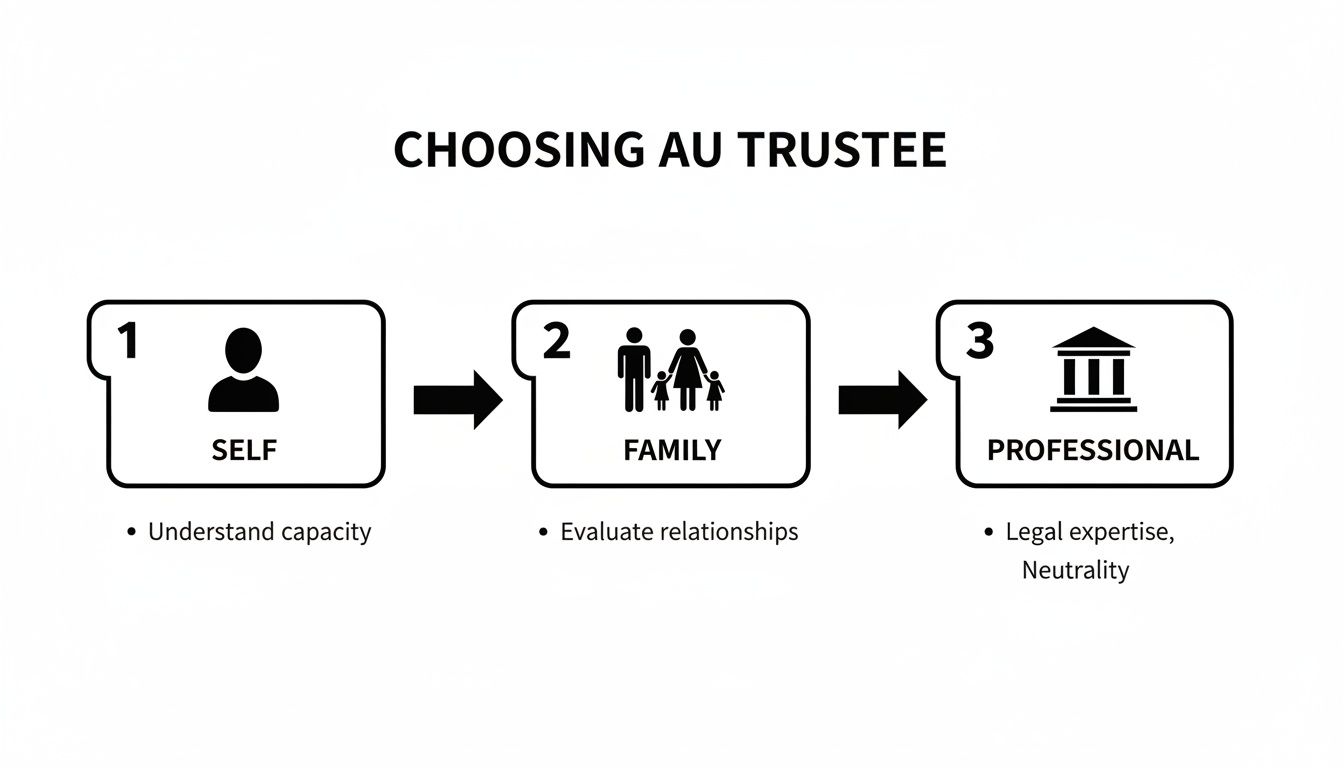
It shows how you might start by managing it yourself, then consider a family member, and finally weigh the benefits of an impartial professional, depending on how complex your estate is.
The Make-or-Break Step: Funding Your Trust
Here’s a hard truth: an unfunded trust is completely useless. It’s like buying a state-of-the-art safe and leaving all your valuables on the kitchen counter. For your trust to work and keep your family out of probate, it must legally own your assets. This process is called "funding the trust." It means changing the title of your assets from your name to the name of your trust.
Realistic Scenario: I once worked with a family whose father, Mark, a retired teacher in Houston, hired an attorney to draft a living trust. He signed the documents and tucked them away, relieved he had protected his daughter, Sarah. His main goal was for her to inherit the house without probate headaches. But he never got around to filing a new deed to put the home in the trust’s name.
When Mark passed away, Sarah found the trust, but the house was still titled in his individual name. The estate had to go through the full Texas probate process, costing thousands of dollars and delaying Sarah's inheritance by almost a year—the exact scenario Mark paid to prevent.
How to Properly Fund Your Texas Trust
To avoid a situation like Mark’s, you have to be methodical about transferring your assets. Here’s a look at what that practically means:
- Real Estate: You’ll sign a new deed that officially transfers your property from "John and Jane Doe" to "The John and Jane Doe Revocable Living Trust." That new deed gets recorded with the county clerk where your property is located.
- Bank Accounts: You’ll need to work with your bank to retitle your checking and savings accounts.
- Non-Retirement Investment Accounts: Your brokerage accounts must also be retitled. This usually involves filling out paperwork from your financial institution.
- Personal Property: For items without a formal title—like furniture, art, jewelry—you can use a simple document called an "Assignment of Property" to formally transfer them into the trust.
An experienced estate planning attorney won't just hand you a binder of documents; they will guide you through every transfer, making sure each one is done correctly.
Step 4: Signing and Maintaining Your Living Trust
You’ve done the hard work. Your living trust is carefully drafted, and your most important assets are funded into it. Now, you’re in the home stretch, with just a couple of final steps to make it official and ensure it protects your family for years to come. This last phase is about signing the document correctly and committing to keeping it current. The real power of a trust comes from treating it as a living plan that adapts right along with your life.
Making It Official: The Signing and Notarization
To bring your Texas living trust to life, you’ll need to sign it in the presence of a notary public. While Texas law doesn’t require witnesses for a trust the way it does for a will, notarization is absolutely critical. It’s the formal step that verifies your identity and signature, giving the document an official seal of authenticity. The notary will check your ID, watch you sign, and then add their official stamp or seal. That simple act transforms your plan into a legally recognized instrument.
Key Insight: A trust is a private document, but its execution needs to meet legal standards. Notarization provides undeniable proof that you, the grantor, willingly and knowingly signed it. This can be invaluable down the road if anyone ever tries to challenge its validity.
A Living Document for Life's Changes
Creating a trust isn't a "one-and-done" event. Life is dynamic—families grow, finances shift, and relationships evolve. Your trust needs to keep up. One of the most common mistakes is when a family fails to update their trust after a major life event. If your family has international ties, you might need legal document translation solutions to ensure your wishes are legally sound everywhere. As a rule of thumb, we recommend reviewing your trust with an attorney every three to five years, or immediately after any significant life change.
The Unintended Consequences of an Outdated Trust
Realistic Scenario: A young couple, David and Lisa, create a living trust after their first child, Emily, is born. They name Emily as the sole beneficiary. A few years later, their son, Jack, is born. Life gets busy, and they never update their trust. Tragically, David and Lisa pass away. Because the trust was never amended, its legal language directs everything to Emily, their "then-living child." Jack is unintentionally disinherited. The family is thrown into the exact kind of expensive Probate Litigation that David and Lisa tried so hard to prevent.
A Practical Checklist for Trust Reviews
To avoid a situation like David and Lisa's, treat your trust like any other vital part of your financial life. Review it periodically. Here are the key life events that should always trigger a call to your estate planning attorney:
- Marriage or Divorce
- Birth or Adoption of a Child
- Death of a Beneficiary or Trustee
- Major Financial Changes
- Moving to Another State
- Changes in Relationships
Keeping your trust current is the only way to ensure it remains an accurate reflection of your wishes, protecting every member of your family exactly as you intend.
Key Takeaway
Creating a living trust is an act of profound care for your family's future. The process involves four key steps: inventorying your assets and naming beneficiaries, choosing a trustworthy trustee, formally drafting and funding the trust document, and committing to regular reviews. While more involved upfront than a simple will, a properly maintained living trust provides unparalleled peace of mind by keeping your estate private, avoiding the costs and delays of probate, and ensuring your loved ones are protected according to your exact wishes.
If you’re facing probate in Texas, our team can help guide you through every step — from filing to final distribution. Schedule your free consultation today.
Common Questions About Living Trusts in Texas
When Texas families start looking into how to create a living trust, many of the same questions come up. Here are some of the most common questions we hear, answered in plain English.
Does a Living Trust Help Me Avoid Estate Taxes?
This is a common myth. A standard revocable living trust—the kind most families need—doesn't eliminate federal estate taxes. Because you still control the assets in your trust, they are considered part of your taxable estate. However, for the vast majority of Texas families, this is not an issue. The federal estate tax exemption is currently very high (over $13 million per person). The primary goal of a living trust for most people is to avoid the probate process, not taxes.
What Happens If I Become Incapacitated?
This is where a living trust truly proves its worth. If you become medically unable to handle your own finances, your successor trustee can step in immediately to manage your affairs. They can pay your bills, manage your investments, and ensure your assets are used for your care—all based on the instructions you laid out in your trust. This all happens privately, with no court involvement. Without a trust, your family would likely face a public, expensive, and stressful guardianship proceeding in court.
Key Insight: A living trust is not just a plan for after you're gone; it's a powerful protective tool for your lifetime. It ensures your affairs are managed by someone you trust if you ever become unable to do so yourself.
Can I Make Changes to My Living Trust?
Absolutely. The “revocable” in revocable living trust means you are in complete control. You can change your mind anytime. This flexibility is a massive advantage. You can:
- Add or sell assets in the trust.
- Change your beneficiaries or what they receive.
- Swap out your successor trustee.
- Amend specific terms or even revoke the entire trust.
We recommend reviewing your trust every 3-5 years, or after any major life event—like a marriage, divorce, or birth of a child—to ensure it always reflects your wishes.
How Much Does It Cost to Create a Living Trust?
The cost to set up a living trust in Texas depends on the complexity of your assets and family situation. While a trust typically costs more upfront than a simple will, it is an investment in your family’s future peace of mind. The costs of probate—court fees, attorney fees, appraisal costs—can easily dwarf the initial price of creating a trust. By avoiding probate, a well-drafted and properly funded living trust can save your family thousands of dollars and months of stress.
At The Law Office of Bryan Fagan, PLLC, we believe that a well-crafted estate plan is one of the greatest gifts you can give your family. If you're ready to explore how a living trust can protect your legacy and provide security for your loved ones, our experienced team is here to help.
If you’re facing probate in Texas, our team can help guide you through every step — from filing to final distribution. Schedule your free consultation today.