Skip to content
For many Texas families, planning for the future is an act of love. One of the kindest things you can do for your loved ones is to simplify how your assets are handled after you’re gone. This often means planning to avoid probate, a court-supervised process that can be time-consuming, expensive, and public. Dealing with the loss of a family member is hard enough; navigating a complex legal system shouldn’t add to the burden.
Why Smart Texas Families Plan to Avoid Probate
When a loved one passes away, the last thing a grieving family wants to deal with is a mountain of legal paperwork and court dates. Probate is the formal legal process where a court validates a will, pays off debts, and distributes what’s left. While it serves a purpose, it’s rarely the best path for every family.
At its core, proactive estate planning is about making a difficult time just a little bit easier for the people you leave behind.
The reasons families look for ways around the Texas probate process are clear and compelling:
- Time Delays: Probate isn’t fast. It can take months, sometimes even years, to wrap up. During this time, assets are often frozen, leaving your beneficiaries waiting for their inheritance and unable to manage or sell property.
- Significant Costs: The process comes with a price tag. Court fees, attorney fees, and other administrative expenses are paid directly from the estate’s assets. As you can learn in our guide to the real cost of probate in Texas, these costs shrink the inheritance you worked so hard to build.
- Lack of Privacy: Probate is a public affair. The will, a detailed inventory of your assets, and a list of your debts all become public record. This means anyone—a nosy neighbor, a distant relative, a potential scammer—can look up the sensitive details of your family’s finances.
- Added Stress: For a family in mourning, the demands of probate can be overwhelming. Attending court hearings, filing paperwork, and meeting strict legal deadlines just adds another layer of stress to an already emotional time.
By planning ahead, you can help your family sidestep these challenges entirely.
A Common Misconception About Wills
Many people believe that having a will is enough to avoid probate. This is one of the biggest—and most costly—misunderstandings in estate planning. In reality, a will is nothing more than a set of instructions for the probate court. It names an executor and outlines your wishes, but it still has to go through the formal court process to be validated and carried out. The will is a central document in the probate process, not a way around it.
The Compassionate Alternative
Thinking about avoiding probate in Texas isn’t about finding legal loopholes. It’s about choosing a more direct, private, and efficient path for your assets to get to your loved ones. Strategies like setting up a Revocable Living Trust or using Transfer-on-Death Deeds (TODDs) allow your property to pass directly to your chosen heirs without any court intervention.
This guide will walk you through these practical and effective methods, giving you a clear roadmap to protect your legacy and, more importantly, your family. If you need help with a Guardianship or creating Wills & Trusts, our team is here to assist.
Your Toolkit for Bypassing the Texas Probate Court
When you decide to proactively plan your estate, you’re not just organizing paperwork—you’re giving your family a clear, compassionate roadmap for a difficult time. The goal is to create a direct path for your assets to reach your loved ones, and fortunately, Texas law provides several excellent tools to make this happen.
These aren’t complex legal loopholes. They are established, proven methods designed to protect your family’s privacy, save them money, and spare them the stress of a public court battle.
This visual guide shows the difference. A planned estate can steer clear of the courthouse, while an unplanned one often heads directly into the probate process.
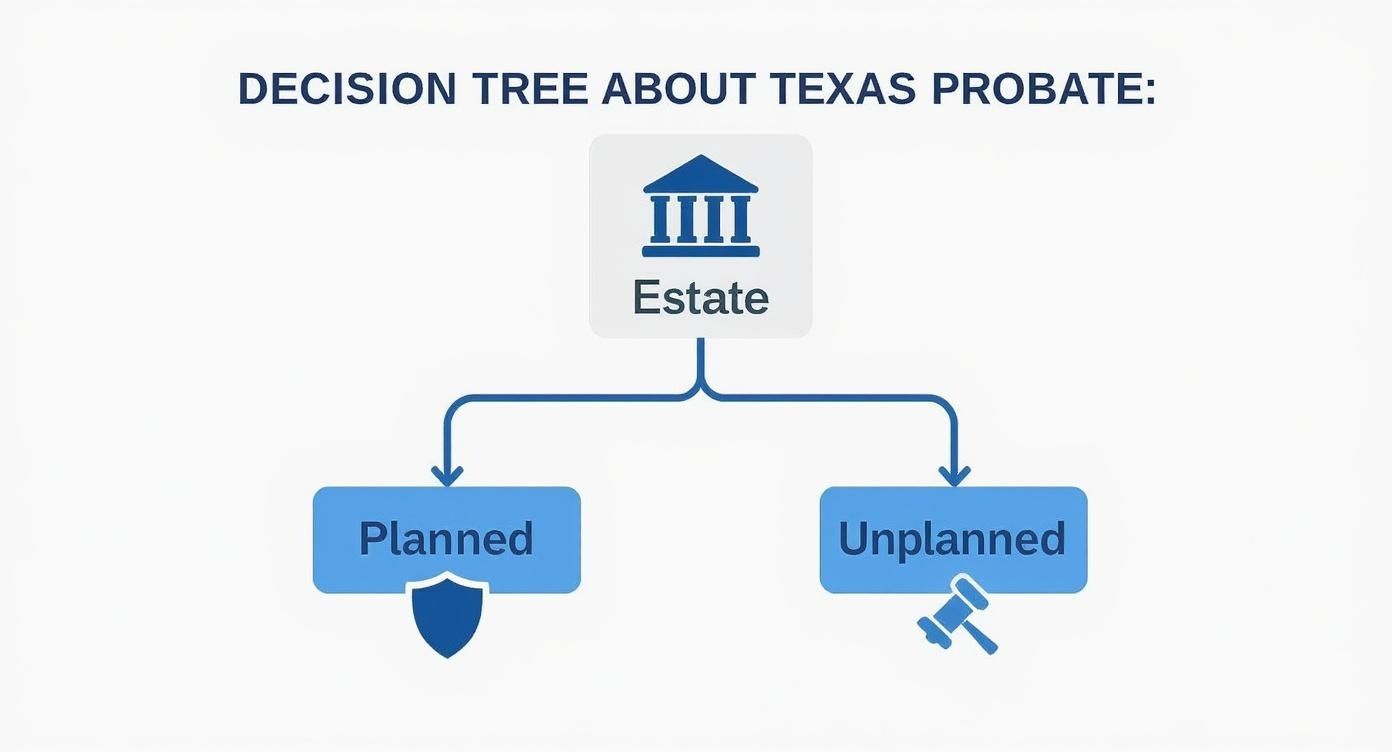
The key takeaway here is that the path your estate takes is a choice—one made through deliberate planning with the right legal instruments.
The Cornerstone of Probate Avoidance: The Revocable Living Trust
For many Texas families, the most powerful and flexible tool for bypassing probate is the Revocable Living Trust. Think of it as a private, legal container you create to hold your assets. You simply transfer ownership of your property—like your home, investments, and bank accounts—from your name into the name of the trust.
During your lifetime, you remain in complete control, typically serving as the trustee. You can buy, sell, or manage the assets just as you always have. Nothing really changes in your day-to-day life.
The real magic happens after you pass away. A successor trustee, whom you’ve already chosen, steps in to manage and distribute the trust’s assets according to your private instructions. This all happens completely outside of court supervision. To learn more, check out our guide on why setting up a trust might be the right move for you.
Simplifying Real Estate Transfers with a TODD
A family’s home is often their single most significant asset. That’s where a Transfer-on-Death Deed (TODD) comes in. This is a simple yet incredibly effective instrument designed specifically for Texas real estate.
Here’s the step-by-step process:
- Draft and Sign: You sign the TODD, which names your chosen beneficiary for the property.
- File with the County: The deed must be filed with the county clerk where the property is located.
- Maintain Control: While you are alive, you are still the full owner. You can sell, mortgage, or even revoke the TODD at any time. The beneficiary you named has zero rights to the property until after you pass.
- Automatic Transfer: Upon your death, your beneficiary just files a simple affidavit of death, and ownership transfers automatically. No court, no probate.
This tool is perfect for people whose primary asset is their home and who want a direct, no-fuss transfer to a child or another loved one.
Using Beneficiary Designations for Financial Accounts
Your financial accounts—like bank accounts, retirement funds, and investments—can also sidestep probate with a few simple forms. Texas law makes it easy to keep these out of court using beneficiary designations.
These designations include:
- Payable-on-Death (POD): Used for bank accounts, including checking, savings, and CDs.
- Transfer-on-Death (TOD): Used for investment and brokerage accounts, stocks, and bonds.
Just like a TODD for real estate, these designations give you full control during your life. After you’re gone, the named beneficiary can claim the funds directly and immediately by presenting a death certificate to the financial institution. It’s that simple.
The Power of Joint Ownership with Right of Survivorship
Another common strategy involves how you title your property in the first place. Joint Tenancy with Right of Survivorship is a form of co-ownership where two or more people own an asset together. When one owner dies, their share automatically passes to the surviving owner(s) without ever touching a probate court.
This method works for real estate, bank accounts, and even vehicles. It does require careful consideration, though, since adding a joint owner gives them immediate rights to the property, which isn’t always the right move for every situation.
Comparing Probate Avoidance Methods in Texas
| Method | Best For | How It Works | Key Benefit |
|---|---|---|---|
| Revocable Living Trust | Comprehensive estate planning, multiple assets, complex family situations. | Assets are retitled into a trust you control. A successor trustee distributes them per your instructions. | Maximum control and privacy; avoids probate for all trust assets. |
| Transfer-on-Death Deed (TODD) | Passing a single piece of real estate to a specific beneficiary. | You file a deed naming a beneficiary who inherits the property automatically upon your death. | Simple, inexpensive, and keeps your home out of court. |
| POD/TOD Designations | Bank accounts, investment accounts, retirement funds, and life insurance. | You fill out a form with your financial institution to name a beneficiary for the account. | Quick and direct transfer of funds to your loved ones. |
| Joint Ownership with ROS | Married couples or partners sharing a primary home or bank account. | Property is owned jointly, and the survivor automatically inherits the entire asset. | Seamless transition for the surviving owner; no probate needed. |
Each of these tools has its place in a well-crafted estate plan. The best approach often involves a combination of them, tailored to your specific assets and family dynamics.
Beyond these traditional tools, you might also explore other asset-holding structures. For instance, understanding strategies involving LLC liability protection could offer a unique approach to managing certain business or rental assets within your estate plan. The right combination of tools ultimately depends on your goals.
When Probate Is Actually the Right Path
While most families aim to avoid probate in Texas, it’s a mistake to think of this court-supervised process as the enemy. In some situations, the structure, oversight, and legal finality that probate offers is actually the most responsible and protective path forward for an estate.
Think of probate as a specific tool in the estate planning toolbox, not a universal problem. The right strategy is never a one-size-fits-all solution; it’s about what best serves your family’s unique circumstances. Sometimes, that means leaning into the formal process instead of trying to sidestep it.
https://www.youtube.com/embed/Y-C1ZGdEOWo
When Court Supervision Provides Necessary Protection
The very features that make probate seem intimidating—court oversight, formal notices, and rigid deadlines—are also its greatest strengths when things get complicated or contentious. These procedural safeguards are there for a reason: to protect everyone involved, from heirs to creditors.
Probate is often the smartest choice when:
- There are disputes among heirs. If you see a family fight brewing over the will or the assets, the courtroom provides a neutral ground to sort it out. A judge’s final ruling is legally binding, which can stop years of family drama and expensive Probate Litigation.
- The estate has significant debts. When a loved one passes away with multiple creditors, probate creates a clear, orderly process for notifying them and handling their claims. It sets a firm deadline for creditors to come forward, after which their claims are barred forever. This gives the executor and the heirs peace of mind that no old debts will pop up years later.
- The validity of the will might be questioned. If there are any whispers that the will was signed under duress or that the person wasn’t of sound mind, the probate process is the only legal way to validate the document. Once a will is officially admitted to probate, its terms are legally confirmed.
A Realistic Scenario Involving Creditor Claims
Picture a small business owner in Houston who passes away unexpectedly. He left a simple will giving everything to his two adult children, but he also had business loans, unpaid vendor invoices, and a commercial lease. His kids are overwhelmed, unsure which debts are legitimate, and terrified that creditors will start harassing them directly.
In this case, starting the formal Texas probate process is the best move they can make. The court-appointed executor can publish a legal notice to all potential creditors, forcing them to present their claims in a specific way by a specific date, just as Title 3 of the Texas Estates Code requires. This structured approach shields the children from harassment and makes sure only valid debts are paid from their father’s estate before they inherit a dime.
The Financial Threshold for Formal Probate
Sometimes, the decision isn’t a choice—it’s a legal requirement. In Texas, avoiding probate is often a strategic goal, but formal probate becomes mandatory if the estate’s value exceeds $75,000.
This number excludes non-probate assets like life insurance payouts and retirement accounts with designated beneficiaries. For estates that fall below this threshold, Texas offers simpler procedures, like a Small Estate Affidavit, which can transfer assets without full court supervision. This limit was put in place to ease the burden on both the courts and families dealing with smaller, less complex estates. You can discover more insights about the probate threshold on our blog.
When an estate is valued above $75,000 and doesn’t have probate-avoidance tools like a living trust, the formal process isn’t just an option—it’s a legal necessity to properly transfer title to assets.
Ultimately, the decision to plan around probate or use it depends entirely on your family’s situation. For estates with clear assets, no debt, and harmonious beneficiaries, tools like Wills & Trusts are incredibly effective. But for those facing potential disputes or complex financial loose ends, the Texas probate court offers the structure, authority, and finality needed to settle an estate correctly and permanently.
Building a Complete Estate Plan Beyond Probate
A truly effective estate plan is so much more than a binder full of legal documents; it’s a living strategy designed to protect you and your family through life’s unexpected turns. While avoiding probate in Texas is a huge piece of the puzzle for many people, it doesn’t work in isolation. That goal has to be woven into a broader plan that safeguards your well-being and makes sure your wishes are followed, both during your life and after.

This means looking beyond what happens when you pass away. It’s just as important to prepare for potential incapacity—a situation where you’re alive but can’t make decisions for yourself. A complete plan addresses both possibilities with foresight and compassion.
Integrating Probate Avoidance with Incapacity Planning
One of the biggest advantages of using a tool like a Revocable Living Trust is that its benefits reach far beyond simply skipping probate court. When you set up a trust, you name a successor trustee to manage the trust’s assets if you ever become incapacitated.
This creates a seamless handover of control without any court intervention. If you were to suffer a sudden illness or accident, your chosen successor could immediately step in to pay your bills, manage your investments, and handle all your financial affairs. That’s a powerful benefit that a will simply can’t offer, since a will only kicks in after you die.
A solid plan coordinates your probate avoidance tools with other critical documents:
- Durable Power of Attorney: This document lets you appoint a trusted agent to handle financial matters that fall outside of your trust.
- Medical Power of Attorney: This is where you name someone to make healthcare decisions for you if you’re unable to speak for yourself.
- Advance Directive (Living Will): This document clearly states your preferences for end-of-life medical care.
Together, these documents form a protective shield. They ensure your financial and medical needs are met according to your instructions, often preventing the need for a costly and public Guardianship proceeding.
The Pour-Over Will: A Vital Safety Net
Even the most organized people can overlook an asset. You might buy a new car, open a small savings account, or inherit something unexpectedly and forget to formally title it in the name of your trust. This is exactly where a special type of will, called a pour-over will, acts as an essential safety net.
A pour-over will is brilliantly simple. It just says that any assets owned in your individual name when you die should be “poured over” into your living trust. While this will does have to go through probate, it makes sure that any forgotten assets end up exactly where you intended, governed by the private terms of your trust. You can learn more about how these two foundational documents work together in our guide comparing a living trust vs. a will.
Recent changes in Texas law continue to make direct asset transfers easier. The state encourages the use of tools like transfer-on-death deeds, and the legislature keeps making procedural improvements. The cumulative effect is a legal landscape that increasingly supports proactive planning to bypass the courts.
Ultimately, building a complete estate plan is about creating an interconnected system. Your trust, beneficiary designations, and joint ownership strategies are your frontline for avoiding probate. They should be supported by powers of attorney for incapacity and a pour-over will to catch anything that slips through the cracks. This layered approach provides the ultimate peace of mind, knowing your family is protected from every angle.
Common Missteps Texas Families Make in Estate Planning
Even with the best of intentions, a simple oversight in an estate plan can accidentally drag your family into the very probate process you were trying to avoid. Planning is an act of love, but small mistakes can completely undermine your efforts, creating a mess of confusion and stress for your loved ones.
Understanding these common tripwires is the first step toward building a plan that truly protects them.

Time and time again, we see families who have taken steps in the right direction, only to have their plans fall short because of one of these preventable issues. The good news is they are easy to fix with careful attention to detail and the right guidance.
Creating an Empty Trust
This is one of the most frequent—and heartbreaking—mistakes we encounter: failing to properly fund a living trust. So many people go through the work of creating a sophisticated Revocable Living Trust, sign the documents, and then stick it in a drawer, thinking the job is done.
But a trust is just an empty box. It only works if you actually put your assets inside it.
This means you have to formally transfer ownership of your property—your house, bank accounts, investments—from your individual name into the name of the trust. If an asset is never retitled, the trust has no power over it. That asset will get stuck in the Texas probate process.
Neglecting Beneficiary Designations
Another landmine is relying on outdated beneficiary designations. Life happens—marriages, divorces, births, and deaths—and these events can all change who you want to inherit your assets. A life insurance policy or an old 401(k) from a previous job might still list an ex-spouse as the beneficiary.
Under Texas law, these designations often trump whatever your will or trust says. Forgetting to update them can send your assets to someone you no longer intended, which is a painful shock for your family and a common trigger for Probate Litigation.
Take a few minutes to review these common accounts:
- Life insurance policies
- 401(k)s, IRAs, and other retirement accounts
- Annuities
- Payable-on-Death (POD) bank accounts
Relying on Generic DIY Documents
While online legal forms might look like a cheap and easy fix, they often create more problems than they solve. These one-size-fits-all templates are not tailored to the specific legal requirements found in the Texas Estates Code. A document that isn’t drafted or executed correctly can be tossed out by a court.
Worse, these forms lack the personalized counsel you need to handle complex situations like blended families or special needs beneficiaries, or to properly integrate tools like Wills & Trusts. Avoiding probate in Texas requires a thoughtful, coordinated strategy, not just a stack of fill-in-the-blank documents. The guidance of an experienced attorney ensures your plan is legally sound and actually does what you want it to do.
Key Takeaway: Planning is an Act of Care
When we talk about avoiding probate in Texas, the real goal is simple: to make an incredibly difficult time a little easier, faster, and more private for the people you leave behind. It’s about replacing potential legal nightmares with a clear, direct path for your assets. This isn’t about finding an obscure loophole; it’s about compassionate, efficient planning that gives your family the gift of certainty right when they need it most.
A thoughtful estate plan is one of the greatest gifts you can give your family. It lets them focus on grieving and healing, not on navigating a complex and often impersonal court system. The essence of avoiding probate comes down to proactive decision-making. You’re choosing to replace the court’s one-size-fits-all process with your own clear, private instructions. This ensures your legacy is handled exactly as you wish, without unnecessary delays or public prying.
Whether you’re just starting to create your Wills & Trusts or find yourself facing potential Probate Litigation, a well-structured plan is your family’s best protection.
Answering Your Questions About Avoiding Probate
When it comes to planning your estate, a lot of questions pop up. It’s natural. We’ve gathered some of the most common ones we hear from Texas families to give you the clarity you need to protect your family’s future and work on avoiding probate in Texas.
“I Have a Will, So I’m All Set to Avoid Probate, Right?”
This is probably the biggest misconception we see. A will doesn’t dodge probate—it directs it. Think of a will as your personal set of instructions for the probate court. It tells the judge who gets your property and who you’ve picked to be in charge of the process.
While having a will is a critical piece of any solid estate plan, it will not bypass the Texas probate process on its own. To keep your assets out of court, you need different tools, like a properly funded Living Trust, smart beneficiary designations, or joint ownership with right of survivorship.
“Can I Just Shove Every Single Asset into My Living Trust?”
Almost, but not quite. While most of your assets belong in a trust to avoid probate, some things, like your 401(k)s and IRAs, are a different animal. These retirement accounts have specific tax rules that are best handled by naming beneficiaries directly.
If you try to move a 401(k) into your trust, you could accidentally trigger a massive tax bill for your heirs, which is the last thing you want. The right way to do it is to make sure your beneficiary designations work in harmony with your trust. This creates a plan that’s not just about avoiding probate but also about being as tax-smart as possible.
“How Often Should I Really Be Looking at My Estate Plan?”
Life never stands still, and neither should your estate plan. We tell our clients to pull out their documents for a review every three to five years. More importantly, you need to revisit it immediately after any major life event.
What counts as a major event?
- Getting married or divorced
- Welcoming a new child or grandchild
- A big jump (or dip) in your financial situation
- Moving to a new state with different inheritance laws
An outdated plan can cause as much chaos as having no plan at all. It can lead to your assets going to the wrong people or even spark a bitter and expensive Probate Litigation battle. Keeping your plan current is the only way to guarantee your wishes are protected, no matter what happens.
If you’re facing probate in Texas, our team can help guide you through every step — from filing to final distribution. Schedule your free consultation today.