When a loved one passes away without a will, the path forward can feel overwhelming. Families are often left grappling not just with grief, but with the confusing question of what happens to their property. In Texas, an Affidavit of Heirship is a practical legal tool designed to cut through that confusion, offering a simpler alternative to formal probate court.
Think of it as an official family history, recorded to transfer property—most commonly the family home—when there’s no will to guide the way. It’s a compassionate approach that acknowledges the emotional weight your family is carrying while still addressing the necessary legal steps with clarity.
A Straightforward Guide to the Affidavit of Heirship
Losing someone is hard enough. The last thing you need is a complicated legal battle over their estate. For many Texas families, the Affidavit of Heirship offers a more direct and reassuring solution when a loved one dies "intestate"—the legal term for dying without a will.
In plain English, this document is a sworn statement that clearly identifies the rightful heirs to an estate based on Texas law. Once it's filed in the county's public records, it creates a clean, legally recognized chain of title for real property. Instead of getting bogged down in a lengthy and often expensive court process, this affidavit can help your family move forward more efficiently during a difficult time.
When Is an Affidavit of Heirship the Right Choice?
An Affidavit of Heirship isn't a one-size-fits-all fix. It’s designed for a very specific set of circumstances. Knowing when it applies can save you a world of trouble and help you decide if it’s the right move for your family.
You should consider using this affidavit when:
- The Decedent Died Without a Will: This is the primary reason. The affidavit officially establishes who the heirs are according to Texas's intestate succession laws, found in Title 2 of the Estates Code.
- The Main Asset is Real Estate: It’s tailor-made to transfer the title to real property, like a house or a piece of land.
- The Estate Has Few or No Debts: If the only major debt is a mortgage on the property, an affidavit can still work. But if there are significant debts owed to other creditors, a formal administration through the Texas Probate Process might be unavoidable.
- All Heirs Are on the Same Page: Family harmony is non-negotiable here. Every legal heir must agree on how the property is handled. Any disputes will likely push the matter into probate court anyway.
This tool is especially useful in Texas, where many estates are settled without a will. Under Texas Estates Code § 203.002, these documents can save families significant time and money in probate fees, reducing timelines from months or years down to just a few weeks. You can find out more about the practical impact of these legal documents on Texas families.
The Purpose and Benefits
At its core, the purpose of an Affidavit of Heirship is to create a clear, public record of who inherits the deceased’s property. It acts as solid evidence of ownership that title companies and banks can rely on to issue title insurance, approve a sale, or clear a title.
For families navigating a loss, the benefits are obvious. It offers a path that is quicker, less stressful, and far more affordable than traditional probate, making a difficult time just a little more manageable.
Nailing the Legal Requirements for a Valid Affidavit
For an Affidavit of Heirship to hold any legal weight—and be accepted by title companies, banks, and courts—it has to meet some pretty strict criteria laid out in the Texas Estates Code. Think of these rules not as bureaucratic hoops to jump through, but as crucial safeguards. They exist to make sure the document is accurate, trustworthy, and legally sound.
Getting these details wrong can render the affidavit completely useless, leading to frustrating delays and piling on extra costs. Let's break down exactly what the law requires, translating the legal jargon into a clear, actionable checklist for your family.
It's a Sworn Statement, So It Needs a Notary
First things first: an Affidavit of Heirship is a sworn statement. This isn't like signing a birthday card. Everyone putting their name on the document, from the heir to the witnesses, must sign it in front of a notary public. When they do, they're taking a legal oath, swearing that everything they've stated is true to the best of their knowledge.
This formal declaration is made under penalty of perjury. The notary’s seal acts as the official stamp of approval, verifying the identities of the people signing and confirming they made their statements under oath. Without that notarization, the document is just a piece of paper with no legal standing.
The Make-or-Break Role of Disinterested Witnesses
This is arguably the most critical piece of the puzzle. A valid affidavit requires the testimony of two disinterested witnesses. That’s a very specific legal term, and it’s not flexible. A "disinterested witness" is someone who:
- Knew the person who passed away (the decedent) and their family history.
- Will not inherit a single thing from the estate—no money, no property, no assets whatsoever.
- Is not related to the decedent or any of the heirs by blood or marriage.
These witnesses are your neutral, third-party verifiers. Their job is to back up the family history laid out in the affidavit, confirming details about marriages, children, divorces, and other relatives. Their testimony is what gives the document its credibility. Finding the right people is absolutely essential, and our guide on proofs in Texas probate like affidavits and witnesses can offer more detailed insight.
The Required Information Checklist (Don't Skip Anything)
The affidavit must paint a comprehensive and meticulously accurate picture of the family history. Under Texas Estates Code § 203.002, the document has to lay out very specific facts about the decedent and their heirs. Any mistake or missing piece of information can lead to a title company rejecting it flat-out.
Here’s what the law demands you include:
- The decedent’s full name and their date and place of death.
- A complete marital history, including all marriage and divorce dates.
- The names of all children (biological and adopted) and a note if any of them have passed away.
- If a child has died, the names of their children (the decedent's grandchildren) must be listed.
- A list of the decedent's parents and siblings if there was no surviving spouse or children.
- A clear statement confirming the decedent died without a will.
- A full legal description of the real property being transferred.
This level of detail is non-negotiable. To make this easier to follow, here’s a quick summary of the legal requirements.
| Key Requirements for a Valid Texas Affidavit of Heirship |
| :— | :— | :— |
| Requirement | Explanation (Why It Matters) | Texas Estates Code Reference |
| Sworn and Notarized | Ensures all statements are made under oath, making the document legally binding and subject to perjury laws. | § 203.002(b) |
| Two Disinterested Witnesses | Provides credible, third-party verification of the family history, preventing fraud or self-serving claims. | § 203.002(c) |
| Comprehensive Family History | Creates a clear line of succession, identifying all legal heirs and their relationship to the decedent. | § 203.002(a) |
| Statement of No Will | Confirms the decedent died "intestate," which is the legal prerequisite for using an Affidavit of Heirship. | § 203.002(a)(6) |
| Filed in the County | Must be filed in the real property records of the county where the property is located to serve as public notice of ownership. | § 203.003 |
Ultimately, treating these requirements as a detailed roadmap rather than a set of obstacles is the key to successfully using an Affidavit of Heirship to transfer property in Texas.
How to Complete and File the Affidavit Step by Step
Creating and filing an Affidavit of Heirship isn't just about filling out a form; it's a careful process that, when done right, can save your family a world of time and money. Think of it as a practical roadmap. I'll walk you through each stage, from gathering the puzzle pieces of your family's history to the final, crucial step of recording the document.
Let's use a realistic scenario to make these steps more tangible. Imagine two siblings, Sarah and Mark. Their mother recently passed away in Houston without a will. Her only significant asset is the family home in Harris County, and thankfully, Sarah and Mark are in complete agreement about how to handle her estate. They’ve decided an Affidavit of Heirship is their best path forward to transfer the title.
Step 1: Gather All Necessary Information and Documents
Before you even think about drafting the affidavit, you have to do your homework. Accuracy is everything here. A single mistake or omission can get the entire document thrown out, so this first step is the foundation for everything that follows.
For Sarah and Mark, this means hunting down a few key items:
- Their mother's death certificate: This is non-negotiable. It provides the official date and place of death.
- A complete family tree: They need details on their mother's entire marital history (dates of marriage and divorce), the names and birthdates of all her children (even any who may have passed away), and the names of any grandchildren.
- The property's legal description: You can't just use the street address. You need the full legal description found on the property deed.
- Contact information for witnesses: They need to find two people who knew their mother for years but have absolutely no financial stake in the outcome.
Step 2: Identify and Prepare Your Disinterested Witnesses
As we've mentioned, Texas law is very clear on this point. You need two qualified disinterested witnesses. These are people who can swear under oath that the family history laid out in the affidavit is true. Their testimony is what gives the document its legal weight.
Sarah and Mark start brainstorming. Their aunt is out—she’s a relative. Instead, they think of a long-time family friend and a former next-door neighbor. Both knew their mom for over a decade and won't inherit a dime. They reach out, explain what's needed, and get them on board.
Step 3: Draft the Affidavit of Heirship
This is where having a professional in your corner really pays off. You can find templates for an Affidavit of Heirship online, but they're generic. They don't account for your family's unique situation and might not be up-to-date with the latest Texas statutes. One small error could make the whole document worthless.
Sarah and Mark decide to work with an attorney to get it right the first time. The attorney helps them structure the complex family history correctly, inserts the precise legal description of the property, and makes sure every piece of statutory language required by the Texas Estates Code is included. This is how you avoid the common mistakes that lead to a title company rejection later on.
This infographic breaks down the essential components: a sworn statement, the two witnesses, and the final filing.
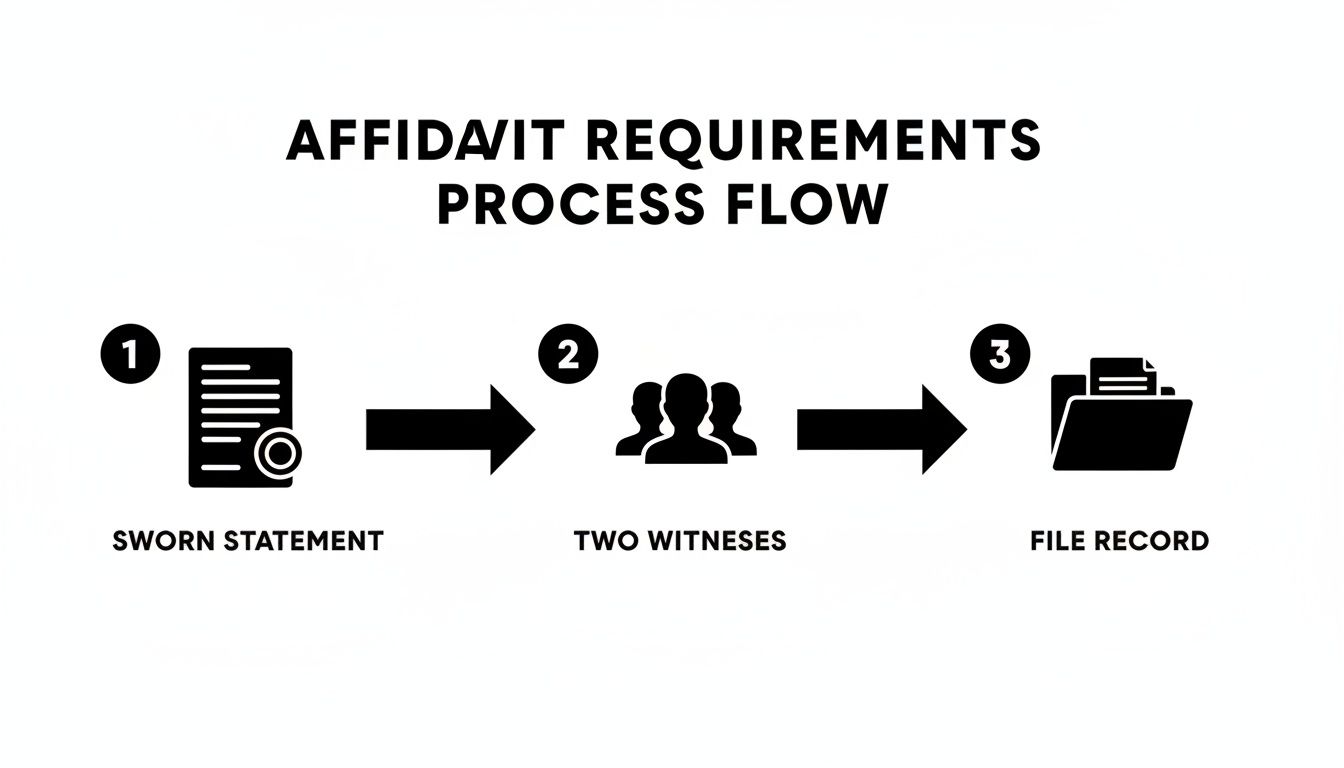
This visual really drives home the point that each step is a critical link in a chain. If you skip or mishandle one, the whole process can fall apart.
Step 4: Sign Before a Notary Public
Once the document is drafted and everyone has double-checked it for accuracy, it's time to make it official. Sarah, Mark, and their two witnesses must all sign the affidavit in the presence of a notary public. This isn't just a suggestion; it's a legal requirement. They are taking a sworn oath that the information is true to the best of their knowledge.
The notary will check everyone's ID, administer the oath, watch the signatures happen, and then apply their official seal. This act of notarization is what turns a simple document into a legally binding statement.
Step 5: File the Affidavit in the County Property Records
This is the final, and arguably most important, step. The fully signed and notarized affidavit must be filed with the county clerk in the real property records of the county where the property is located. For Sarah and Mark, that means filing it with the Harris County Clerk's office.
Once it's filed, the Affidavit of Heirship becomes the proof of ownership. It gives the heirs the legal authority to sell the property, refinance it, or simply get the title put into their own names. The process has several moving parts, but by following them carefully, you can ensure a smooth and legally sound transfer of your loved one's legacy.
Comparing an Affidavit of Heirship to Other Options
When you're settling an estate in Texas, you have choices. Picking the right one can save your family a world of time, money, and emotional strain during an already difficult period. The Affidavit of Heirship is an incredibly effective tool, but it’s just one of several options on the table.
Understanding how it stacks up against other common probate alternatives is the key to making a smart decision. Each path has its own rules, costs, and best-use cases. Your family’s unique situation—whether there’s a will, the size of the estate, and what kind of assets are involved—will ultimately point you to the most suitable route.
Let's compare the Affidavit of Heirship to two other frequently used alternatives in Texas: the Small Estate Affidavit and a Muniment of Title.
Affidavit of Heirship vs. Small Estate Affidavit
At first glance, these two options seem pretty similar. Both are designed to help families sidestep the complexities of a full probate administration. But they serve very different purposes and are governed by completely different rules under the Texas Estates Code.
A Small Estate Affidavit (SEA) is a court-supervised process used for very small estates, valued at $75,000 or less (not counting the homestead and other exempt property). It can transfer both real estate and personal property, like bank accounts, but it comes with some pretty strict limitations.
The key differences really boil down to this:
- Court Involvement: A Small Estate Affidavit has to be filed with the probate court and get a judge’s stamp of approval. An Affidavit of Heirship, on the other hand, is simply filed in the county property records with zero court oversight.
- Property Type: While an SEA can handle a homestead, it's often used for personal property like bank accounts. The Affidavit of Heirship is almost exclusively for transferring title to real estate.
- Debt Restrictions: To even qualify for an SEA, the estate's debts can't be more than its assets (again, not counting the homestead). An Affidavit of Heirship is far more flexible, especially if the only debt is a mortgage tied to the property itself.
In short, think of a Small Estate Affidavit as the tool for truly modest estates with minimal assets that need a judge's sign-off. The Affidavit of Heirship is the non-court solution focused squarely on real estate when there is no will.
Affidavit of Heirship vs. Muniment of Title
The biggest dividing line between these two options is the existence of a will. An Affidavit of Heirship is only used when someone dies intestate (without a will). A Muniment of Title, however, is a streamlined probate process built specifically for situations where there is a valid will.
A Muniment of Title proceeding basically asks a probate court to formally recognize the will as the official document transferring property to the people named in it. It’s an efficient way to clear title, but it has its own set of rules.
This path is only an option if the estate has no outstanding debts, other than a mortgage on a piece of property. While it does involve a court hearing, it’s much faster and less expensive than a full probate administration because no executor is ever appointed. You can learn more about Muniment of Title in our detailed guide to see if it might work for your situation.
To understand how an affidavit of heirship fits into broader legal strategies, it's helpful to compare it with other estate planning options like wills and trusts, which are proactive measures taken before someone passes away.
To give you a clearer picture, I've put together a table that breaks down the main differences at a glance.
Comparing Texas Estate Settlement Options
A side-by-side comparison of the most common methods for settling an estate in Texas, helping you understand which may be right for your family.
| Method | Best For | Court Involvement | Typical Timeline | Handles Real Estate? |
|---|---|---|---|---|
| Affidavit of Heirship | Estates with no will where the primary asset is real estate and all heirs agree. | None. Filed directly in county property records. | 2-4 weeks | Yes, this is its main purpose. |
| Small Estate Affidavit | Small estates (under $75,000) with or without a will, often with personal property. | Yes. Requires court filing and judge's approval. | 2-3 months | Yes, but only the homestead. |
| Muniment of Title | Estates with a valid will and no debts (other than a secured mortgage). | Yes. Requires a court hearing to probate the will. | 2-4 months | Yes. |
Choosing the right legal tool isn’t just a matter of convenience; it’s about honoring your loved one’s legacy efficiently and with compassion. Each of these options offers a solution for a specific scenario, and a clear understanding of the differences empowers you to select the best path forward for your family.
Common Mistakes to Avoid and When You Need a Lawyer

While an Affidavit of Heirship feels like a straightforward solution, it’s far from foolproof. One seemingly small mistake can bring the whole process to a screeching halt, leading title companies to reject it and leaving your family stuck in a legal mess. Understanding the common traps is the best way to ensure a smooth property transfer.
An affidavit is only as good as the information inside it. Any inaccuracy—whether it's an honest mistake or a deliberate omission—can invalidate the entire document. The goal is a perfect, legally sound record that leaves no room for questions.
Pitfalls That Can Derail the Process
Even with the best of intentions, families often stumble into traps that compromise their affidavit. These errors usually come from incomplete information or just not knowing the strict legal hoops you have to jump through in Texas.
Common mistakes include:
- Discovering an Unknown Heir: Maybe your loved one had a child from a previous relationship that nobody knew about. An heir who was left out has a legal claim to the property and can challenge the affidavit years later.
- Struggling to Find Qualified Witnesses: Finding two people who knew the deceased for years but get absolutely nothing from the estate can be tougher than you think. Using an "interested" witness is an automatic red flag for title companies.
- Uncovering Hidden Debts: If big debts pop up after the affidavit is filed, creditors can still slap a lien on the property. This complicates any attempt to sell or even just transfer it.
- Errors in the Property Description: A lot of people use a simple street address, but you need the full legal description from the deed. This mistake will get your affidavit rejected right away by the county clerk or a title company.
These aren't just minor delays; they can create painful arguments among family members when everyone is already grieving.
Why Banks and Title Companies Might Say No
Financial institutions and title companies are in the business of managing risk, so they are incredibly thorough. They will reject a sloppy Affidavit of Heirship without a second thought if it seems incomplete, contradictory, or unverified. To them, a flawed document signals a potential break in the chain of title, which could mean future lawsuits—a risk they just won’t take.
When to Call an Attorney
While it’s smart to get legal advice from the very beginning, some situations make it absolutely essential. If you're on the fence about whether you need a probate lawyer, our guide can provide additional clarity.
You definitely need an attorney if:
- Heirs are uncooperative or live out of state or the country.
- The family history is complex, with adoptions, multiple marriages, or half-siblings involved.
- There are any whispers of disagreement among family members.
- You aren't completely sure if there are outstanding debts.
Bringing in an experienced attorney is the best way to head off these problems before they even start. A lawyer can untangle complex family dynamics, perform a thorough search for all heirs and debts, and make sure the document is perfect. It’s an investment in getting it right the first time and protecting your family’s legacy.
Key Takeaway
Navigating the loss of a family member is hard enough without having to untangle a legal mess. Understanding your options is the first step toward getting things settled and finding some peace of mind.
The Texas Affidavit of Heirship can be a fantastic tool—a fast, court-free alternative to probate. But it only works in very specific situations. It shines when someone dies without a will and their main asset is a piece of real estate.
This guide has walked you through the details, but the most important lessons are pretty straightforward.
Essentials to Remember
For an affidavit of heirship to work as intended, you absolutely have to get three things right:
- Absolute Accuracy: The family history has to be perfect. Every marriage, divorce, child, and relative must be listed flawlessly. Even a small mistake can render the whole document useless.
- Qualified Witnesses: You need two disinterested witnesses. These are people who knew the person who passed away but have absolutely nothing to gain from the estate—they won't inherit a dime. They are there to swear to the family history.
- Proper Filing: Once it's all filled out and notarized, the affidavit must be filed in the real property records of the county where the land is located. Until it's filed, it's not legally effective.
Key Insight: Think of this affidavit as a key that can unlock property ownership without a formal probate process, but it must be cut perfectly to fit the lock. Rushing the process or skipping steps often leads to greater expense and delay down the road.
Once the property is officially in your name, you'll have new responsibilities as an owner. One of the first things families should look into is the available property tax exemptions in Texas to help keep costs manageable.
If you’re facing probate in Texas, our team can help guide you through every step — from filing to final distribution. Schedule your free consultation today.
Frequently Asked Questions About Affidavits of Heirship
When you're dealing with a loved one's estate, practical questions always come up. To help you find your footing during this difficult time, we've put together answers to some of the most common things families ask about using an Affidavit of Heirship in Texas.
How Much Does an Affidavit of Heirship Cost in Texas?
One of the biggest draws of an Affidavit of Heirship is that it's far more affordable than a traditional probate. While the exact cost can vary, it's almost always significantly less than going through the full court process.
Typically, you're looking at two main expenses:
- Attorney Fees: This is for having a professional draft the document. A lawyer will make sure it meets all the strict requirements of the Texas Estates Code, gather the necessary information, and give you solid legal advice. This is the single best way to avoid having a title company kick it back later.
- Filing Fees: Once the affidavit is signed and notarized, it has to be recorded in the official property records of the county where the real estate is. County clerks charge a small fee for this, usually somewhere between $50 and $75.
Can Someone Contest an Affidavit of Heirship?
Yes, they absolutely can. An Affidavit of Heirship isn't set in stone the moment it's filed. For instance, an omitted heir—a relative who was legally entitled to inherit but was left off the document—or a creditor of the decedent can challenge its validity in court.
If a challenge is successful, the whole matter could get pushed into a formal probate administration to sort out who the rightful heirs are and settle any claims. This is exactly why getting it drafted by a professional, based on a deep dive into the family history, is your best defense against future disputes and potential probate litigation.
How Long Until the Affidavit Becomes Effective?
An Affidavit of Heirship is technically effective as soon as it's filed with the county clerk. From that point on, it acts as evidence showing the transfer of title to the heirs. It's on the public record.
But its legal weight gets stronger over time. Under Texas Estates Code § 203.001, once an affidavit has been on file for five years, it becomes what’s known as "prima facie" evidence. In plain English, this legal term means the facts it contains are presumed to be correct. After five years, it's a very powerful and permanent part of the property's official history.
Do All Banks and Title Companies Accept It?
No, and this is a huge point to understand. While an Affidavit of Heirship is a perfectly valid legal tool for clearing up title to real estate, private companies like banks and title companies don't have to accept it. Their own internal policies on risk often dictate whether they’ll rely on an affidavit or demand a formal court order from a probate proceeding.
This is one of the main reasons it's so important to talk to an attorney before you go down this road. An experienced lawyer can help you figure out if an affidavit is the right tool for all of your loved one's assets and can often step in to communicate with these institutions on your behalf.
If you’re facing probate in Texas, our team can help guide you through every step — from filing to final distribution. Schedule your free consultation today.