Skip to content
If you suspect a loved one's will is invalid, the most pressing question you’re likely asking is: How long do I have to do something about it? In the whirlwind of grief and confusion after a death, the last thing on anyone's mind is a legal stopwatch. But in Texas, that’s exactly what you’re up against. The state enforces a strict two-year period to contest a will, and if you miss it, your chance to challenge what you believe is an unjust will could be gone forever.
Losing a family member is a deeply personal and difficult experience. Navigating the legal system at the same time can feel overwhelming, but you don't have to do it alone. This guide will walk you through the process in plain English, helping you understand your rights and the critical deadlines you face.
The Unforgiving Clock on Texas Will Contests
When a loved one passes, your world is turned upside down. You're dealing with funeral arrangements, notifying family, and trying to process your loss. A legal battle is the last thing you want. But if you have reason to believe a will is fraudulent, was signed under duress, or is otherwise invalid, Texas law gives you a very specific—and unforgiving—window to act.
Understanding this deadline isn't just a good idea; it's the most critical first step in protecting your rights. This isn't a friendly guideline. It's a hard legal boundary designed to bring finality to the Texas Probate Process, and it can slam the courthouse doors shut on even the most legitimate claims if you're a day too late.
The Two-Year Statute of Limitations
The core rule for challenging a will in Texas is laid out plainly in the Texas Estates Code. It establishes a firm timeline that every potential challenger must respect.
- The Rule: You have two years to contest a will after it has been admitted to probate.
- The Starting Point: This is where many people get tripped up. The clock does not start when your loved one dies. It starts the moment a probate court signs an order officially declaring the will valid.
- The Law: This deadline is mandated by Texas Estates Code § 256.204, the statute that serves as the foundation for will contest timelines across the state. This provision is part of Title 2 of the Estates Code, which governs the descent and distribution of a person's property.
Why such a strict deadline? The law is designed to give executors and rightful heirs confidence. It ensures estates can be settled, debts paid, and assets distributed without the lingering threat of a lawsuit popping up years down the road.
A Realistic Scenario: The Deadline in Action
Picture a family in Houston. Their father passes away, and a will they’ve never seen before is filed in Harris County court. After a hearing, the will is officially admitted to probate on February 15, 2026. That date—not the date of death—is the one that matters.
The family now has until February 15, 2028, to file a formal contest. It doesn’t matter when their father died or when they first got a copy of the will. If they uncover rock-solid evidence of forgery on February 16, 2028, they're almost certainly out of luck. The legal window has closed.
Key Insight: Many families mistakenly believe the deadline relates to the date of death. This misunderstanding can be devastating, causing them to miss their opportunity to challenge an unjust will. The clock starts with the court's action, not the family's loss.
This two-year rule is applied consistently from Dallas to Austin. In our experience, one of the most common reasons will contests fail is simply because they were filed too late. This is why it’s absolutely critical to seek guidance from an experienced Probate Litigation attorney the moment you have concerns. You can find more perspectives on the unforgiving nature of this deadline from other detailed probate law resources.
Texas Will Contest Key Timeframes
This table provides a quick-reference summary of the critical timeframes and events related to contesting a will in Texas.
| Event | Deadline | Governing Law (Texas Estates Code) | Who Bears the Burden of Proof? |
|---|---|---|---|
| Initial Will Application | Generally within 4 years of death | § 256.003 | The will proponent (person filing the will). |
| Filing a Will Contest | Generally within 2 years of the will being admitted to probate | § 256.204 | The will contestant (person challenging the will). |
| Contest Based on Fraud or Forgery | 2 years from the date the fraud or forgery is discovered | § 256.204(b) | The will contestant. |
| Contest by an Incapacitated Person | 2 years after their legal disability is removed | § 256.204(c) | The will contestant. |
As you can see, while the two-year rule is the main takeaway, there are specific nuances for situations involving fraud or legal incapacity. However, relying on these exceptions is risky and complicated. The safest path is always to act well within the initial two-year window.
When Does the Countdown Officially Begin?
Knowing you have a two-year window to contest a will in Texas is one thing. Knowing exactly when that two-year clock starts is a completely different—and far more important—piece of the puzzle.
It's the single most critical detail in the entire process, and it’s a point of confusion that can have devastating consequences. Let's clear it up.
The countdown does not begin when your loved one passes away. It doesn't start when you first see a copy of the will, either. Instead, the clock officially starts ticking on the specific date a Texas probate court signs an order admitting the will to probate. This is the formal legal event that validates the will, and it's your starting line.
The Path to Probate Admission: A Step-by-Step Guide
So, how does a will get "admitted to probate"? It's a formal court procedure that transforms a private document into a legally binding one. For families navigating loss, understanding this path is key to tracking your deadline.
- Application Filed: The person named as executor in the will files an "Application to Probate Will" with the appropriate county court.
- Citation and Notice: After the application is filed, a public notice (called a citation) is posted at the courthouse. This serves as a formal announcement that a will has been submitted for probate.
- The Hearing: A court hearing is scheduled. Here, a judge listens to testimony to confirm the will is valid and was executed according to Texas law.
- Order Admitting Will to Probate: If the judge is satisfied, they will sign a court order. This order is the official starting gun for your two-year deadline.
The date on this specific court order is the only one that matters. It’s a public record, and you or your attorney can get a copy to confirm the exact start of your two-year window. Learning about the full journey can demystify the steps; you can read more on our detailed Texas Probate Process page.
This is the critical sequence of events for any will contest in Texas.
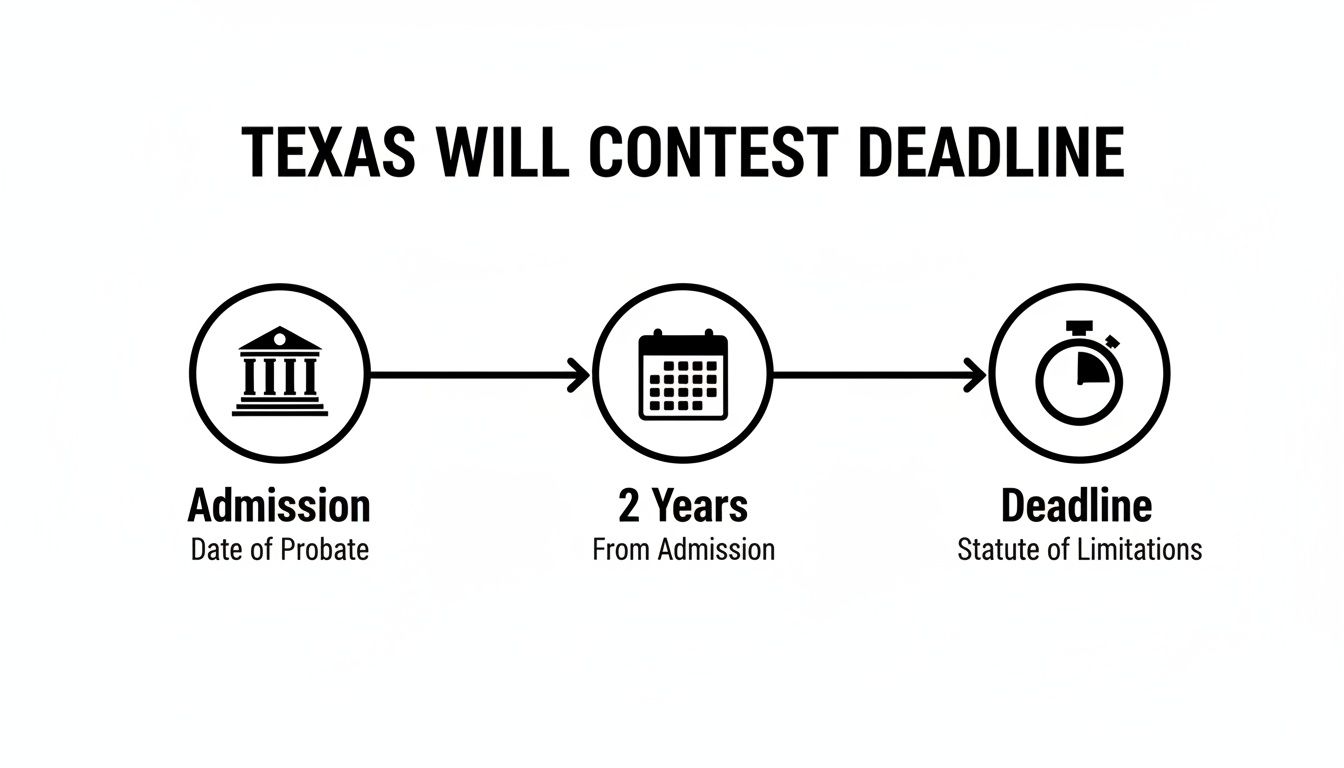
As the diagram shows, that two-year period is a direct result of the court's action. It creates a fixed, non-negotiable timeframe for any potential challenge.
A Houston Family's Search for the Start Date
Imagine a family in Houston whose mother recently passed. Her new caregiver suddenly produces a will that leaves him the entire estate, completely disinheriting the children. They're suspicious and know they need to act, but they feel lost about the timeline.
They call a probate attorney, who immediately gets to work. The attorney checks the Harris County court records online and discovers the caregiver filed an application to probate the will just two weeks ago. The hearing is scheduled for next month.
The attorney explains that the two-year clock has not started yet. However, the moment the judge signs that order admitting the will to probate, that date becomes their ground zero. By monitoring the court case, they can pinpoint the exact start of their two-year deadline and start building their case for undue influence.
Key Insight: You don't have to wait for the will to be admitted to probate to take action. In fact, contesting a will before it's admitted can be strategically smart. The key is to be proactive, track the court proceedings, and know the exact date the clock starts ticking.
This scenario shows why waiting is a mistake. By understanding how to find the official start date, you remove the guesswork and empower yourself with the knowledge needed to protect your inheritance. Don't let confusion about the timeline stop you from taking the necessary steps.
Valid Reasons to Contest a Will in Texas

It’s a gut-wrenching moment. You’ve just read a loved one’s will, and the words on the page make no sense. It completely contradicts everything you knew about their wishes, their relationships, and their promises. The feeling that something is deeply wrong is overwhelming.
But in a Texas courtroom, feeling that a will is unfair isn't enough. You can’t walk into court and successfully challenge a will simply because you don’t like what it says. The law requires a specific, legally valid reason—what we call "grounds"—to even get started.
These grounds aren't about hurt feelings or perceived slights; they're about the legal integrity of the document itself. Was it a true expression of the deceased’s final wishes? Or is the will flawed in a way that makes it invalid? Understanding these grounds is the first and most critical step in any will contest.
Lack of Testamentary Capacity
One of the most common reasons to challenge a will is a lack of testamentary capacity. This is a legal term for a simple idea: the person who made the will (the testator) didn't have the required mental clarity to understand what they were doing when they signed it.
This isn’t about having a flawless memory or being in perfect physical health. The bar is very specific. Under Texas law, the testator must have understood four key things at the moment they signed the will:
- They were signing a document that would give away their property after they died.
- They had a general idea of what property they owned.
- They knew who their closest family members were (what the law calls the "natural objects of their bounty").
- They could hold all these pieces of information in their mind long enough to make a rational decision.
The crucial part is that their capacity is judged at the exact moment the will was signed. Someone with dementia might have periods of lucidity. Proving a lack of capacity often means digging into medical records, interviewing caregivers, and finding testimony about their behavior around the time the will was created.
Undue Influence
Undue influence is another major reason to contest a will, and it’s often one of the hardest to prove. This isn't just about giving advice or making a suggestion. It happens when someone in a position of trust and confidence uses that relationship to manipulate or pressure the testator into making a will that benefits the influencer.
Think of it as a form of psychological hijacking. The testator's own free will is so completely overpowered that the will becomes a reflection of the influencer's desires, not their own.
Realistic Scenario: Undue Influence in Action
Picture an elderly father in Fort Worth. After his wife passes, he becomes increasingly isolated. A new neighbor starts helping with groceries and errands, slowly becoming his only companion and actively pushing his children away. Shortly before he dies, the father signs a brand-new will leaving his entire multi-million dollar estate to this neighbor.
His children are blindsided and immediately suspect something is wrong. Their attorney would start looking for evidence of classic undue influence:
- Did the neighbor get involved in hiring the lawyer or driving the father to the signing?
- Was the father suddenly cut off from his family and old friends?
- Was this new will a radical departure from previous estate plans that had always left everything to his kids?
This scenario shows how undue influence works in the real world—it’s subtle, corrosive, and requires a mountain of evidence to prove. To learn more about what a court looks for, check out our guide on the evidence needed to contest a will.
Fraud or Forgery
Fraud and forgery are more direct and, frankly, more brazen grounds for a will contest. They are exactly what they sound like.
Fraud: This is about deception. The testator was tricked into signing the will. Maybe they were told it was just a power of attorney, or the pages were swapped out at the last minute. The signature is real, but the intent is not.
Forgery: This is even simpler. The signature on the will is fake. The testator never signed the document at all.
Proving forgery almost always involves hiring a forensic handwriting expert to compare the signature on the will to known, authentic examples of the testator's signature.
Improper Execution
Finally, a will can be thrown out if it doesn't follow the strict, technical rules required by the Texas Estates Code. These aren't just suggestions; they are mandatory. For a standard Texas will to be legally valid, it must be:
- In writing.
- Signed by the testator.
- Attested to by two credible witnesses, both at least 14 years old, who sign the will in the testator's presence.
If even one of these technical requirements is botched, the entire will can be invalidated. For example, if only one witness was present at the signing, or if the witnesses signed it a week later at home, the will is no good.
Key Takeaway
Challenging a will in Texas is not for the faint of heart. It demands more than a sense of unfairness. You must have solid, provable legal grounds like lack of capacity, undue influence, fraud, or a technical flaw in the will’s execution. Figuring out which, if any, apply to your case is the first conversation you need to have with a probate attorney.
What Happens If You Miss the Deadline?
Thinking about legal deadlines can feel overwhelming, especially when you’re grieving. It’s natural to want to sidestep conflict while processing the loss of a loved one. But the Texas will contest deadline is one you simply can’t ignore. Its consequences are severe, tangible, and almost always irreversible.
Missing that two-year window isn't like being late on a bill and paying a small penalty. It’s more like the courthouse doors slamming shut forever on your right to challenge the will. It doesn't matter how strong your evidence is. The law is designed to bring estates to a final close, and once that time runs out, your opportunity to act is gone.
The Finality of a Missed Deadline
The single biggest consequence of missing the deadline is that you permanently lose your right to contest the will. This means that even if you find undeniable proof of a forged signature, a hidden medical diagnosis proving a complete lack of mental capacity, or a signed confession from someone who manipulated your loved one, the court will almost certainly refuse to even hear your case.
The real-world impact of this is devastating. It means:
- Your Inheritance is Gone for Good: Any assets you believe were rightfully yours will be distributed based on the will you think is invalid. That loss is permanent.
- A Questionable Will Becomes Law: The will, no matter how flawed, is treated as the final, legally binding word on how the estate is divided.
- Your Loved One’s True Wishes are Ignored: The intentions you know your loved one had will be overridden by a document that may not reflect their actual desires.
The legal system is built to create certainty. While it may seem harsh, the two-year deadline ensures estates can be closed and heirs can move on without the endless threat of future lawsuits. This is why the law doesn’t pause for grief, making it critical to act quickly.
A Story of a Lost Opportunity
Imagine a family in Dallas. They were suspicious of their father's final will, which he signed just weeks before his death, leaving almost everything to a new caregiver. Overcome with grief and hoping to avoid a family fight, they decided to wait. Twenty-six months after the will was admitted to probate, they discovered a string of emails where the caregiver openly bragged about a plan to manipulate their father.
They rushed to a lawyer, armed with what seemed like airtight proof of fraud. But it was too late. They were two months past the two-year statute of limitations. A judge would have no choice but to dismiss their case. The inheritance they believed was stolen would remain with the caregiver—legally and permanently.
This isn’t just a cautionary tale; it’s a reality we’ve seen families face time and again. The point isn't to create fear but to give you a clear-eyed view of what’s on the line. Acting within the deadline is your only guaranteed chance to protect your rights and honor your loved one's true legacy. You can discover more insights about Texas will contest deadlines to see a deeper analysis of these trends.
Key Takeaway
Missing the two-year deadline to contest a will in Texas is not a small mistake; it's a permanent legal shutdown. It results in the absolute loss of your right to challenge the will, no matter how powerful your evidence becomes later. The law's need for finality means your window to seek justice is brief, making it essential to act even while grieving.
If you’re facing probate in Texas, our team can help guide you through every step — from filing to final distribution. Schedule your free consultation today.
Are There Exceptions to the Two-Year Rule?
While the two-year deadline to contest a will in Texas is one of the firmest rules in probate law, the legal system isn't completely blind to extraordinary circumstances. The Texas Estates Code carves out a few very narrow exceptions that can sometimes "toll," or pause, this otherwise rigid timeline.
A word of caution is essential here: these exceptions are incredibly rare and notoriously difficult to prove. You should never, ever count on them. Think of the two-year window as a hard-and-fast rule and these exceptions as a last-ditch legal argument for highly specific, almost unheard-of situations.
The Fraud and Forgery Discovery Rule
The biggest and most significant exception to the two-year rule involves outright fraud or forgery. This is where the law acknowledges that it's fundamentally unfair to penalize someone for not acting on a deception they couldn't possibly have known about.
Under Texas Estates Code § 256.204(b), if your will contest is based on a forged will or one created through fraud, the clock is different. A challenger has two years from the date the fraud or forgery was discovered to file their case.
This is what lawyers call the "discovery rule."
- How It Works: Let's say a will was probated, and three years later, you uncover concrete proof that the signature was forged. The discovery rule might grant you a fresh two-year window starting from that moment of discovery.
- The Catch: The burden of proof is entirely on you. You have to prove not just the forgery itself but also that you acted with diligence and couldn't have reasonably uncovered it sooner. Courts examine these claims with a fine-toothed comb.
Key Insight: The discovery rule isn't a free pass for not paying attention. It’s designed for cases where someone actively and successfully concealed the fraud from you and other interested parties.
Legal Incapacity and Tolling the Clock
Another crucial exception applies to potential challengers who are legally incapacitated. The law recognizes that some individuals, through no fault of their own, are simply unable to protect their own legal rights.
According to Texas Estates Code § 256.204(c), if a person entitled to contest a will is under a "legal disability," the two-year statute of limitations is tolled. In plain English, the clock is paused until that disability is removed.
The most common examples of legal disability include:
- Minors: A person under the age of 18 cannot file a lawsuit on their own behalf. For them, the two-year window to contest a will only begins on their 18th birthday.
- Incapacitated Adults: An adult who has been declared legally incapacitated by a court, often with a Guardianship in place, also falls under this exception. Their two-year period would only start if and when a court restores their legal capacity.
Example: A Minor’s Delayed Rights
Imagine a grandfather passes away and his will is probated when his only grandchild is 15 years old. The will seems suspicious, leaving everything to a caregiver, but the grandchild is legally unable to take action.
Under this exception, the deadline doesn't expire when she turns 17. Instead, the two-year clock starts ticking on her 18th birthday, giving her until her 20th birthday to file a contest.
While these exceptions exist on paper, their real-world application is complex and hinges entirely on the specific facts of your case. If you're past the two-year mark and believe your situation falls into one of these narrow categories, you need to seek immediate legal advice. The stakes are too high to guess. To learn more, check out our detailed article on whether you can contest a will after probate.
Your Action Plan for a Suspect Will

Knowing the rules is one thing, but knowing what to do is another. When you believe a loved one’s will is fraudulent or invalid, the stress can feel overwhelming. It's easy to get paralyzed by uncertainty. This isn't just a legal guide; it’s a practical action plan. If something feels wrong about a will, don’t just worry—take control. Here’s your step-by-step checklist to turn your suspicions into a proactive strategy.
Step 1: Acknowledge the Ticking Clock
First, you must accept that time is not on your side. The will contest deadline Texas courts enforce is unforgiving. Procrastination is the greatest risk to your claim. Acknowledge your concerns and commit to investigating them now. Every day that passes can make it harder to find the evidence you’ll need to prove your case.
Step 2: Gather Every Piece of Paper
Your next move is to become a document detective. This goes far beyond just getting a copy of the will you're questioning. You need to collect everything related to the estate, including:
- Any official court notices you've received about the probate case.
- All letters or emails from the executor or their lawyer.
- Copies of any previous Wills & Trusts or other estate planning documents you can find.
- The deceased's financial statements or medical records, if you can access them.
These documents are the bedrock of a potential will contest. In cases involving claims of diminished capacity, your legal team will need to dig deep into the deceased's health history, which is where a guide on reviewing medical records for attorneys can be incredibly helpful.
Step 3: Create a Timeline of Events
Now, start writing it all down. Create a detailed timeline of events surrounding the signing of the will and your loved one's final days or weeks. Jot down strange conversations, odd behavior you witnessed, or any instances where a specific person seemed to be isolating your loved one from others. This timeline will be invaluable for your attorney, helping them spot patterns of undue influence or coercion.
Step 4: Be Cautious with the Executor
It's tempting to demand answers or make accusations, but you need to be careful. While you should stay informed, limit your communication with the executor, especially if you suspect they had a hand in the problem. Keep your conversations brief, stick to the facts, and never reveal your strategy. Anything you say can potentially be used against you later, so it's best to say very little until you have a lawyer in your corner.
Step 5: Call a Probate Litigation Attorney Immediately
This is the single most important step you can take. You cannot—and should not—try to fight a will contest on your own. The legal complexities are immense, and the other side will have a lawyer. An experienced probate litigation attorney will look at your evidence, confirm your specific deadline, and lay out your legal options in plain English. This is the moment your anxiety transforms into a concrete legal plan.
Frequently Asked Questions About Texas Will Contests
Losing a loved one is hard enough. When you’re also facing doubts about the validity of their will, the legal questions can feel overwhelming. Here are some plain-English answers to the questions we hear most often from families navigating the will contest deadline in Texas.
What if I Was Never Officially Notified That the Will Was Probated?
This is a tough, and unfortunately common, situation. While the person probating the will has a duty to notify beneficiaries, mistakes happen. Sometimes, it’s an oversight; other times, it’s intentional.
Even if you never received formal notice, the two-year deadline to contest the will usually still applies. However, a lack of proper notice might be your ticket to challenging the probate itself. Proving you were entitled to notice and didn’t get it requires a strong legal argument and solid evidence. Courts look at these claims very carefully, so you’ll want to speak with a probate attorney right away to see what your options are.
Can I Contest a Will Before It Is Admitted to Probate?
Yes, and frankly, this is almost always the best time to act. You can file a formal challenge after the will has been submitted to the court but before a judge has signed an order admitting it to probate.
Why is this so important? Because it changes who has to prove what. In a pre-probate contest, the burden of proof is on the person submitting the will to prove it’s valid. Once the will is admitted, that burden flips entirely onto you—the contestant—to prove it’s invalid. That's a much steeper hill to climb. This window of opportunity is short, so you have to move fast.
Does a No-Contest Clause Prevent Me from Challenging the Will?
Not necessarily. A "no-contest" clause, which lawyers sometimes call an in terrorem clause, is designed to scare off potential challengers. It basically says that if you contest the will and lose, you forfeit any inheritance you were supposed to receive. It sounds intimidating, but Texas law has a built-in protection for you.
Under Texas Estates Code § 254.005, a no-contest clause can’t be enforced against you if you brought the challenge in "good faith" and with "just cause." This means if you have a legitimate, evidence-based reason to believe the will is invalid—not just a hunch or a feeling of being wronged—you can proceed without the fear of being automatically disinherited if you lose. An attorney can help you figure out if your evidence meets this critical standard.
Key Insight: A no-contest clause isn't an iron-clad shield. Texas law protects your right to challenge a will if you have good reason and evidence to back it up. Don't let it scare you away from getting legal advice.
How Much Does It Cost to Contest a Will in Texas?
The cost of a will contest varies wildly. There’s no one-size-fits-all answer. A dispute that’s settled quickly through a few negotiation sessions might only cost a few thousand dollars.
On the other hand, a complex fight that involves digging up old records, deposing multiple witnesses, hiring experts, and going to a full-blown trial can run into the tens or even hundreds of thousands of dollars.
Many probate litigators offer different ways to pay, like hourly billing or contingency fee arrangements where they take a percentage of what you recover. The best thing to do is schedule a consultation to talk about the facts of your case and get a realistic picture of the potential costs. To get a better handle on this, you can learn more about who pays legal costs when contesting a will.
If you’re facing probate in Texas, our team can help guide you through every step — from filing to final distribution. Schedule your free consultation today.