A death in the family already puts people on edge. Then something small starts to bother you. A will appears that no one had ever heard about. An executor stops returning calls. A bank account that should exist isn't listed anywhere. A caregiver who was barely around a year ago is suddenly at the center of every decision.
That uneasy feeling matters.
Probate is supposed to be a court-supervised process for gathering property, paying valid debts, and distributing what remains to the right people. In Texas, heirs, beneficiaries, and other interested parties have rights under the Texas Estates Code to ask questions, request information in the right circumstances, and bring disputes before the probate court when something doesn't add up. Titles 2 and 3 of the Estates Code govern much of the probate and administration process, including how wills are admitted, how representatives serve, and when a court can step in.
If you're trying to figure out what to do if you suspect fraud in a probate case, the first goal isn't to accuse someone loudly. It's to protect the estate, preserve evidence, and make smart decisions before records disappear or positions harden.
Is Something Wrong with a Loved One's Probate Case
Maria's father died in Harris County. For years, he told the family that his estate would be divided evenly among his children. After his death, one sibling produced a newer will that left nearly everything to him. He said their father “changed his mind,” but no one had seen this document before. The signature looked different. The father had been isolated and very ill near the end. The sibling also refused to share financial records.
That kind of situation is exactly why families start searching for answers.
Sometimes the problem is fraud. Sometimes it's mismanagement. Sometimes it's poor communication that looks suspicious but has an innocent explanation. The hard part is that grief makes everything feel urgent, and probate procedure can feel cold and confusing when you're already carrying a loss.
If your concern is based on specific facts, not just family tension, you're right to take it seriously.
Texas probate isn't supposed to operate in secret. When a will is filed and admitted to probate, court filings become part of the record. A personal representative, often called an executor when named in a will, owes legal duties to the estate. In plain English, that means the person in charge isn't allowed to treat estate property like personal property, hide assets, or mislead the court.
What probate fraud can look like in real life
A fraud concern usually starts with one of these patterns:
- A document problem such as a signature that looks off, pages that don't match, or a “new” will that conflicts sharply with years of known planning.
- A money problem such as missing accounts, unexplained transfers, or estate property sold under murky circumstances.
- A control problem such as an executor who withholds information, avoids accounting, or acts like no one else has a right to ask questions.
If you're dealing with any of those, the next steps matter. The right early move can preserve a strong case. The wrong one can alert the wrongdoer and make proof harder to find.
Recognizing the Red Flags of Probate Fraud
Probate fraud usually shows up as a pattern, not a single dramatic event. One odd document may have an innocent explanation. Several inconsistencies tied to money, control, or secrecy deserve a close look before you confront anyone.
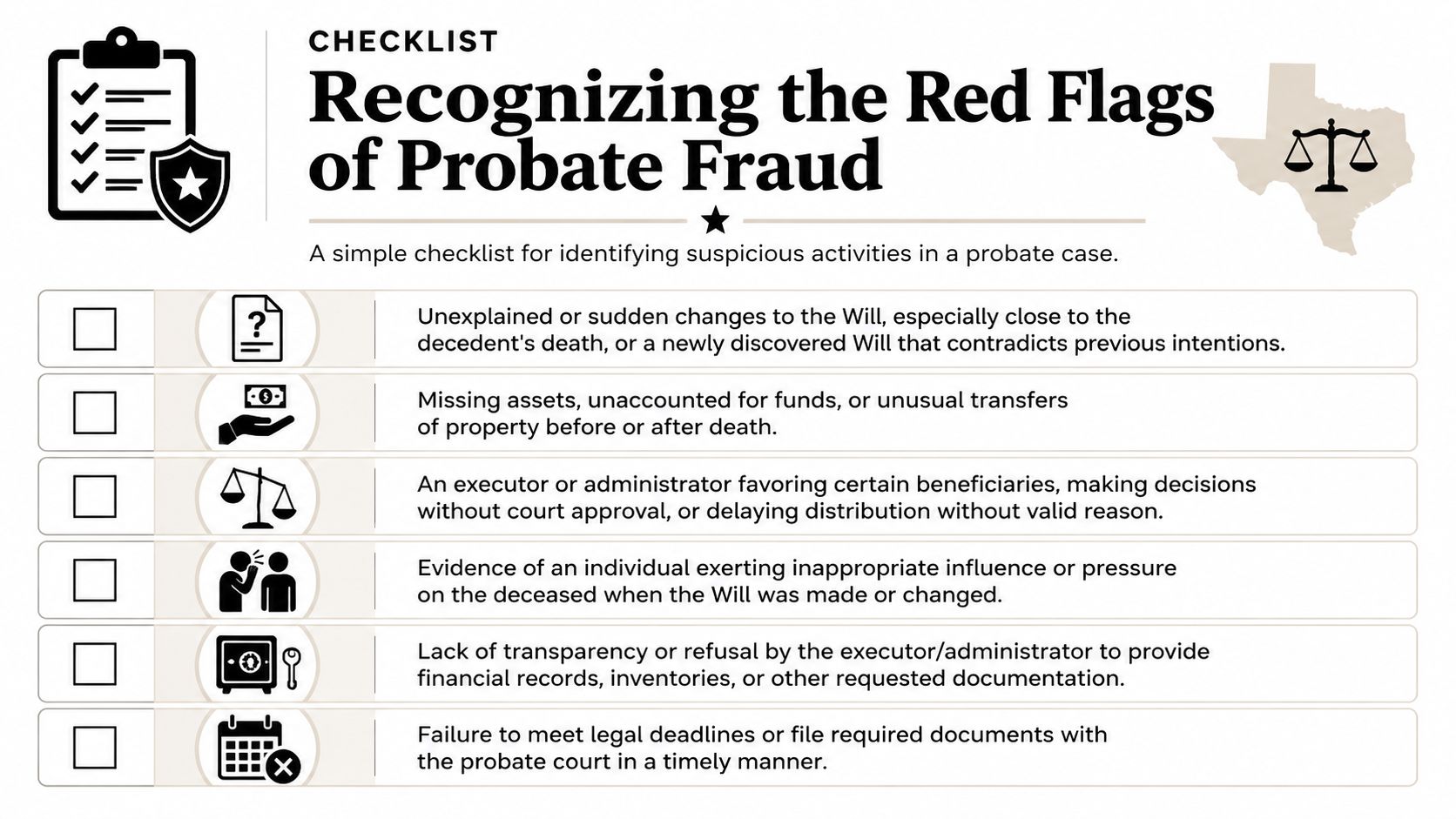
The broader fraud problem is real. The Federal Trade Commission reported major consumer fraud losses in past years, which reflects how often people use confusion, trust, and access to take money or property (FTC fraud loss reporting). Estates create those same conditions. Family members are grieving. Records are scattered. One person may suddenly control information.
What matters here is specificity. Courts do not act on a feeling that something is off. They do pay attention to concrete facts that point to undue influence, forgery, concealment, or false statements.
Undue influence
Undue influence often starts before death and becomes visible only after the will is produced.
A parent becomes dependent on one child, caregiver, or new companion. That person begins controlling transportation, medications, appointments, and access to other family members. Then a new will, deed, or beneficiary change appears and sharply benefits the person who had that access. The legal question is whether the decedent made a free choice, or whether pressure and dependency replaced real independence.
Timing matters here. So does isolation.
Forgery or altered documents
Some fraud claims center on the paper itself. A signature looks wrong. Initials are missing. Font, spacing, or page numbering changes within the same document. A staple is missing from a set of pages that supposedly belonged together. Witness information is incomplete, or the story about where the will was signed keeps changing.
Any one of those facts may turn out to be harmless. Together, they often justify a careful review of the original document and the circumstances around its execution.
Asset concealment or theft
In many cases, the will is valid and the problem starts after death. Property disappears before an inventory is filed. Bank accounts that the family knew existed are never mentioned. Vehicles, jewelry, firearms, or collectibles are removed from the home. Estate funds are used for personal bills and explained away later as reimbursement.
This is one of the most common points of confusion for families. An executor does have authority to handle estate assets. That does not include treating estate property like a personal account.
Misrepresentation to the court or to heirs
Fraud can also take the form of a false story. Someone understates the value of property, omits an heir, exaggerates debts, or claims there was no will when the family has reason to believe one exists. In heirship disputes, false statements about marriages, children, or family history can change who inherits.
Secrecy is not proof by itself. It is still a warning sign, especially if requests for basic information are met with delay, hostility, or shifting explanations.
Practical rule: Be more concerned when the person with the strongest control over records is also the person who benefits most from the disputed change.
A quick way to organize your concerns
| Concern you noticed | What it may suggest |
|---|---|
| Sudden late-life will change favoring one person with new control over the decedent | Undue influence or lack of capacity |
| Signature, initials, or pages look inconsistent | Forgery or alteration |
| Known assets never appear in probate filings | Concealment, theft, or incomplete inventory |
| Executor refuses ordinary questions or gives changing answers | Possible fiduciary breach or cover-up |
| Unexpected heir claim or inaccurate family history | Misrepresentation or heirship dispute |
If your concern centers on the person handling the estate, review these signs of probate executor fraud in Texas. The goal at this stage is not to accuse someone in a family group text. It is to identify facts discreetly, sort ordinary probate friction from true fraud, and avoid tipping off the person who may be hiding the trail.
How to Preserve Evidence Without Escalating Conflict
The riskiest early mistake is confronting the suspected person before you've secured records. Guidance from estate professionals consistently warns that tipping off a suspect too soon can lead to missing documents, deleted messages, and a cleaner-looking story after the fact (estate fraud victim guidance).
Quiet preparation is usually better than emotional confrontation.
Start with the public record
Probate filings often tell you more than family conversations do. Get copies of what has been filed with the probate court. In Texas, depending on the case, that can include the application to probate the will, the order admitting the will, the oath, letters testamentary or letters of administration, inventories, accountings, notices, and any motions already on file.
Write down dates carefully. The date a will was admitted to probate can matter later. So can the date an inventory was due, whether notices were sent, and whether the personal representative appears to be following court requirements under the Estates Code.
Preserve digital communications
Don't rely on memory.
Save emails, text messages, voicemails, screenshots, and social media messages relating to the estate, the decedent's health, and any disputed transfers or documents. If someone made statements like “Dad changed everything last week” or “Don't tell your sister about this account,” those details matter. Keep the messages in their original format when possible.
Build a timeline before you build an accusation
A clean timeline often reveals patterns that a pile of documents won't.
Create a simple chronology with entries such as:
- Health changes when the decedent became confused, isolated, hospitalized, or dependent on others.
- Document events when a new will, deed, or beneficiary designation supposedly appeared.
- Financial events when property disappeared, accounts changed, or valuables were removed.
- Probate events when the case was filed, the representative was appointed, and notices were sent.
That timeline helps your attorney see whether the legal issue is likely a will contest, an accounting dispute, a removal action, or several claims at once.
The best early evidence is often boring. Court filings, bank statements, old signatures, medical records, and dated messages usually carry more weight than family opinions.
Gather comparison documents
If you suspect forgery or undue influence, older records can be powerful. Look for prior wills, powers of attorney, deeds, signature samples, handwritten notes, calendars, or correspondence showing the decedent's wishes over time. If a dramatic change occurred near death, earlier planning documents may help show whether the new version fits a believable pattern.
A useful next read is what evidence is needed to contest a will. It can help you identify which records are likely to matter most.
What not to do
A few bad moves create problems fast:
- Don't threaten the executor with criminal accusations in text or email.
- Don't remove original documents from someone else's possession without legal advice.
- Don't post about the dispute online where statements can be used against you.
- Don't coach witnesses on what to say.
- Don't wait too long while hoping the situation resolves itself.
Quiet, methodical documentation protects you better than a family showdown.
Your Legal Options for Contesting Fraud in Texas
The right legal move depends on what is being faked, hidden, or mishandled. In some cases, the will itself is the problem. In others, the estate representative is using a valid appointment to do improper things with money, records, or property.
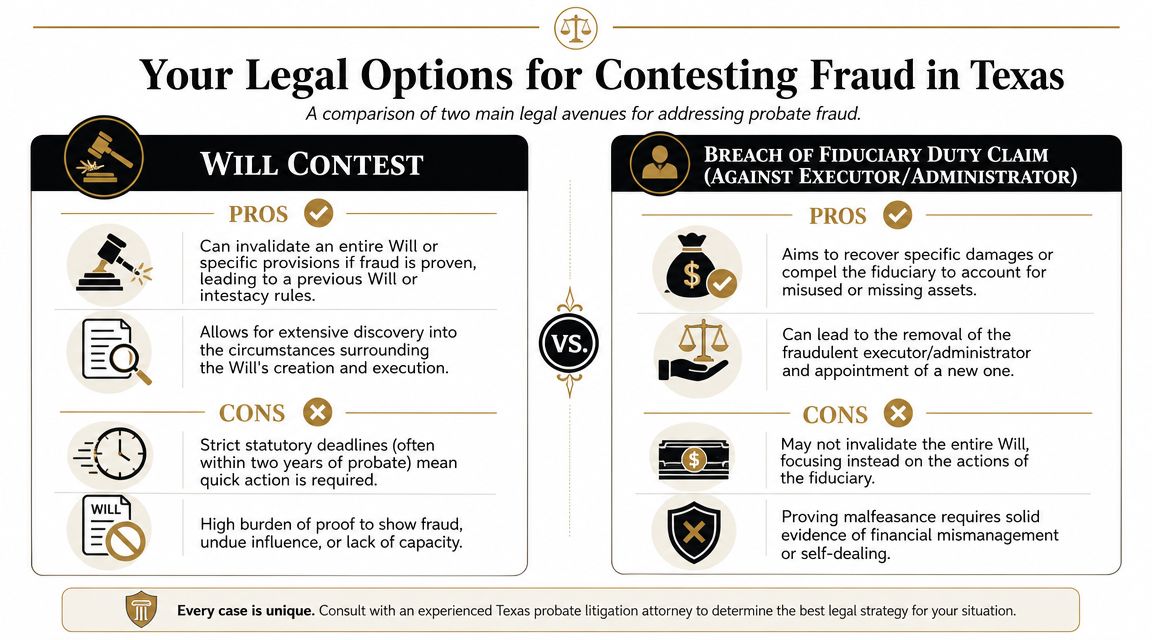
That distinction matters early because the remedy shapes what you ask the court to do. If you choose the wrong fight first, you can spend time and money arguing about the document when the immediate risk is an executor draining an account or selling estate property before anyone can object.
Texas courts do not set aside wills or remove fiduciaries based on suspicion alone. Fraud claims usually require strong proof. Judges want documents, testimony, medical evidence where relevant, financial records, and a clear explanation of what happened, who did it, and how the estate or heirs were harmed.
A will contest challenges the document
A will contest is the usual path if you believe the will should never have been admitted or should not control the estate because of:
- Forgery
- Undue influence
- Lack of testamentary capacity
- Fraud in the signing or procurement of the will
If that claim succeeds, the court may disregard the challenged will. An earlier valid will may control instead. If there is no valid prior will, Texas intestacy rules may apply.
This type of case often turns on details families overlook at first. Who arranged the signing. Who was in the room. Whether the decedent had a diagnosis affecting memory or judgment. Whether the new will sharply departs from years of prior planning. A practical overview of that process appears in this guide to how to contest a will and win in Texas.
Removal or fiduciary claims focus on the person handling the estate
Sometimes the will is valid, but the executor or administrator is the source of the trouble. Texas law allows courts to address serious misconduct by a personal representative, including failure to perform required duties, disqualification, incapacity, or mismanagement that puts the estate at risk.
That route often fits better if you are seeing:
- Missing estate funds
- Refusal to provide an accounting
- Self-dealing or suspicious transfers
- Sale or use of estate property for personal benefit
- False statements to beneficiaries or the court
This is often the better first move when assets could disappear while a will contest is still being prepared. In practice, families sometimes need emergency relief, a formal accounting, or removal before the larger fraud story is fully litigated.
Some cases require more than one remedy
A common pattern looks like this. A late-stage will appears under suspicious circumstances, and the same person who benefits most under that will is also controlling the estate records, refusing to share information, and liquidating property.
That may call for parallel claims. One claim attacks the will. Another asks the court to stop the representative's conduct, require disclosures, recover property, or remove the fiduciary.
Courts care about precision. Alleging "fraud" in general terms is usually weaker than asking for specific relief tied to specific conduct.
| Problem you suspect | Remedy often worth discussing first |
|---|---|
| The will was forged, coerced, or signed without capacity | Will contest |
| The executor will not disclose transactions or inventory | Accounting request, document demand, or removal action |
| Estate property was transferred or sold improperly | Recovery claim, surcharge, or fiduciary-duty claim |
| Someone is acting before authority is clear | Temporary restraining relief or other court intervention |
Protect the estate while the case is developing
Families sometimes focus so hard on proving wrongdoing that they miss the immediate risk. If a house is about to be listed, an account is being emptied, or personal property is being hauled away, the first objective may be stopping further loss.
That is one reason quiet preparation matters. A rushed accusation can prompt the wrongdoer to destroy records, harden their story, or move assets faster. A measured filing, supported by records and a clear request for relief, usually puts you in a stronger position.
If estate real property is part of the dispute, practical sale issues often overlap with the court case. Cyber Homes' guide for executors gives a useful overview of probate home-sale logistics, which can help families spot when a proposed sale is routine and when it deserves closer scrutiny.
The short version is this. Challenge the will if the document is tainted. Challenge the representative if the administration is tainted. Do both when the facts support both.
Navigating Texas Probate Deadlines and Court Filings
Deadlines can decide the case before the facts ever do. A strong fraud claim can still fail if it's filed too late or raised in the wrong procedural posture.
What “admitted to probate” means
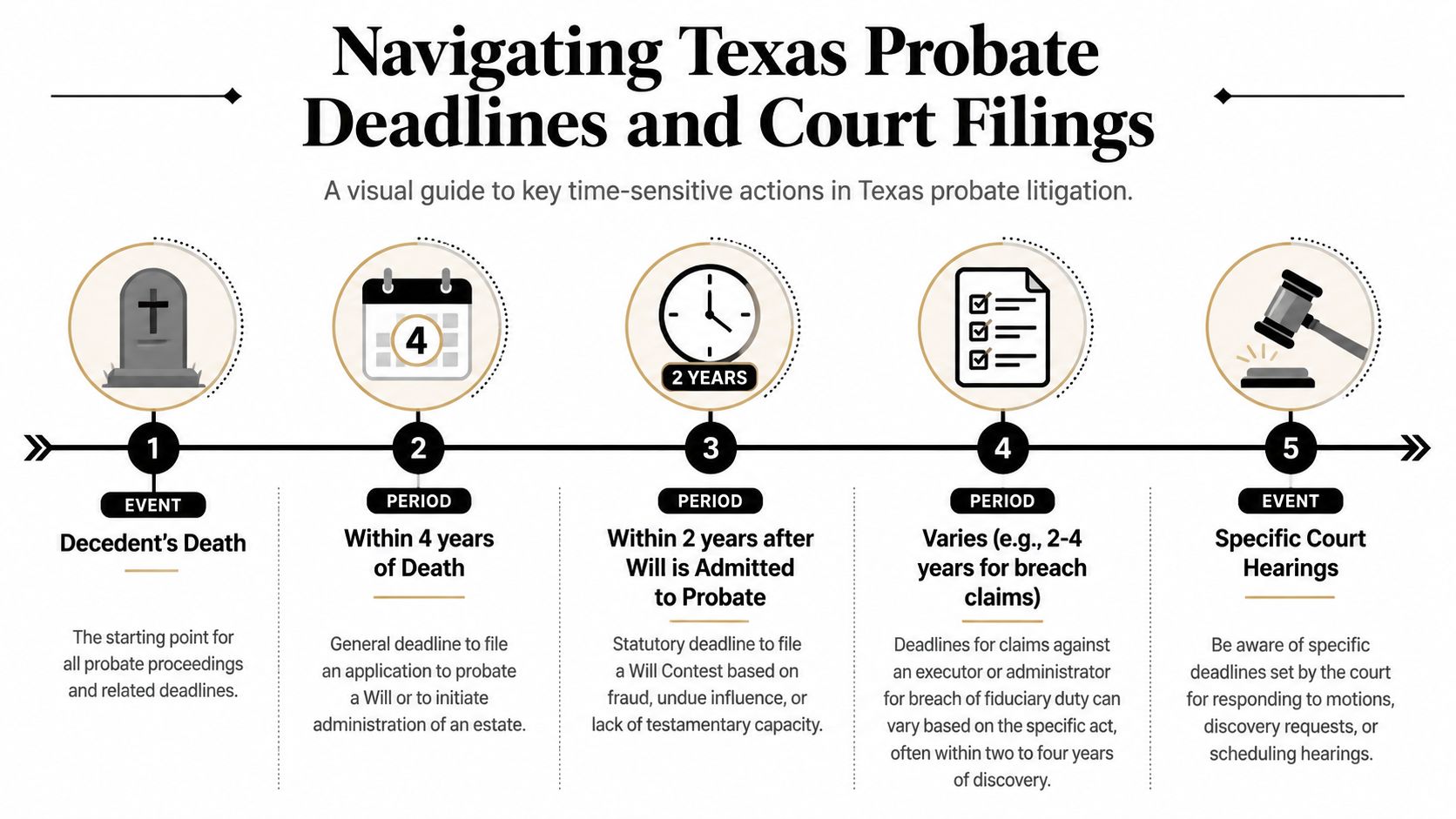
A will is “admitted to probate” when the court accepts it as the instrument that will govern the estate and enters an order allowing administration to move forward. That date matters. In many Texas disputes, it becomes the point from which certain limitation periods are measured, including the general two-year contest window under Texas Estates Code Section 256.204.
Texas law also generally allows up to four years from death to file an application to probate a will in many situations. That doesn't mean every dispute can safely wait that long. Once assets are transferred, sold, or commingled, recovery becomes harder.
Why fast action matters even outside Texas statutes
Probate lawyers in other jurisdictions warn how unforgiving these deadlines can be. Some will-contest deadlines can be as short as 120 days in certain jurisdictions, which shows how quickly rights can be lost when families delay (probate fraud deadline guidance). Texas has its own rules, but the practical lesson is the same. Don't assume fraud gives you unlimited time.
A short visual can help make the timeline easier to understand:
Filings that often matter early
Watch these documents and events closely:
- The probate application because it tells you who is asking the court for authority.
- The order admitting the will because it may trigger contest deadlines.
- Letters testamentary or administration because they show who has legal authority to act.
- Inventories and accountings because they reveal what property the estate acknowledges.
- Hearing notices and response deadlines because missing one can weaken your position.
If real estate is part of the dispute, timing can become even more important. A house may need upkeep, insurance decisions, and sale planning while litigation is pending. Families trying to understand those practical pressures often find Cyber Homes' guide for executors useful, especially when a probate property may be sold before everyone agrees on what should happen next.
Court deadlines and property transfers tend to move faster than families expect.
Building Your Case and Working with a Probate Attorney
A strong probate fraud case usually starts subtly, long before anyone files an objection in court. By the time you speak with counsel, the most useful thing you can bring is a clean timeline, copies of records, and a short list of specific concerns tied to documents or transactions. That gives your attorney something concrete to test.
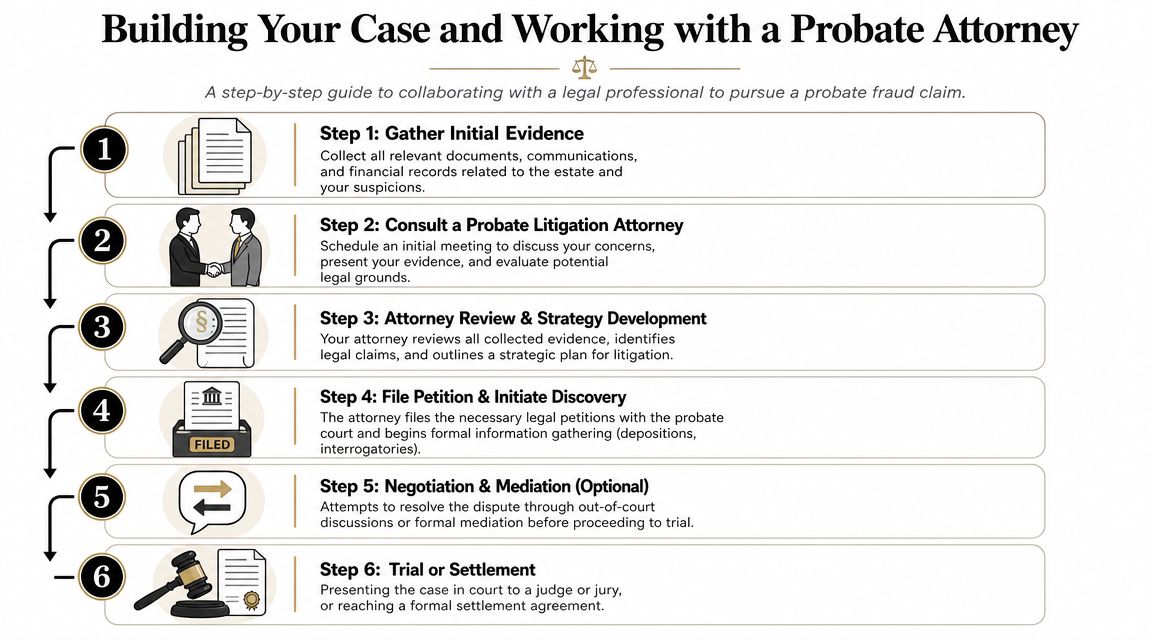
In practice, these cases often come together in three parts. First, the paperwork itself may look wrong, such as a signature that does not match prior records, a will with unusual formatting, or missing pages. Second, the decedent may have been vulnerable because of illness, isolation, dependence on one relative, or declining memory. Third, the money trail may show unexplained transfers, closed accounts, changed beneficiaries, or property moved shortly before death. A court may see any one of those facts as suspicious. Several of them, tied together carefully, can support a serious challenge.
What an attorney actually does with your evidence
A probate litigator does more than read a will and offer an opinion. The job is to sort your records into claims the court can act on and to identify what proof is still missing. That can include:
- Comparing signatures and versions of documents for signs of forgery, substitution, or later changes.
- Reviewing medical, caregiving, and facility records to examine capacity, dependence, and susceptibility to undue influence.
- Tracing money and title changes through bank records, brokerage statements, deeds, and subpoenaed materials.
- Choosing the right procedural tool such as a will contest, request for accounting, petition to remove a personal representative, or a related civil action.
- Asking the court for protective relief if estate assets are at risk of being sold, transferred, or depleted.
Experts sometimes matter. A handwriting examiner may help with a disputed signature. A forensic accountant may follow transfers that do not appear in the inventory. In an heirship dispute, a forensic genealogist may be necessary. Those are not dramatic extras. They are often what turns suspicion into admissible proof.
A realistic example
A daughter believes her father's final will was fabricated after a sharp decline in his health. She has older greeting cards and checks with his signature, text messages showing another relative screening his calls, and medical records reflecting cognitive problems in the last months of life. She also learns that one investment account was emptied shortly before his death.
That fact pattern gives an attorney several places to work. The old signatures allow a comparison. The medical records help address capacity and undue influence. The text messages may show isolation and control. The account activity points to tracing and subpoenas. This is the kind of file that can be developed without alerting the suspected wrongdoer too early.
That last point matters.
Families sometimes damage good cases by confronting the person they suspect before the records are secured. Once that happens, documents disappear, stories harden, and account access changes. A better approach is usually to preserve what you already have, avoid accusations by text or email, and let your lawyer decide when formal notice should go out.
Where pre-death exploitation may matter
Some probate fraud cases begin before death, during a period when an older adult was being isolated, pressured, or financially used. That history can explain why beneficiary designations changed, why a new will appeared, or why assets no longer match what the family expected. It may also affect what records your attorney requests first, including caregiver communications, adult protective services records, or prior power of attorney documents.
If you want legal help evaluating your options, one available resource is Law Office of Bryan Fagan, PLLC, which handles Texas probate administration and probate litigation matters.
Key Insight: If you suspect fraud in a Texas probate case, start by preserving records, building a timeline, and getting legal advice before the suspected actor knows you are preparing a challenge. Quiet preparation often protects the estate better than an early confrontation.
Calm, organized action puts families in a stronger position. Sometimes the problem is fraud. Sometimes it is executor misconduct, undue influence, or serious neglect. Either way, the families who do best are the ones who document first and accuse later.
If you're facing probate in Texas, our team can help guide you through every step, from filing to final distribution. The attorneys at Law Office of Bryan Fagan, PLLC work with families dealing with probate disputes, contested wills, executor misconduct, and estate administration concerns across Texas. If something about a loved one's estate doesn't feel right, schedule your free consultation today.