Skip to content
When a loved one dies, families often expect grief, paperwork, and hard decisions. What they don't expect is opening the mail and finding credit card bills, medical balances, loan notices, and tax letters that seem larger than everything the person owned.
That's often the moment panic sets in. People worry the house will be taken immediately. They worry the executor has to start paying bills right away. Most of all, they worry the family will inherit the debt along with the loss.
In Texas, that fear is usually not how the law works. If you're trying to understand What If Estate Debts Are More Than Assets in Texas?, the first thing to know is that Texas has a legal process for this situation. It isn't random, and it isn't supposed to be handled by guesswork.
If the estate is underwater, the focus shifts away from “how do we pay everything” and toward “what must be paid, in what order, and what property is protected by law.”
A Compassionate First Look at Insolvent Estates
Maria's father dies owning a pickup, a bank account, and a home with debt attached to it. Within weeks, the family starts receiving statements for medical bills and credit cards. Her brother says they should just pay the smallest bills first to stop the calls. Maria worries that if they don't, the family will be personally responsible.
That reaction is very common, especially in the first days after a death. But it usually starts from the wrong assumption.

Under Texas probate guidance, heirs generally are not personally liable for an estate's unpaid debts because the estate is insolvent. If the estate's assets are insufficient, creditors may recover only from estate property, and unpaid balances are typically not shifted to family members unless a specific person independently owed the debt or co-signed it. You can read that explanation in this discussion of debt after death in Texas.
That point matters because it changes the emotional posture of the case. The family may still lose an inheritance. The estate may still have serious problems. But the law usually doesn't turn a parent's unpaid bills into a child's personal debt just because the child is an heir.
What this situation is called
When debts are greater than available estate assets, lawyers call it an insolvent estate. That sounds intimidating, but the basic idea is simple. The estate can't cover everything that's owed.
An insolvent estate is a legal administration problem, not an automatic personal debt crisis for the family.
Probate becomes important. The court-supervised or court-recognized process helps the personal representative gather property, identify claims, and follow Texas rules before any distributions are made. If you need a plain-English overview of that larger process, this guide to the Texas probate process after someone dies with debt is a helpful starting point.
Families often feel pressure to act fast. In most cases, the better move is to slow down, identify what's in the estate, and avoid paying creditors out of order.
What Legally Defines an Insolvent Estate in Texas
A Texas estate is considered insolvent when the debts and obligations tied to the estate are greater than the assets available to pay them. Texas law treats that as a specific probate issue, not just a financial inconvenience.
A useful way to think about it is a small business that closes with more bills than cash and property. Someone still has to sort out what exists, what is protected, and which creditors have legal priority. An estate works in a similar way, except the rules come from the Texas Estates Code and related property protections.
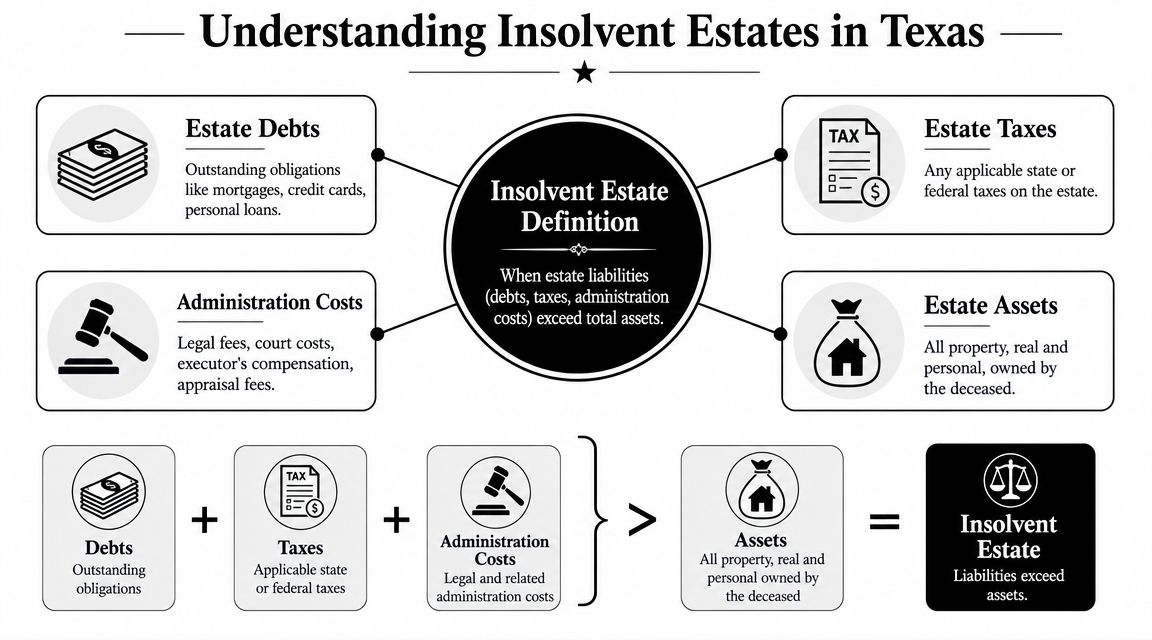
Texas guidance explains that when an estate has more debts than assets, it is treated as an insolvent estate and the personal representative must follow a statutory priority system. Texas law also protects certain property from liquidation, including exempt property and homestead protections, which can further reduce the pool available to creditors. That summary appears in TexasLawHelp's discussion of debts and deceased relatives.
Probate assets and non-probate assets
Many families often misunderstand the situation. Not everything a person owned becomes part of the pool available to pay estate debts.
Probate assets are generally the assets that pass through the estate administration process. These may include property titled only in the deceased person's name and requiring legal authority to transfer.
Non-probate assets usually pass outside the estate based on how they were titled or who was named to receive them. Common examples can include an account with a payable-on-death designation or a life insurance policy with a named beneficiary.
Here's the practical difference:
| Asset category | General treatment |
|---|---|
| Probate asset | May be part of the estate administration and potentially available for valid claims |
| Non-probate asset | Often passes directly to the named beneficiary or surviving owner, outside normal estate administration |
Why the distinction matters
Families often assume every asset is available to creditors. That's not always true. If a person dies with a bank account in their sole name, that may be part of the probate estate. If they also had a life insurance policy payable directly to a child, that's often a separate path entirely.
The estate's balance sheet can look much smaller once you separate probate property from property that passes outside probate.
That's one reason insolvent estates require careful review before anyone promises payment. On paper, the family may think there are enough assets. In reality, once exempt property and non-probate property are set aside, the amount available to creditors may be far less than expected.
For Texas families, that legal framework usually starts in Title 2 and Title 3 of the Texas Estates Code, which govern many probate administration rules, personal representative duties, creditor claims, and estate handling procedures.
How Texas Law Prioritizes Creditor Claims
The most important practical rule in an insolvent Texas estate is this. The executor does not pay bills in the order they arrive.
That surprises many families because ordinary life trains us to respond to whoever is calling the loudest. Probate doesn't work that way. Under Texas law, creditor claims are handled through a required order of payment.
Texas probate commentary explains that in an insolvent Texas estate, the executor does not pay creditors on a first-come, first-served basis. Texas Estates Code establishes a statutory priority ladder where higher-class claims must be fully satisfied before any lower-class claim can be paid. If funds are insufficient for a class, they are distributed pro rata among claims in that class. That summary appears in this discussion of Texas creditor priority rules in probate.
Why the order matters
The priority system exists for fairness and legal control. If executors could pay whichever creditor complained first, lower-value or less urgent debts might consume funds that should have gone to protected or higher-priority obligations.
That can create a second problem. If an executor pays the wrong claim too soon, the executor may later face demands to correct the mistake. In disputed cases, that can lead to conflict requiring probate litigation over secured claims and payment rights.
Texas Priority of Claims for Insolvent Estates
The Texas Estates Code, including Chapter 355 and the claims-priority framework often discussed with Section 355.102, creates the basic ladder. In plain English, some categories come ahead of others.
| Priority Class | Type of Claim |
|---|---|
| Higher priority claims | Estate administration costs and other claims Texas law puts near the top of the ladder |
| Next levels | Certain funeral and last-illness expenses, followed by other classes recognized by statute |
| Lower priority claims | General unsecured debts, such as many credit card or personal loan balances |
The exact classification of a claim can be technical. That's why executors shouldn't rely on a billing statement alone to decide where it belongs.
A simple example
Suppose an estate has limited non-exempt probate funds. The executor receives:
- A funeral invoice that may fall into a priority class recognized by Texas law
- A credit card demand from an unsecured creditor
- An administration expense tied to handling the estate
- A secured debt notice involving collateral
The executor cannot just pay the credit card company because it called first. Higher-priority claims must be addressed before lower-priority claims receive payment.
If there isn't enough money to pay every creditor within the same class in full, the available funds are typically shared pro rata. That means creditors within that class are usually paid proportionally rather than one being paid in full while another gets nothing.
Practical rule: Before writing any check from an insolvent estate, identify the claim's legal class, whether the asset involved is exempt, and whether a deadline or notice requirement applies under the Estates Code.
Common family misunderstandings
Families often mix up three different questions:
- Is the debt valid
- Is the debt collectible from estate property
- If collectible, where does it fall in the payment order
Those are not the same issue.
A debt might be real, but still recoverable only from certain estate assets. Another claim might be valid but low priority, which means it may receive nothing if higher classes exhaust the estate first. This is why payment sequencing matters so much in insolvent administrations.
Assets Shielded from Estate Creditors
One of the most reassuring parts of Texas law is that not everything is up for grabs. Even when an estate has serious debt, some property may be legally protected for the surviving family.
That protection matters because many estates in Texas include a mix of protected and unprotected property. The result is that the pool available to creditors can be much smaller than the family first assumes.

Homestead protection
Texas is well known for strong homestead protections. In many situations, the law protects the home for a surviving spouse and minor children rather than treating it like a simple asset to liquidate for general creditors.
That doesn't mean every debt tied to a house disappears. It means the analysis is more careful than many families expect. The house may not be available to satisfy ordinary creditor claims in the same way as non-exempt estate property.
Exempt property
Texas law also protects certain exempt property from liquidation. In plain English, exempt property is property the law sets aside from many creditor claims.
Examples often include categories of ordinary living property, such as:
- Household items needed for daily life
- Clothing and personal effects used by the family
- Some vehicles or tools depending on the facts
- Other property protected by Texas exemption law
These rules matter because creditors may focus on what exists, while the probate court focuses on what is legally reachable.
Property that often passes outside the estate
Some assets often avoid the normal probate estate entirely if they have a valid beneficiary designation or survivorship feature.
Examples may include:
| Asset type | Why families often ask about it |
|---|---|
| Life insurance with a named beneficiary | It may pass directly to that beneficiary instead of through the estate |
| Retirement accounts with designated beneficiaries | These often have their own transfer mechanism |
| Joint accounts with survivorship rights | Ownership may pass directly to the surviving owner |
This is one reason planning matters. Families who work on Wills and trusts planning in Texas often try to reduce confusion about what passes through probate and what doesn't.
Creditors can only pursue property that the law actually makes available to them. They cannot simply point to every asset the deceased ever touched.
The hard part is that protection questions can turn on details. Title records, beneficiary forms, marital property issues, and the presence of a surviving spouse or minor child can all change the answer.
Your Duties as Executor and Strategic Options
A lot of executors worry about one question first: "Am I going to be stuck paying these bills myself?" In many Texas estates, that is not the first problem to solve. Your first job is to protect the estate, follow the creditor rules in the right order, and avoid paying the wrong claim too soon.
That can feel backwards to a family under pressure. Creditors may call early. Relatives may ask when they will receive property. You may feel pulled in ten directions at once.
Your role is closer to a traffic officer than a bill payer. You gather information, direct each claim into the right lane, and make sure estate property that Texas law protects stays protected.
What the executor should do first
In an insolvent estate, a careful executor usually works through a sequence like this:
Pin down what property is in play
Identify the probate estate before paying anyone. If property is exempt or passes outside probate, it may not be available to general creditors.Gather the paper trail
Pull account statements, deeds, loan documents, tax records, titles, and correspondence from creditors. A debt is harder to evaluate if the records are incomplete.Review claims through probate procedures
Some demands look urgent but still need to be examined for timing, proof, and legal priority. If a demand appears unsupported or defective, the estate may need to consider rejecting a creditor claim in Texas probate.Hold off on distributions
Do not transfer cash or property to heirs before debts, costs of administration, and protected family rights have been sorted out.
One early payment can create a mess.
Suppose Elena is serving as executor for her father's estate. A credit card company sends a firm collection letter, and she pays it from the estate checking account because she wants to act responsibly. A short time later, she learns the estate funds should have been reserved for higher-priority obligations and administration costs first. The problem was not bad intent. The problem was paying before the estate's priority system had been fully mapped out.
Strategic options beyond paying bills
An insolvent estate is not handled by writing checks until the money runs out. Often, the better approach is to slow down, sort claims by legal status, and make deliberate decisions.
Possible options include:
Negotiating with creditors
Some creditors will discuss settlement when estate funds are limited and the probate record shows there is little to collect.Testing the claim itself
A claim may fail because it lacks documentation, was not presented correctly, arrived too late, or falls lower in priority than the creditor suggests.Using disclaimers carefully
In some circumstances, an heir may choose to refuse an inheritance. That decision can affect who receives the property and how the estate is administered, so it should be reviewed closely before anyone signs.Keeping estate debt and personal debt separate
Family members sometimes mix the deceased person's obligations with their own financial stress. If a surviving relative is also trying to organize separate personal bills, it may help to plan your debt repayment path so those issues stay distinct from the probate process.
Here's a short resource many families find useful before meeting with counsel:
The community property exception
Texas adds another layer when a surviving spouse is involved. As a general rule, heirs do not become personally liable for estate debts just because the estate cannot cover them all. A surviving spouse, however, may still have responsibility for certain community debts depending on the nature of the debt, the property tied to it, and how the obligation arose, as explained in this discussion of handling debts during Texas estate administration.
This is why executors need to separate two questions that families often blend together. One question is what the estate owes. The other is whether Texas marital property law places some separate responsibility on a surviving spouse. They are related, but they are not the same.
When minors are involved
If minor children are part of the picture, the executor may need to pay close attention to who can receive property, who can manage it, and what family protections apply. Those issues can overlap with court procedures involving guardianships or other protective arrangements.
For executors who want structured legal help with inventorying assets, handling notices, and managing claim review, one available option is the Law Office of Bryan Fagan, PLLC, which handles Texas probate administration matters.
Key Insights and When to Contact a Probate Attorney
A family often reaches this stage after weeks of sorting mail, answering questions, and worrying about what comes next. Then one clear pattern appears. The estate cannot pay everything.
That does not mean you have failed as executor. It means your job becomes more precise.
In an insolvent Texas estate, the executor's work is less about panic over personal liability and more about following an ordered process. You are identifying which assets are part of the probate estate, separating out property the law protects for the family, reviewing creditor claims carefully, and paying valid claims in the order Texas law requires. A useful way to picture it is a set of labeled buckets. Some property belongs in the estate bucket. Some belongs in a protected bucket. Some debts get paid sooner than others. Problems usually start when those buckets get mixed together.
Key takeaway
Key Takeaway: In Texas, an estate with more debts than assets does not automatically mean relatives must pay those debts themselves. The key issues are identifying the probate estate, protecting exempt property, applying the creditor priority rules in the Texas Estates Code, and handling any community property questions correctly.
A short delay for legal guidance can prevent a much larger problem later. Paying the wrong creditor first, agreeing too quickly that a claim is valid, or distributing property before the estate is ready can create avoidable conflict and, in some cases, expose an executor to unnecessary risk.
When legal help becomes especially important
You should speak with a probate attorney promptly if any of these apply:
- You have received creditor notices and are unsure whether the claims are valid, timely, or properly classified
- The estate includes a home or other real property and you do not know whether it is exempt, secured, or part of the probate estate
- A surviving spouse is involved and community debt questions may affect who is responsible for what
- Family members are asking for distributions before debts, exemptions, and claim priority have been sorted out
- You are serving as executor and want help following the required probate steps under Texas law
A probate lawyer can help you examine the estate like a checklist instead of a crisis. That includes reviewing the asset list, identifying property creditors cannot reach, checking whether claims were presented correctly, and helping you avoid payments out of order. For many families, that guidance brings two things they need right away. Clarity and breathing room.
If you are facing probate in Texas, the Law Office of Bryan Fagan, PLLC can help guide you through each step, from filing through final distribution. Schedule your free consultation today.