A lot of executors first learn about creditor claims the hard way. You open the mail while still handling funeral paperwork, family calls, and court filings, and there it is: a bill you don’t recognize, a collection notice that feels inflated, or a demand that doesn’t match what your loved one told you. That moment can be unsettling.
If you’ve been appointed to manage a Texas estate, you’re not required to pay every bill that arrives. Your job is to protect the estate, follow the Texas Estates Code, and make careful decisions before estate assets go out the door. In many cases, that means reviewing a debt closely and, when appropriate, rejecting it.
For families searching for guidance on rejecting creditor claim texas probate, the biggest source of stress is usually the same. They want to do the right thing, but they’re afraid one missed step could create personal liability or delay the estate. That concern is valid. The rules matter. So does the timing.
This guide walks through the process in plain English, with special attention to a group that often gets overlooked: out-of-state executors trying to manage a Texas probate remotely.
Your Role as the Estate's Financial Guardian
Maria had just been appointed executor for her father’s estate. She lived in Colorado. Her father had lived in Harris County. Within days of receiving letters testamentary, she started seeing mail addressed to him from hospitals, credit card companies, and one creditor she had never heard of. One envelope claimed the estate owed money for services she couldn’t verify.
That is a common probate moment.
As executor or personal representative, you become the estate’s financial guardian. That doesn’t mean you act like a debt collector or a judge. It means you gather information, protect assets, and make sure only proper claims are paid. If a debt is wrong, unsupported, already paid, expired, or aimed at the wrong person, you may need to challenge it.

What a creditor claim means
A creditor claim is a demand for payment from the estate. The person or company making the demand says your loved one owed a debt at death. That can include things like medical bills, loans, invoices, or credit card balances.
Some claims are straightforward. A mortgage statement tied to the decedent’s home is usually easy to identify. Others are far less clear. You may see old collection accounts, duplicate charges, or claims with little backup.
You’re not protecting the estate by paying fast. You’re protecting it by paying carefully.
Texas probate law gives executors tools to review and reject claims because estates need order and finality. Heirs and beneficiaries shouldn’t lose their inheritance to debts that were never proven.
Why caution matters
Executors often feel pressure to “clear the bills” quickly so probate can move along. That instinct is understandable, especially when family members want closure. But paying too soon can create problems.
Start with the basics:
- Confirm the debt belongs to the decedent: Some claims are addressed correctly but relate to another person with a similar name.
- Check whether the amount makes sense: Fees, interest, and add-ons can raise questions.
- Look for supporting records: Contracts, statements, invoices, and payment history matter.
- Ask whether the debt is secured or unsecured: That distinction affects how the claim is handled.
If you’re organizing estate finances from a distance, it can help to create a simple tracking system for incoming bills, claim dates, and supporting documents. Even practical business resources on automating accounts payable can give you ideas for building a clean review process, especially if you’re sorting large volumes of mail and invoices for an estate.
Your duty is to the estate as a whole
Probate isn’t only about debts. It’s also about preserving what remains for beneficiaries after lawful expenses are handled. That’s why a rejection isn’t aggressive or improper when it’s justified. Sometimes it’s exactly what the executor is supposed to do.
A careful executor asks, “Is this valid, documented, timely, and properly presented?” That question protects everyone involved.
Evaluating a Creditor's Claim The First Step
You may be sitting in Denver or Atlanta, opening a scanned claim that arrived at the Texas probate court or at your loved one’s old address, and wondering whether you are supposed to pay it, reject it, or ask for more proof. That uncertainty is normal. Your job at this stage is to verify the claim before you decide what the estate should do with it.

A creditor’s claim is a request for estate money, but the request itself does not prove the estate owes it. Start by reading the claim as if you were balancing a checkbook for someone else. Slow, methodical review usually prevents the mistakes that create bigger probate problems later.
Read the claim like an auditor, not a bill payer
Look for the basic facts first. Who is making the claim? What exactly are they saying the decedent owed? Is the amount tied to a contract, invoice, loan statement, or judgment? If those pieces are unclear, you do not yet have enough to make a sound decision.
For out-of-state executors, this step often takes more coordination. Mail may be going to a Texas residence, a post office box, your lawyer’s office, or a mail forwarding service. Ask that every claim be scanned in full, including envelopes, cover letters, and attachments. The postmark date and the exact paperwork received can matter.
What should be in the file
Before you decide whether a claim is valid, gather and label these items:
- Creditor identity
- Amount claimed
- Basis for the debt
- Supporting records, such as statements, contracts, invoices, or account histories
- Any verification or authentication included with the claim
- Date received and where it was sent
That last point gets missed often. If you live outside Texas, create one digital folder for each creditor and save every PDF, email, fax confirmation, and mailing receipt in that folder. A good probate file works like a well-labeled medical chart. If someone questions a decision later, you can show exactly what arrived and when.
Secured claims and unsecured claims require different analysis
A mortgage lender and a credit card company are not asking for the same kind of right.
A secured claim is tied to property, such as a house or vehicle. The creditor may have rights in that specific asset.
An unsecured claim is a general request for payment from estate funds. Medical bills, many personal loans, and credit card balances often fall into this category.
That distinction affects how you evaluate risk. With a secured claim, ask what property backs the debt and whether the balance matches the records. With an unsecured claim, focus on whether the creditor has properly presented and documented the demand. If you want a fuller explanation of the Texas probate creditor claims process, that guide is a helpful companion.
A common example
Suppose a hospital sends a large bill to the estate. The statement shows only a balance due. It does not include dates of service, insurance adjustments, or any explanation of prior payments. You also find notes in your aunt’s papers suggesting coverage was under review before she died.
That claim may be valid. It may also be overstated, premature, or missing required support.
In that situation, compare the bill to insurance explanations of benefits, prior bank payments, correspondence, and any records from the decedent’s files. If you are managing the estate from another state, ask a Texas family member, your lawyer, or a trusted mail service to scan both sides of every page. Missing the back page of a statement or the affidavit attached to a claim can change the legal analysis.
Independent executors have a useful tool
If you are serving in an independent administration, Texas law gives you a way to force clarity on certain unsecured claims. A permissive notice can require the creditor to present an authenticated claim within the statutory period. If the creditor does not do that on time, the claim can be barred. A practitioner discussion of that process appears in this discussion of disputing creditor claims in Texas probate.
For remote executors, this tool can be especially helpful. It reduces the chance that loose, half-documented demands will linger while you are trying to manage probate from hundreds of miles away. It also creates a cleaner paper trail if your communications are being handled by certified mail, email coordination, and faxed signatures. If you are reviewing whether a signature, affidavit, or claim presentation is legally effective, this explanation of what makes a document legally binding gives useful background.
Questions to answer before you respond
Ask yourself:
- Is this the decedent’s debt?
- Is the amount supported by records?
- Is the claim secured or unsecured?
- Was it presented in a form Texas probate practice recognizes?
- Do I have a complete copy of everything that was sent?
- If I live out of state, do I need my Texas attorney or local agent to confirm what was physically received?
A careful review at this stage protects the estate and protects you. Many claim disputes turn on paperwork, timing, and recordkeeping long before anyone argues about the debt itself in court.
How to Formally Reject a Claim in Texas
You may be sitting in Colorado, Florida, or California with a stack of estate papers on your kitchen table, trying to make a Texas deadline from hundreds of miles away. That distance does not prevent you from rejecting a claim, but it does make precision more important. In probate, a rejection that is clear, dated, and provable works like a certified snapshot of the estate’s position at that moment.
The first question is the one that controls the procedure. Is this an independent administration or a dependent administration? Texas treats those two paths differently, and out-of-state executors often get into trouble by assuming one set of rules applies to both.
The two administration types
An independent administration gives the executor more room to act without asking the court for permission at every turn.
A dependent administration involves tighter court supervision. Deadlines and formal steps matter more, and your paper trail needs to be clean.
If you live outside Texas, do not guess which one you have. Confirm it from the court order appointing you, the will, or your Texas probate attorney. A wrong assumption here can affect both timing and the form of your response.
Dependent administration process
In a dependent administration, the administrator generally has 30 days after receiving the claim to allow or reject it. The rejection should be in writing, and you should keep proof showing exactly when the creditor received that notice.
That deadline is short. If you are managing the estate remotely, build in mailing time, signature time, and time to confirm what was received in Texas. Many remote executors use a local attorney, registered agent, or trusted mail service so there is no confusion about the date a claim arrived.
Silence is risky in a dependent administration. A written response protects the estate and shows that you handled the claim in the time Texas law expects.
Independent administration process
In an independent administration, the process is less rigid, but a casual response is still a bad idea. A written rejection is usually the safest course because it creates a record of what you rejected, why you rejected it, and when the creditor received notice.
That matters even more when you are out of state. Phone calls, informal emails, and voicemail messages can create confusion later. A dated letter sent in a way you can prove is much easier for a court to understand than a back-and-forth chain of scattered communications.
If you are signing remotely or sending documents electronically, it helps to understand what makes a document legally binding, especially when the estate file includes scanned signatures, emailed approvals, and mailed originals.
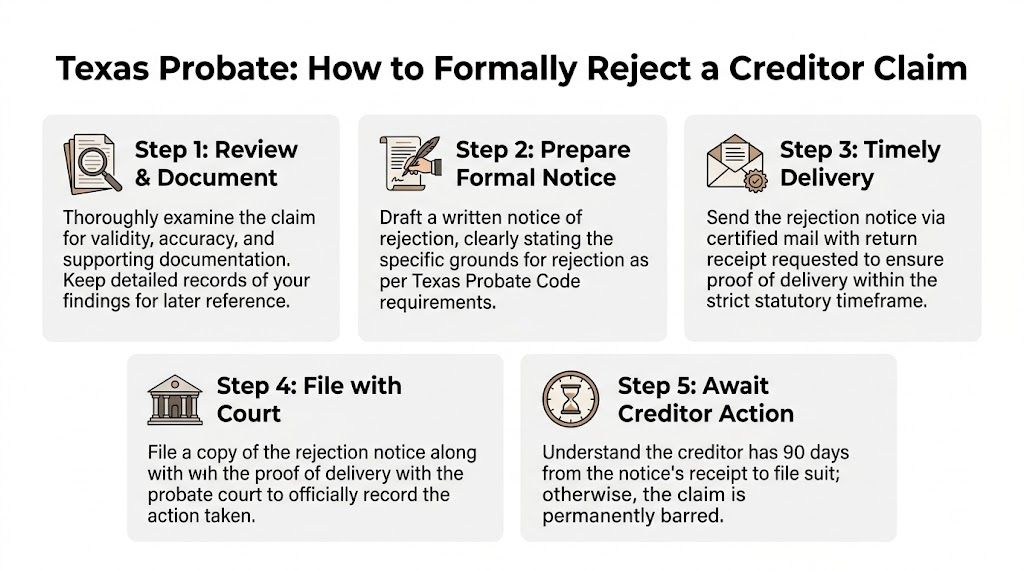
A practical five-step method
Use the same method each time. Consistency keeps small mistakes from turning into expensive ones.
1. Build a claim file
Gather the creditor’s claim, envelopes, emails, supporting records, account statements, and any estate documents that contradict the debt. Add your notes about when the claim was received and who received it.
For a remote executor, this file should exist in two places. Keep a digital copy you can access immediately and a physical copy with your Texas attorney or local contact if one is involved.
2. Draft a plain written rejection
The rejection letter should identify the estate, the creditor, and the specific claim. State clearly that the claim is rejected. If there is a short explanation, include it. Examples include lack of documentation, incorrect amount, prior payment, or dispute over whether the debt belongs to the decedent.
Clarity matters more than dramatic wording.
3. Send it in a way you can prove
Certified mail is often the safest practical choice. Some executors also send a courtesy copy by email to create a faster communication trail, but the mailed proof is usually what matters most.
If you live outside Texas, ask one practical question before sending anything. Who will keep the green card, tracking record, or delivery confirmation in the estate file? Decide that first.
4. Preserve filing and delivery proof
In a dependent administration, formal court procedures may require more than mailing a letter alone. Your Texas lawyer can tell you whether a filing, notation, or other court-facing step is needed in your county and case posture.
In any administration, keep the signed notice, mailing receipt, tracking confirmation, and a copy of everything sent.
5. Calendar the next deadline immediately
A rejection often starts a new clock for the creditor. As soon as the notice goes out, note the mailing date, delivery date, and any follow-up dates your attorney wants tracked. Remote executors do best when they treat probate deadlines like flight times. If you miss one, the whole plan changes.
Here is the visual summary:
Sample rejection language
You do not need legal theatrics. You need a notice that is specific and easy to prove.
“The Estate hereby rejects the claim submitted by [Creditor Name] regarding the alleged debt of [description or account reference]. The claim is rejected because the Estate disputes its validity, amount, documentation, or enforceability. This notice is provided by the personal representative of the Estate.”
Use that as a starting point only. The wording should match the actual reason for rejection. A claim rejected because the records are incomplete may be framed differently from a claim rejected because the debt was already paid or never belonged to the decedent.
Comparison table for executors
| Feature | Independent Administration | Dependent Administration |
|---|---|---|
| Executor flexibility | More discretion in handling claims | More court supervision |
| Need for formal written rejection | Strongly recommended | Usually part of a stricter process |
| Response timing | Depends on the claim and procedure used | 30 days to allow or reject after claim receipt |
| Use of notice as a claim-control tool | Written notice can affect later deadlines | Similar review concerns apply, with more court oversight |
| Court involvement in payment decisions | Lower day-to-day court involvement | Court approval is often central |
| Post-rejection creditor action | Depends on the procedural setting and limitations rules | Rejection can trigger a short deadline to sue |
Details executors often miss
A rejection should match the claim you are disputing. If there are three separate debts, identify the one you are rejecting. A vague statement denying “all claims” can create unnecessary confusion.
Recordkeeping is just as important as the letter itself. Keep one organized folder with the claim, the rejection notice, proof of delivery, and your supporting documents. For out-of-state executors, that single folder often becomes the difference between calm administration and a scramble for paperwork six months later.
If you need context for where claim rejection fits in the broader timeline, this guide to Texas probate notice to creditors procedures helps place the rejection step in order.
When legal help becomes practical
Some claim rejections are routine. Others involve secured liens, business debts, old family loans, or facts that are hard to verify from another state. In those situations, local Texas probate counsel can protect both the estate and you personally by making sure the rejection is timely, documented, and delivered correctly.
Options may include county-specific probate counsel, litigation counsel if a lawsuit is threatened, or a firm such as the Law Office of Bryan Fagan, PLLC that handles Texas probate administration and creditor claim disputes.
You do not need to panic. You do need a clean process, a good calendar, and records you can prove.
After the Rejection What Happens Next
Once the rejection goes out, many executors expect silence. Sometimes that’s exactly what happens. Sometimes it isn’t.
The creditor now has to decide whether to walk away, negotiate, or sue. The result depends heavily on the administration type and how carefully the rejection was handled.

Outcome one happens more than families expect
Sometimes the creditor does nothing.
That matters most in dependent administration, where Texas Estates Code § 355.064(a) imposes a strict deadline after rejection. A creditor whose claim is rejected in a dependent administration must file suit in probate court within 90 days of rejection or the claim is permanently barred, with no recourse against the estate or its heirs, as explained in this discussion of the Texas 90-day deadline.
That rule is one of the sharpest deadlines in Texas probate.
Missing the suit deadline doesn’t just weaken the claim. It can end it completely.
Outcome two is negotiation
A creditor may contact the executor or the estate’s attorney and try to resolve the dispute. That can happen when the documentation is incomplete, the amount is in dispute, or both sides want to avoid litigation.
Settlement talks don’t automatically mean the claim is valid. They indicate that probate administration often involves practical choices. If records show part of a claim may be legitimate, the estate may evaluate whether resolution makes more sense than a court fight.
Outcome three is litigation
If the creditor files suit on time, the dispute moves into probate litigation. At that point, the estate may need evidence, witnesses, payment history, medical billing records, contract documents, or communications showing why the claim should be denied in whole or in part.
The court then decides whether the claim is enforceable and, if so, in what amount.
A real-world lesson from secured debt
Executors sometimes assume that secured creditors are protected no matter what. That is not always the full story. In the 2023 Hernandez case described in the verified material, a secured creditor filed claims on three notes in a dependent administration. The administrator’s silence triggered automatic rejection under Texas probate procedures in June 2023. The creditor missed the 90-day lawsuit deadline and lost deficiency recovery rights beyond its collateral lien.
That example matters because it shows how strict the deadline can be. Even when a debt appears valid, missing the deadline can strip the creditor of major recovery rights.
What this means for the estate
For the estate, rejection creates movement. It prevents the probate from sitting open while unresolved claims linger indefinitely.
That helps in several ways:
- It creates a decision point: The creditor must act.
- It protects heirs from open-ended uncertainty: The estate can move toward administration and distribution.
- It sharpens the record: If a dispute goes to court, both sides know what is contested.
A simple timeline mindset
After rejection, executors should think in terms of monitoring rather than guessing.
Keep track of:
- the date the rejection was sent,
- the date it was received,
- any contact from the creditor,
- and any court filing by the deadline that applies.
If the creditor misses the controlling deadline in dependent administration, the estate may be able to treat the claim as barred. If the creditor sues on time, the estate shifts from claims administration into litigation defense.
That is why the rejection letter is not just a notice. It is a trigger.
Common Pitfalls and Solutions for Remote Executors
Many executors assume the hardest part of probate is gathering assets. In practice, the harder part is often procedure. A valid rejection can fail if notice is sloppy, records are incomplete, or deadlines are misread.
That risk increases when the executor lives outside Texas.
The most common mistakes
Some problems come up again and again:
- Poor documentation: The executor knows why the claim looks wrong but hasn’t preserved proof.
- Unclear rejection language: The creditor receives a vague letter that doesn’t clearly identify the claim being rejected.
- Mailing without a trackable record: If you can’t prove delivery, arguments about timing can follow.
- Confusing independent and dependent administration: The rules are not interchangeable.
- Paying to avoid conflict: Families sometimes approve a questionable debt just to keep peace.
These errors usually aren’t caused by bad intentions. They’re caused by grief, distance, and the mistaken belief that probate is mostly paperwork.
A remote executor has the same legal duties as a local executor. Distance doesn’t relax the deadlines.
The out-of-state executor problem
An estimated 15% of Texas probate filings involve out-of-state parties, and those remote executors face specific challenges such as navigating eFileTexas and virtual court proceedings, according to this discussion of out-of-state probate issues.
If you live outside Texas, the obstacles are practical before they’re legal. You may need to sign and return documents across state lines, review original records stored in a Texas home, coordinate certified mail, and stay current with probate court requirements in a county you’ve never visited.
Practical solutions that help
Build one master claim file
Use a single digital folder for each creditor. Save the claim, supporting documents, photos of mail, notes from phone calls, and every delivery receipt. Consistency matters more than sophistication.
Use eFileTexas and local court procedures carefully
Texas courts increasingly allow remote participation in many settings, but each court may have its own preferences. Check filing instructions, hearing settings, and whether your county expects local formatting or proposed orders.
Consider local counsel early
This is especially important if the estate is in dependent administration, if a creditor is represented by counsel, or if you anticipate a hearing. A Texas probate attorney can handle filings, notices, and appearances while you manage the estate from another state.
Don’t mix family conversations with legal positions
A sibling may insist a debt “should just be paid.” Another may say the creditor is lying. Record the input, but base your action on documents and legal process.
Related planning issues often overlap
Remote executors are often handling more than one estate concern at once. If the family is also dealing with an incapacitated relative, questions about Guardianship can arise alongside probate. And when the experience exposes weaknesses in a family’s planning, many families begin revisiting Wills & Trusts for the future.
Those related issues don’t change the creditor-claim deadlines. They do explain why so many executors feel stretched thin.
The safest mindset for remote administration
Treat every claim deadline as if no one else is tracking it for you. Because often, no one is.
Distance can be managed. Unclear records can be fixed. Missed deadlines are much harder to repair.
Key Insights and When to Hire a Probate Attorney
You may be reading this after opening one more letter from a creditor while living hundreds of miles from the Texas court handling the estate. If so, the pressure is real. You are trying to protect the estate, follow Texas rules, and avoid a mistake that could cost the beneficiaries money.
Your job is not to guess. Your job is to make careful decisions from records, deadlines, and procedure.
That is the key insight.
An executor is the estate’s financial guardian. When a creditor’s claim looks unsupported, inflated, late, or legally defective, Texas probate law gives you a way to reject it and require the creditor to prove its position through the proper process. Used correctly, that protects estate assets. Used carelessly, it can create delay, expense, and court problems, especially when you are handling everything from another state.
For out-of-state executors, distance adds a second layer of risk. A missed certified mailing, a county-specific filing requirement, or a hearing set on short notice can turn a manageable claim dispute into a scramble. Remote administration is possible, but it usually works best when someone in Texas is helping watch the calendar and respond quickly if the creditor pushes back.
Takeaway
Key Insight: As executor, you stand between the estate and claims that should not be paid without proof. Texas law gives you tools to reject questionable claims, but those tools work only if you follow the required steps and deadlines closely. If you live outside Texas, the legal rules stay the same while the practical challenges increase. Good records, prompt action, and local legal support when needed can protect both the estate and your peace of mind.
When you should strongly consider legal help
Some claim disputes are straightforward. Others deserve immediate attorney involvement because the cost of getting it wrong is too high.
Call a probate lawyer when:
- The claim is large or document-heavy: This often means contract terms, account histories, or missing records need close review.
- The estate is in dependent administration: Court oversight is tighter, and procedure matters even more.
- A secured creditor is involved: The estate may be dealing with lien rights, collateral, and separate deadlines.
- The creditor has threatened suit or already sued: At that point, the matter is no longer only administrative.
- You live outside Texas: Remote service issues, hearing settings, and county filing practices can create problems fast.
- A relative says the decedent owed them money: Family claims often mix grief, memory, and incomplete paperwork.
If litigation seems possible, it also helps to understand the broader path of Probate Litigation. And if you’re still deciding whether counsel is necessary at all, this guide on whether you need a probate lawyer can help frame that decision. For families who are earlier in the estate process, a broader overview of the Texas Probate Process can also put creditor claims in context.
A careful rejection can preserve the estate for the people the decedent intended to benefit. A rushed rejection can lead to hearings, legal fees, and avoidable conflict.
If you need help with rejecting a creditor claim, responding to a probate demand, or managing a Texas estate from another state, the Law Office of Bryan Fagan, PLLC can help you understand your options and next steps. If you’re facing probate in Texas, our team can help guide you through each stage, from filing to final distribution. Schedule your free consultation today.