When a loved one passes away, especially without a will, the last thing your family needs is a complicated legal process. Dealing with grief is hard enough. For many Texas families in this situation, the Texas Small Estate Affidavit (SEA) offers a compassionate and practical solution. Think of it as a simplified, faster path to transferring property to heirs, designed to save you time, money, and stress during an already difficult time.
At the Law Office of Bryan Fagan, we understand what you're going through. This guide is designed to provide clear, step-by-step information to help you navigate this process with confidence and peace of mind.
What Is a Small Estate Affidavit? A Plain-English Explanation
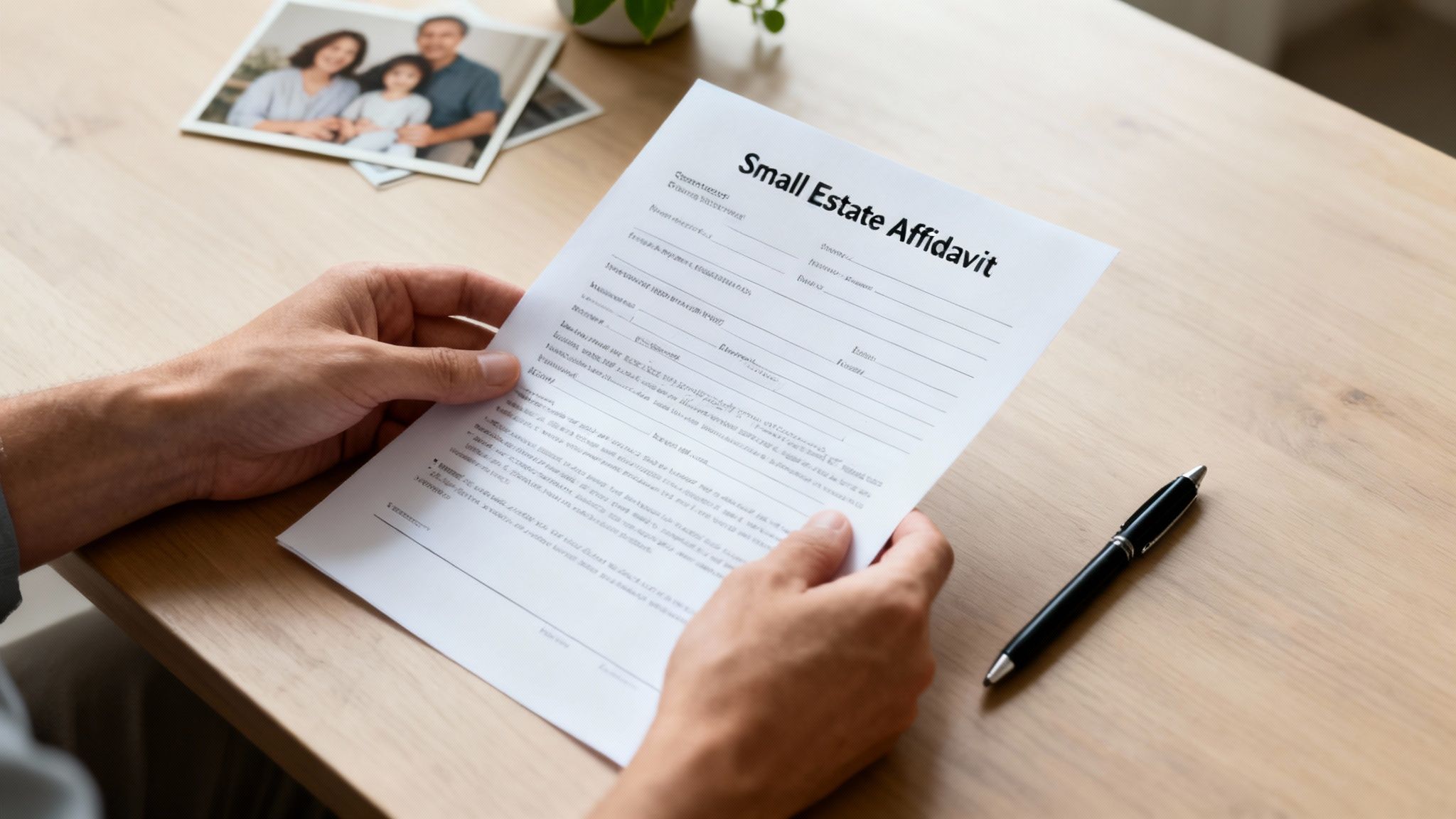
A Small Estate Affidavit is a sworn legal document used to collect and distribute the assets of a person who died without a will (a situation known as dying "intestate"). It is a powerful tool under Texas law that allows heirs to sidestep the more formal, lengthy, and expensive probate administration process.
Under Texas Estates Code, Chapter 205, this option is specifically designed for estates where the total value of the assets—not including the homestead and other specific exempt property—is $75,000 or less.
Why Does the SEA Exist?
The main purpose of the SEA is to provide a quicker, less expensive alternative to formal probate court, offering relief to families with straightforward estates. Instead of appointing an executor and attending multiple court hearings, the heirs can present a court-approved affidavit directly to banks, financial institutions, or anyone else holding the deceased's assets.
For an SEA to be valid, a few key conditions must be met: the person must have died without a will, at least 30 days have passed since their death, and the affidavit must be sworn to by two disinterested witnesses plus all the adult heirs. It's a way to handle simple estates without getting bogged down in the legal system while you are grieving.
Who Can Use a Small Estate Affidavit?
This is where the details matter. To qualify for this simplified procedure, the estate must meet a strict set of criteria laid out in Texas law. Getting this right from the start can save you from hitting a wall later.
A Small Estate Affidavit is only an option if:
- There's No Will: The person who passed away must have died intestate.
- The Value is Under the Limit: The estate's value, once you exclude the homestead and other exempt property, cannot be more than $75,000.
- Real Estate is Limited: The SEA can only transfer a homestead to a surviving spouse or minor children. It cannot be used to transfer any other kind of real estate.
- Assets Outweigh Debts: The estate’s assets must be greater than its known debts (not counting mortgages or other debts secured by the homestead).
This checklist helps you quickly see if you're on the right track.
Texas Small Estate Affidavit Eligibility Checklist
Here’s a quick summary of the essential criteria your loved one's estate must meet to qualify for a Small Estate Affidavit in Texas.
| Requirement | Explanation (Plain English) | Reference (Texas Estates Code) |
|---|---|---|
| Died Intestate | The person passed away without leaving a valid will. | § 205.001(1) |
| 30-Day Waiting Period | At least 30 days must have passed since the date of death. | § 205.001(3) |
| $75,000 Asset Limit | The total value of the estate (not counting the homestead and exempt property) is $75,000 or less. | § 205.001(4) |
| Assets Exceed Liabilities | The value of the estate's assets is greater than the total known debts. | § 205.001(5) |
| Heirs Identified | All heirs (and their legal capacity) are known and listed on the affidavit. | § 205.002(a)(2) |
| No Pending Administration | No one has already started a formal probate process for the estate. | § 205.001(2) |
If the estate checks all these boxes, you're likely in a good position to use the Small Estate Affidavit.
While the SEA is a powerful tool, it's not the right fit for every situation. You can learn more about when a small estate probate process is necessary in our detailed guide. And for a broader perspective, it's always wise to look into comprehensive end-of-life planning to make things easier for those you leave behind.
Calculating the Estate's Value for Qualification
The first and most important hurdle for using a Small Estate Affidavit (SEA) is determining the total value of the estate. Under Texas law, the estate’s assets cannot add up to more than $75,000. But here's the critical part—and where many families find relief—not everything counts toward that limit.
The law is designed with compassion. It specifically excludes certain major assets from the calculation, which makes the SEA a viable option for more families than you might first think.
What Assets Are Excluded From the Total Value?
The Texas Estates Code is clear about what property doesn't count toward the $75,000 cap. This is designed to protect a family’s basic living situation after losing a loved one.
The two main categories you can set aside are:
- The Homestead: This is the primary residence where the deceased person lived. If your loved one's main asset was the family home, its value does not get added to the total, regardless of what it's worth.
- Exempt Personal Property: Texas law also shields certain personal items from creditors, and these are excluded from the SEA calculation too. This typically includes one vehicle for each licensed driver in the family, home furniture, cherished family heirlooms, and tools of a trade.
By subtracting these protected items, you’re left with what we call non-exempt assets. This is what actually counts toward the limit—think bank accounts, stocks, rental properties, or a second vehicle.
A Real-World Calculation Example
Let's walk through a common scenario to illustrate how this works. Imagine a father in Houston passed away without a will, leaving behind his two adult children. His estate consists of:
- His primary home, valued at $250,000.
- A savings account with $25,000.
- His paid-off car, worth about $15,000.
- Furniture and personal belongings, valued around $10,000.
- A small portfolio of stocks worth $30,000.
At first glance, the total seems to be $330,000, which is well over the limit. But when you apply the Texas rules, the math changes completely.
The home ($250,000) is the homestead, so it's excluded. The car ($15,000) and his personal belongings ($10,000) are considered exempt personal property, so they're excluded too.
The only assets that actually count are the non-exempt ones: the savings account ($25,000) and the stocks ($30,000). When you add those up, the total value for the Small Estate Affidavit is only $55,000—well under the $75,000 threshold. This means his family can use the SEA to take ownership of the bank account and stocks without the headache and cost of a full probate process.
Putting together a detailed list is your first step. Our guide on how to make an itemized inventory for probate in Texas can walk you through that process. For many, the Texas small estate affidavit is the most affordable way to handle these types of assets. The court filing fee is usually just a few hundred dollars, a small fraction of what a full probate could cost. You can discover more insights about these cost savings from legal experts in the field.
Getting the Affidavit Form Right: A Step-by-Step Guide
Filling out a Texas Small Estate Affidavit isn't just paperwork; it's a sworn statement to a judge. Any mistake, no matter how small, can get your affidavit rejected, sending you back to square one and adding frustration to an already tough time. Let's walk through what the form asks for and why each detail is so critical.
The affidavit is typically broken down into three core sections: details about the person who passed away (the "decedent"), a complete roster of their heirs, and a transparent accounting of everything they owned and owed. Getting each of these pieces right is the key to having the court legally recognize the transfer of property.
Decedent and Heirship Information
This first part seems simple, but it’s the foundation of the whole affidavit. You'll need the decedent's full legal name, their exact date of death, and the county where they lived. This information establishes the court's jurisdiction and confirms that the most basic requirements for using an SEA are met—namely, that the person passed away without a will.
Next comes what is often the trickiest part: identifying every single heir. Texas intestacy laws (the rules for who inherits when there’s no will) can get complicated fast, especially with blended families, remarriages, or estranged relatives.
You are legally required to list:
- Every single heir entitled to a share of the estate.
- Their relationship to the decedent (e.g., spouse, child, parent).
- Their current address.
- The specific share of the estate they are entitled to under the law.
If you miss even one heir or can't locate them, the entire process grinds to a halt. The court cannot approve an affidavit if the heirship information is incomplete.
Listing All Assets and Debts
When it comes to the estate's finances, total transparency is non-negotiable. The court needs a complete and honest picture to confirm the estate qualifies for this simplified process. You must list all known assets and their fair market value at the time of death—think bank accounts, cars, furniture, and any other personal property.
Likewise, you have to list every known debt. This includes things like credit card balances, outstanding medical bills, or personal loans. The affidavit can only be approved if the value of the estate's assets (excluding the homestead and other exempt property) is more than its total known debts.
This visual shows exactly how that calculation works.
This calculation is the heart of what makes the SEA so useful. Since only non-exempt assets count toward the $75,000 limit, many families who might not otherwise qualify are able to use this faster, more affordable process.
Required Supporting Documents Checklist
Along with the affidavit itself, you'll need to submit a few other crucial documents. It’s always a good idea to gather these before you even start filling out the form to avoid delays.
- Certified Death Certificate: This is the official, government-issued proof of death.
- Proof of Assets: For every asset you list, you need documentation. This means recent bank statements, vehicle titles, or anything else that proves ownership and value.
- Proof of Homestead (if applicable): If the decedent owned a home that you're claiming as the homestead, you'll need a copy of the deed and the latest property tax statement.
Figuring out heirship or how to classify certain assets can be challenging. For families facing complex scenarios like blended families or unclear property records, getting professional guidance on matters like Guardianship or a Wills & Trusts consultation can provide the clarity you need. If disagreements pop up, it’s also helpful to know the basics of Probate Litigation. The entire Texas Probate Process has many steps, and we are here to help you through each one.
Filing the Affidavit with the Court
Once you've carefully filled out the small estate affidavit, the next step is to make it legally binding. This isn’t as simple as just signing a piece of paper; the document has to go through a few formal hoops before a judge will even glance at it. This process ensures everything is done transparently and under oath, giving the affidavit the legal weight it needs.
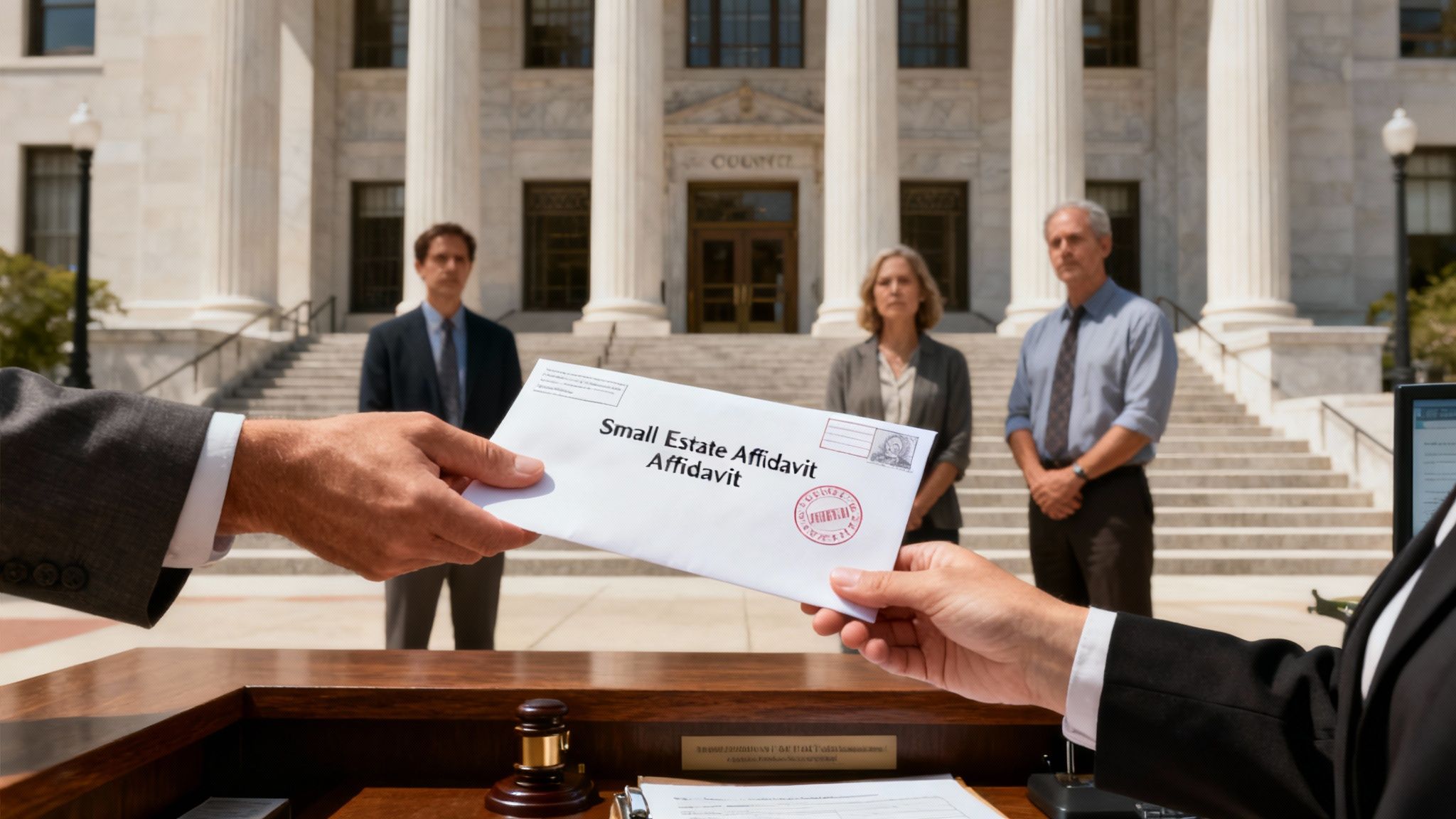
The first critical task is getting the signatures of your two disinterested witnesses. These individuals are essential for validating the entire affidavit.
Securing Witness Signatures
So, what is a disinterested witness? In plain English, it’s someone who has no financial stake in the estate. They can't be an heir, a creditor, or anyone else who stands to gain or lose something when the assets are distributed. Their job is to swear under oath that they knew the person who passed away and that, to the best of their knowledge, the family and heirship information in the affidavit is true.
Finding the right people is key. Good examples of disinterested witnesses often include:
- A longtime neighbor who knew the family dynamics.
- A close family friend who isn't named as an heir.
- A coworker or church member who was familiar with the decedent’s family.
Their sworn statement adds a layer of credibility to your filing, assuring the court that the information about the heirs is accurate.
Notarization: A Non-Negotiable Step
After the two disinterested witnesses and every single heir have signed the affidavit, the document must be notarized. This is an absolute must. Everyone who signed has to do so in the presence of a notary public. The notary's seal is the legal proof that the signatures are authentic and that each person swore to the truthfulness of the document's contents.
Don't even think about skipping this. An affidavit filed without proper notarization will be rejected on the spot by the court clerk. It's a simple but crucial requirement.
Where and How to File the Affidavit
With the fully signed and notarized affidavit in hand, you're ready to head to the county clerk. But which one? The venue is critical: you must file the Small Estate Affidavit in the probate court of the county where your loved one was living when they died. Filing in the wrong county is a common mistake that will bring everything to a grinding halt.
Every county has its own specific procedures, so it’s always a good idea to check the local court's website or call the clerk’s office before you go. Taking a few minutes to understand the specific probate court filing requirements for that jurisdiction can save you a wasted trip. You will also need to pay a filing fee, which varies by county but usually runs a few hundred dollars.
Once the judge approves the affidavit and signs the order, you can get certified copies from the clerk. This certified court order is the golden ticket—it's the legal document you will present to banks, vehicle title offices, and other institutions to officially transfer the assets to the rightful heirs.
Avoiding Common Pitfalls and Delays
Navigating a Small Estate Affidavit (SEA) can feel like a final, caring act for a loved one. But the path is narrow, and simple mistakes can lead to frustrating rejections from the court, adding unnecessary stress to an already difficult time.
From our experience helping Texas families through this process, we've seen the same honest mistakes derail otherwise straightforward filings. Knowing them ahead of time can make all the difference.
The Problem with Undisclosed Debts
One of the biggest red flags for a judge is a failure to disclose a known debt. The court requires absolute transparency. Omitting a credit card bill or a small medical expense—even if it feels insignificant—can invalidate the entire affidavit.
Why? Because the judge's approval hinges on the fact that the estate's assets truly outweigh its liabilities, as required by the Texas Estates Code. An incomplete financial picture makes that impossible to verify.
Inaccurate Heirship and Invalid Wills
Another common pitfall is getting the heirship wrong. Texas intestacy laws can be surprisingly complex, especially with blended families or children from different relationships. You are legally required to list every single heir.
Forgetting to include a distant but legally entitled cousin isn't a minor oversight; it will cause an immediate rejection from the court.
Similarly, trying to use an SEA when a valid will exists is a non-starter. A Small Estate Affidavit is designed exclusively for intestate estates—those without a will. If a will is discovered later, any order approved based on the SEA could be voided, creating a legal mess for everyone involved.
Steering Clear of Rejection
To make sure your affidavit is accepted on the first try, slow down and double-check every detail before heading to the courthouse.
Here are a few final pointers from the field:
- Confirm All Debts: Don't guess. If you're unsure about outstanding balances, it’s worth the time to proactively contact potential creditors.
- Verify Heirship: If there’s even a hint of uncertainty about the family tree, it's far better to resolve it now than to have the court find an error later.
- Check for a Will: Before you even start the SEA process, conduct a diligent search for a will among personal papers, in safe deposit boxes, and with family members.
By tackling these common issues head-on, you can submit your small estate affidavit form texas with confidence. This diligence honors your loved one's memory by ensuring their affairs are settled smoothly and correctly, avoiding painful delays during a time of grief.
Our team has experience in every aspect of the Texas Probate Process and can step in to help with complex situations involving Guardianship or disagreements requiring Probate Litigation. For those planning ahead, we also offer guidance on Wills & Trusts.
Got Questions About Texas SEAs? We’ve Got Answers.
When you're sorting out a loved one's affairs, a lot of specific questions pop up, especially when you're navigating something like a Texas Small Estate Affidavit. It's tough to deal with legal details when you're also grieving. Let's walk through some of the most common hurdles people face.
What if My Loved One Owned a House?
This is a big one. A Small Estate Affidavit can be used to transfer the decedent’s main home—what the law calls a homestead—but only to a surviving spouse or minor children.
This is a critical rule found in the Texas Estates Code, Chapter 205. The great thing is that the value of the homestead doesn't count toward that $75,000 estate limit. That makes the SEA an incredibly powerful tool for keeping the family home secure. But be aware: it cannot be used for any other kind of real estate, like a rental property or a plot of land.
Can I Use an SEA if There Are Debts?
Yes, but you have to be completely transparent about them. The affidavit form requires you to list every single known liability of the estate.
For a judge to approve the SEA, the estate's non-exempt assets must be worth more than its total known debts. This is the law's way of making sure creditors get a fair shake before any assets are handed over to the heirs. Being honest here isn't just good practice—it's a legal requirement that determines whether the affidavit is even valid.
How Long Does This Whole Process Take?
It’s important to set realistic expectations here, because this isn't an overnight process. By law, you have to wait 30 days after the date of death before you can even file the affidavit.
Once it's filed, the timeline for a judge's review can vary wildly from one county to another. You might be waiting a few weeks, or it could stretch into a couple of months. A judge has to personally review and sign off on the document before you get the certified court order you'll need to actually start collecting the assets.
What if I Find Another Asset Later?
It happens. A forgotten bank account or some old savings bonds might surface after the SEA has already been approved. If that occurs, you can't just tack it onto the old affidavit.
The correct legal move is usually to file a new or amended Small Estate Affidavit with the court. Of course, this only works if the newly discovered asset doesn't push the estate’s total value over the $75,000 limit.
Key Takeaway
The Texas Small Estate Affidavit is a compassionate, efficient, and cost-effective legal tool for families dealing with smaller, uncomplicated estates where there is no will. Its primary benefit is allowing heirs to bypass the formal probate process, saving significant time and money. However, success depends on strict adherence to the rules set out in the Texas Estates Code, particularly the $75,000 asset limit (excluding the homestead), accurate identification of all heirs, and complete transparency about all assets and debts. Meticulous preparation is the key to a smooth and successful filing during a difficult time.
If you’re facing probate in Texas, our team can help guide you through every step — from filing to final distribution. Schedule your free consultation today.