When you’re planning for your family’s future, the difference between a revocable and an irrevocable trust comes down to one simple idea: control. Understanding this distinction is the key to choosing the right tool to protect your legacy.
A revocable trust, often called a living trust, is designed for flexibility. As the creator (known as the grantor), you keep the power to change it, add or remove assets, or even cancel it entirely. On the other hand, an irrevocable trust is built for permanence. Once you place assets inside it, you generally cannot take them back or change the terms. This is a deliberate trade-off.
The choice you make depends on what you value more: maintaining complete control over your assets now, or securing powerful, long-term protection for the future.
Understanding Your Trust Options in Texas

When you’re planning your estate in Texas, a trust is one of the most effective tools available. It helps you manage your assets and ensures your wishes are carried out exactly as you intend. Unlike a will, a properly funded trust operates outside the court system, allowing your family to avoid the public, often expensive, and lengthy probate process detailed in the Texas Estates Code.
Think of a trust as a private rulebook for your property—a set of instructions for how things should be handled both during your lifetime and after you’re gone. The two main types serve very different purposes, and picking the right one is a critical first step in protecting your family.
- A Revocable Trust means you keep full control. You can modify it, move assets in or out, change who benefits (the beneficiaries), or even dissolve the entire arrangement. It’s essentially a flexible extension of your personal finances.
- An Irrevocable Trust involves permanently moving assets out of your name and into the trust’s legal ownership. Once it’s set up, you cannot easily make changes. This loss of control is a strategic decision made to gain significant benefits, like asset protection.
The Trade-Off Between Flexibility and Protection
The revocable trust is, by far, the more common choice for Texas families, mainly because of its adaptability. It’s estimated that over 70% of trusts created each year are revocable, allowing people to adjust their estate plans as their lives change—a new grandchild, a marriage, or a shift in financial goals. This makes it a fantastic tool for many families who want a straightforward way to manage their assets and skip probate. You can explore how a living trust compares to probate in our detailed guide.
However, an irrevocable trust offers powerful advantages that a revocable one simply cannot. It is the go-to solution for protecting assets from creditors, lawsuits, and, in some cases, minimizing estate taxes. The key isn’t which one is “better,” but which one aligns with what you and your family are trying to achieve.
| Feature | Revocable (Living) Trust | Irrevocable Trust |
|---|---|---|
| Ability to Change | High. You can modify or cancel it anytime. | Low. It’s permanent and can’t be easily changed. |
| Asset Control | You keep full control over the assets. | You give up control of the assets to a trustee. |
| Probate Avoidance | Yes, assets in the trust avoid probate court. | Yes, assets in the trust also avoid probate. |
| Creditor Protection | No. The assets are still considered yours. | Yes. The assets are generally shielded from creditors. |
Comparing Key Differences Between Trust Types
To truly understand the impact of choosing a revocable trust versus an irrevocable one, it helps to put them side-by-side. Moving beyond simple definitions, let’s look at how each trust actually performs in the areas that matter most to Texas families: flexibility, asset protection, and tax implications. This comparison gets to the heart of the decision you have to make between keeping control and locking in long-term security.
The fundamental choice boils down to this question: How much control are you willing to give up to achieve your estate planning goals? A revocable trust keeps you in the driver’s seat. An irrevocable trust, on the other hand, prioritizes preserving your assets by putting them just beyond your direct reach.
Flexibility and the Power to Change Your Mind
The biggest, most immediate difference is your ability to change the trust after it’s been created. This is incredibly important, because life is unpredictable. Family situations, relationships, and finances can change in ways you never saw coming.
A revocable living trust gives you maximum flexibility. As the person who created it (the grantor), you hold all the cards. You can amend its terms, swap out beneficiaries, add or remove assets, or even tear the whole thing up and start over. Think of it as a detailed set of instructions that you can edit anytime you want, as long as you’re mentally competent. This adaptability is exactly why it’s a go-to choice for families wanting a straightforward way to organize their estate and sidestep the probate process laid out in the Texas Estates Code, Title 2.
In stark contrast, an irrevocable trust is built to be permanent. Once you transfer assets into it, you’ve given up your right to make changes on a whim. While Texas law does provide some very limited and complex ways to modify one—usually requiring a court order or the agreement of every single beneficiary—you should create an irrevocable trust with the mindset that its terms are set in stone.
Asset Protection from Creditors and Lawsuits
For many Texans, protecting a lifetime of hard work from potential threats is a top priority. This is where the two trust types could not be more different.
Because you keep complete control and ownership of the assets in a revocable trust, the law still sees those assets as yours. This means they are generally not protected from your creditors, legal claims, or judgments. If you are sued, the assets inside your living trust are typically fair game for collection.
An irrevocable trust, however, provides a powerful shield. When you move property into an irrevocable trust, you are no longer the legal owner—the trust is. As a result, those assets are generally placed beyond the reach of your future personal creditors and lawsuits. This makes it an essential tool for doctors, business owners, and anyone in a high-liability profession, or for anyone who simply wants to secure a legacy for their heirs, no matter what financial storms may come. This is a cornerstone of our firm’s approach to creating comprehensive Wills & Trusts.
Tax Implications and Medicaid Planning
The final major difference is tax efficiency and planning for long-term care. Here, an irrevocable trust offers significant advantages that a revocable trust simply cannot match.
Assets in a revocable trust are still part of your taxable estate. For tax purposes, nothing has really changed—you still own and control the property. This means it offers no special estate tax benefits. Likewise, those assets are counted when determining your eligibility for government benefits like Medicaid, a critical factor for anyone planning for future long-term care needs.
On the flip side, assets properly moved into an irrevocable trust are removed from your taxable estate. For people with significant wealth, this can dramatically reduce or even eliminate federal estate taxes. What’s more, after a five-year look-back period, assets in a properly structured irrevocable trust aren’t counted for Medicaid eligibility. This can be the key to preserving your life savings from being wiped out by nursing home costs and can prevent the need for a court-ordered Guardianship down the road.
To make these differences even clearer, let’s break them down into a simple, side-by-side comparison. This table cuts through the legal jargon and shows you the practical outcomes of each choice.
Revocable vs. Irrevocable Trust Feature Comparison
| Consideration | Revocable Living Trust | Irrevocable Trust |
|---|---|---|
| Ability to Modify | Fully flexible. You can amend, change, or revoke it at any time. | Permanent. Changes are extremely difficult and often require court approval. |
| Asset Protection | None. Assets are still considered yours and are vulnerable to creditors. | Strong. Assets are owned by the trust and are protected from your future creditors. |
| Estate Tax Benefits | None. Assets remain in your taxable estate. | Significant. Assets are removed from your taxable estate, reducing potential tax liability. |
| Probate Avoidance | Yes. Assets in the trust bypass the probate process. | Yes. Assets in the trust bypass the probate process. |
| Medicaid Planning | No. Assets count toward your eligibility limits. | Yes. After 5 years, assets are not counted for Medicaid eligibility. |
| Control Over Assets | Full control. You manage the assets as the trustee. | No direct control. You give up control to an independent trustee. |
| Best For | Organizing your estate, avoiding probate, and maintaining flexibility. | Asset protection, tax reduction, and long-term care planning. |
Looking at the features this way highlights the core trade-off: a revocable trust offers control, while an irrevocable trust offers protection. Understanding which of those is your top priority is the first step toward making the right decision for your family’s future.
When a Revocable Trust Is the Right Choice
For many Texas families, the revocable living trust is the workhorse of a solid estate plan. Its defining feature is simple: you, the person creating it (the grantor), keep complete control over every asset you put inside. Think of it as a flexible container for your property that you can modify whenever life changes.
This level of control means you can change the trust’s rules, add or remove property, switch out beneficiaries, or even dismantle the whole thing if you need to. It acts as a seamless extension of your personal finances—managed by you, for your own benefit, as long as you live. For most people who go this route, the main goal is making sure their assets get to their loved ones without a judge or court getting involved.
The Power of Avoiding Probate
The single biggest reason people in Texas choose a revocable trust is to sidestep the often burdensome probate process. Probate is the court-supervised system for validating a will and distributing assets, all governed by the Texas Estates Code. While it’s necessary in some situations, it can be public, slow, and expensive for your heirs during an already difficult time.
When you transfer assets like your home, bank accounts, or investments into a revocable trust, you are technically changing the owner’s name on the title. Because the trust now owns the property—not you personally—there’s nothing for the probate court to manage when you pass away. Instead, your hand-picked successor trustee steps in to handle and distribute the assets according to the private instructions you left behind. This efficiency is one of the main benefits of setting up a trust to begin with.
This decision tree gives you a simplified path for choosing between the flexibility of a revocable trust and the protection of an irrevocable one.
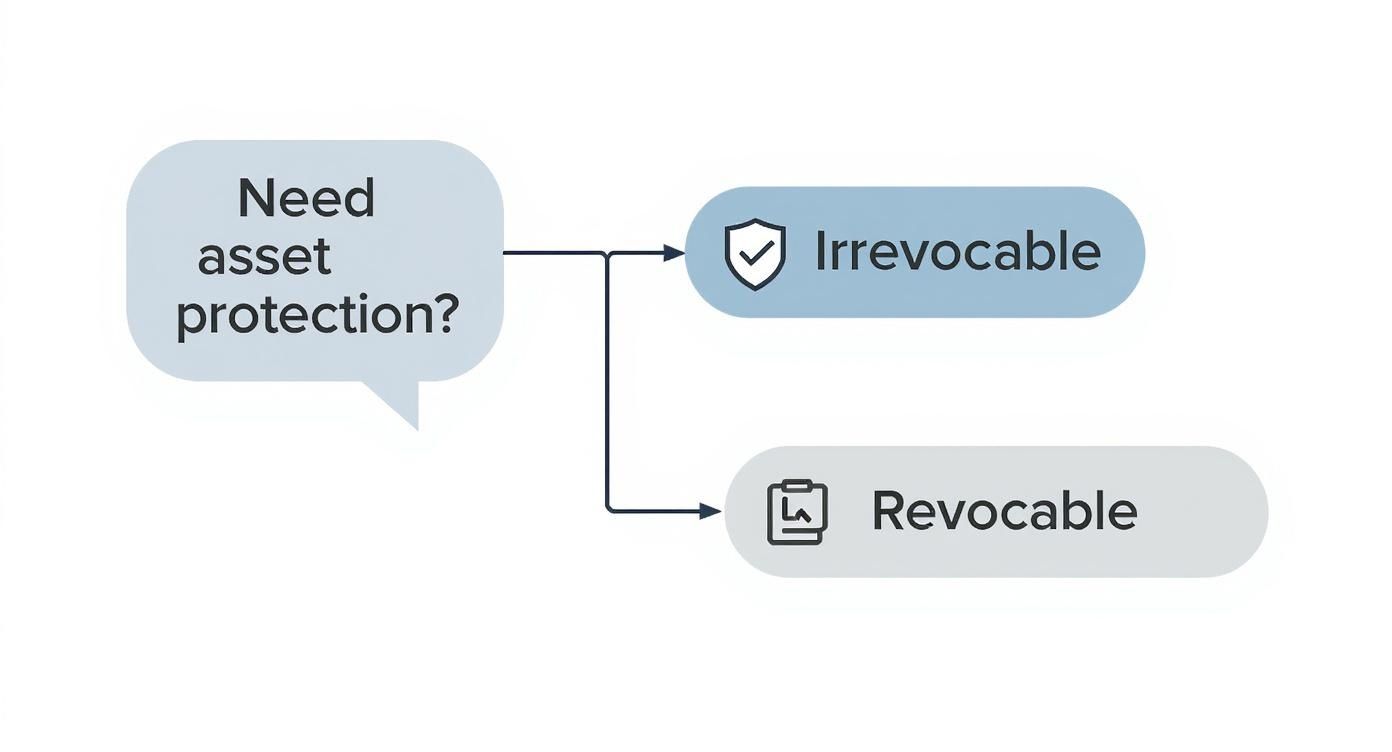
As the guide shows, if your primary objective is flexibility and avoiding probate—rather than needing immediate asset protection—a revocable trust is almost always the way to go.
A Realistic Scenario: Making Things Simple for the Next Generation
Let’s walk through a common example. Meet the Garcias, a family from a Houston suburb with a paid-off home, two adult children, and some savings. Their number one goal is simple: make sure their house passes directly and quickly to their kids after they’re gone, without forcing the family to hire lawyers and deal with the probate courts. They want the process to be as gentle and private as possible for their grieving children.
- Step 1: Creation and Funding. The Garcias meet with an estate planning attorney to create the “Garcia Family Revocable Living Trust.” They then sign a new deed that retitles their home from “Mr. and Mrs. Garcia” to “Mr. and Mrs. Garcia, Trustees of the Garcia Family Revocable Living Trust.” This step is called “funding the trust.”
- Step 2: Lifetime Management. For the rest of their lives, absolutely nothing changes. They live in the home, pay their property taxes, and can sell or refinance it just as they always could. They also move their main savings account into the trust’s name.
- Step 3: After They Pass. When the surviving parent passes away, their chosen successor trustee (in this case, their eldest daughter) takes over. Without any court filings or hearings, she follows the trust’s private instructions, uses the trust’s savings to pay final bills, and then transfers the deed of the home to herself and her brother, just as the trust specifies.
The entire transfer is private, efficient, and happens on the family’s schedule, not the court’s. This is the practical power and compassion of a revocable trust.
Understanding the Limitations
While it’s an excellent tool for dodging probate and managing your affairs, a revocable trust has very clear limitations. It’s critical to understand what it cannot do. A revocable trust does not protect your assets. Because you keep full control and can take assets out at any time, the law still sees them as yours. This means they remain vulnerable to creditors, lawsuits, and legal judgments. On top of that, it provides no tax benefits and is ineffective for Medicaid planning. For families who need asset protection or tax savings, the conversation has to shift toward irrevocable options.
When an Irrevocable Trust Offers Better Protection

While a revocable trust offers fantastic flexibility, some situations demand a more permanent, powerful solution. This is where the irrevocable trust comes in, designed for one primary mission: protection. For some Texas families, the smartest way to preserve their wealth for future generations is to strategically give up direct control over certain assets.
This type of trust creates a strong legal barrier between you and the assets you place inside it. Once funded, those assets are no longer legally yours; they belong to the trust. It’s this fundamental shift in ownership that unlocks significant advantages a revocable trust simply can’t match. Making the decision to create one is a big step, usually driven by two major goals: shielding your legacy from future threats and minimizing the impact of estate taxes.
Securing Your Legacy with Asset Protection
In a world filled with financial uncertainty, protecting what you’ve built is a huge concern—especially for doctors, business owners, or anyone in a high-liability profession. An irrevocable trust is the gold standard for this kind of defense.
Because the assets are no longer in your name, they are generally out of reach for future personal creditors, lawsuits, or judgments against you. Let’s be clear: this isn’t about hiding from current debts. It’s about proactively safeguarding your family’s future from the unexpected.
Here’s a real-world scenario:
- A Texas surgeon is concerned about potential malpractice lawsuits down the road. She wants to guarantee that a portion of her savings is set aside for her children’s education, no matter what happens in her career.
- She works with an attorney to establish an irrevocable trust, transferring a large investment portfolio into it. Her brother is named as the independent trustee, responsible for managing the funds according to the trust’s rules.
- Years later, she faces a lawsuit that exceeds her insurance coverage. The assets inside the irrevocable trust are not her personal property and are therefore shielded from the legal claim, securing her children’s financial future.
This level of protection is precisely why many families choose this route. The peace of mind it delivers is invaluable.
Minimizing Estate Taxes for High-Net-Worth Families
Another core function of an irrevocable trust is to reduce the size of your taxable estate. For families with significant wealth, this is a critical piece of long-term planning. When you move assets into an irrevocable trust, they are removed from your estate for tax purposes, which can dramatically lower or even eliminate your federal estate tax bill.
This is where irrevocable trusts fundamentally differ from revocable ones—they generally cannot be changed or canceled once created. This loss of control is the trade-off for major tax and asset protection benefits. For instance, the federal estate tax exemption has fluctuated over the years, from $675,000 in 2001 to as high as $11.7 million in more recent years, pushing more affluent families to use irrevocable trusts as a cornerstone of their tax planning.
Ultimately, the choice comes down to your priorities. If your main objective is to build a fortress around your assets to guard against future threats and taxes, an irrevocable trust provides the unmatched protection you’re looking for. To see how this stacks up against other tools, you might want to read our guide on irrevocable trusts vs wills.
Real-World Scenarios for Texas Families
Legal definitions are one thing, but seeing how trusts work for real Texas families makes the choice between revocable and irrevocable much clearer. A legal tool is only as good as the problem it solves. By walking through a few common situations, you can get a better sense of which path aligns with your own family’s needs.
These stories highlight the practical differences, showing how each trust is built for a distinct purpose.
Scenario One: The Miller Family and Probate Avoidance
Let’s meet the Millers, a couple in their late 50s from a Dallas suburb. They own a home, have two grown children, and a few investment accounts. Their estate planning goals are straightforward:
- They want their assets to pass to their children quickly and privately, without the hassle and public record of the Texas probate process.
- They need to maintain total control over their finances while they’re alive, with the freedom to sell their house or change their investment strategy at any time.
- They want to name their responsible youngest son to step in and manage their affairs if they both become incapacitated.
For the Millers, a revocable living trust is a perfect match. They create the “Miller Family Trust” and simply retitle their home and investment accounts into the trust’s name. In their day-to-day life, absolutely nothing changes—they still manage their money and live in their house just as they did before. When they pass away, their son, as the successor trustee, can immediately take charge and distribute the assets according to their private instructions, completely bypassing the Texas probate courts. It’s efficient, private, and exactly what they needed.
Scenario Two: Dr. Chen and Asset Protection
Now, picture Dr. Chen, a successful surgeon in Houston. She has built considerable wealth but operates in a high-liability profession where a future lawsuit is a real concern. Her goals are quite different from the Millers’:
- She wants to protect a significant portion of her assets from potential professional claims or future creditors.
- She needs to reduce her taxable estate to lessen the blow of federal estate taxes for her children.
- She’s planning for potential long-term care needs and wants to do so without draining her life savings.
For Dr. Chen, an irrevocable trust provides the strong shield she needs. She transfers a large investment portfolio and a vacation home into an irrevocable trust, appointing her sister as the independent trustee. This move legally separates those assets from her personal ownership. If a lawsuit ever materializes, the assets inside the trust are out of reach. Plus, they are removed from her taxable estate, creating major tax advantages. This kind of strategic move is a cornerstone of advanced Wills & Trusts planning.
Scenario Three: The Rodriguez Family and Long-Term Care
Finally, let’s consider the Rodriguezes. Mr. Rodriguez is a retired widower in his 70s living in San Antonio. His health is declining, and he foresees needing nursing home care in the next few years. His primary goal is to qualify for Medicaid to help cover the staggering costs, all while preserving his home and modest savings for his daughter.
An irrevocable trust is a critical tool for Medicaid and senior long-term care planning. Mr. Rodriguez works with an attorney to transfer his home into a specially designed irrevocable trust.
Once the five-year Medicaid “look-back” period has passed, the house will no longer be counted as one of his assets for eligibility purposes. This smart, proactive planning allows him to qualify for the assistance he needs without the state forcing the sale of the family home, preserving that legacy for his daughter. It’s a move that can also prevent the need for a costly, court-supervised Guardianship later on.
Key Takeaway: Control vs. Protection
Deciding between a revocable and irrevocable trust is one of the biggest moves you’ll make in your estate plan. There’s no single “right” answer. The best choice is deeply personal and comes down to your unique goals, your finances, and what you’re trying to protect for your family.
At its core, the decision boils down to a fundamental trade-off: control versus protection.
If your main goal is to sidestep the Texas probate process while keeping total flexibility over your assets, a revocable trust is likely your best bet. It lets you change your mind and adapt your estate plan as life unfolds. But if your priorities shift toward shielding assets from creditors, cutting down on estate taxes, or planning for long-term care, an irrevocable trust becomes the essential tool.
Reflecting on Your Priorities
To get clear on which path is right for you, take a moment to ask yourself these questions:
- Is my primary goal simply to make things easier on my heirs by keeping them out of probate court?
- Do I have assets that need protection from potential lawsuits or business risks down the road?
- Is my estate large enough that minimizing estate taxes is a serious concern?
- Am I thinking about the possibility of needing long-term care and wanting to qualify for Medicaid?
Answering these honestly will point you in the right direction. Your choice will always be shaped by changing tax laws and your personal circumstances. You can find more perspectives on how these factors influence trust selection from Bankrate.com.
Key Insight: The real question isn’t “Which trust is better?” It’s “What problem am I trying to solve?” Your answer will tell you whether you need the flexibility of a revocable trust or the powerful shield of an irrevocable one.
Of course, trusts are just one piece of a complete estate plan. It’s also important to understand how other documents fit into the picture. For example, learning about the critical role of Power of Attorney in protecting your future can help you build a more resilient strategy.
Ultimately, this decision is about shaping your legacy. Getting professional guidance isn’t just a good idea—it’s how you ensure your final choice provides genuine peace of mind and secures your family’s future exactly as you intend.
If you’re facing probate in Texas, our team can help guide you through every step — from filing to final distribution. Schedule your free consultation today.
Answering Your Texas Trust Questions
When it comes to estate planning, trusts can feel complicated. Families we work with in Texas often have the same key questions, and getting clear, plain-English answers is the first step toward feeling confident about your plan. Let’s tackle some of the most common ones.
Can I Have Both a Will and a Trust in Texas?
Not only can you, but you absolutely should. A will and a trust work together to create a comprehensive estate plan. Think of the will as a safety net for your trust. A special type of will, called a “pour-over will,” is designed to catch any assets you might have forgotten to put into the trust. When you pass away, this will simply “pours” those forgotten assets into the trust.
There’s another critical job only a will can do: name a legal guardian for your minor children. Your trust can’t handle this. The Texas Estates Code is very clear that this designation must be made in a valid will. If you don’t have one, a judge will be the one deciding who raises your kids, which is a situation every parent wants to avoid.
What Does It Mean to “Fund” a Trust?
“Funding” a trust is the hands-on process of actually transferring ownership of your assets to it. A trust is just an empty legal shell until you put things in it. It only controls what it legally owns.
This isn’t just paperwork; it’s a crucial step. It means changing the deed to your house, updating the ownership on your bank accounts, and retitling other assets so they are officially owned by the trust. We’ve seen too many families discover that an unfunded trust doesn’t avoid probate. Any assets left in your personal name will get stuck in the court system, which is the exact costly mistake a trust is designed to prevent.
How Does a Trust Help if I Become Incapacitated?
This is one of the most powerful and compassionate benefits of a revocable living trust. If an illness or injury leaves you unable to manage your own financial affairs, the successor trustee you already named can step in right away.
There’s no need to go to court. Your successor trustee can immediately start managing the trust’s assets for your benefit—paying your mortgage, handling investments, and protecting your property. This allows your family to completely sidestep the public, expensive, and emotionally draining process of seeking a court-ordered Guardianship.
Can an Irrevocable Trust Ever Be Changed in Texas?
While “irrevocable” sounds permanent, Texas law does offer a few narrow paths to modify these trusts under very specific circumstances. It’s a complex legal maneuver, sometimes called “decanting” or modification, and it isn’t a simple request. It typically requires either the unanimous agreement of every single beneficiary or a formal court order.
You should never assume an irrevocable trust can be changed easily. The process is difficult, success is not guaranteed, and it’s something that should only be attempted with an experienced attorney who truly understands the nuances of Texas trust law and Probate Litigation.
If you’re facing probate in Texas, our team can help guide you through every step — from filing to final distribution. Schedule your free consultation today.