When Texas families face major life changes, legal terms like ‘custody’ and ‘guardianship’ are often used interchangeably. However, they represent two fundamentally different legal paths, handled in separate courts and arising from very different circumstances. Understanding this distinction is the first, most crucial step for anyone navigating the care of a child or an incapacitated adult.
At its heart, the difference comes down to who is involved and why. Custody, which Texas law formally calls conservatorship, is about defining the rights and responsibilities between a child's parents, typically following a divorce or separation. It operates within the parent-child relationship. In contrast, guardianship is a protective court proceeding that grants a non-parent the legal authority to care for someone—either a minor child or an incapacitated adult—when their parents are unable to do so.
Understanding the Core Difference in Texas Family Law
Grasping the distinction between these terms isn't just about legal trivia; it's essential because it determines which court has jurisdiction, which laws apply (the Family Code vs. the Estates Code), and what the outcome means for everyone involved. For families grieving a loss or planning for the future, clarity on this point is paramount.
Custody, or conservatorship, falls under the Texas Family Code. It is handled in family court, and its sole focus is structuring the parent-child relationship in the child's best interest. The court’s role is to allocate rights and duties between two parents, ensuring the legal bond between the child and both parents is preserved and supported.

Guardianship, however, operates in a completely different legal world. It is governed by the Texas Estates Code (specifically Titles 2 and 3) and is managed in probate court. Think of it as a protective measure of last resort. It is used when a minor child or an incapacitated adult cannot care for themselves and their parents (or spouse, in the case of an adult) are unavailable—perhaps due to death, serious illness, or a court finding them unfit. A guardian steps in to fill that role, but the legal framework is entirely separate from a custody case. For a more detailed look at this process, you can learn more about legal guardianship in Texas.
Because these two areas of law are so distinct, navigating them requires different legal strategies. This is why many families seek out specialized Texas Family Law firms with experience in both family and probate matters.
Custody vs. Guardianship At a Glance
To make this even clearer, it helps to see the key distinctions side-by-side. This table breaks down the fundamental differences between conservatorship (custody) and guardianship in Texas.
| Aspect | Child Custody (Conservatorship) | Guardianship |
|---|---|---|
| Primary Parties Involved | Parents of the child. | Non-parents (e.g., grandparents, other relatives, or close family friends). |
| Legal Framework | Governed by the Texas Family Code. | Governed by the Texas Estates Code. |
| Court Venue | Typically handled in Family Court. | Handled in Probate Court. |
| Core Purpose | To define parental rights and duties for a child, usually after separation or divorce. | To appoint a caregiver for a minor or incapacitated adult when parents are unavailable or unfit. |
| Parental Rights | Parental rights are allocated and defined but generally remain intact for both parents. | Parental rights have often been suspended by a court, terminated, or lost due to death. |
As you can see, while both legal tools aim to protect a vulnerable person, they operate in separate legal universes. Knowing which one applies to your situation is the first and most critical step toward finding the right solution for your family.
Comparing Legal Rights and Decision-Making Authority
When a Texas court grants someone power over another person's life, the scope of that authority is the single biggest difference between custody and guardianship. One is about sharing parental duties, while the other is often about replacing them entirely. Understanding this is critical, as it determines who gets to make life-altering decisions.
A Texas custody order, legally called a conservatorship order under the Texas Family Code, is designed to carefully divide rights and duties between two parents. The goal is almost always to keep both parents deeply involved in their child’s life.
Most often, judges name parents Joint Managing Conservators. This isn't just a title; it means they are legally required to share the responsibility for major decisions. While one parent might have the exclusive right to decide where the child lives, most other critical rights are shared, encouraging collaboration.

Custody: A Framework for Co-Parenting
Think of a standard Joint Managing Conservatorship order as a rulebook for co-parenting. It ensures both parents have a say in the major milestones of their child's life.
Typically, both parents will share the right and duty to:
- Make decisions about the child's education.
- Consent to non-emergency medical, dental, and surgical treatments.
- Guide the child’s moral and religious upbringing.
This shared authority is the bedrock of Texas custody arrangements. It encourages communication and ensures that a child benefits from having two active parents, even if they no longer live together.
Guardianship: A Transfer of Parental Power
Guardianship operates on a different plane. Governed by the Texas Estates Code, it grants a much wider and more absolute level of authority. This is necessary because a guardian is only appointed when parents are deceased, incapacitated, or otherwise unable to fulfill their roles. The probate court is essentially handing over the full weight of parental power to a non-parent.
In Texas, a Guardianship for a minor is often split into two distinct roles:
- Guardian of the Person: This gives the guardian control over the child's day-to-day life—where they live, the school they attend, and all their medical care.
- Guardian of the Estate: This grants authority to manage the child’s finances, property, and any inheritance they are entitled to receive.
A court might appoint one person to handle both, or it could split the duties between two different people if that's what’s best for the child. You can get a deeper understanding by reading about the differences between guardianship and conservatorship in Texas law.
Realistic Scenario: A Tale of Two Families
Let’s put this into perspective. Imagine Sarah and Tom, a divorced couple who are Joint Managing Conservators for their 10-year-old daughter, Emily. Their custody order requires them to consult on big decisions, like which middle school Emily should attend or if she needs braces. It’s a partnership, guided by a court order.
Now, consider a different family facing a sudden tragedy. Emily’s grandmother, Mary, learns that Emily's parents have passed away in an accident. Mary petitions the probate court to become Emily's guardian. Once the judge appoints Mary as guardian of both the person and the estate, her authority is far more comprehensive than what either of Emily's parents had individually.
Mary can now:
- Decide where Emily lives without needing anyone else's permission.
- Manage the life insurance money and inheritance left for Emily, making investments and paying for her expenses from those funds.
- Make all educational and medical decisions on her own.
In this scenario, Mary’s power as a guardian is far more sweeping than a parent’s authority under a typical custody order. She holds the combined power to manage Emily’s daily life and her financial assets—a level of responsibility that custody orders are not designed to address. This highlights the fundamental gap in decision-making power between the two roles.
Who Is Eligible for Custody or Guardianship?
Understanding who the court even considers for these powerful roles is central to grasping the real-world difference between custody and guardianship. In Texas, the law draws a very clear line based on one simple factor: the person’s relationship to the child. This reflects the distinct purpose of each legal arrangement.
In a custody case, the court’s starting point is a powerful legal presumption that a child's parents should be named their conservators. Texas law is built on preserving parental rights. A court will only move away from this default if there is clear evidence that appointing a parent would not be in the child's best interest or would physically or emotionally endanger the child. The focus is almost entirely on the parents.
For guardianship, however, the circle of potential candidates is much wider. This is a critical distinction for families to understand, especially when planning an estate or facing an unexpected crisis.
The Pool of Candidates for Guardianship
When a probate court needs to appoint a guardian, it looks beyond just the parents. Why? Because in most guardianship scenarios, the parents are unavailable, unable, or have been found unfit to care for the child. The Texas Estates Code allows a much broader group to step in.
Potential candidates for guardianship often include:
- Grandparents
- Adult siblings
- Aunts or uncles
- Other close relatives
- Even qualified and trusted family friends
This flexibility is by design. The goal is to find a responsible, caring adult who can provide stability and make sound decisions for the child (known as the "ward") when the parents simply can't.
The Higher Hurdle for Non-Parent Guardians
So what happens if a child's parents are still alive, but a grandparent believes they are a better caregiver? This is where the legal standards truly show their teeth. To obtain guardianship over a minor who has living parents, a person must navigate a difficult probate court process.
They have to prove to the court that the parents are unfit, unavailable, or that appointing them as conservators is not in the child's best interest. This is a very high legal bar to clear because it directly challenges the constitutional rights of the parents. This process is laid out in the Texas Estates Code and requires compelling, undeniable evidence.
This legal reality is reflected in the real world. While custody orders overwhelmingly favor biological parents in marital splits, guardianship is the tool for non-parental arrangements, often involving extended family. Nationally, millions of children are raised by relatives like grandparents, but official guardianship filings cover only a tiny fraction of these cases, which highlights just how complex the legal hurdles can be. You can explore more data on how court policies affect these arrangements and often leave children without a formal legal guardian.
Ultimately, the eligibility rules underscore the core difference between custody and guardianship in Texas. Custody reinforces the parent-child bond. Guardianship creates a new, protective relationship when that original bond is broken or unavailable. This distinction is vital for anyone involved in the Texas probate process or planning for the future of their minor children.
How to Navigate Each Legal Process in Texas
The paths to establishing custody and guardianship in Texas are worlds apart, each with its own legal hurdles and emotional weight. While both are designed to create a stable environment for someone who needs care, the processes unfold in entirely different legal arenas—Family Court for custody and Probate Court for guardianship.
Knowing which door to knock on is the first and most critical step for any Texas family facing this decision.
This visual guide shows the typical starting point for each process. Custody is almost always rooted in the parental relationship, while guardianship steps in when non-parents must take legal responsibility.
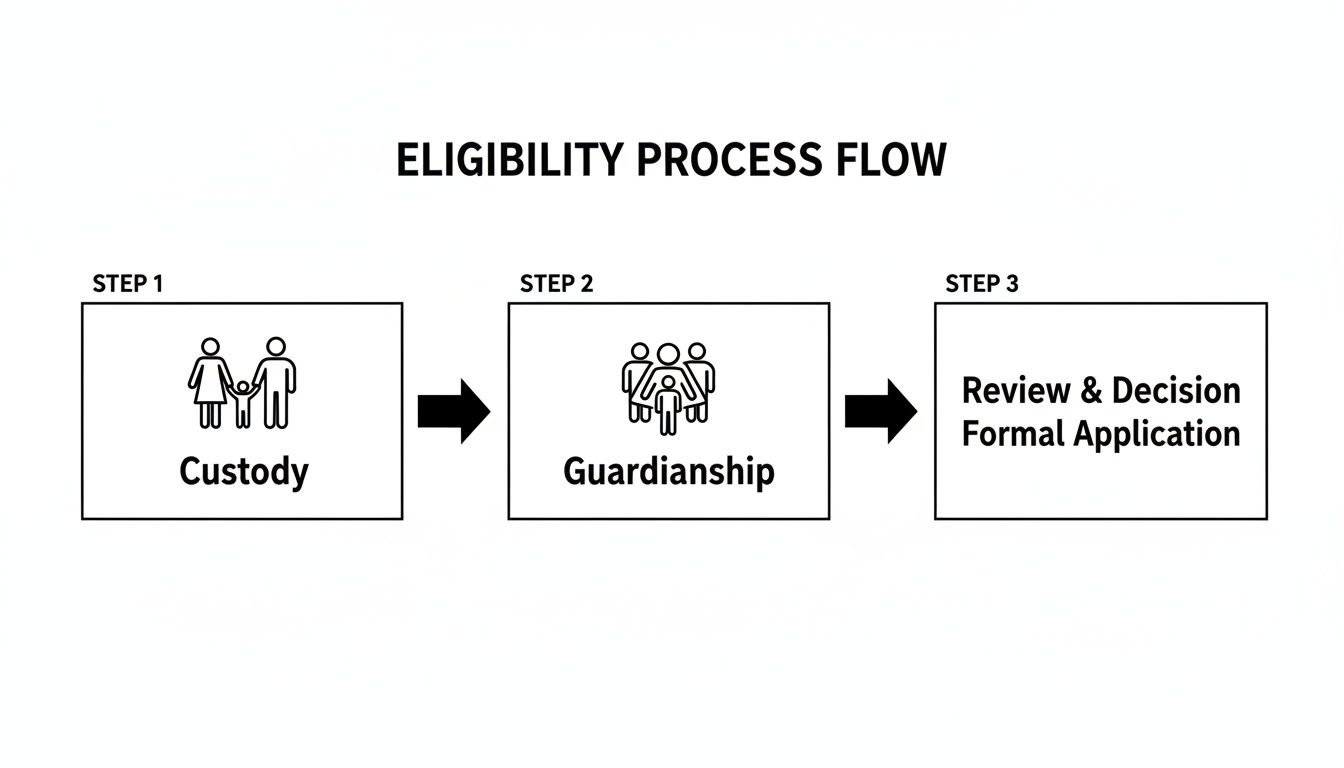
The key takeaway here is eligibility. Custody cases are a matter between parents. Guardianship cases, on the other hand, are initiated by other concerned individuals when parental care simply isn't an option.
The Path to a Custody Order: Step-by-Step
A custody order, known as a conservatorship in Texas, is typically established during a divorce or as part of a Suit Affecting the Parent-Child Relationship (SAPCR). This entire process is handled in family court and is governed by the Texas Family Code. The court’s one and only guiding principle is the “best interest of the child.” Here’s how it usually plays out:
- Filing a Petition: One parent begins by filing a petition, either for divorce or as a standalone SAPCR.
- Service: The other parent must be formally notified of the lawsuit. This is a formal legal step.
- Mediation: Texas courts strongly encourage parents to work things out themselves. They often require parents to attend mediation to try and reach an agreement.
- Court Orders: If mediation is successful, the agreement is turned into a formal court order. If not, a judge will listen to both sides and make the final decision after a hearing or trial.
The Guardianship Application Process: Step-by-Step
Guardianship is a much heavier lift. It’s a formal probate court proceeding governed by the Texas Estates Code, and because it involves transferring parental-level authority, the court’s oversight is far more intense. The steps are significantly more involved:
- Filing an Application: A detailed application is filed in probate court, explaining exactly why a guardianship is necessary.
- Public Notice: Notice of the application must be physically posted at the courthouse to inform the public and any interested parties.
- Court Investigator Evaluation: The court appoints an investigator to conduct a thorough review of the proposed ward’s situation and the applicant’s suitability.
- Attorney Ad Litem: The court is required to appoint an independent attorney, called an attorney ad litem, whose sole job is to represent the proposed ward’s best interests.
- Court Hearing: A formal hearing is held where the applicant must present clear and convincing evidence to a judge, proving that a guardianship is truly necessary.
To get through the complexities of any court proceeding, knowing how to conduct effective legal research is a huge advantage. The procedural demands of a guardianship are significant, and understanding them is crucial. For a deeper look into the specific requirements, check out our guide on how to apply for guardianship in Texas.
The differences in timelines, costs, and ongoing court supervision between these two processes are massive. Choosing the correct legal path from the very beginning is vital.
Changing or Ending Custody and Guardianship Orders
Life is not static, and Texas law recognizes this. Family circumstances shift, children grow, and jobs change. But the way the legal system handles these shifts depends entirely on whether you're dealing with a custody order or a guardianship. The standards for changing them are worlds apart because one is built for flexibility and the other is designed for permanence.
Custody orders, or conservatorships, are meant to evolve with a child's life. A parent can go back to family court and ask for a modification by proving a "material and substantial change in circumstances" has occurred since the last order was signed. This standard gives the court the power to adapt the parenting plan to new realities—a cross-country move, a new work schedule, or a teenager’s changing needs.
Guardianships, on the other hand, are a different matter. They are established in probate court under the Texas Estates Code and are much harder to undo. The law views them as a long-term solution, usually put in place because parents are deceased or otherwise out of the picture. The path to ending one is narrow, and the legal bar is set incredibly high.
How a Guardianship Ends in Texas
A guardianship over a minor doesn't end because someone changes their mind. It typically terminates automatically under a few specific, life-altering conditions:
- The child (legally called the "ward") turns 18.
- The child is legally adopted.
- The child passes away.
- A court officially rules that the guardianship is no longer necessary.
That last point is where the real legal battle lies. For a parent to terminate a guardianship and regain their rights, they face a steep climb. They must prove to the probate court that they are now fit and fully capable of providing proper care—a difficult, emotionally taxing, and often expensive process.
The Stability of Guardianship in Practice
While the law intends for guardianships to be permanent, real-world data shows a more complex picture. Research reveals that even with the high legal bar to create them, these placements can be surprisingly fragile.
A landmark study found that guardianship placements for children dissolve at a rate of 7%. While that may seem low, it's more than triple the 2% dissolution rate for adoptions. You can read the full research on guardianship stability to get a better sense of the factors at play.
This highlights a fundamental difference between custody and guardianship. A custody order is a living document that can be adjusted as life unfolds. A guardianship is a foundational legal shift meant to last until a child becomes an adult. This permanence has massive implications for anyone involved in long-term Wills & Trusts planning, as it demands a financial and legal structure that can stand the test of time.
Key Takeaways: What This Means for Your Family
Understanding the difference between custody and guardianship is not an academic exercise—it is essential for protecting your family. Whether you are creating an estate plan, facing a divorce, or stepping in to care for a loved one, making the right legal choice is critical.
- Custody Defines Parental Roles: Custody orders (conservatorship) are for parents to define their rights and responsibilities. They do not grant authority over a child's inheritance.
- Guardianship is a Protective Tool: Guardianship is a probate court process for non-parents to gain legal authority when parents cannot act. It is necessary to manage a minor's or incapacitated adult's personal and financial affairs.
- Estate Planning is Proactive: Your will is the correct place to name a guardian for your minor children. Combining this with a trust is the most effective way to protect their financial future.
- The Courts and Codes are Different: Custody is handled in Family Court under the Texas Family Code. Guardianship is handled in Probate Court under the Texas Estates Code. The legal standards and procedures are completely separate.
Navigating these complex issues during an already emotional time can feel overwhelming. An experienced probate and estate planning attorney can provide the clarity and compassionate guidance you need to ensure your loved ones are protected.
If you’re facing probate in Texas, our team at The Law Office of Bryan Fagan, PLLC can help guide you through every step — from filing to final distribution. Schedule your free consultation today.
Common Questions About Texas Family Law
When you’re in the middle of a family law issue, the legal jargon can feel like a foreign language. But behind the complicated terms are real, human concerns: protecting a child, securing their future, and doing what's right. We've compiled some of the questions we hear most often to give you clear, straightforward answers.
These situations are almost always packed with emotion and high stakes. Getting a handle on the legal basics can help you feel more in control during a deeply challenging time.
Can a Grandparent Get Guardianship of a Grandchild If the Parents Are Alive?
Yes, it's possible for a grandparent to get guardianship over a grandchild even when the parents are alive, but the legal bar is incredibly high. This isn't just about proving you can offer a better or more stable home; you are directly challenging a parent’s fundamental constitutional rights.
To succeed, you must prove to a probate court that the parents are unfit or unable to care for the child. This requires clear and convincing evidence of serious issues like neglect, abuse, or ongoing substance abuse. It is a difficult and often heartbreaking process under the Texas Estates Code.
Does a Custody Order Allow Me to Manage My Child’s Inheritance?
No, and this is one of the most critical misunderstandings in the difference between custody and guardianship. A standard custody order (called a conservatorship in Texas) gives you authority over a child’s day-to-day life—school, healthcare, and general well-being. It does not give you the legal power to touch their financial estate.
If your child inherits money or property, that’s a completely separate legal matter. You would need to go to a probate court to be appointed as the guardian of the estate. The best way to avoid this is through proactive estate planning, such as setting up a trust. You can explore our services for Wills & Trusts to see how proper planning avoids this exact problem.
Is Guardianship in Texas a Permanent Arrangement?
Guardianship is built for long-term stability and is considered a much more permanent solution than a typical custody order. It's designed to last until the child turns 18, is adopted, or passes away. That said, it's not set in stone.
A court can modify or even terminate a guardianship if there's a significant change in circumstances. For instance, if a parent who was once deemed unfit successfully completes rehabilitation and can prove to the court they are now capable of providing a safe home, they can petition to end the guardianship. It’s a demanding process that focuses entirely on the child's best interests as defined under the Texas Estates Code.
If you’re facing probate in Texas, our team at The Law Office of Bryan Fagan, PLLC can help guide you through every step — from filing to final distribution. Schedule your free consultation today.