Planning for your family’s future is one of the most profound acts of love you can undertake. The biggest revocable living trust benefits boil down to this: bypassing the public probate process, protecting your family’s privacy, and creating a seamless plan in case you become incapacitated. In simple terms, it's about giving you and your loved ones genuine peace of mind when it matters most.
What a Revocable Living Trust Means for Your Family

When Texas families hear the term "living trust," it can sound intimidating or like something reserved only for the wealthy. The reality is much simpler. A revocable living trust is a powerful and flexible tool for anyone who wants to protect their assets and make life easier for their loved ones.
Think of it less as a complex legal document and more as a private, detailed instruction manual for your property—one you write yourself and can change at any time. This guide is designed to explain, in plain English, how thoughtful estate planning can secure your legacy and provide stability for your family.
Key Advantages for Texas Families
A well-structured trust offers several critical protections that a simple will cannot match. The core benefits are straightforward:
- Avoiding Probate: Assets held in a trust pass directly to your beneficiaries without court intervention. This saves a significant amount of time, money, and stress. The Texas Probate Process can be lengthy, and a trust helps avoid it.
- Ensuring Privacy: A will becomes a public record once it enters probate. A trust, on the other hand, is a private document that keeps your family’s financial affairs confidential.
- Planning for Incapacity: A trust allows your chosen successor trustee to step in and manage your finances if you become unable to do so. This helps you avoid a potentially costly and public Guardianship proceeding.
Despite these clear advantages, the use of revocable living trusts remains surprisingly low. A recent report found that only 11% of Americans have established a trust. This highlights a gap in estate planning, especially when you consider that 55% of Americans have no plan at all, leaving their families vulnerable to probate complications.
Choosing the right estate planning tool comes down to your specific goals. Understanding the differences between a will and a trust is the critical first step. You can explore a detailed comparison in our article on choosing between a living trust and a will in Texas. This guide will further unpack the powerful benefits a trust can provide for your family’s security and your own peace of mind.
How a Trust Helps You Avoid Texas Probate Court

For many Texas families, the single biggest reason to set up a revocable living trust is its power to sidestep the probate process entirely. Probate is the formal, court-supervised legal process required to validate a will, pay off debts, and distribute a person's property after they die. While it serves a purpose, it’s often a source of stress and frustration for grieving families.
The entire ordeal is governed by the Texas Estates Code (specifically Title 2), which outlines all the required steps and timelines. Unfortunately, this means assets often get locked up for months—sometimes even a year or more—while everyone waits for a judge's approval. That delay can put a financial strain on loved ones who might be counting on that inheritance.
Realistic Scenario: The Hurdle of Probate Court
Imagine a family in Dallas. A father passes away, leaving behind a house, some investments, and a couple of bank accounts, all detailed in his will. Before the family can access any of it, the will must be filed with the local probate court.
From that moment, a series of formal legal steps begins:
- Filing the Application: An official application to probate the will is submitted to the court.
- Court Hearing: A judge holds a hearing to legally recognize the will and appoint an executor to manage the estate.
- Inventory of Assets: The executor must assemble and file a detailed public list of every single asset.
- Notifying Creditors: A public notice must be published, giving any potential creditors a chance to make a claim against the estate.
Every one of these steps costs time and money, from court filing fees to attorney bills. All the while, the family is stuck in limbo, unable to manage the assets or move forward.
How a Trust Forges a Private, Direct Path
A revocable living trust offers a completely different route. When you create and fund a trust, you are changing the title of your assets from your name to the trust's name. Legally, the trust now owns the property, and you, as the trustee, continue to manage it for as long as you live.
Because the trust owns the assets, there's nothing for the probate court to administer when you pass away. Your assets are no longer part of your "probate estate." Your successor trustee—the person you picked to take over—can step in immediately to manage and distribute the assets just as you instructed in the trust document. The entire transfer happens privately and efficiently, without court interference, saving your family from court costs and delays.
You can learn more about how this works in our detailed guide on how to avoid probate in Texas with a living trust.
Will vs. Revocable Living Trust in Texas
To see the differences in action, it helps to compare a will and a living trust side-by-side. While both are critical Wills & Trusts tools, they operate in fundamentally different ways.
| Feature | Will | Revocable Living Trust |
|---|---|---|
| Probate Required? | Yes, assets must go through court-supervised probate. | No, assets owned by the trust bypass probate. |
| Public Record? | Yes, becomes a public court record. | No, remains a private family document. |
| Asset Access | Delayed for months or even years. | Immediate access for the successor trustee. |
| Incapacity Plan? | No, does not manage assets if you're incapacitated. | Yes, the successor trustee can manage assets for you. |
| Cost to Create | Typically lower upfront cost. | Higher upfront cost, but saves money later. |
| Cost to Settle | Higher, with court fees, legal bills, and executor fees. | Minimal, usually no court or significant legal fees. |
| Geographic Reach | Requires separate probate for property in other states. | Avoids probate for property in any state (if titled in trust). |
As you can see, the initial effort to create and fund a trust pays massive dividends by saving your loved ones from the cost, delay, and public scrutiny of the Texas probate system.
Protecting Your Family's Privacy and Your Legacy
When you create an estate plan, you are making deeply personal decisions about your family’s future. One of the most overlooked—yet critical—benefits of a revocable living trust is its power to keep those decisions completely private, shielding your loved ones from public view during a difficult time.
In Texas, when a will is submitted to the court for probate, it becomes a public record. This means anyone—a nosy neighbor, a distant relative, or even a scammer—can go to the courthouse or search online to see the details of your estate: what you owned, how much it was worth, and who you chose to inherit it. This public exposure is the last thing a grieving family needs.
Keeping Your Affairs Confidential
A revocable living trust operates as a private agreement. It is never filed with a court or made part of the public record. The administration of your trust happens privately between your chosen successor trustee and your beneficiaries, according to your exact instructions.
This confidentiality provides a powerful shield, protecting your beneficiaries from:
- Unsolicited Financial Pitches: When an inheritance becomes public, beneficiaries often become targets for salespeople.
- Potential Scams: Scammers comb through public probate records to identify and target recent heirs.
- Family and Social Pressure: Privacy prevents unwanted opinions or resentment from those who feel they were entitled to more.
Crafting a Precise and Controlled Legacy
Beyond privacy, a trust gives you an incredible level of control over how and when your assets are distributed. A will typically results in a one-time, lump-sum distribution. A trust, however, allows you to create a detailed, long-term plan to protect your beneficiaries. Of course, the integrity of your revocable living trust documents is paramount. Learning about protecting PDF documents from editing can prevent unauthorized alterations and preserve your precise wishes, safeguarding your family's legacy.
Real-World Example: Protecting Young Heirs
Imagine a grandparent in Houston wants to leave a significant inheritance to their two grandchildren, ages 16 and 19. If they use a will, the 19-year-old would receive their entire inheritance in cash as soon as probate closes. Handing a large sum of money to a young adult with little financial experience could lead to irresponsible spending.
By using a revocable living trust, that same grandparent can design a much smarter plan:
- Educational Milestones: The trust can instruct the trustee to pay for college tuition and expenses directly.
- Staggered Distributions: It can specify that each grandchild receives one-third of their remaining inheritance at age 25, another third at age 30, and the final portion at age 35.
- Incentive Clauses: The trust could even include a provision to match a down payment on their first home, encouraging responsible saving.
This structure ensures the inheritance is used for a positive, life-building purpose. This level of customized control is one of the most compelling revocable living trust benefits you can get.
Creating a Plan for Incapacity and Asset Management

Most people think estate planning is only about what happens after you’re gone. But one of the most powerful revocable living trust benefits is how it protects you during your lifetime.
Life is unpredictable. An unexpected illness or injury could leave you unable to manage your own affairs. A revocable living trust is your proactive plan for that possibility. It ensures your financial life continues without interruption, even if you’re not the one steering the ship.
Avoiding a Court-Ordered Guardianship
If you become incapacitated without a plan, your family may be forced to go to court to establish a guardianship. This is a formal legal proceeding where a judge decides who gets to manage your finances and make personal decisions for you.
A guardianship proceeding is often a family’s worst nightmare. The process is:
- Public: Your private financial and medical details become part of the public record.
- Costly: Court costs and attorney's fees pile up quickly, all paid from your assets.
- Slow: It can take weeks or months for a court to appoint a guardian, leaving your finances frozen.
A revocable living trust lets you sidestep that entire invasive process. You stay in control by choosing your trusted person ahead of time, on your own terms.
How a Successor Trustee Provides Seamless Management
When you set up your trust, you name a successor trustee. This is the person or institution you've hand-picked to take over management of the trust assets if you can no longer do it yourself. Their authority kicks in based on the rules you set in the trust document—often, a letter from one or two doctors is all that's needed.
Once they step in, their job is to manage the trust property entirely for your benefit. They can immediately:
- Pay your mortgage, utility bills, and medical expenses.
- Manage your investment portfolio.
- Access funds to pay for your care.
- File your tax returns and handle other financial duties.
This instant, private transition means there is no disruption. It’s important to know that a successor trustee only handles assets inside the trust. That's why a durable power of attorney is also crucial. You can learn more by reading our guide explaining what a power of attorney is.
A Real-World Scenario Protecting a Texas Family
Let’s look at Maria, a retired teacher in Austin. Her home, retirement account, and savings are all titled in the name of her revocable living trust. She named her daughter, Sofia, as the successor trustee.
One day, Maria suffers a serious stroke that leaves her unable to communicate or handle her finances. Because Maria had a trust, Sofia doesn't have to go to court. She simply follows the trust's instructions, presents letters from two doctors to the bank, and immediately gains access to the trust accounts. Sofia can pay for her mother’s specialized medical care and manage all bills without delay or a legal battle. The family gets to focus on Maria’s recovery, not a stressful court case.
Protecting Your Beneficiaries Long After You're Gone
A revocable living trust proves its worth by protecting your beneficiaries and hard-earned assets for years to come. It allows you to build a customized shield around your legacy, which is especially important for blended families or for loved ones who might not be ready to handle a large inheritance at once. This control can be crucial in cases of Probate Litigation.
Tailoring Distributions to Your Family's Needs
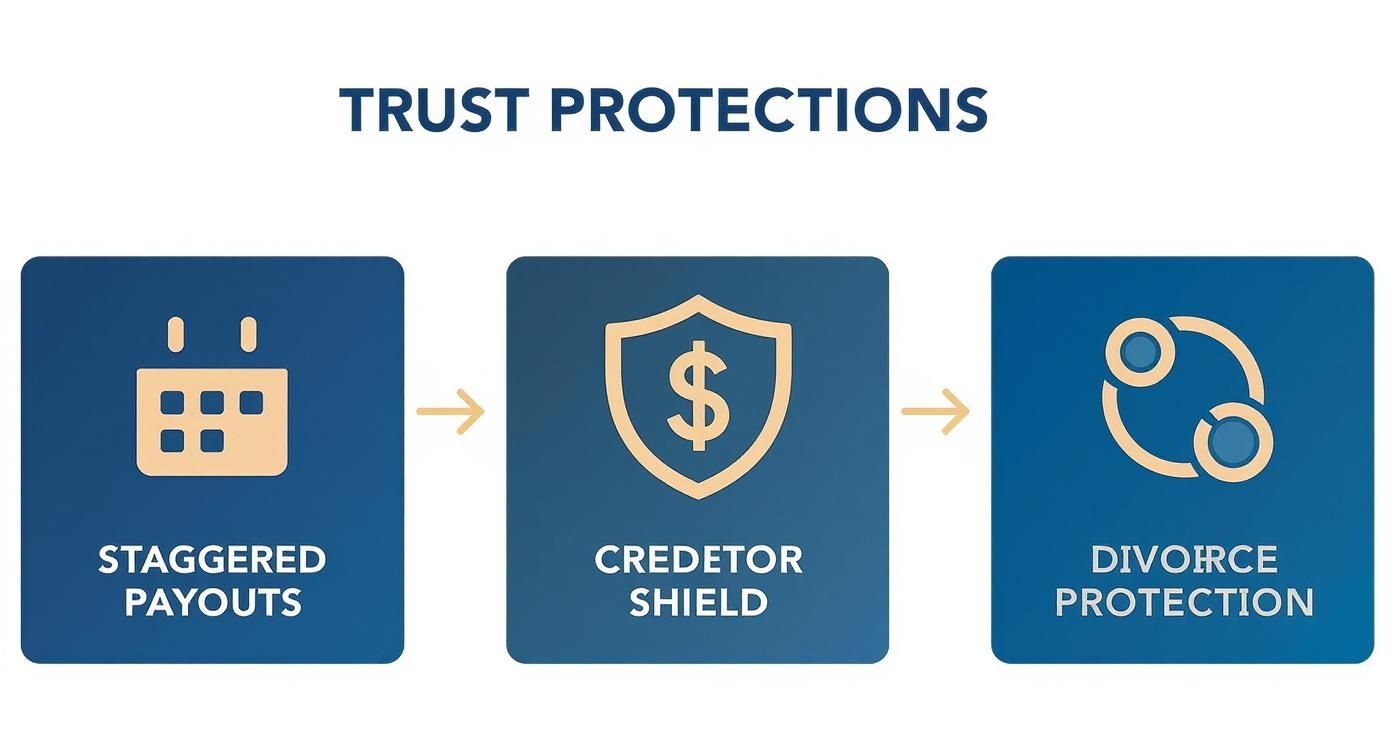
A will typically pays out an inheritance in one lump sum. A trust lets you be more strategic. Instead of a single check, you can design a plan for staggered distributions. This means your successor trustee will release funds to your beneficiaries based on a schedule you create.
It could look something like this:
- A beneficiary receives one-third of their inheritance at age 25.
- The next third is released at age 30.
- The final portion is distributed at age 35.
This approach gives your loved ones time to mature and gain financial experience, ensuring your legacy provides long-term stability.
The Power of a Spendthrift Provision
One of the most valuable features you can include in a Texas trust is a spendthrift provision. In plain English, this provision acts like a financial safety net for your beneficiary's inheritance. It is designed to protect the inheritance from a beneficiary's own potential mistakes and from outside threats like creditors, lawsuits, or even claims in a divorce settlement.
This clause prevents a beneficiary from selling or promising their inheritance to someone else. It also blocks their creditors from coming after the assets held in the trust. As long as the money stays in the trust, it's generally protected.
A Real-World Scenario: Protecting a Blended Family
Consider Mark, who has two children from his first marriage and is now married to Susan. He wants to ensure Susan is cared for after he's gone, but he also wants his own property to eventually go to his children.
With a revocable living trust, Mark can achieve both goals:
- He can structure the trust so that after his death, Susan receives all the income the trust assets generate for the rest of her life, ensuring her financial support.
- The trust can then state that once Susan passes away, the remaining principal—the original assets—is distributed directly to his two children.
This structure provides security for his current spouse while preserving his children’s inheritance—a delicate balance that is difficult to achieve with just a will. You can discover more about these custom trust provisions to see how they can be tailored to fit your family’s specific needs.
Key Insights and Your Next Steps
We’ve covered the core revocable living trust benefits for Texas families. A trust is a powerful tool that keeps your estate out of the public and lengthy probate process, protects your family’s privacy, and puts a clear plan in place for your care if you ever become incapacitated. It also gives you flexible, long-term control over your legacy.
From Plan to Action: Funding Your Trust
Creating a trust is more than just signing a document. To bring it to life, you must complete the critical process known as funding the trust. This means you must transfer ownership of your assets—like your home, bank accounts, and investments—from your individual name into the name of the trust.
If you skip this step, your trust is an empty container. It holds no assets, and your property will still be subject to the probate process you wanted to avoid. Funding your trust is the action that activates all the benefits we’ve discussed.
A trust is a sophisticated instrument for safeguarding inheritances against future risks and ensuring your legacy is managed responsibly. Our goal is to empower you with the clarity and confidence to move forward.
Takeaway
A revocable living trust is more than an estate planning document; it's a comprehensive life-planning tool. It protects you during periods of incapacity, shields your loved ones from the public and costly probate process, and provides a private, controlled way to pass on your legacy. The key is proper creation and funding, which ensures your instructions are followed precisely, giving your family security and peace of mind.
If you’re facing probate in Texas, our team can help guide you through every step—from filing to final distribution. Schedule your free consultation today.
Answering Your Questions About Texas Living Trusts
Trusts can seem complicated, and it’s natural to have questions. Let’s clear up some of the most common things Texas families ask about revocable living trusts.
Does A Revocable Living Trust Help Avoid Estate Taxes?
This is a common point of confusion. The answer is no. A standard revocable living trust is designed to avoid the public probate process, not to sidestep estate taxes.
Because you keep total control over the assets in the trust while you're alive, the IRS still considers those assets part of your taxable estate. For most Texans, this is not an issue. Texas does not have a state-level estate tax, and the federal exemption is so high that it only impacts a very small number of estates.
Can I Change My Revocable Living Trust?
Absolutely. The word “revocable” means the trust is a flexible, living document that you control as long as you are mentally competent. You can make changes whenever you want for common life events, such as:
- A birth, death, marriage, or divorce in the family.
- Wanting to name a different successor trustee or change beneficiaries.
- Major changes in your finances or assets.
Life changes, and your estate plan should be able to change with it.
Do I Still Need A Will If I Have A Trust?
Yes, and this is a critical piece of a complete estate plan. The specific type of will used with a trust is called a pour-over will, and it works like a safety net.
Its job is simple but vital: it is designed to catch any assets you might have forgotten to transfer into your trust. When you pass away, the will directs that any of these overlooked assets get "poured into" your trust, ensuring they are distributed according to your wishes. Without it, those forgotten assets could end up subject to Texas intestacy laws, meaning the state—not you—decides who gets them.
If you’re facing probate in Texas, our team can help guide you through every step — from filing to final distribution. Schedule your free consultation today.