A parent has died. The family is exhausted, grieving, and trying to get through the next practical step. Then the will is read, and one child receives the house, another gets a smaller share, and someone else is left wondering whether this was really their parent's decision.
That moment changes the conversation fast. Hurt feelings turn into suspicion. Old family tensions resurface. People start asking whether the will is unfair, whether it can be challenged, and whether the executor is required to “fix” what feels wrong.
Probate Disputes Over Unequal Inheritance: What Texas Law Says starts with one hard truth. In Texas, a will can be unequal and still be valid. But that doesn't mean every unequal will is beyond challenge. The question is not whether the distribution feels harsh. The question is whether the will was created and signed in a legally valid way, by someone who had capacity and acted freely.
For families in this position, clear legal guidance matters. Texas probate law, especially under Titles 2 and 3 of the Texas Estates Code, provides a defined process for probating a will, contesting one, administering an estate, and protecting the rights of beneficiaries, spouses, and children. Knowing that process can lower panic and help you make better decisions early.
The Moment a Will Divides a Family
A common situation looks like this. Three siblings gather after their mother's death expecting a fairly routine probate. Instead, they learn that one sibling receives the family home, another gets a cash gift, and the third receives almost nothing. Nobody is just reacting to dollars. They're reacting to what the distribution seems to say about love, loyalty, and family history.
That reaction is real, and it matters. An unequal inheritance often feels personal, especially when the estate includes a ranch, a homestead, or belongings tied to childhood memories. In many families, the dispute begins before anyone has even read the probate file.

Texas families are hardly alone in facing this. An estimated 70% of adult Americans lack wills, a major factor fueling inheritance disputes. When a will does exist but distributes assets unequally, the risk of conflict escalates, turning family homes and assets into courtroom battles according to this discussion of probate conflict and intestacy in Texas.
Why the conflict often starts before the legal fight
When there's no plan, Texas intestacy rules control who inherits. Under Title 2 of the Texas Estates Code, those rules can divide separate and community property in ways that surprise families, especially in blended family situations. Even when there is a will, unequal gifts can trigger the same kind of confusion because people compare the result to what they expected, not to what the law allows.
A family also has to deal with practical problems at the same time:
- The house still has to be maintained: Taxes, insurance, and access issues don't pause because siblings disagree.
- The executor still has duties: Someone has to gather assets, give notices, and move the estate through court.
- Deadlines keep running: Waiting too long can weaken your position.
Grief and legal deadlines often arrive together. Families who act early usually preserve more options than families who wait for emotions to cool on their own.
Sometimes families also need support outside the courtroom. If conflict is affecting communication between parents, adult children, or grandchildren, a resource such as Kelowna counseling for parents and children can help some families stabilize emotionally while legal issues are being sorted out.
Is an Unequal Inheritance Legally Wrong
The short answer is not necessarily.
Texas law generally lets a person decide who receives their property at death. That includes leaving more to one child, less to another, or disinheriting someone altogether, subject to protections the law gives certain surviving family members in specific situations. A probate court does not rewrite a will just because someone thinks the outcome is unfair.
Unfair and illegal are not the same thing
Many readers come in asking the wrong first question: “Can I contest this because it isn't fair?” In Texas, fairness by itself isn't a legal standard for invalidating a will. Probate judges look for legal defects, not family consensus.
A useful way to think about it is this. A will is not graded like a family decision. It's tested like a legal document. If the person making it had the required mental ability, acted voluntarily, and followed the required signing formalities, the court may uphold it even if the distribution causes serious resentment.
Reasons unequal gifts happen without wrongdoing
Not every unequal will is evidence of manipulation. In practice, families often discover facts that make the parent's decision more understandable, even if it still hurts.
For example:
- Caregiving history: One child may have provided years of hands-on care.
- Prior financial help: A parent may believe one child already received substantial lifetime support.
- Different needs: A parent may want to provide more support to a child with financial or medical challenges.
- Blended family planning: A spouse, children from a prior marriage, and separate property can create difficult choices.
Readers dealing with a complete disinheritance issue may also find it helpful to review how Texas law handles cutting someone out of a will.
Practical rule: If your complaint is only “I should have received more,” that usually isn't enough. If your complaint is “this will doesn't reflect a free and valid decision,” that may justify closer review.
Where Titles 2 and 3 matter
Under Title 2, Texas law governs estates of decedents, including probate procedures, personal representatives, and distribution issues. Title 3 deals with guardianship matters, which can become relevant if concerns existed about the decedent's capacity before death or if prior guardianship-related records help explain family dynamics. Those records don't automatically prove a contest, but they can become important evidence.
Valid Legal Grounds to Contest an Unequal Will
If you want to challenge a will in Texas, you need more than disappointment. You need a recognized legal ground, and you must raise it inside the probate case.
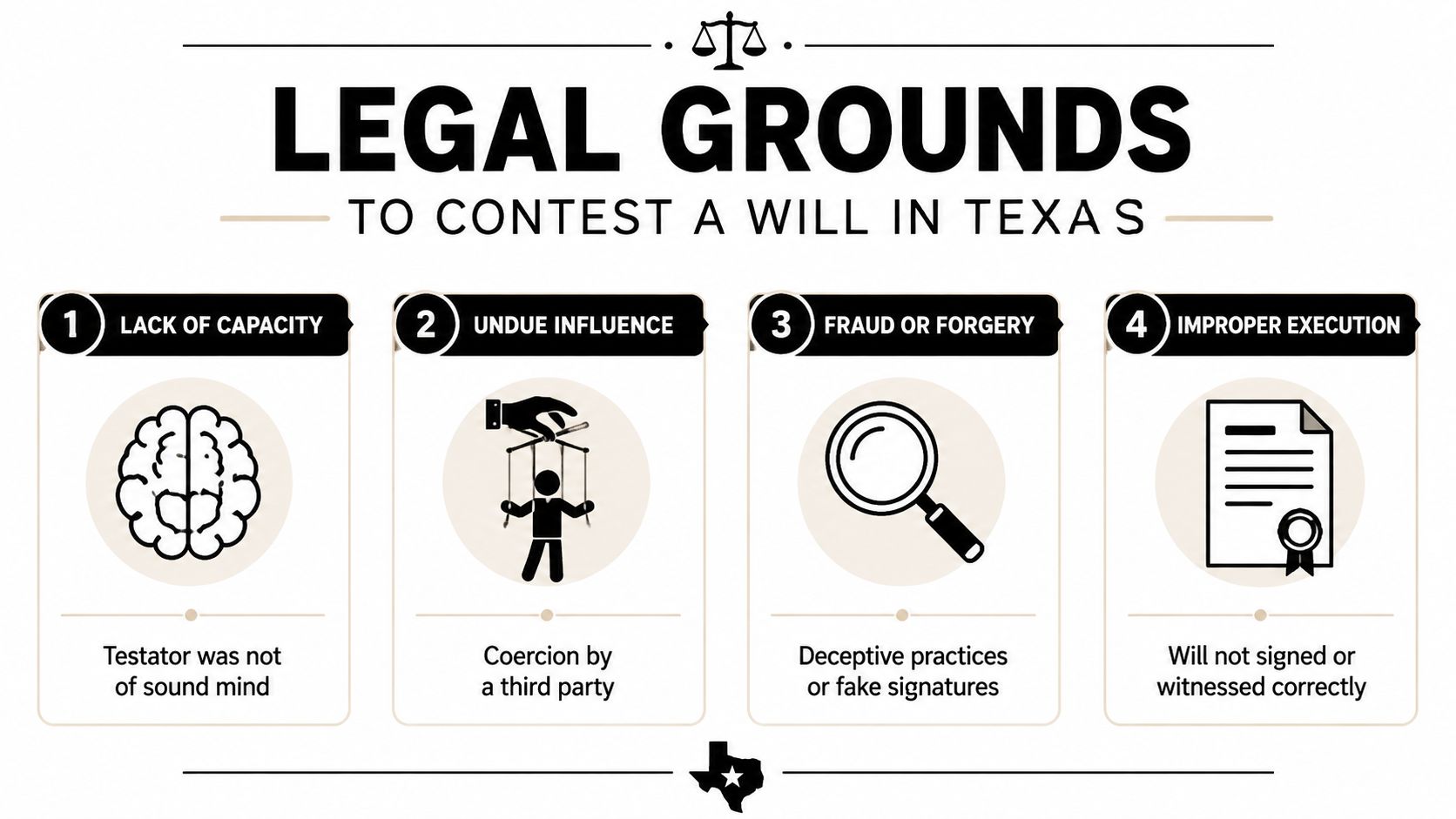
Under Texas law, following the landmark Archer v. Anderson case, all inheritance disputes, including those over unequal shares, must be litigated within the probate system. A challenger can't sue for “tortious interference with inheritance” in civil court. They must use the Texas Estates Code to prove specific grounds like undue influence, lack of capacity, or fraud within the probate case itself as outlined in the Texas probate will contest guide.
For a more detailed discussion, see grounds for contesting a will in Texas.
Lack of testamentary capacity
This means the person signing the will was not of sound mind at the time of signing. In plain English, they must understand that they are making a will, know the general nature of their property, recognize the natural objects of their bounty, and understand the effect of the document.
A diagnosis alone doesn't decide the issue. A person may have memory problems and still have legal capacity on the day they sign. The timing matters.
A realistic example would be an elderly father who signs a new will during a period of severe confusion, cannot identify his children consistently, and cannot explain what property he owns. That fact pattern deserves close review.
Undue influence
This ground comes up often in unequal inheritance disputes. It means someone pressured or manipulated the testator so strongly that the will reflects the influencer's wishes instead of the testator's own free choice.
Common allegations involve a child, caregiver, or romantic partner isolating the decedent, controlling access, arranging the lawyer, or pushing for sudden changes. Suspicion alone won't carry the case. The court wants evidence tying the pressure to the actual will.
The strongest undue influence cases usually show both vulnerability and opportunity, plus a document that departs sharply from the decedent's long-standing intentions.
Fraud or forgery
Fraud can involve tricking someone into signing a will or misleading them about what they are signing. Forgery means the signature or document isn't genuine.
These claims are serious and fact-intensive. Families often raise them when a late will appears unexpectedly, especially if the circumstances around drafting and signing are murky.
Improper execution
Texas has formal requirements for a valid will. If those requirements were not followed, the will may fail even without bad intent. This issue often turns on whether the will was signed correctly and witnessed as Texas law requires.
What a contest is really asking the court to do
A successful contest does not ask the judge to make the shares more equal. It asks the judge to determine that the challenged will is not legally valid. If that happens, the estate may pass under a prior valid will or, if none exists, under intestacy rules in the Estates Code.
That's a major strategic point. Sometimes a contest produces a result a disappointed heir likes less than the current will. Before filing anything, compare the likely outcomes carefully.
The Texas Will Contest Process Step by Step
When families hear “will contest,” they often imagine one dramatic hearing. In reality, probate litigation is a sequence of filings, deadlines, evidence gathering, negotiation, and sometimes trial. Under the Texas Estates Code, procedure matters almost as much as proof.
Step one, confirm the probate status and deadline
A key issue is timing. In Texas, a will contest generally must be filed within two years after the court admits the will to probate, subject to limited exceptions described in the Texas will contest procedures summary. If you wait too long, the court may never reach the merits.
Start by obtaining the probate filings from the county where the estate is pending. You need to know whether the will has already been admitted, who applied to probate it, and who is serving as executor or seeking appointment.
Step two, file the challenge in probate court
The challenge belongs in the probate proceeding, not in a separate inheritance tort case. The filing should identify your legal basis, your standing to object, and the relief requested.
At this stage, broad accusations usually hurt more than help. Courts and opposing counsel take better notice when the pleading is focused and supported.
Step three, gather evidence through discovery
Discovery is the formal process for obtaining information. That can include medical records, drafting attorney files, witness testimony, financial records, communications, and prior estate planning documents.
Maria's situation is a useful example. After her mother died, Maria learned that her brother received the home and most of the remainder of the estate under a new will signed shortly before death. Maria believed her mother had been increasingly confused and isolated. A proper case review would focus on timeline, records, witnesses, and how the new will was prepared, not just on the fact that the shares were unequal.
Here's a helpful overview if you're trying to understand what this stage can involve:
Step four, expect mediation before trial
Texas courts often encourage mediation, especially in probate disputes involving family property. Mediation is a structured settlement conference with a neutral third party. It is not the same thing as giving up your claim. It's an opportunity to control risk, reduce expense, and sometimes preserve important relationships.
Possible settlement terms may include a negotiated distribution, sale of property, accounting agreements, or terms for personal property division.
Step five, prepare for a judge or jury decision
If the case does not settle, the court decides whether the challenged will is valid. That may involve live testimony from family members, subscribing witnesses, doctors, caregivers, and the lawyer who drafted the will.
Probate litigation is rarely about a single dramatic fact. Most cases turn on documents, timelines, witness credibility, and whether the evidence fits a recognized legal ground.
Strategies for Heirs Executors and Out-of-State Relatives
A will can leave one child angry, another defensive, and the executor stuck in the middle before the probate case has even started. Each person has a different job once that happens. The wrong move early can increase cost, delay distributions, and make settlement harder.

For heirs who believe the will is invalid
Start with records, not accusations. If you believe a parent was pressured, confused, isolated, or suddenly changed long-standing plans, preserve the evidence that shows when those changes happened and who was involved.
Useful evidence often includes:
- A clear timeline: Dates of hospitalizations, diagnoses, caregiver changes, new bank activity, and revisions to estate documents.
- Communications: Texts, emails, voicemails, letters, and calendar entries that show access, pressure, or changes in decision-making.
- Witness information: Names of neighbors, caregivers, friends, medical providers, or relatives who saw the decedent close to the time the will was signed.
- A realistic outcome analysis: If the will is set aside, the estate may pass under an earlier will or under intestacy rules. That result is not always better for every heir.
Families often lose ground by turning the dispute into a moral argument instead of a legal one. Feeling cut out matters. In court, proof matters more. A judge will want evidence tied to capacity, undue influence, execution problems, fraud, or another recognized basis for contest.
Another common mistake is treating the executor as the architect of the problem before the facts are clear. Sometimes the executor supported the new will. Sometimes the executor is merely the person named to carry out a document that is now under attack.
For executors trying to do the job correctly
An executor does not represent one side of the family. The executor's duty is to the estate and to the court process. That means protecting assets, keeping records, giving required notices, responding to claims, and following the orders that govern administration under the Texas Estates Code.
Neutrality is harder than it sounds, especially when the executor is also a beneficiary or sibling. I often tell executors to assume every text, email, and reimbursement request may later be read in a courtroom. Good records help. Informal side deals usually do not.
If a contest is filed or clearly coming, get legal advice early. In some cases, an executor may retain counsel, such as the Law Office of Bryan Fagan, PLLC, to assist with probate filings, administration issues, and disputed proceedings while the executor continues meeting statutory duties. That does not mean the executor is choosing a family faction. It means the estate is being managed carefully while the dispute is addressed.
For out-of-state relatives
Living outside Texas no longer means you have to guess what is happening from a few forwarded emails and scattered phone calls. Remote participation is more common in probate matters than many families expect, including status conferences, some hearings, and mediation settings, depending on the court and the issue involved.
That convenience has limits. A remote appearance does not replace organized documents, prompt communication, or a local strategy for obtaining records and filing objections on time. If you live out of state, ask early whether the court allows remote attendance, what platform it uses, and which proceedings still require in-person participation.
Distance also changes the emotional side of the case. The child who lived nearby may have more day-to-day facts. The child who lived away may have a clearer view of long-term family patterns. Both perspectives can matter. Neither replaces evidence.
If you are an out-of-state heir, ask for the probate filings, hearing dates, and inventory information as soon as possible. Delay is expensive, and in a will contest, lost time can mean lost evidence.
Key Insight How to Prevent Inheritance Disputes Before They Start
The most effective probate dispute strategy is often prevention long before death. Unequal inheritances are not automatically a problem. Surprise, ambiguity, and poor documentation are.
Use the right planning tools for the family you actually have
A cleanly drafted will helps. In some families, a revocable trust helps more because it can move assets outside the probate process and provide clearer administration instructions. Beneficiary designations also matter because some accounts pass outside the will entirely.
When unequal distributions are intentional, documentation helps reduce later doubt. That may include attorney notes, clear drafting, and thoughtful communication with family during life. Silence often invites families to create their own explanations.
No-contest clauses can change the risk analysis
Texas law allows for no-contest clauses, which state that a beneficiary who unsuccessfully challenges a will forfeits their inheritance. To make this an effective deterrent against disputes over unequal shares, attorneys often advise leaving the potential challenger a large enough sum that the financial risk of a contest becomes irrational as discussed in this article on unequal inheritances and no-contest planning.
That tool isn't magic. It works best when combined with a solid estate plan and a record that shows the testator acted knowingly and voluntarily.
A practical prevention checklist
- Update documents after major life changes: Marriage, divorce, remarriage, illness, or a new caregiving arrangement can all affect estate goals.
- Explain unusual decisions: A brief written explanation can reduce confusion if one child receives more or receives a specific asset.
- Coordinate probate and non-probate assets: Wills, trusts, deeds, and beneficiary designations should point in the same direction.
- Choose the right executor: Pick someone who can stay organized, communicate calmly, and handle conflict.
- Address family vulnerability early: If capacity may become an issue later, planning sooner is usually better.
Families don't usually fight hardest over what was clearly planned. They fight hardest over what was left unclear.
This is also where Titles 2 and 3 of the Texas Estates Code connect in a practical way. Good incapacity planning, powers of attorney, and in some cases guardianship-related planning can preserve records and decision-making structure before a crisis spills into probate.
Facing Your Probate Dispute with Confidence
The hard part often starts before anyone files anything. A son in Houston reads the will on a video call, a daughter in another state logs off in tears, and the executor is left with a stack of questions no one wants to ask out loud. Was this unfair, or was it legal? In Texas, that difference controls what happens next.
An unequal inheritance can feel personal. Probate court still looks for proof tied to a legal claim. The judge will focus on whether the will is valid, whether the estate is being administered correctly, and whether there is evidence of lack of capacity, undue influence, fraud, or another recognized basis to challenge the document.
That matters for everyone involved.
If you are considering a contest, the first question is not whether the will hurt your feelings. The first question is whether the facts can support a case strong enough to justify the cost, delay, and strain on family relationships. If you are serving as executor, your job is to protect the estate, follow the court's orders, keep records, and avoid acting as if you represent one side of the family. If you live outside Texas, remote hearings and electronic filing can make participation easier than it used to be, but distance still creates practical problems with gathering records, attending depositions, and making decisions quickly.
Good legal advice should do two things at the same time. It should tell you, plainly, whether you have a real claim. It should also give you a plan for the next step, whether that means contesting the will, defending it, negotiating a resolution, or closing probate with as little added damage as possible.
If you are facing probate in Texas, Law Office of Bryan Fagan, PLLC can help with the legal steps from filing through final distribution. Schedule a free consultation to discuss the will, the probate record, and the options available in your specific case.