When you take on the role of an executor, you’re stepping into a position of immense trust, often while still grieving a personal loss. We understand how overwhelming this can feel. One of your very first legal duties is sending out the official notice to beneficiaries. This isn't just a courtesy—it's a mandatory step under Texas law, and getting it right sets the tone for a smooth and transparent Texas probate process.
This guide offers a compassionate, step-by-step explanation to help you navigate this critical responsibility with confidence.
What Is the Notice to Beneficiaries in Texas Probate?
Think of the beneficiary notice as the formal kickoff for administering the estate. It’s the official letter that tells everyone named in the will that the probate process has started and that their loved one's final wishes are now being legally carried out.
This simple piece of paper is the cornerstone of a transparent and smooth-running estate settlement, ensuring everyone feels respected and informed.

Why This Notice Is So Crucial
The legal requirement for this notice is spelled out in the Texas Estates Code, Title 2, Chapter 308. The law exists for a very good reason: to protect beneficiaries. Before this statute was in place, it was alarmingly possible for an estate to be managed and even closed without the heirs ever being formally notified. They could be left completely in the dark about assets they were entitled to receive.
The formal notice solves this problem by creating a clear, documented record. It guarantees that:
- Every beneficiary is officially aware that the will has been admitted to probate by the court.
- They know exactly who is in charge of the estate—that’s you, the executor.
- They receive a copy of the will and the court order admitting it to probate, leaving no room for secrets or speculation.
By handling this duty with care, you immediately build trust and significantly reduce the chances of future disputes or messy probate litigation. When family members feel included and respected from day one, they are far more likely to be cooperative. On the other hand, failing to send the notice can cause serious problems, from delays in closing the estate to legal action taken against you personally. A clear grasp of an executor of a will's responsibilities is vital to avoid these kinds of missteps.
The Deadlines You Absolutely Cannot Miss
The Texas Estates Code is very clear about the timeline, and these are not just suggestions. As the executor, you have 60 days from the date the judge signs the order admitting the will to probate to send this notice.
After that, you have another deadline: you must file proof with the court that you sent the notices within 90 days of that same probate date.
Key Takeaway: These deadlines are firm and designed to keep the process moving. Missing them can create unnecessary problems with the court and send a signal to beneficiaries that you aren't managing the estate properly. Staying organized and acting promptly is one of your best strategies for a smooth administration.
The table below breaks down these critical timeframes, giving you a clear roadmap for this essential first task. Getting this right shows your commitment to honoring your loved one’s wishes and fulfilling your role with integrity.
Key Deadlines for Texas Beneficiary Notices
This table summarizes the critical timeframes and actions an executor must take regarding beneficiary notices after a will is admitted to probate.
| Action Item | Deadline | Governing Statute (Texas Estates Code) |
|---|---|---|
| Send Notice to Beneficiaries | Within 60 days of the will being probated | Section 308.002 |
| File Affidavit or Waiver of Notice with the Court | Within 90 days of the will being probated | Section 308.004 |
Following these steps carefully is not just about checking a box; it’s about starting the probate process on the right foot and honoring the trust placed in you during a difficult time.
Who Needs to Receive a Formal Notice?
Okay, you've been named executor and you know you need to send out notices to the beneficiaries. But who, exactly, gets one? It might seem like you should mail a notice to every single person mentioned in the will, right?
Not so fast. Texas law is actually pretty specific about this, and it even carves out some key exemptions that can save you time and hassle. Getting this right is a big part of doing your job correctly without making it harder than it needs to be.
First, you have to figure out who all the beneficiaries are. This means anyone—a person or even an entity like a charity—named in the will to receive property. As the executor, you have a duty to use "reasonable diligence" to find them. In plain English, this means making a real, good-faith effort to track down current addresses for everyone, not just the main heirs.
Required Notices vs. Exempt Beneficiaries
While you need a list of everyone, you don't have to send a formal, certified-mail notice to all of them. This is where understanding the rules really helps you work smarter.
Texas Estates Code Section 308.002 lays it all out. The general rule is that you must send this notice to all beneficiaries within 60 days after the court officially admits the will to probate. But the law also provides some common-sense exceptions for when a formal notice would just be redundant.
You are specifically exempt from sending a formal notice to a beneficiary if they:
- Have already appeared in court for the probate case.
- Sign a waiver of notice, confirming they know about the probate and don't need the formal mailing.
- Are set to receive a gift with an estimated value of $2,000 or less.
- Have already received their full inheritance or gift before the 60-day notice deadline.
- Are a minor or incapacitated person, and their court-appointed guardian receives the notice on their behalf.
Key Insight: That $2,000 exemption is a game-changer for many executors. Many wills include small, sentimental gifts to friends, neighbors, or distant relatives. This rule means you can avoid the cost and paperwork of sending dozens of certified letters for these minor bequests, simplifying your duties significantly.
A Real-World Scenario
Let's put this into practice to see how it works. Imagine your aunt passed away, and you're the executor of her will. She was a thoughtful person, and her will reflects that, leaving her house to her son (your cousin) and then making several cash gifts:
- $25,000 to her sister.
- $1,500 to her helpful neighbor who always checked in on her.
- $1,000 to her favorite local animal shelter.
- $500 to each of her five grand-nieces and grand-nephews.
In this scenario, who gets a formal, certified-mail notice? Only two people: your cousin (inheriting the house) and your aunt's sister (receiving $25,000).
The neighbor, the animal shelter, and all five grand-nieces and grand-nephews are exempt from the formal notice requirement. Why? Because each of their gifts is valued at less than the $2,000 threshold. This is exactly how the law helps you streamline the administration process while still ensuring all major heirs are properly notified.
Don't Confuse This with Other Notices
It's really important not to mix up the notice to beneficiaries with other legal notices that are part of probate. For instance, a probate citation is a totally different document. That's a formal notice served at the very beginning of a case to get the court proceedings started. If you're looking for more on that, our firm has a guide that clarifies the probate citation requirements in Texas.
The notice to beneficiaries comes after the court has approved the will, and it’s a task that falls squarely on your shoulders as the executor.
By taking a careful look at the will and applying these rules, you can confidently sort out who needs a formal notice and who doesn't. This approach ensures you’re following the law while managing the estate as efficiently and compassionately as possible.
How to Draft and Send the Notice Correctly
Alright, you've been appointed executor by the court. Now comes one of your first and most important legal duties: formally notifying the beneficiaries. Getting this step right isn’t just about checking a box; it’s about creating a bulletproof legal record that protects you and provides clarity to everyone involved.
Think of this notice as your first official act of communication. It needs to be precise, professional, and contain very specific information required by Texas law.
What Must Be Included in the Notice
The Texas Estates Code is crystal clear about what this notice must contain. Each piece of information is there for a reason—to ensure beneficiaries are fully informed about their loved one's estate and your role in it.
In plain English, your notice has to state:
- The full legal name of the person who passed away.
- That their will has been officially admitted to probate by a Texas court.
- The specific county and court number where the probate case is filed.
- Your name and complete contact information (address and phone number) as the executor.
You are also legally required to attach a copy of the will and the court order that admitted it to probate. This is not optional. It’s a critical transparency measure that allows the heirs to see the decedent’s final wishes for themselves and understand the legal authority you now hold.
This visual guide shows the high-level process of determining who to notify.
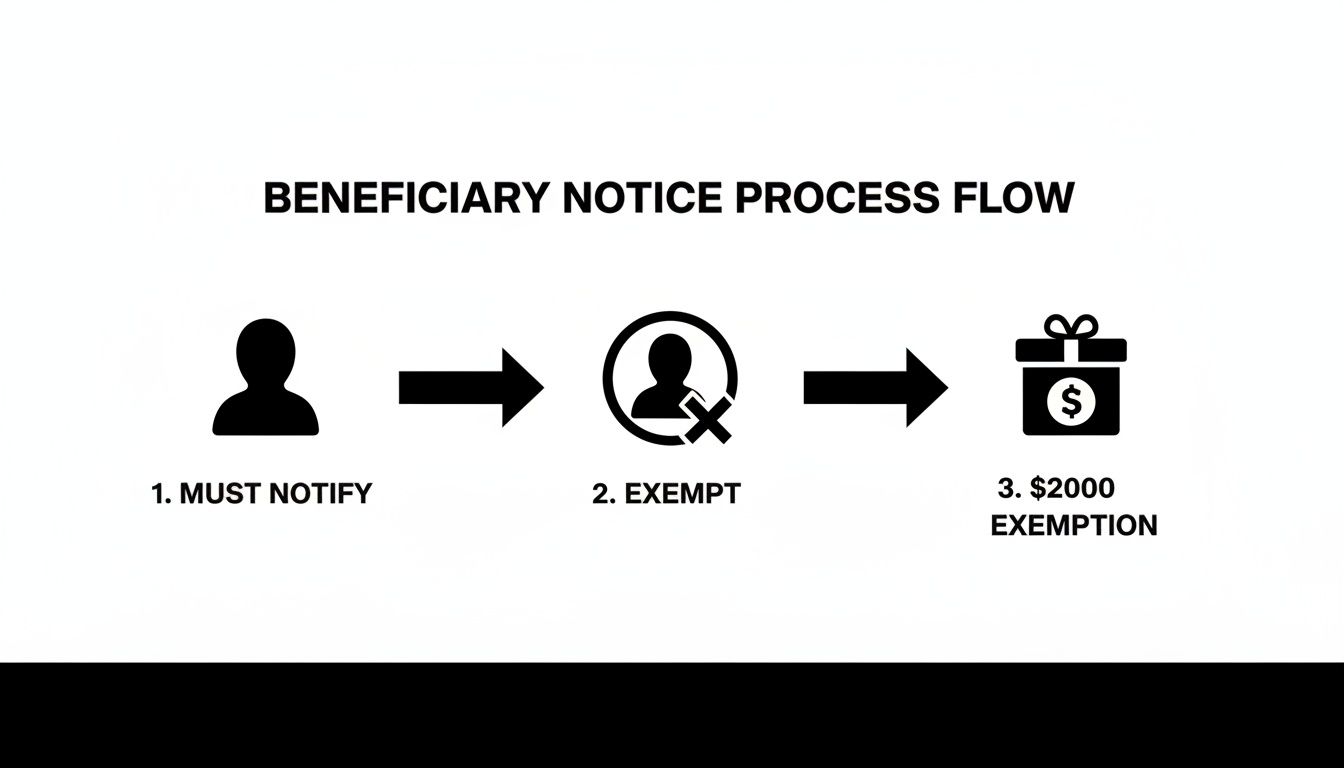
As the flowchart shows, while most beneficiaries must be notified, there are a few exceptions—like those receiving small gifts under $2,000—that can simplify your duties.
An Adaptable Sample Notice for Your Use
To make this step more concrete, here is an example of what your notice could look like. Remember, this is a template; you should adapt it to fit the specific details of your case.
Subject: Official Notice to Beneficiary Regarding the Estate of [Decedent's Full Name]
Dear [Beneficiary's Name],
This letter serves as formal notice, as required by Texas law, that the Last Will and Testament of [Decedent's Full Name] was admitted to probate on [Date of Probate Order].
The probate proceedings are filed in the [County Name] County Court at Law No. [#], Texas, under Cause Number [Case Number].
I have been appointed as the Independent Executor of the estate. My contact information is as follows:
[Your Full Name]
[Your Street Address]
[Your City, State, ZIP Code]
[Your Phone Number]Enclosed with this letter, you will find a copy of the Will and the Order Admitting Will to Probate for your records. Please feel free to contact me if you have any questions.
Sincerely,
[Your Signature]
[Your Printed Name], Independent Executor
This straightforward format hits all the legal requirements and sets a professional, respectful tone from the start.
The Correct Way to Send the Notice
How you send the notice is just as important as what's in it. The notice to beneficiaries in Texas probate must be sent via certified mail with return receipt requested.
This is non-negotiable. We sometimes see executors try to cut corners here by using regular mail or email, and it often creates problems. The law requires this method for a very important reason.
Sending it by certified mail creates an official paper trail. That little green card you get back from the post office—the return receipt—is your golden ticket. It’s the legal proof you’ll file with the court to show you fulfilled your duty. This single piece of paper can shut down any future claim that a beneficiary wasn't properly notified and is fundamental to avoiding messy probate litigation down the road. It also reinforces the trust needed when dealing with sensitive family matters like guardianship or discussing personal wishes found in wills and trusts.
Filing Your Proof of Notice with the Court
Sending out all those beneficiary notices is a big milestone, but you’re not quite over the finish line. The final, critical step is to circle back and formally report to the court, proving you’ve done your job correctly. This closes the loop on your duties, creates an official record that protects you as the executor, and keeps the Texas probate process moving forward.
You have a strict deadline for this: 90 days from the date the will was officially admitted to probate. There are two main ways to get this done: filing an Affidavit of Notice or, even better, collecting Waivers of Notice.
The Affidavit of Notice to Beneficiaries
The most common path is to file a sworn statement with the court, known as an Affidavit of Notice to Beneficiaries. Think of it as your formal report. It's a document you sign, usually in front of a notary, confirming that you sent out all the required notices.
Along with the affidavit, you'll need to attach your evidence:
- A copy of the actual notice letter you mailed.
- The certified mail return receipts—those little green cards—signed by each beneficiary.
This package of documents becomes your official proof. It shows the judge you followed the notice to beneficiaries Texas probate rules to the letter. We talk more about the power of these sworn statements in our guide on key documents you'll need in Texas probate. Filing this correctly shuts down any future argument that a beneficiary was kept in the dark.
A Streamlined Alternative: The Waiver of Notice
There is another, often much simpler, route: the Waiver of Notice. Instead of going through the formal certified mail process, you can simply ask each beneficiary to sign a waiver. This is a straightforward legal document where the beneficiary confirms they know about the probate and agree to "waive" their right to get that formal notice.
This approach is a lifesaver when you're dealing with cooperative family members who just want to make the process as smooth as possible. Collecting waivers can save you a surprising amount of time and the expense of certified mail, especially if the will names many beneficiaries.
A Real-World Scenario: An Executor Using Both Waivers and Formal Notice
Let's put this into practice. Imagine you're the executor for your brother's estate. The beneficiaries are his two adult children, who live nearby, and a cousin who lives out of state. You have a great relationship with your nieces.
Instead of sending certified letters to everyone, you call them. You explain, "I need to send a formal notice about Uncle John's will, but the law gives us a simpler way. If you're okay with it, I can email you a 'Waiver of Notice' to sign. It just confirms you know the probate has started and saves us the hassle of certified mail."
They agree. You email them the waiver forms, they sign them, and they send them right back. Easy.
But for your cousin, who you don’t know as well, you stick to the formal process. You send the notice via certified mail with a return receipt requested to ensure there's no question he received it.
Once you have the two signed waivers from your nieces and the green return-receipt card from your cousin, you’re ready. You file the signed waivers along with your affidavit (with the cousin's receipt attached) with the court clerk. Just like that, you’ve fulfilled your duty within the 90-day deadline, using a practical mix of methods that respected your family relationships while adhering strictly to the law.
Common Notice Mistakes and How to Avoid Them
Even the most organized executor can feel overwhelmed by the deadlines and details of probate. It's a high-stakes job, and you're often doing it while grieving. When it comes to sending the notice to beneficiaries in Texas probate, a few simple mistakes can create serious friction. Knowing the common pitfalls ahead of time will help you handle your duties with confidence and compassion.

Missing the 60-Day Clock
One of the easiest traps to fall into is missing the 60-day deadline to send the notice. The moment the judge signs the order admitting the will to probate, that clock starts ticking. Forgetting this deadline or putting it off can send a red flag to the court and beneficiaries, suggesting you aren't managing the estate diligently. That can lead to uncomfortable questions about your fitness to serve as executor.
The best defense is a good offense. As soon as you have that probate date, mark your calendar and set a reminder for 45 days out. This gives you a two-week cushion to track down addresses, prepare the notices, and get them in the mail without a mad dash to the post office.
Accidentally Forgetting a Beneficiary
It’s natural to focus on the main heirs—the children getting the house or the spouse receiving the bulk of the assets—and inadvertently overlook others. Wills often contain smaller, sentimental bequests to friends, distant relatives, or even charities. While there's a $2,000 exemption for small gifts, you can't afford to make assumptions.
Here’s a real-world example: A will leaves the primary estate to the decedent's children but also gifts a grandfather clock to a nephew and a collection of rare books to a local university. You might glance at the clock and guess its value, but it turns out to be an antique worth $2,500.
You assume it’s a minor gift and don't send the nephew a formal notice. Later, he feels he's been kept in the dark, and this simple oversight becomes a source of conflict that could delay closing the estate. Your best move is to meticulously review the will and create a complete list of every single beneficiary, no matter how small their gift seems.
Sending Notice the Wrong Way
Another critical error is sending the notice through regular first-class mail, email, or just handing it to someone. Texas law is crystal clear on this point for a good reason: you need proof of delivery. Without that little green return-receipt card from certified mail, you have no legally binding evidence that the beneficiary ever received the notice.
This isn't just a bureaucratic hoop to jump through; it's your legal shield. If a beneficiary ever claims they weren't informed, that signed receipt is your irrefutable proof for the court. It can be the one thing that stops a simple misunderstanding from escalating into full-blown probate litigation.
Key Insight: Think of your paperwork as your armor. Every certified mail receipt, every signed waiver, and every court filing confirmation builds a protective file. This documentation is what proves you've diligently fulfilled your duties under the Texas Estates Code and shields you from personal liability. It demonstrates your commitment to transparency and care for the family.
The modern requirement for executors to notify beneficiaries within 60 days was established in Texas law in 2007. This change was a direct response to cases where executors mismanaged funds while heirs remained unaware. You can learn more about how the law has changed to protect families by exploring Texas probate's evolution. This history underscores why proper documentation isn't just a good idea—it’s a legal necessity designed to protect heirs. Whether you're dealing with wills and trusts or a complex guardianship, meticulous records are always your best defense.
Common Questions We Hear About Texas Probate Notices
Even with a clear roadmap, the probate journey can be emotional and complex. As an executor, you’re bound to hit a few bumps—especially when it comes to the nitty-gritty details of notifying beneficiaries. Getting every detail right feels critical, because it is.
Here are answers to a few of the most common, real-world questions we get from Texas families who are in the thick of it.
What Happens if I Discover a New Beneficiary After the 60-Day Deadline?
It’s a scenario that sends a jolt of panic through any executor: the 60-day notice window has closed, and you’ve just discovered a forgotten or previously unknown beneficiary. The most important thing to do is take a deep breath and act, don't ignore it.
Your duty is to make sure every beneficiary gets proper notice, even if it's late. The first call you should make is to your probate attorney. They will guide you through sending a late notice to the newly found heir and, just as importantly, filing an amended Affidavit of Notice with the court.
Acting quickly and transparently shows the court you're acting in good faith. It's the best way to avoid potential personal liability or drag out the process of closing the estate.
Do Contingent Beneficiaries Need to Be Notified?
Yes, they absolutely do. A contingent beneficiary is someone who only inherits if a certain condition is met. For example, a will might say, "I leave my house to my son, but if he passes away before I do, it goes to my niece." The niece is a contingent beneficiary.
Her inheritance isn't a sure thing—it depends on her cousin not being alive—but she still has a legal interest in the estate that Texas law recognizes. The Texas Estates Code includes them in the group of people who must be kept in the loop.
Sending them the formal notice ensures they know about their potential interest and the status of the estate. It's a simple step that can prevent a future claim from someone arguing they were wrongfully left out.
Key Takeaway: Transparency is your best friend in probate. Notifying everyone, including contingent beneficiaries, builds trust and creates an airtight record. It's always better to over-communicate than to face a legal challenge down the road from someone who felt ignored or disrespected during a sensitive time.
Can I Waive My Own Notice if I Am Both Executor and a Beneficiary?
Yes, and you absolutely should. This is a very common situation and a practical shortcut. If you're running the show as the executor and you’re also named as a beneficiary in the will, there’s no need to send yourself a certified letter.
Instead, you can simply sign a waiver of notice for yourself. It’s an efficient move that cuts down on your own paperwork.
When you file the Affidavit of Notice with the court, you’ll include your signed waiver along with the return receipts or waivers from all the other beneficiaries. This officially shows the court you're aware of the proceedings (since you're the one managing them) and helps streamline the final documentation.
Is a Notice Required for a Muniment of Title?
No. This is a crucial distinction that can save a ton of time and effort in the right situation. The formal notice process laid out in Texas Estates Code §308 isn't required when a will is probated as a Muniment of Title.
A Muniment of Title is a simplified probate alternative. It’s used when the person who died had a valid will but no debts—other than loans secured by real estate, like a mortgage. The court’s order essentially acts like a deed, legally recognizing the will as the document that transfers property to the beneficiaries.
Because this streamlined process doesn't involve appointing an executor or formally “administering” the estate, all the duties tied to administration—like sending a notice to beneficiaries in Texas probate—don't apply. While it’s a more direct path, it only fits very specific circumstances.
Choosing the right type of probate is vital. The best approach depends entirely on your loved one's estate, from their wills and trusts to whether sensitive family matters like guardianship or potential probate litigation are on the horizon.
If you’re facing probate in Texas, our team can help guide you through every step — from filing to final distribution. Schedule your free consultation today.