Skip to content
When you’re grieving the loss of a loved one, the last thing you need is a long, confusing legal process dropped in your lap. It’s one of the first questions we hear from families: how long does probate take in Texas? While every situation is unique, a straightforward, uncontested probate typically takes between 6 to 12 months to complete.
Navigating this process can feel overwhelming, but our goal is to provide a clear, compassionate roadmap. This guide will walk you through the timeline, step-by-step, explaining complex legal concepts in plain English so you know exactly what to expect.
Setting Realistic Expectations for the Texas Probate Timeline
Losing a family member is difficult enough without the added stress of a drawn-out legal journey. The Texas Probate Process is the formal court procedure for settling a person’s final affairs, but its duration is definitely not one-size-fits-all.
Think of it as a path with a clear destination—distributing the estate to its rightful heirs and beneficiaries—but the length of that journey depends entirely on the terrain.
Key Factors That Shape the Timeline
Several key factors determine whether your family’s experience will be a relatively direct route or one with significant detours. These include:
- The presence of a valid will: A clear, legally sound Will is the best roadmap you can have for a smoother process. It leaves little room for arguments.
- The complexity of the estate: An estate with a single bank account and a house will be settled much faster than one involving business assets, multiple properties, or complicated investments.
- Family cooperation: When heirs and beneficiaries are in agreement, things move forward. When disputes arise, the process can grind to a halt.
Texas law, primarily governed by the Texas Estates Code, offers different paths for handling an estate, and each comes with its own timeline. The most common path, Independent Administration, is used in about 80% of Texas probate cases and is the one that generally fits that 6 to 12-month window.
On the other hand, a court-supervised Dependent Administration—often needed when there are disputes or complex debts—can easily stretch to one to two years or even longer.
To give you a clearer picture, here’s a quick comparison of what to expect.
Estimated Texas Probate Timelines at a Glance
This table breaks down the typical timelines for different probate scenarios in Texas. It’s a helpful starting point for understanding what your family might be facing.
| Probate Scenario | Estimated Timeline | Key Factors |
|---|---|---|
| Simple, Uncontested Probate | 6-12 Months | Valid will exists, minimal assets, heirs cooperate. |
| Probate with Minor Complications | 12-18 Months | Minor creditor issues, multiple properties, or slight disagreements among heirs. |
| Dependent Administration (Court-Supervised) | 1-2+ Years | No will, significant debts, or ongoing disputes that require court oversight. |
| Complex or Contested Probate | 2+ Years | Will contests, lawsuits, business valuation issues, or serious family conflict. |
As you can see, the path forward really depends on the specifics of the estate and the dynamics of the family involved.
Ultimately, understanding how long it takes to receive inheritance from a will is directly tied to this process. Knowing the factors at play will help you set realistic expectations for the months ahead and navigate the journey with a bit more clarity.
Your Step-by-Step Guide to the Probate Process
To fully understand how long probate takes in Texas, it helps to see the entire roadmap laid out. It’s less like a single event and more like a series of connected stages, each with its own purpose and timeline. Let’s walk through that journey together, step by step, in plain English.
The entire process begins when an executor (or an interested family member) files an Application to Probate Will with the appropriate county court. This legal document, filed along with the original will, officially gets the ball rolling.
The Initial Court Steps
Once that application is filed, Texas law requires a short waiting period. The county clerk must post a public notice about the application for about two weeks before any hearing can be scheduled.
- The First Hearing (Weeks 2-4): This is usually a brief, formal hearing. A judge will review the will, officially confirm the passing of the deceased, and legally appoint the executor. If all paperwork is in order, the judge signs an Order Admitting Will to Probate.
- Executor Takes the Oath and Gets “Letters” (Weeks 3-5): The newly appointed executor must take an oath of office, a formal promise to fulfill their duties according to the law. In return, the court issues Letters Testamentary. These are the official documents that give the executor the legal power to act for the estate—think of them as the keys to managing your loved one’s affairs.
This infographic paints a clear picture of how the path can split, depending on whether the process is smooth or hits legal roadblocks.
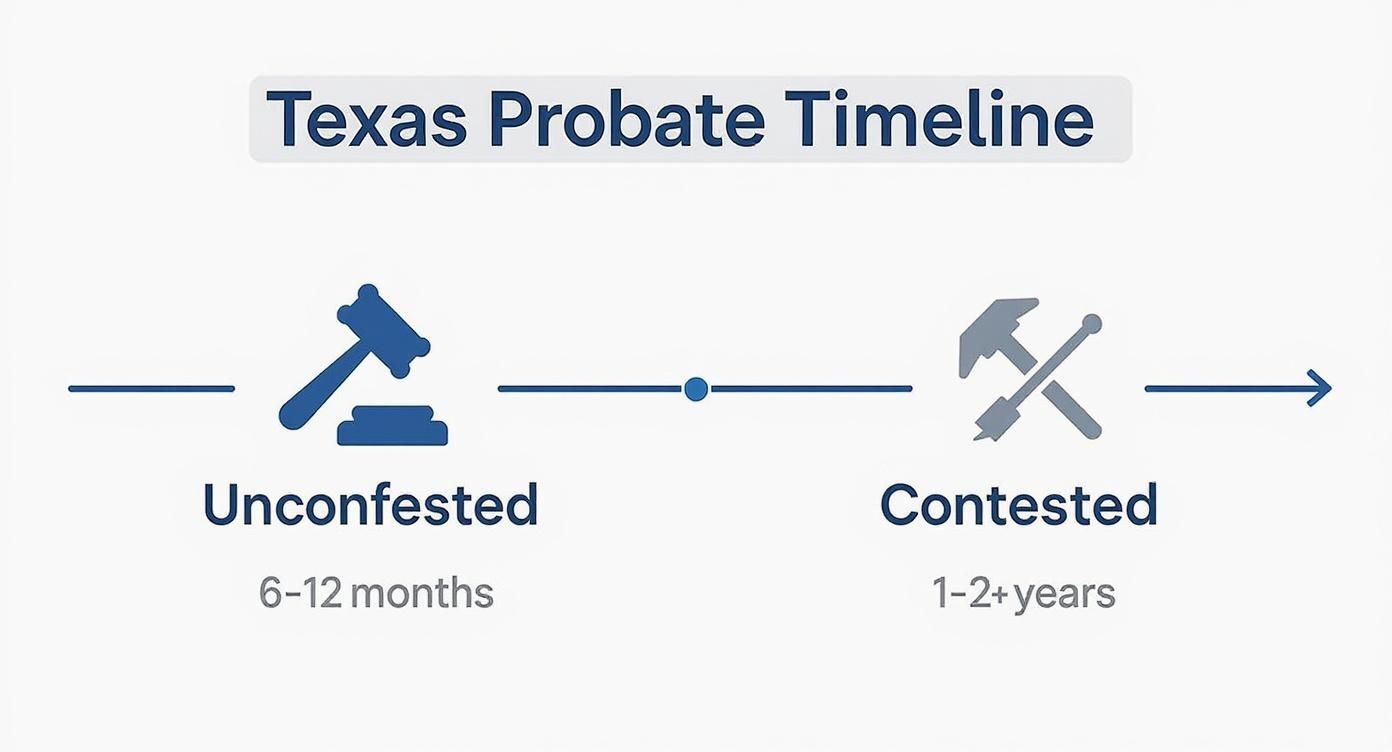
As you can see, an uncontested probate is a much faster track. A contested one, where disputes arise, can stretch the timeline out significantly.
Managing the Estate’s Affairs
With the Letters Testamentary in hand, the executor’s real work begins. This is almost always the longest part of the probate process, packed with critical duties required by the Texas Estates Code.
- Notice to Creditors (Within 30 Days of Appointment): The executor must publish a notice in a local newspaper. This serves as a formal announcement to any potential creditors that the person has passed away and an estate has been opened.
- Inventory, Appraisement, and List of Claims (Within 90 Days): This is a crucial step. The executor has a legal duty to create a detailed inventory of every single asset the estate owns, from real estate to bank accounts, along with their values. This document is filed with the court and becomes the official record of what the estate owns and owes.
Closing the Estate
Once the inventory is approved and the required waiting period for creditors has passed, the executor can begin paying the estate’s valid debts and final taxes.
After all obligations are settled, the final step is to distribute the remaining assets to the heirs and beneficiaries named in the will. The executor may need to file a final accounting with the court, showing how every penny was managed, before the estate can be formally closed. This final stage wraps everything up and, hopefully, provides some closure for the family.
Common Roadblocks That Extend the Probate Timeline

While many probate cases proceed smoothly in under a year, others hit snags that can turn a straightforward process into a long, emotionally draining ordeal. Knowing what these potential hurdles are is the first step toward preparing for them—and, whenever possible, sidestepping them entirely.
Of all the things that can go wrong, family disagreements are the most common and damaging cause of delay. When emotions are high after a loss, even small misunderstandings can escalate into serious conflicts, bringing the entire process to a grinding halt.
Will Contests and Family Disputes
A will contest is a formal lawsuit filed in court challenging a will’s validity. This type of Probate Litigation can easily add years to the probate timeline and significantly increase legal costs.
A beneficiary might contest a will for several reasons, claiming:
- The person who made the will lacked “testamentary capacity” (was not of sound mind) when they signed it.
- Someone exerted “undue influence,” pressuring the deceased into changing the will against their true wishes.
- The will itself is fraudulent or was not signed and witnessed according to Texas law.
Realistic Scenario: Imagine two siblings who discover their elderly father changed his will just weeks before his passing, leaving the entire estate to a new caregiver. One sibling might file a will contest, alleging undue influence. This triggers a lawsuit, requiring depositions, evidence gathering, and court hearings, pausing the entire probate process for a year or more until the dispute is resolved.
Complexities Within the Estate
Sometimes, the delay isn’t caused by people but by the assets themselves. Not every estate is just a simple checking account and a house. The more complex the assets, the more time an executor will need to properly manage, value, and distribute everything.
Some of the most common complexities include:
- Business Ownership: Valuing a family business, settling its debts, and managing a succession plan is a meticulous and time-consuming process.
- Out-of-State Property: If your loved one owned real estate in another state, a separate legal process called ancillary probate must be opened there.
- Significant Debts or Tax Issues: When an estate has many creditors or owes federal estate taxes, the executor must carefully negotiate payments and file complex returns, which can be a slow, drawn-out task.
You can take a deeper dive into what causes these hold-ups by exploring the various factors affecting probate timelines in more detail. By anticipating these potential issues, you and your family can build a strategy to tackle them proactively instead of being caught by surprise.
Independent vs. Dependent Administration

In Texas, the single biggest factor that dictates how long probate will take is the type of administration the estate goes through. You can think of it as choosing between an express lane on the highway and a country road with a stop sign at every corner. The path you take completely changes the length of the journey.
The two main routes under the Texas Estates Code are Independent Administration and Dependent Administration.
An Independent Administration is the express lane, and it’s by far the most common path for estates in Texas. It’s designed to be much faster and more cost-effective because the executor can handle most of the estate’s business without asking the court for permission at every step.
Once the court appoints an independent executor, that person is empowered to pay debts, sell property, and distribute assets with minimal court supervision. This streamlined approach is possible when the will specifically requests it or when all beneficiaries agree to it.
The Quicker Path: Independent Administration
The efficiency of independent administration is undeniable. It allows the executor to act decisively to settle the estate, which is why most straightforward probate cases wrap up within that 6 to 12-month timeframe. It trusts the executor to act in the estate’s best interest and keeps things moving without the constant delays of waiting for court dates.
The Supervised Route: Dependent Administration
On the other hand, a Dependent Administration is that slow, supervised route—more complex and under the constant watch of the court. This heavily supervised process is often required when there’s no will, when beneficiaries are in conflict, or when a minor is a beneficiary.
In this scenario, the person in charge (called an administrator) has very limited power. Nearly every significant action, from paying a utility bill to selling a car, requires filing a formal application with the court and getting a judge’s approval. This means more paperwork, higher legal fees, and much more time.
Let’s look at a real-world example: selling the family home.
- In an Independent Administration, the executor can hire a realtor, list the house, accept an offer, and close the sale, much like any homeowner would.
- In a Dependent Administration, the administrator must first file an application to sell, get the property appraised, attend a hearing for court approval, publicly post the sale, report the final sale back to the court, and wait for another hearing to confirm it. This convoluted process can easily add three to six months just to sell one asset.
This stark difference makes it clear why the type of administration is the primary driver of the probate timeline in Texas and highlights the incredible value of a well-drafted Will.
Faster Alternatives to Traditional Probate
Does every estate have to go through the full, formal probate process? Thankfully, here in Texas, the answer is no. For many families dealing with smaller or less complicated estates, the law offers a few shortcuts designed to save time, money, and stress.
These are not loopholes; they are streamlined legal pathways created for specific situations. Instead of spending months navigating court requirements, you might be able to wrap up your loved one’s affairs in just a matter of weeks.
Small Estate Affidavit
One of the most powerful tools for smaller estates is the Small Estate Affidavit. This is a sworn legal document that allows heirs to collect a loved one’s property without ever setting foot in a formal probate court. It’s a fantastic option, but it comes with very strict rules under Chapter 205 of the Texas Estates Code.
To qualify for a Small Estate Affidavit in Texas, the estate must meet these conditions:
- The total value of the assets (not counting the homestead and other exempt property) is $75,000 or less.
- The person must have passed away without a will.
- The estate’s assets are worth more than its total debts.
- Every single heir must agree on how the property will be divided and sign the affidavit.
This is the perfect route for simple situations, like accessing a small bank account or transferring a car title.
Muniment of Title
Another uniquely Texan option is probating a will as a Muniment of Title. You can think of this as an express lane for probate. It’s ideal for estates that have a valid will but have no significant unsecured debts.
Instead of a full probate administration, this process simply asks the court to officially recognize the will as the legal document that transfers ownership of property to the beneficiaries.
Under Title 2 of the Texas Estates Code, a Muniment of Title proceeding allows a will to be legally recognized and recorded. This creates a clear chain of title for real estate and other assets without ever needing to appoint an executor or open a formal administration.
To use this shortcut, the estate can’t have any debts, with one major exception: debts secured by real estate, like a mortgage.
If your loved one left behind a clear will and their finances were straightforward, you should learn more about how a Muniment of Title could be the quickest way to settle their estate.
Answering Your Questions About the Texas Probate Timeline
Navigating probate often brings up specific questions as families try to get a clear picture of the road ahead. Here are straightforward answers to some of the most common concerns we hear.
Can an Executor Sell Property During Probate?
Yes, but how and when they can do it hinges entirely on the type of probate administration.
In an Independent Administration, the executor has significant freedom. Once they receive their Letters Testamentary from the court, they generally have the authority to sell property without needing to ask the judge for permission, which helps keep the process moving efficiently.
In a Dependent Administration, the process is much more supervised. The administrator must get the court’s approval for almost everything, including selling property. This involves filing a formal application, attending a hearing, and waiting for a judge’s order before any asset can be sold, a process that can add months to the timeline.
What Happens If an Heir Cannot Be Found?
This situation can definitely slow down the probate process. The executor has a legal duty to conduct a thorough and diligent search for any missing heir. This may involve hiring investigators or publishing notices, all of which takes time.
If, after all that effort, the heir still cannot be located, the court will typically appoint an attorney ad litem—an independent lawyer whose sole job is to represent the missing heir’s interests. The share of the estate belonging to the missing heir is then usually paid into the court’s registry, where it’s held safely until they (or their own heirs) eventually surface to claim it.
Does Every Will Have to Go Through Probate?
Not necessarily. While most wills are probated to legally transfer assets, it’s not always required, especially if the estate was structured to avoid it.
For instance, assets held in a living Trust do not go through probate. The same applies to assets with designated beneficiaries (like life insurance or retirement accounts) or property owned jointly with rights of survivorship. These pass directly to the named person outside of the will and the probate process.
For estates with a will but no debts, the Muniment of Title process can serve as a much quicker, simpler substitute for a full probate administration.
Key Insight
The single most powerful tool for a smooth probate process is a well-drafted Will that clearly names a capable executor and provides for independent administration. This simple act of planning provides a detailed roadmap for the court, minimizes the potential for family disagreements that can lead to Probate Litigation, and honors your loved one’s final wishes with dignity and efficiency. While you can’t control every factor, proactive steps like encouraging family cooperation and seeking experienced legal guidance can shield your family from prolonged stress during an already difficult time. This is also true when navigating related matters like a Guardianship or the administration of a trust.
If you’re facing probate in Texas, our team can help guide you through every step — from filing to final distribution. Schedule your free consultation today.