When planning for your family's future, understanding the difference between a will and a trust comes down to one critical process: probate. A will is a set of instructions for what happens after you die, but it has no legal power until a Texas court validates it through the public probate process. A living trust, on the other hand, is a private legal tool that holds your assets, allowing your chosen successor to manage and distribute them immediately—completely bypassing the probate court.
Navigating these choices can feel overwhelming, especially while grieving or trying to make the best decisions for your loved ones. Our goal is to provide clear, compassionate guidance to help you protect your family and your legacy.
Will vs. Trust: A Quick Comparison for Texas Families
Choosing between a will and a trust is a significant decision. To help you understand the core differences in a plain-English way, we’ve broken down how each tool handles privacy, cost, and control. Understanding the fundamentals of both wills and trusts is essential for effective trusts and estates planning.
At-a-Glance Will vs. Trust Comparison
Here is a simple table comparing how a Texas will and a living trust measure up on the factors that matter most to families.
| Factor | Last Will and Testament | Revocable Living Trust |
|---|---|---|
| Probate Process | Required. Your will must be validated by a Texas probate court, which is a public process. | Avoided. Assets held in the trust pass directly to beneficiaries without court involvement. |
| Privacy | Public Record. Once filed for probate, the will and a list of your assets become public documents. | Private. The trust document and its terms remain confidential among your trustee and beneficiaries. |
| Effective Date | Upon Death. A will only takes effect after you pass away and it is admitted to probate. | Immediately. A trust becomes active as soon as you sign it and transfer assets into it (a process called "funding"). |
| Incapacity Planning | Does Not Help. A will offers no protection if you become unable to manage your own affairs. | Provides Protection. Your designated successor trustee can manage trust assets for you if you become incapacitated. |
| Naming a Guardian | Yes. A will is the only legal document in Texas where you can nominate a guardian for minor children. | No. A trust cannot be used to nominate a guardian for your children. |
This table provides a high-level overview, but the real-world impact is what truly affects your family's future.
Recent data highlights a concerning lack of preparation. The 2025 Trust & Will Estate Planning Report found that only 34% of men and 29% of women have wills. The numbers for trusts are even lower—just 15% of men and 9% of women. This suggests that many Texas families may be choosing what seems like the simpler option—a will—without fully understanding the long-term financial and emotional costs of probate. You can review the key findings from the 2025 report for more details.
Both documents serve crucial but different purposes. A will is non-negotiable for naming guardians. However, a trust offers superior privacy, control, and efficiency for transferring assets. Many Texas families find that a combination of both provides the most complete protection. For a foundational overview, you can learn more about the basics of estate planning in Texas.
How a Will Works Under the Texas Estates Code
When a person passes away in Texas, their will doesn't automatically transfer property. It must first go through a formal, court-supervised process called probate, which is governed by Title 2 of the Texas Estates Code.
This journey from a written document to a legally executed plan can seem intimidating, but understanding the steps brings much-needed clarity during a difficult time. Probate is simply the legal system's way of confirming your will is valid and officially giving your chosen representative—the Executor—the authority to carry out your wishes.

Step-by-Step Guidance: The Probate Journey
Probate isn’t a single event; it's a series of required steps that can take several months or more. While every estate is unique, the process for probating a will in Texas generally follows these steps:
- Filing the Will: The person you named as Executor will file an "Application to Probate Will" with the appropriate county court. This must be done within four years of the person's death, as required by Texas Estates Code § 256.003.
- Court Validation: The court holds a hearing to legally recognize the will. A judge confirms it meets Texas's legal requirements: it must be in writing, signed by you, and witnessed by two credible people.
- Appointing the Executor: Once the will is validated, the court officially appoints your chosen Executor. This person receives Letters Testamentary, a legal document giving them the power to manage the estate’s affairs.
- Administering the Estate: The Executor must then gather all estate assets, notify creditors of the death, pay valid debts and taxes, and file a detailed inventory of the estate's property with the court.
- Distributing Assets to Heirs: After all debts and administrative tasks are complete, the Executor can finally distribute the remaining assets to the beneficiaries exactly as instructed in the will.
It is important to understand that each of these steps involves court filings, legal notices, and strict deadlines. You can learn more by understanding the importance of wills in Texas estate planning and how they function within this process.
A Realistic Scenario: A Houston Family's Experience
Let’s imagine Maria, a retired teacher from Houston, passes away. Her will leaves her home to her two adult children, David and Sarah, and names David as the Executor.
David cannot simply sell the house or transfer the title himself. He must first hire an attorney to file Maria's will for probate in Harris County. After the court validates the will, it issues Letters Testamentary to David. For the next several months, David is responsible for inventorying Maria's assets, paying her final medical bills, and filing her last tax return. Throughout this process, Maria’s will, her assets (including her home's value), and the names of her beneficiaries all become part of the public record. Anyone can go to the courthouse and view these personal family details.
Only after the court approves David's actions can he finally transfer the deed of the home to himself and his sister. This relatively straightforward probate takes nearly a year and costs the estate several thousand dollars in court fees and legal expenses. This timeline and lack of privacy are fundamental differences when you compare a will to a trust.
How a Living Trust Works to Avoid Texas Probate
While a will is a set of instructions for the probate court, a revocable living trust is a private legal entity you create to hold and manage your assets for your beneficiaries. Think of it like a secure container for your property. This key difference is why a trust is such a powerful tool for avoiding the public, time-consuming, and often costly Texas Probate Process.
The process that makes a trust work is called funding. This is the critical step where you transfer legal ownership of your assets—like the deed to your house or your bank accounts—from your individual name into the trust’s name. You remain in complete control as the trustee. However, because the assets are legally owned by the trust, they are not part of your personal estate.
When you pass away, there is nothing for the probate court to oversee. Your designated successor trustee simply steps in and distributes the assets directly to your heirs according to the private instructions in the trust document.
The Power of Privacy and Efficiency
One of the greatest comforts a trust provides is privacy. When a will goes through probate, it becomes a public court record. This means anyone—a nosy neighbor, a distant relative, or a scam artist—can look up the details of your estate.
A trust, on the other hand, is a completely private document. Its terms, assets, and beneficiaries remain confidential. This protects your family’s financial matters from public view and can help prevent disputes.
Furthermore, the efficiency of a trust is a true gift to a grieving family. While probate can drag on for months, a successor trustee can often begin distributing trust assets in a matter of weeks. They can pay final bills and transfer property without waiting for a court hearing, making the entire process smoother and less stressful. For a deeper look, you can learn more about how trusts avoid probate in our detailed guide.
Planning for Incapacity: A Benefit Wills Cannot Offer
A living trust provides another critical benefit that a will cannot: a plan for managing your finances if you become incapacitated. If you are unable to make decisions for yourself due to illness or injury, the successor trustee you named can immediately step in to manage the trust assets on your behalf.
This allows them to pay your bills, handle your investments, and take care of your financial life without interruption. Without a trust, your family would likely have to go to court to establish a Guardianship, a public and burdensome legal process.
A will that goes through probate can easily cost 3-7% of an estate's total value in fees. For a $500,000 estate, that's $15,000 to $35,000 lost to the process. Trusts avoid these costs, preserving more of your hard-earned assets for your family. You can discover more insights about these probate cost differences and their impact on Texas families.
Key Insight
A trust plans for two of life's certainties—death and the possibility of incapacity. It provides a private, efficient plan for distributing your assets after you're gone and a protective shield for managing them if you cannot do so yourself, avoiding the need for a court-supervised guardianship.
Choosing the Right Tool for Your Family's Needs
Understanding the legal definitions is one thing; figuring out which tool your family needs is another. The best choice is about selecting the right solution to protect your loved ones and secure your legacy.
This decision is deeply personal and depends on your assets, family structure, and goals. The right plan for a young couple with small children will look very different from the plan for a business owner with multiple properties. Let's walk through some realistic scenarios to see how these tools work for Texas families.
This decision tree helps visualize the core choice: do you want your estate to go through the public probate court, or do you prefer a private transfer of assets?
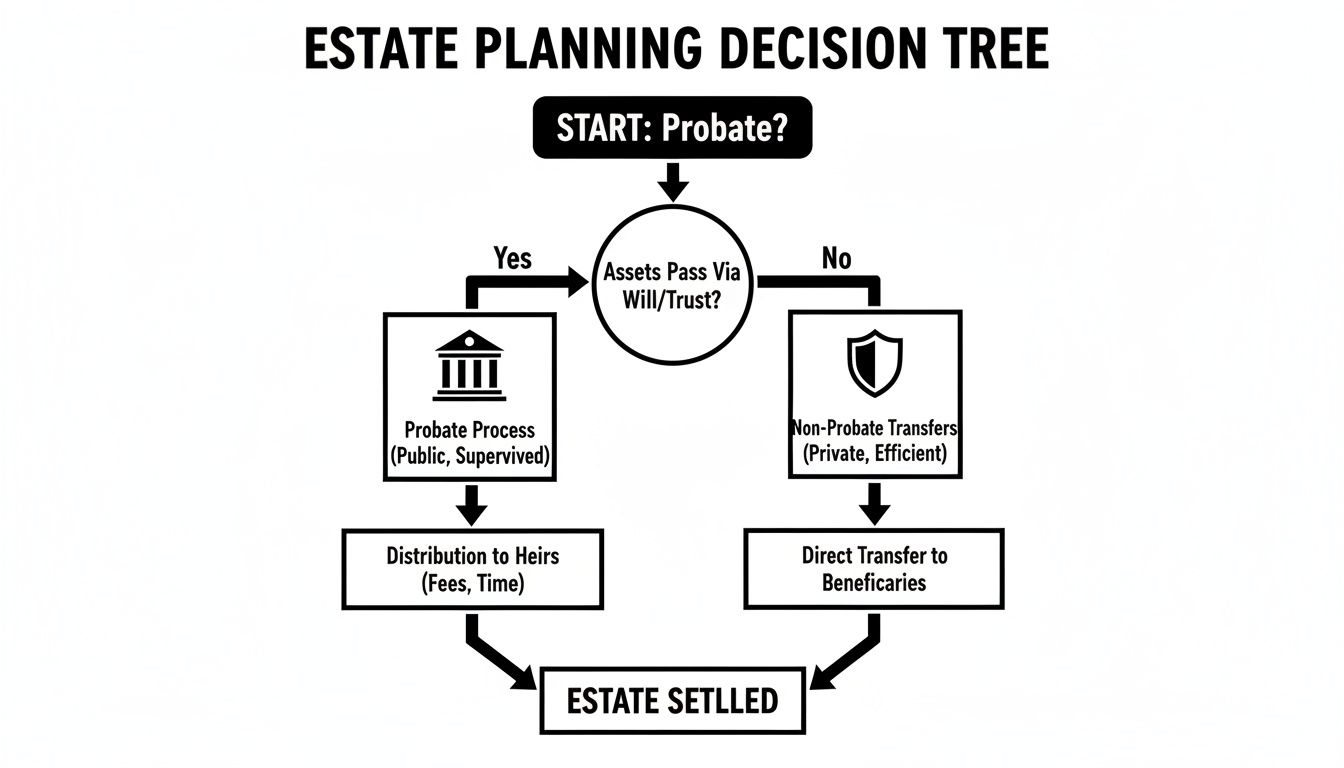
As you can see, the path you choose—a public court process versus private administration—is the most fundamental difference between a will and a trust.
Scenario 1: Young Couple with Minor Children
Meet Mark and Jessica, a couple in their thirties with two young children. Their primary concern is ensuring their kids are raised by the right person if something unthinkable happens. For them, a will is essential. Under the Texas Estates Code, a will is the only place you can legally nominate a guardian for minor children. Without one, a judge who doesn't know their family will decide who raises their kids.
Scenario 2: Blended Family Navigating Complexity
Now, consider David, who is in his second marriage to Susan. Both have children from previous relationships. Their goal is to provide for the surviving spouse while ensuring their respective children eventually receive an inheritance. A trust is ideal for this situation. David can set up a trust that allows Susan to live in their home and use the income for her lifetime. After Susan's death, the remaining trust assets are distributed to David's children. A will cannot provide this level of detailed, multi-stage instruction.
Scenario 3: Business Owner with Multiple Properties
Maria is an entrepreneur who owns her home in Harris County, a vacation property in Galveston County, and commercial properties in Dallas County. If Maria only has a will, her family would face an administrative burden. They would have to open separate probate cases in every county where she owned real estate, a process called ancillary probate. A revocable living trust solves this. By transferring all property deeds into her trust, her successor trustee can manage or distribute them all without involving any court.
Scenario 4: Older Individual Planning for Incapacity
Finally, meet Robert, a widower in his late seventies. His biggest concern is what happens if he can no longer manage his finances. A will is useless in this scenario, as it only takes effect after death. A living trust is designed for this. Robert can name his daughter as successor trustee. If he becomes incapacitated, she can immediately and seamlessly manage the trust assets for him, avoiding a costly and public Guardianship proceeding.
These stories show that the right choice becomes clearer when viewed through your family’s unique circumstances. Often, the best solution involves using both tools to create a complete plan. Our experienced attorneys can help you explore Wills & Trusts and determine the best fit for you.
Decision Guide: When to Use a Will, a Trust, or Both
| Your Situation | Primary Recommendation | Why It's Recommended |
|---|---|---|
| You have minor children. | Will (or Will + Trust) | A will is the only way to nominate a guardian. A trust can manage their inheritance until they are old enough. |
| You have a simple estate and modest assets. | Will | A will is a cost-effective tool for directing property if avoiding probate is not a primary concern. |
| You want to avoid probate. | Trust | A properly funded trust transfers assets privately and directly, completely bypassing the court system. |
| You own real estate in multiple counties. | Trust | A trust avoids the need for separate probate proceedings (ancillary probate) in every county. |
| You're in a blended family. | Trust | A trust provides clear instructions to protect both your current spouse and children from previous relationships. |
| You want to plan for potential incapacity. | Trust | A living trust allows your chosen successor trustee to manage your finances if you become unable to do so. |
| You need privacy. | Trust | Trust administration is private. Wills, once probated, become public records. |
This guide is a starting point, but every family’s situation is unique. The best estate plans often use both a will and a trust to protect against the challenges of the Texas Probate Process and potential Probate Litigation.
Key Takeaway
The choice between a will and a trust is not about which is "better," but which is right for your family's specific needs. A will is essential for naming guardians for minor children, while a trust offers superior privacy, probate avoidance, and incapacity planning. For many Texas families, a comprehensive plan that includes both documents provides the greatest peace of mind.
If you’re facing probate in Texas, our team can help guide you through every step — from filing to final distribution. Schedule your free consultation today.
Why a Will and a Trust Work Better Together
One of the biggest misconceptions in estate planning is that you must choose between a will and a trust. The reality is that the most secure estate plans in Texas almost always use both, working together as a comprehensive system to protect your family from every angle.

The key to this powerful strategy is a specific type of will known as a pour-over will. It is designed to act as the ultimate safety net for your living trust.
The Role of the Pour-Over Will
Life is busy. Imagine you create a living trust and carefully transfer your home, investments, and bank accounts into it. But years later, you buy a new car or open a savings account and forget to title it in the name of the trust. This happens often.
Without a pour-over will, that forgotten asset is now outside your trust. This means it must go through the public, and often lengthy, Texas probate process—the very thing you wanted to avoid.
A pour-over will solves this problem. It is a simple document with one primary job: to "pour over" any assets left out of your trust back into it when you pass away.
This approach gives you the best of both worlds. The trust does the heavy lifting by handling the private transfer of your main assets and planning for incapacity. Meanwhile, the will stands guard, catching anything that might have slipped through the cracks and directing it where it belongs.
Why This Combination Provides Real Peace of Mind
An experienced attorney builds a cohesive, leak-proof system, not just a set of documents. This integrated strategy addresses the "what-ifs," leaving no asset unprotected. It's especially critical for a few key tasks:
- Naming a Guardian: Only a will can nominate a guardian for your minor children. A trust cannot perform this vital function.
- Covering All Your Bases: It guarantees that all your property, including assets acquired later, is managed by your chosen trustee.
- Maintaining Your Privacy: While the pour-over will goes through probate, the only beneficiary it lists is the trust itself. The specifics of who gets what remain confidential within your trust document.
Beyond just wills and trusts, effective estate tax planning strategies are key to preserving your legacy. By combining these tools, you create a seamless plan that protects what you’ve built and the people you love. You can see how our firm designs comprehensive Wills & Trusts to achieve these goals for families across Texas.
Actionable Next Steps for Your Texas Estate Plan
You’ve learned the difference between a will and a trust—now it's time to build a plan for your family. The core distinction is simple but powerful: a will is a public document that guides your assets through the Texas probate court, while a trust is a private tool designed to skip court entirely.
Taking these clear, manageable steps now will bring clarity and make the entire process much less intimidating.
Define Your Goals and Inventory Your Assets
First, create a simple list of your assets—your home, bank accounts, investments, vehicles, and significant personal property. This straightforward inventory will help you see the full picture.
Next, think about who you are protecting. Do you have young children who need a guardian? Does a family member with special needs require lifelong financial support? Is privacy a major concern for you? Your estate plan is ultimately about people, not just property. When you define your goals for your family’s future, the right tool—a will, a trust, or both—often becomes clear.
Take the Most Important Step
With this groundwork done, the most critical step is to speak with a professional. An article is a great start, but only a one-on-one consultation with an experienced estate planning attorney can turn general knowledge into a legally sound plan tailored to your life.
Every family's situation is unique, and the stakes are too high for a generic document. A legal professional will help you navigate Texas law, ensure a trust is funded correctly, and make sure every detail is handled with care.
This consultation is the best way to design a plan that truly protects what you’ve built and the people you love most. Our firm specializes in creating comprehensive Wills & Trusts that give Texas families lasting peace of mind.
Key Takeaway
The first step in creating your estate plan is to list your assets and define your goals for your family. An estate plan is about protecting people, not just property. Once you are clear on your objectives—such as naming a guardian, avoiding probate, or planning for incapacity—the next and most important step is consulting with an experienced attorney to build a plan that meets your specific needs.
If you’re facing probate in Texas, our team can help guide you through every step — from filing to final distribution. Schedule your free consultation today.
Answering Your Top Questions About Texas Wills & Trusts
As you get closer to a decision, specific questions naturally arise. Below are straightforward, plain-English answers to some of the most common questions we hear from Texas families. Our goal is to provide clarity and build your confidence in this important process.
Can I Have Both a Will and a Trust in Texas?
Yes, and in many cases, you should. Using both a will and a trust together is often the gold standard for a solid estate plan. The most common combination is a revocable living trust paired with a special pour-over will. The pour-over will acts as a safety net, "catching" any assets you may have forgotten to transfer into your trust and directing them into it upon your death.
Does a Living Trust Protect My Assets From Creditors?
This is a common misconception. A standard revocable living trust offers almost no protection from your own creditors while you are alive, because you retain complete control over the assets. For significant asset protection, a different tool called an irrevocable trust is required. Creating an irrevocable trust is a major legal decision, as it involves permanently giving up control over the assets you place inside it. This specialized area of planning requires careful legal advice.
What If I Forget to Put an Asset Into My Trust?
This is precisely why a pour-over will is so critical. If an asset (like a newly opened bank account) is not titled in the name of your trust when you die, it will get stuck in the Texas Probate Process. However, the pour-over will instructs the probate court to transfer that asset into your trust. This ensures the property eventually ends up where you intended, following your trust's private instructions.
Which Document Names a Guardian for My Children?
This is one of the most important distinctions. In Texas, a will is the only legal document where you can nominate a guardian for your minor children. A trust cannot perform this function. While a trust is excellent for managing the inheritance you leave for your children, the legal appointment of the person who will raise them must be in your will. For any parent with young children, having a will is non-negotiable. Our firm can help you navigate Texas Guardianship matters with compassion and expertise.
If you’re facing probate in Texas, our team can help guide you through every step — from filing to final distribution. Schedule your free consultation today.