Losing a loved one is hard enough. Then the paperwork starts, and a will that looked simple at first suddenly raises painful questions. One line seems vague. A family member reads it one way, another reads it differently, and you, as executor, are left trying to keep the peace while also doing your job correctly.
That’s often where declaratory judgment probate texas issues begin.
You may not need a courtroom fight. You may need clarity. In many Texas probate cases, the issue isn’t hostility. It’s uncertainty. The will might use unclear language. A deed or account may not fit neatly into the estate. An heir’s rights may be disputed. A declaratory judgment gives the probate court a way to step in and officially state what the law means for your family’s situation.
For an executor, that can be a form of protection. It can help you avoid distributing property the wrong way, selling an asset too soon, or making a decision that later triggers a larger dispute. For heirs, it can create a clear answer everyone has to follow. For families, it can prevent grief from turning into long-term litigation.
When Probate Gets Complicated An Introduction
Sarah had just lost her father. He named her executor because she was organized, calm under pressure, and the sibling he trusted to handle details. But once she sat down with the will, one sentence stopped her cold. Her father left “all other things owned” to one child, while another part of the will dealt with land and a family home in a way that wasn’t fully clear.
Her brother insisted that phrase included the house. Her aunt said it didn’t. Sarah wasn’t trying to take sides. She just wanted to carry out her father’s wishes without creating a permanent family rift.
That’s a familiar Texas probate problem.
A will doesn’t have to be invalid to become difficult. Sometimes the issue is narrower. The document exists, but the wording leaves room for disagreement. Sometimes the problem involves heirship, title to property, or whether an asset passes through probate at all. In those moments, an executor often feels trapped between urgency and caution.
A declaratory judgment is often the court’s way of answering a legal question before that question becomes a bigger family conflict.
Texas probate law gives families a path for that kind of clarity. Instead of guessing, an executor can ask the court to interpret the will, define rights, or settle uncertainty. That request is called a declaratory judgment.
Executors are tasked with substantial duties under the Texas Estates Code, particularly in Titles 2 and 3, covering estate administration, probate procedures, and the handling of a decedent’s property. If you act too quickly, you may expose the estate to avoidable disputes. If you do nothing, delays can pile up and tensions can worsen.
When a probate matter turns unclear, the safest next move is often not “push forward.” It’s “get the court to clarify the rules first.”
What Is a Declaratory Judgment in Texas Probate
A declaratory judgment gives the probate court a chance to answer a legal question before an executor makes a costly mistake.
For many families, that timing is the whole point. If the estate contains a house, mineral rights, a business interest, or a bank account with unclear ownership, waiting until everyone is angry usually makes the problem harder and more expensive to solve. A declaratory judgment lets the court step in early and say what the law requires, so the executor can act with a clear map instead of educated guesses.
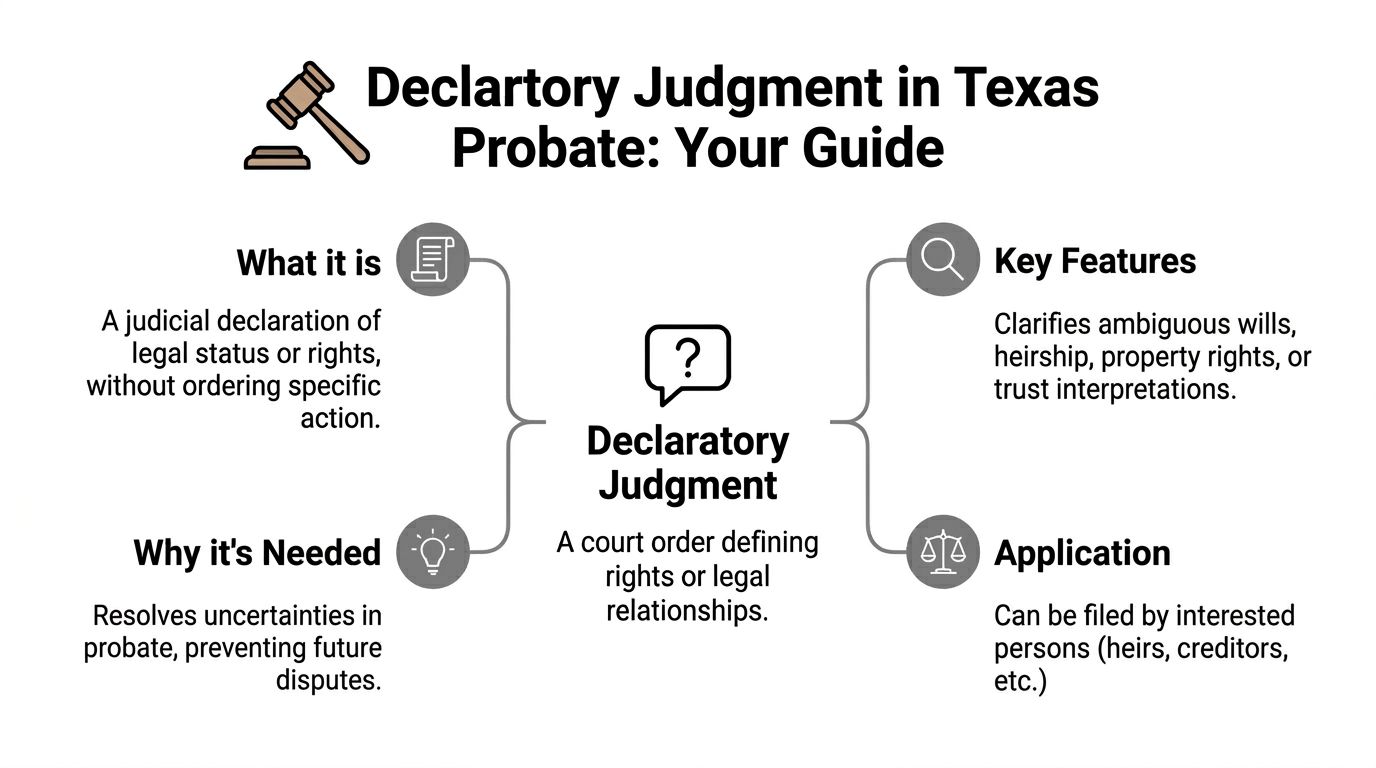
A declaratory judgment is a court order that states the parties’ rights, duties, or legal status in a probate dispute. In plain terms, it tells you what a will means, who is entitled to specific property, or whether the executor has authority to take a particular step.
It works like asking a judge to read the instructions before anyone starts assembling the furniture. The court is not drafting a new plan. The court is confirming which instructions apply.
What it does in plain English
The phrase sounds technical, but the job is fairly straightforward.
- The court identifies legal rights. It can determine who is legally entitled to receive an asset.
- The court interprets unclear language. It can decide what a disputed clause in a will means.
- The court defines authority. It can clarify whether an executor, trustee, or beneficiary has the power to act.
- The court resolves uncertainty before damage spreads. It can settle a dispute while the estate is still manageable, which often protects family relationships and estate funds.
Texas law allows this kind of relief under Chapter 37 of the Texas Civil Practice and Remedies Code when there is a real controversy and a court declaration will resolve uncertainty. In probate, that makes declaratory relief less of a technical filing and more of a preventive tool. Used at the right time, it can stop a disagreement from turning into a full will contest and probate fight in Texas.
A declaratory judgment gives a binding answer about legal rights. It does not award damages simply because someone feels wronged.
That distinction matters. If the dispute is over theft, fraud, or a breach of duty, the estate may need additional claims. A declaratory judgment answers the legal question first so the executor knows where everyone stands.
Why probate courts use it
Probate problems often start small. One sentence in a will is broad. One account was titled in an unexpected way. One beneficiary remembers a promise that never made it into the documents.
An executor is then left holding the risk.
If you distribute property too soon, you may have to ask for it back, which rarely goes well. If you freeze everything for months without court guidance, bills may pile up, property may sit idle, and family members may assume the executor is playing favorites. A declaratory judgment helps address that pressure by replacing uncertainty with a court ruling people are expected to follow.
This is why probate lawyers often view declaratory relief as a family protection strategy. The order itself does not heal every conflict, but it can narrow the fight, preserve estate assets, and give the executor a safer path forward.
What a declaratory judgment is not
Families also benefit from knowing the limits of this tool.
| It does | It does not do |
|---|---|
| Interpret a will or trust provision | Rewrite a will to match what someone wishes it said |
| Clarify heirship or ownership rights | Guarantee every relative will agree with the ruling |
| Define an executor’s authority | Remove every possible dispute in the estate |
| Provide a binding legal answer | Replace careful planning and sound probate strategy |
If you have been named executor, this is the practical takeaway. A declaratory judgment does not create a new estate plan. It helps the court identify and enforce the one your loved one left behind.
Common Scenarios for Seeking a Declaratory Judgment
Some probate disputes are obvious. Others build slowly. A relative asks a question no one can answer with confidence. A bank account doesn’t line up with what the family expected. A sentence in the will seems simple until property has to be transferred.
That’s where declaratory relief can be useful.

Unclear language in the will
This is one of the most common reasons families end up in probate court.
Texas courts apply strict construction when interpreting wills. The court begins with the plain meaning of the words used. A Fort Worth ruling discussed in this explanation of strict will construction in Texas courts excluded real estate from the phrase “all other things owned” because the will did not clearly transfer real property with that language.
That tells executors something important. Courts won’t fill in missing language just because the family assumes it must have been intended.
A realistic example helps. Suppose a will says:
- one child receives “my home on Oak Street”
- another receives “all personal property”
- the remainder goes to a third beneficiary
The conflict starts when the executor has to decide whether a storage building on the same land goes with the home, counts as personal property, or falls into the residue. A declaratory judgment can let the judge answer that question before distribution.
Practical rule: If the wording can support more than one reasonable reading, an executor should think carefully before distributing anything tied to that wording.
Heirship questions and blended families
Not every estate has a clean family tree. Second marriages, children from prior relationships, informal marriages, adoptions, and deaths that occurred before the decedent can all complicate who inherits.
In some estates, the will itself raises questions about identity. “To my grandchildren” sounds simple until one child has adopted children, another has stepchildren, and a third died before the testator. The executor may need the court to determine who qualifies and in what share.
This is different from a full will contest. The parties may not be attacking the document itself. They may need the court to declare who the legal beneficiaries are under the language used.
If a dispute starts moving toward open conflict, it can help to understand broader grounds for contesting a will in Texas, because some family disagreements begin as interpretation problems and later develop into formal litigation.
Questions about an executor’s planned action
Executors often ask a quiet but important question: “If I do this, will someone later accuse me of mishandling the estate?”
That concern is legitimate.
You may need to decide whether to sell a vehicle, transfer a mineral interest, recognize a beneficiary designation, or treat a disputed account as part of the estate. If the legal status of the asset is unclear, acting first and defending later can be risky.
A declaratory judgment can provide a safer route. The executor asks the court to determine the proper treatment of the asset before making a final move.
Consider a ranch estate with farm equipment, trailers, and land used by several relatives. One person says the equipment belongs to the estate. Another says it passed outside probate. Instead of relying on family memory or informal promises, the executor can ask the court for a binding declaration.
Non probate assets and title problems
Many families assume every asset listed by the decedent is a probate asset. That’s often not true.
Some property may pass by beneficiary designation, survivorship rights, deed, or trust. Other assets may look non-probate but still raise legal questions. If the estate includes real property, title issues become especially sensitive because future buyers, lenders, and heirs may all be affected by uncertainty.
Here are examples where a declaration may help:
- Bank accounts: Was there a valid payable-on-death designation?
- Real estate: Did a deed transfer ownership before death?
- Trust-related property: Did the trust hold title to the asset in question?
- Business interests: Does the governing document restrict transfer after death?
These aren’t small clerical problems. They affect whether the executor has authority at all.
Navigating the Legal Process Step by Step
You may be standing at the kitchen table with a stack of papers, a few worried relatives, and one question you cannot safely answer on your own: what can I do now without making this estate harder to fix later?
That is often the moment a declaratory judgment becomes useful. It gives the executor or another interested person a way to ask the court for a clear legal answer before a misunderstanding turns into a larger family conflict, a title problem, or avoidable expense.

Step one choosing the right court
The first question is simple, even if the answer is not: which court has authority to decide this issue?
In Texas, some counties have specialized probate courts that regularly handle estate disputes involving will interpretation, fiduciary duties, title questions, heirship, and related matters. In other counties, the case may belong in a county court, county court at law, or district court, depending on the type of dispute and the estate already on file.
This step matters for a practical reason. Filing in the wrong court can slow the estate, increase cost, and create frustration for a family that already feels stretched thin.
Step two preparing the petition
The petition is the written request that starts the case. A good petition does not tell the judge that the family is upset. It tells the judge exactly what legal uncertainty needs an answer.
A strong petition usually makes four points clear:
- What question needs to be decided
- Why that question affects the estate right now
- Which documents control the issue, such as a will, codicil, deed, trust paper, or account agreement
- What specific declaration the court should make
Precision helps. If the request is broad or sounds hypothetical, the court may see it as an invitation to give advice instead of resolve an active dispute. Probate courts are there to decide real legal questions, not referee every family disagreement.
Step three giving notice to the right people
A declaratory judgment can affect property rights, inheritance rights, and an executor’s authority. Because of that, the people whose interests may be affected must receive proper notice and a chance to respond.
That group may include heirs, beneficiaries, co-executors, trustees, or anyone else with a legal stake in the issue. Notice is more than a technical step. It is part of what makes the result durable. If someone should have been included and was left out, the order may face problems later.
For many families, the process begins to feel more serious. Careful procedure also protects the estate. Bringing the right people into the case early is often what prevents a larger fight later.
If you need a broader picture of how these disputes fit into estate administration, this guide on the grounds for contesting a will in Texas helps explain the kinds of conflicts that can grow when legal questions are left unresolved.
Step four gathering the evidence
The court decides these cases from documents, testimony, and legally relevant facts. Family assumptions do not carry much weight by themselves.
Evidence may include:
- The will
- Any codicils or amendments
- Deeds and title records
- Bank or account documents
- Affidavits or live testimony
- Facts about ownership or execution, if the law allows the court to consider them
Here is where many executors get tripped up. They know what their parent said at holidays, in the hospital, or around the dining room table. The court may care far more about what the signed documents say.
A will works much like a set of written instructions left for people who were not in the room when it was signed. If the wording is clear, the judge usually stays with the text.
If the written instrument answers the question on its face, the court will usually stay close to the document.
Later in the process, families often find it helpful to hear a general discussion like this before meeting with counsel:
Step five attending the hearing
At the hearing, the judge reviews the petition, the response from other parties, the controlling documents, and any evidence needed to resolve the dispute. Some hearings are short and focused mostly on legal interpretation. Others take more time because the facts matter too.
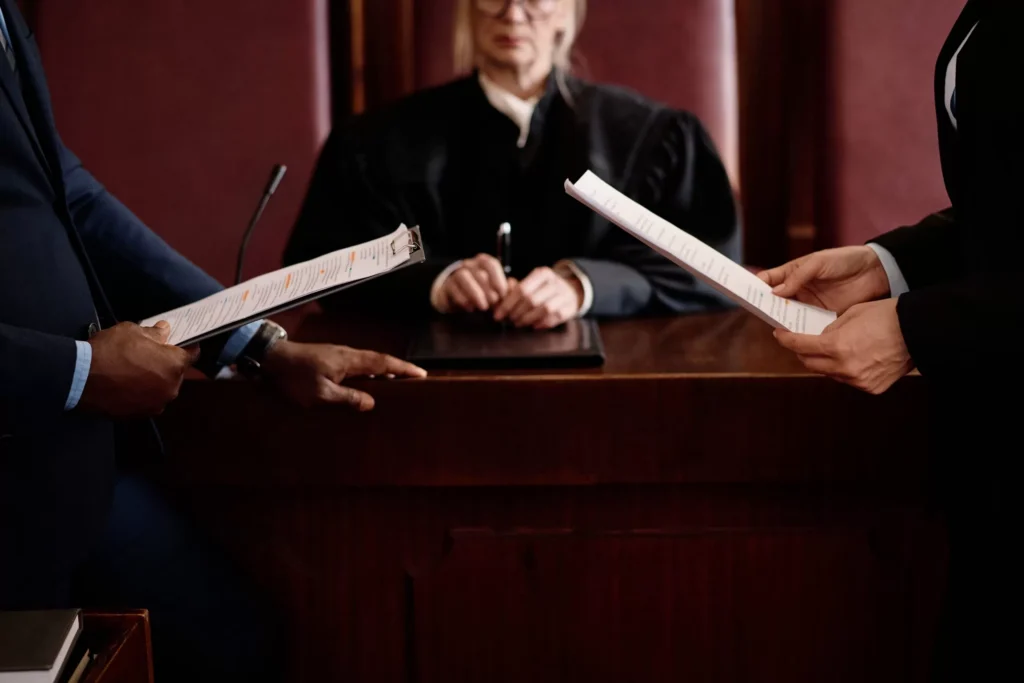
Many executors expect a dramatic courtroom scene. Probate hearings are often calmer than that. In many cases, the hearing feels more like a structured discussion about what the law requires and which document controls.
That quieter setting can be reassuring. The goal is not to punish someone. The goal is to protect the estate by replacing uncertainty with a ruling people can rely on.
| Stage | What it usually feels like |
|---|---|
| Filing | Stressful because the uncertainty is still open |
| Notice | Tense because interested parties become involved |
| Hearing preparation | Detail-heavy and document-focused |
| Court ruling | Relief, even if not everyone agrees |
Step six following the court’s order
Once the judge signs the declaratory judgment, the executor has a legal answer to work from. That answer may clarify who receives property, whether an asset belongs in the estate, how a will provision should be read, or whether the executor has authority to take a specific action.
For a grieving family, that clarity does more than tidy up paperwork. It can protect relationships, reduce the chance of future claims, and help preserve estate assets that might otherwise be spent on a larger dispute.
The order does not remove grief. It does give the family firmer ground to stand on.
Outcomes Strategy and Potential Costs
A declaratory judgment is powerful because it can bring finality to a specific legal question. If the court decides what a will provision means or who has the right to certain property, the executor can move forward with much more confidence.
That outcome has strategic value. It can prevent a small ambiguity from growing into a larger estate fight. It can also protect a fiduciary who wants to act carefully and transparently.

What the judge may decide
In probate, the court may declare rights involving will interpretation, title questions tied to estate administration, fiduciary duties, or the status of particular property. A successful declaration gives everyone a defined legal answer they can rely on.
That doesn’t mean every filing succeeds. A court can refuse declaratory relief if the request won’t resolve the uncertainty.
Under the Texas Declaratory Judgments Act, courts have discretionary power to award attorney’s fees that are “reasonable and necessary” and also “equitable and just,” as discussed in this Texas declaratory judgments analysis. The same authority also reflects a limit. Judges may refuse to issue a declaration if it doesn’t terminate the controversy, and they can deny fees if the action is improper.
Attorney’s fees and why they matter
This is one of the biggest strategic differences between declaratory actions and many other lawsuits.
In plain English, the court may award attorney’s fees in a probate declaratory case, but it doesn’t have to. That decision is discretionary. So an executor should never assume fees will automatically be shifted to another party or reimbursed from the estate.
Some families hear “declaratory judgment” and think it’s a low-risk way to force the other side to pay. That’s not a safe assumption.
A more realistic way to think about fees is this:
- Helpful, properly framed actions may support a fee request
- Overreaching filings may not
- Defensive filings filed too early can create cost without solving the problem
Strategic pitfalls to avoid
The biggest mistake is using declaratory relief for a problem it doesn’t fit.
For example, if the underlying dispute is a broad fight over possession, damages, or collateral claims, a declaratory judgment may not be the right tool by itself. Courts look for a genuine controversy that can be resolved through a declaration. If the filing is premature or framed too broadly, the court may decline to rule.
That’s especially important for fiduciaries. Executors, administrators, and guardians often want certainty before acting. That instinct is sound. But filing too soon, or asking the court to answer an abstract question, can backfire.
If your role overlaps with decision-making for an incapacitated adult or minor, it may also help to understand how fiduciary duties work in Texas guardianship matters, because probate courts often evaluate the conduct of court-supervised decision makers through the same lens of caution and accountability.
Good strategy starts with a narrow question that the court can actually answer, not a broad request for reassurance.
Key Insight A Proactive Tool for Protecting Your Family
A declaratory judgment is often misunderstood. Families sometimes see it as the first step in a fight. In reality, it can be the opposite. It can be a disciplined, careful way to stop conflict before it expands.
That’s especially true when an executor is trying to honor a loved one’s wishes, preserve estate property, and avoid choosing sides in a family disagreement. Seeking clarity from the court can be an act of stewardship.
Protection is often the real goal
The strongest use of declaratory relief in probate is proactive, not reactive.
Instead of waiting for an heir to sue after property has already been distributed, the executor asks the court for guidance first. Instead of transferring real estate with a clouded title, the estate gets a clear judicial ruling. Instead of relying on verbal family understandings, the court defines the rights that control.
This approach is especially useful in a muniment of title probate.
Under Texas Estates Code Section 257.101, a declaratory judgment can be integrated into an order probating a will as a muniment of title. That allows the court to resolve ambiguity, conclusively identify beneficiaries, and protect good-faith executors and bona fide purchasers from later claims.
A practical example with Texas real estate
Suppose a woman dies owning a homestead in her name alone. Her will is admitted as a muniment of title, but one clause describing who receives the property is unclear because two beneficiaries have similar names and one predeceased her.
Without clarification, the heirs may struggle to sell the house. A title company may raise concerns. A buyer may hesitate. Family members may argue over whether the surviving descendants take the share.
A declaratory judgment inside that probate proceeding can answer the question before the property is transferred. That’s not just legal cleanup. It protects value, reduces uncertainty, and lowers the chance of a later title dispute.
For readers dealing with this kind of real-property issue, this guide to muniment of title in Texas can help explain when that simplified probate option fits.
Asking the court for clarity isn’t a failure. In many estates, it’s the most responsible way to protect both the family and the executor.
Frequently Asked Questions About Declaratory Judgments
Can a declaratory judgment change the terms of a will
No. A declaratory judgment does not let the court rewrite a will or create a new estate plan.
Its role is interpretation, not revision. The court determines what the existing document means under Texas law. If the language is clear, the judge applies it as written. If the language is unclear, the judge resolves the uncertainty within the legal boundaries of the document and the Estates Code.
That distinction matters for grieving families. You may feel that your loved one “would have wanted” a certain result, but the court’s job is to interpret the legal instrument, not update it after death.
How long does a declaratory judgment action take in a Texas probate case
There isn’t a one-size-fits-all timeline.
Some cases move relatively smoothly because the dispute is narrow and the documents are clear. Others take longer because notice must be given to multiple interested parties, evidence must be gathered, or the legal question is tied to broader probate administration. Court schedules also vary by county.
One practical caution is worth keeping in mind. Texas courts may refuse to render a declaratory judgment if it would not terminate the uncertainty or controversy, and a source discussing appellate activity in early 2025 reported that 35% of declaratory filings in probate appeals were dismissed for reasons such as prematurity. That discussion appears in this article about Texas declaratory judgments and probate risks. The lesson is simple. Filing too early can slow things down instead of speeding them up.
Is a declaratory judgment the same as a will contest
No. They can overlap, but they are not the same.
A will contest challenges whether a will should be admitted to probate or remain effective. It may involve claims like lack of capacity, undue influence, or improper execution. A declaratory judgment usually assumes there is a real legal instrument in place and asks the court to clarify rights or meaning under that instrument.
A simple way to separate them is this:
| Question | Likely issue |
|---|---|
| “Is this will valid?” | Will contest |
| “What does this part of the will mean?” | Declaratory judgment |
| “Who has rights under this provision?” | Declaratory judgment |
| “Should this document be set aside?” | Will contest |
That difference helps families choose the right legal tool. Clarity and invalidity are not the same issue, and Texas courts treat them differently.
If you’re facing probate in Texas, our team can help guide you through every step, from filing to final distribution. The Law Office of Bryan Fagan, PLLC helps Texas families, executors, and heirs manage probate with clear answers and compassionate support. Schedule your free consultation today.