Skip to content
When a loved one can no longer make safe decisions for themselves, families often face a confusing landscape of legal terms. You might hear "conservatorship" and "guardianship" used interchangeably, especially in news stories from other states.
But in Texas, they represent two very different legal paths. Understanding this distinction is the critical first step in protecting your family member and navigating the correct legal process with confidence and clarity.
Understanding Guardianship Vs Conservatorship In Texas
Here's the most important thing to know right away: if you're seeking to protect an incapacitated adult in Texas, you're almost certainly going to be dealing with a guardianship. The term conservatorship here is reserved almost exclusively for child custody cases in family law, as defined in the Texas Family Code. Getting these terms mixed up can send you down the wrong legal rabbit hole.
This guide will focus on guardianship because it's the correct court process in Texas for an adult who has become incapacitated. We’ll clarify in plain English what it means, when it's necessary, and how the process works under the Texas Estates Code, offering reassurance during what is often a difficult time.
The Key Texas Distinctions
So, what does guardianship actually do? When a Texas court determines an adult can no longer provide for their own food, clothing, shelter, or manage their financial affairs, it can appoint a guardian. This court-supervised process is designed to protect vulnerable individuals, who are then referred to as the "Ward."
While other states use the term "conservatorship" for this exact function, Texas law is very clear. It's a guardianship here.
To make this crystal clear, here’s a quick summary of the key distinctions between these legal roles.
Guardianship And Conservatorship: A Texas Comparison
This table breaks down the fundamental differences in how these roles are applied in Texas versus their common usage elsewhere.
| Aspect | Guardianship (Texas) | Conservatorship (General/Other States) |
|---|---|---|
| Primary Focus | Personal and/or financial decisions for an incapacitated adult (the "Ward"). | Typically refers to financial management for an adult; in Texas, it applies to child custody. |
| Legal Authority | Granted by a Texas probate court under the Texas Estates Code, Title 3. | Not a recognized term for adult incapacity in Texas; authority stems from the Texas Family Code in custody cases. |
| Applies To | Adults who are legally declared incapacitated due to age, illness, or disability. | Minors in child custody disputes (Texas) or incapacitated adults (other states). |
| Core Purpose | To protect the well-being and/or financial assets of a vulnerable adult. | To determine the rights and duties of parents regarding their children. |
As you can see, the context is everything. Using the wrong term in a Texas court won't just cause confusion—it could get your case dismissed.
Two Types Of Guardianship
The Texas Estates Code also outlines two primary types of guardianships. These can be established separately or together, depending on what the Ward needs.
- Guardianship of the Person: This gives the guardian authority over personal, non-financial matters. This includes making decisions about medical care, living arrangements, and daily well-being.
- Guardianship of the Estate: This grants the guardian authority to manage the Ward’s property and financial affairs. Responsibilities include paying bills, managing investments, and protecting assets from fraud.
While a guardianship is a powerful tool, it's also a significant step that removes a person's rights. It's crucial to recognize it's not the only option. To learn more about how it stacks up against other legal documents, check out our guide on the difference between guardianship and power of attorney. Understanding all available avenues ensures you make the most informed decision for your loved one.
What A Guardianship In Texas Really Means
When a family member can no longer make safe decisions for themselves, the word “guardianship” often enters the conversation. But what does it actually mean in a Texas courtroom? Simply put, a guardianship is a court-supervised process created to protect individuals who have become legally incapacitated.
A Texas probate court will appoint a responsible person or entity—the guardian—to make critical life decisions for the incapacitated person, who is then known as the ward. This is a profound legal intervention because it transfers the ward's fundamental right to make their own choices to someone else. The entire process is strictly governed by the Texas Estates Code, Title 3, to ensure the ward’s best interests remain the absolute top priority.
Defining Incapacity Under Texas Law
A guardianship is only granted when there is clear and convincing evidence that someone is incapacitated. This isn’t a term used lightly; the Texas Estates Code sets a very specific legal standard.
A person is considered incapacitated if, because of a physical or mental condition, they are substantially unable to:
- Provide for their own food, clothing, or shelter.
- Care for their own physical health.
- Manage their personal financial affairs.
A judge doesn’t make this decision on a whim. It requires a formal medical evaluation, typically documented in a physician’s certificate, and a court hearing where all the evidence is carefully weighed.
The Two Core Roles of a Guardian
Here in Texas, a guardianship isn't a one-size-fits-all solution. The court has the flexibility to tailor the guardian's powers to the ward's specific needs, often appointing someone to handle one or both of two distinct roles. Grasping these roles is crucial when you start to look at the difference between a conservatorship vs guardianship.
Guardianship of the Person
A Guardian of the Person is put in charge of the ward’s physical and emotional well-being. It’s a role built on deep personal trust and care.
The duties typically involve making essential life decisions, such as:
- Healthcare: Consenting to medical treatments, surgeries, and medications.
- Living Arrangements: Deciding where the ward will live, whether it’s at home, with family, or in a specialized care facility.
- Daily Care: Overseeing the ward's day-to-day needs for nutrition, safety, and personal comfort.
This guardian effectively becomes the ward’s primary advocate for all non-financial matters, making sure they are safe, respected, and receiving the right care.
Guardianship of the Estate
On the other side of the coin, a Guardian of the Estate is appointed to manage the ward’s financial life. This person acts as a fiduciary, which means they have a strict legal duty to handle the ward's money and property with the utmost prudence and integrity.
Their responsibilities are all about the money and property:
- Managing Assets: Taking control of bank accounts, investments, and real estate.
- Paying Bills: Ensuring all the ward’s financial obligations are met on time.
- Protecting Property: Safeguarding assets from waste, loss, or fraud.
- Court Reporting: Filing detailed annual accountings with the court to show every single dollar that has come in and gone out of the estate.
A court can appoint one person to serve in both roles, or it can split the duties between two different people. This might happen if one family member is better suited for personal caregiving while another has more financial savvy. This flexibility ensures the ward gets comprehensive protection tailored to their unique circumstances. If you believe a loved one may need this level of support, exploring your Guardianship options with an experienced attorney is a critical next step.
When Guardianship Becomes the Only Option
It's one of the toughest decisions a family can face: admitting a loved one can no longer manage their life safely. Pursuing a guardianship is an emotional step, one that often comes after months or years of worry. Recognizing the signs that this level of legal intervention is needed is the first, and most critical, part of protecting someone you care about.
This isn't about taking away freedom. It's about providing a shield when all other options have been exhausted. The path to guardianship usually becomes clear when you see a consistent pattern of behavior that puts your loved one at risk—physically, medically, or financially.
A Realistic Scenario: When is Guardianship Necessary?
Real-world situations often paint the clearest picture. Consider this common example:
- Scenario: Maria’s 82-year-old father, David, has advancing dementia. He has always been fiercely independent, but recently, things have changed. He received a final notice from his mortgage company, having forgotten to pay it for three months. Last week, a neighbor found him wandering several blocks from his home, confused and unable to find his way back. Maria discovered he has also been making large, uncharacteristic online purchases from TV ads, draining his savings. David doesn't have a power of attorney in place, and he no longer has the mental capacity to sign one.
In this situation, Maria sees a clear pattern of risk. David is unable to manage his finances, care for his physical health (by forgetting medications, not included in the scenario but a common issue), or provide for his own shelter. A guardianship would be the necessary legal tool to protect him from financial exploitation and ensure he receives proper care.
The “Last Resort” Rule in Texas Courts
It’s vital to understand that Texas law doesn't take guardianship lightly. When a court appoints a guardian, it strips an individual—known as the "ward"—of their fundamental right to make their own decisions. Because the stakes are so high, courts treat guardianship as a last resort, something to be used only when less restrictive options won't work.
Before you even think about filing for guardianship, you have to explore other avenues. Are there existing estate planning documents like a durable power of attorney or medical power of attorney? Our firm can help you review your loved one's situation and determine if these alternatives, such as those discussed in our Wills & Trusts services, are viable. If the person still has the mental capacity to sign these documents, that is almost always the better path.
Why Texas Favors Limited Guardianships
The Texas Estates Code is designed to preserve as much of a person's independence as possible. Instead of ordering a "full" or "plenary" guardianship that removes all of a person's rights, Texas courts will often grant a limited guardianship.
This tailored approach gives the guardian authority only over the specific areas where the proposed ward can't make decisions. For example, if your father can handle his daily personal needs but is falling victim to financial scams, a court might appoint a Guardian of the Estate to protect his money while letting him keep control over his personal and medical choices. It’s a way to respect his autonomy while shielding his assets.
This trend is becoming more important as our population gets older. Demographic shifts are driving an increase in guardianship filings across the country. One study, for instance, found a 7% annual increase in new adult guardianship filings in Missouri over four years, which tracked with a 10% rise in its elderly population. You can dive deeper into these trends in a report from the National Center for State Courts. This data underscores why more families need to understand when and how to act to protect their vulnerable loved ones.
If you’re seeing these warning signs, it may be time to have a serious conversation about your legal options.
Key Insight
Recognizing the need for a guardianship means seeing a consistent inability to manage personal, medical, or financial affairs, making it a necessary last resort for your loved one's safety. Texas law will always prioritize the least restrictive option, often favoring a limited guardianship tailored to the individual's specific needs to preserve their independence as much as possible.
Navigating The Texas Guardianship Process Step By Step
Understanding that a guardianship might be necessary is one thing; navigating the actual court process is another. For families already stretched thin by a loved one's declining health, the legal system can feel like an impossible maze. Our goal is to provide a clear, step-by-step roadmap of what to expect when you pursue a guardianship in Texas, offering reassurance at every stage.
The whole process is guided by the Texas Estates Code, Title 3, and flows through the probate courts, which are there to make sure every decision is made with the proposed ward’s best interests at heart. While no two cases are exactly the same, the fundamental stages are consistent across the state.
This flowchart gives a bird's-eye view of the key milestones you'll encounter.
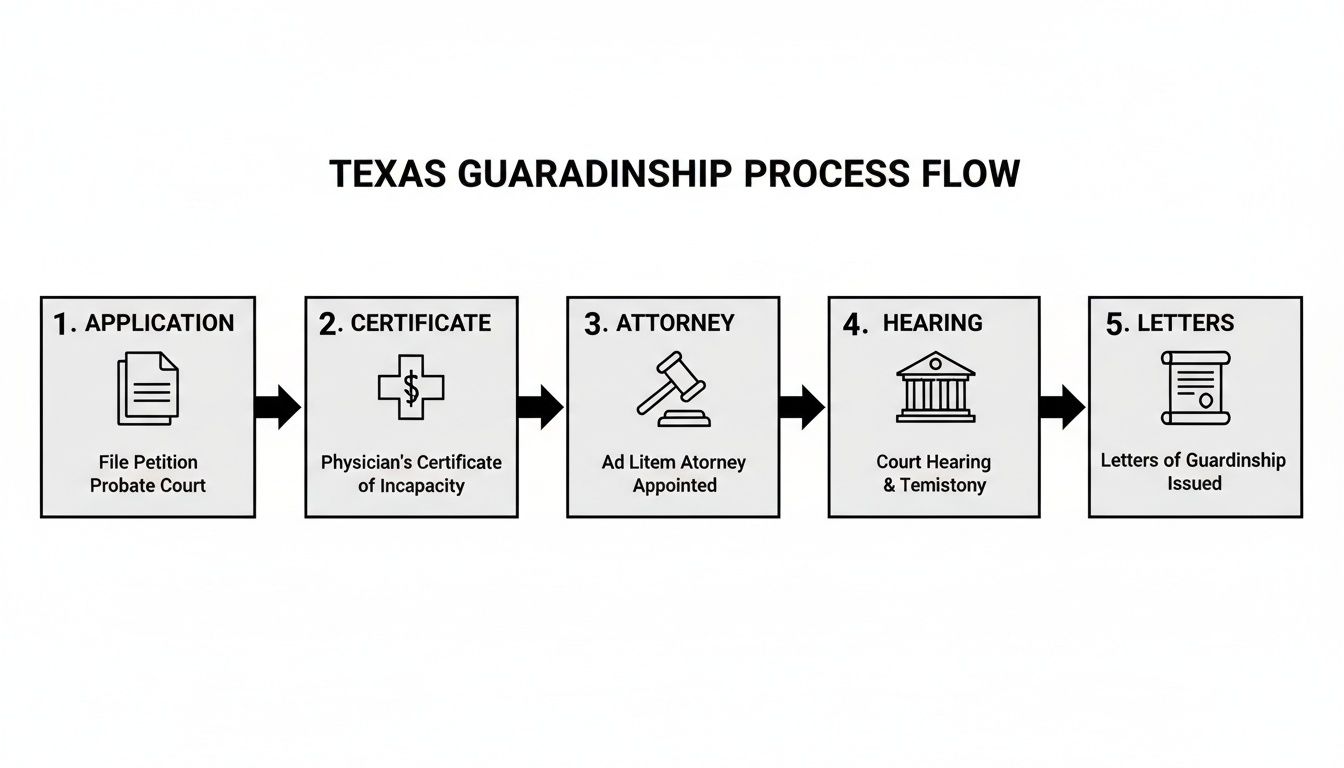
As you can see, each step builds on the last. It’s a structured path, designed to move from identifying a need to legally protecting a loved one.
Step 1: The Initial Application
The journey kicks off when you file an Application for Appointment of Guardian with the proper probate court. This is the formal request that gets the ball rolling. It’s a legal document that lays out all the essential information for the court: who the proposed ward is, who you are (the applicant), and exactly why a guardianship is needed. This application must clearly state whether you’re seeking a Guardianship of the Person, a Guardianship of the Estate, or both.
Step 2: Medical Documentation of Incapacity
Next, you must provide medical proof that the proposed ward is, in fact, incapacitated. Texas law is very specific about this. Under Texas Estates Code §1101.103, the application must be backed up by a written letter or certificate from a physician. This report, which is usually on a standard court form, must detail an examination of the proposed ward that happened within the last 120 days. The doctor will describe the nature, degree, and severity of the person’s condition, giving a professional medical opinion on their ability to handle their own affairs.
Step 3: Appointment of an Attorney Ad Litem
Once the application is filed, the court takes a critical step to protect the rights of the person you’re trying to help. It appoints an independent attorney, called an attorney ad litem, to represent them. This lawyer’s only job is to advocate for the proposed ward’s best interests. The attorney ad litem will meet with the proposed ward, explain what’s happening in terms they can understand, and inform them of their legal rights—including the right to contest the guardianship.
Step 4: The Court Hearing and Final Decision
The entire process leads to a formal court hearing where the judge reviews all the evidence. As the applicant, you must present "clear and convincing evidence" that the proposed ward is incapacitated and that a guardianship is the right move. The judge will likely hear testimony from you, the physician, and the attorney ad litem. If the judge is convinced that a guardianship is in the proposed ward’s best interest, they will sign an order making the appointment official.
Step 5: Qualifying as Guardian
After the order is signed, the new guardian must take an oath and post a bond before the court issues Letters of Guardianship. These Letters are the official documents that grant the guardian the legal power to act on the ward's behalf.
Keeping track of dates is crucial as you go; a legal deadline calculator can be a handy tool for this. For a deeper dive into this first stage, you can learn more about how to apply for guardianship in our dedicated guide.
Exploring Less Restrictive Alternatives To Guardianship
Texas law is built on a deep respect for individual liberty. When a court considers a guardianship, it is legally required to first look for any less restrictive ways to protect the person in need. A guardianship strips someone of their fundamental rights, which is why it should always be the last resort, never the first option.
Fortunately, proactive estate planning offers several powerful tools that can often achieve the same protective goals without a judge’s constant oversight. By putting these documents in place while a person still has the mental capacity to make their own decisions, families can sidestep the emotional and financial toll of a future court battle.
The Power of Proactive Planning
The best way to handle future incapacity is to plan for it today. Legal documents created ahead of time allow you to choose exactly who will make decisions for you if you ever become unable to do so yourself. This approach preserves your autonomy and gives your loved ones a clear, legally enforceable roadmap to follow.
These alternatives aren't just suggestions; they are the first line of defense against the need for a guardianship.
Durable Power of Attorney: This is the workhorse of financial planning. It lets an individual (the “principal”) appoint a trusted person (the “agent”) to manage their financial life. You can set it up to be effective immediately or only if you become incapacitated. This tool is absolutely essential for everything from paying bills and managing bank accounts to selling property.
Medical Power of Attorney: Just like its financial counterpart, this document allows you to name an agent to make healthcare decisions on your behalf. If you can't communicate your wishes, this person can consent to treatments, choose your doctors, and decide on care facilities for you.
Advance Directive to Physicians (Living Will): Often created alongside a Medical Power of Attorney, this legal instrument spells out your wishes for end-of-life medical care. It provides specific instructions on treatments like life support, making sure your values are honored when it matters most.
For a deeper dive into these proactive steps, it’s worth understanding the critical differences in living wills vs. advance directives, as both empower you to make critical healthcare decisions ahead of time.
Using Trusts to Manage Assets
Another incredibly effective alternative is a Revocable Living Trust. When you create a trust, you transfer your assets into it and name yourself as the initial trustee, so you continue managing your property just as you always have. The trust document also names a successor trustee—a trusted person or financial institution—who automatically steps in to manage the trust assets if you become incapacitated. This transition happens privately, without any court intervention. Creating a comprehensive plan with Wills & Trusts can provide this seamless protection.
Unfortunately, far too many families are unaware these options exist until it's too late. The guardianship system itself often fails to adequately inform people about less restrictive alternatives. This isn't just an anecdotal problem; the National Council on Disability identified it as a systemic issue, which makes it vital for families to speak with knowledgeable attorneys who can explain every option before anyone steps into a courtroom.
Key Insight
Creating powers of attorney and trusts while you have capacity is the single most powerful step you can take to protect your future autonomy and spare your family from the stress and expense of a court-mandated guardianship. Taking these steps ensures your wishes are known and the people you trust most are empowered to act for you, keeping intensely personal decisions within the family and out of the courthouse.
Key Fiduciary Duties Of A Guardian
When a Texas court names you as a guardian, it’s more than just an act of love or family duty—it’s the acceptance of a profound legal responsibility. As a guardian, you become a fiduciary, a role that holds you to the highest ethical and legal standards under the Texas Estates Code, Title 3. This means you must always, without exception, act solely in the best interest of the person you’ve been appointed to protect, known as the ward.
Getting this right is non-negotiable. Failing to uphold your fiduciary duty can lead to serious legal consequences, including being removed as guardian and even being held personally liable for any financial losses. It’s a role that demands diligence, complete transparency, and unwavering integrity.

Core Responsibilities of a Texas Guardian
Your fiduciary duties aren't just abstract legal concepts; they are specific, actionable obligations that must guide every single decision you make for the ward. Whether you are a Guardian of the Person or a Guardian of the Estate, these principles are the bedrock of your authority.
Key duties include:
- Duty of Loyalty: Every decision has to be made exclusively for the ward's benefit, completely free from any personal self-interest or conflict.
- Duty of Prudence: You are required to manage the ward’s assets and make healthcare decisions with the same care and skill that a reasonably prudent person would use for their own affairs.
- Duty of Accountability: You must keep meticulous records and file detailed annual reports with the court, accounting for every action taken and every dollar spent.
This level of responsibility is significant. Across the United States, courts oversee approximately $50 billion in assets belonging to individuals under guardianship or conservatorship. This massive figure highlights the financial weight placed on guardians and underscores why strict compliance is so critical.
Navigating Common Challenges and Disputes
Even guardians with the best intentions can run into trouble. Family disagreements are common, especially when it comes to managing finances or making difficult healthcare choices. Other family members might question your decisions, leading to disputes that can quickly escalate into formal legal challenges in court.
Accusations of mismanagement, even if completely unfounded, can be emotionally and financially draining. This is where having an experienced attorney in your corner is invaluable. We can provide ongoing guidance to ensure you remain in full compliance with court requirements, helping you prepare annual accountings and navigate sensitive family dynamics. When disputes do arise, our expertise becomes critical in defending your actions and protecting the ward’s best interests.
Managing these duties correctly is essential for both you and your loved one. For more information on the responsibilities involved, you can explore our resources about legal guardianship in Texas. Our firm provides comprehensive support, from the initial application through ongoing administration and conflict resolution.
Takeaway
A guardian's role is not one of ownership but of stewardship. You are a court-appointed protector of the ward's rights and assets, and every action you take is subject to judicial review to ensure you are meeting your fiduciary obligations under the Texas Estates Code.
Common Questions We Hear About Texas Guardianships
When families are weighing a decision as big as a guardianship, the practical questions always come up. It's one thing to understand the law in theory, but it's another to know how it plays out in the real world. Here are some straightforward, plain-English answers to the questions we hear most often from Texas families just like yours.
How Much Does A Guardianship Really Cost in Texas?
This is the big one, and the honest answer is: it varies. The final cost really depends on how complicated your situation is. At a minimum, you’ll have court filing fees and the cost for an "attorney ad litem"—that's the lawyer the court appoints to represent the person you're trying to protect. Then, of course, there are your own attorney’s fees.
If everyone is on the same page, the process is fairly predictable. But if the guardianship is contested—meaning another family member objects—the costs will climb. A contested case means more legal work, more time in court, and unfortunately, a higher final bill. This is one aspect of the Texas Probate Process where having experienced counsel is crucial.
Can A Guardian Be Paid For Their Time?
Yes, they can. Texas law recognizes that being a guardian is a serious job that takes real time and effort. The Texas Estates Code allows a guardian to receive reasonable compensation for their services.
But here's the key: any payment has to come from the ward’s estate, and it must be approved by the court first. This isn't a blank check. The judge will review the request to make sure the fees are fair and directly related to the work you've done for your loved one.
How Long Does A Guardianship Last?
Think of a guardianship as a long-term commitment. In most cases, it stays in place for the rest of the ward's life, providing continuous protection and oversight.
That said, it’s not always permanent. If the ward’s condition improves and they regain the ability to manage their own affairs, the court can terminate the guardianship. This is rare, but it is possible if there's clear evidence that the person no longer needs that level of protection.
What Happens If A Family Member Objects?
This is where things can get difficult, both legally and emotionally. If a family member formally objects to the guardianship, the case becomes "contested." The court will schedule a hearing where both sides get to present their evidence, call witnesses, and make their arguments.
These situations can quickly become complex and painful. Having an experienced legal team is non-negotiable when a guardianship is contested. Our Probate Litigation attorneys step in to ensure your loved one's best interests remain the top priority, even when family disagreements get in the way.
Takeaway
Guardianship isn't just a legal status; it comes with real-world costs, responsibilities, and the potential for family conflict. Understanding these practical issues from the start—like court-approved compensation and what happens when someone objects—helps you prepare for the road ahead. It’s all about making sure you can provide the best possible protection for the person who needs it most.
If you’re facing probate in Texas, our team can help guide you through every step — from filing to final distribution. Schedule your free consultation today.